Gourmet Street Food Market Size
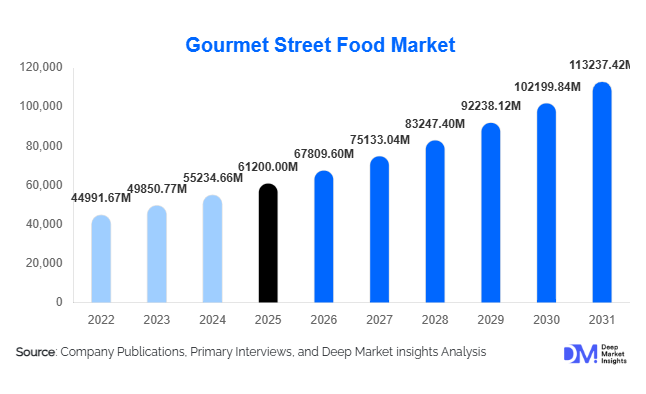
According to Deep Market Insights, the global gourmet street food market size was valued at USD 61.2 billion in 2025 and is projected to grow from USD 67.81 billion in 2026 to reach USD 113.24 billion by 2031, expanding at a CAGR of 10.8% during the forecast period (2026–2031).The market growth is primarily driven by the rapid premiumization of street food, increasing consumer preference for experiential dining, and the expansion of urban food ecosystems such as food truck parks, curated food festivals, and organized street food hubs.
Key Market Insights
- Gourmet street food is transitioning from informal vending to structured, premium dining experiences, supported by improved hygiene standards and regulatory formalization.
- Food trucks and mobile kitchens are expanding rapidly, offering scalable and cost-efficient business models across urban centers globally.
- Asia-Pacific dominates the market, driven by strong street food culture and rising urban middle-class consumption.
- North America and Europe are witnessing strong demand for fusion cuisine, blending global flavors with local ingredients.
- Digital platforms and food delivery apps are transforming accessibility, enabling gourmet street food vendors to reach wider audiences.
- Sustainability and locally sourced ingredients are emerging as key differentiators, influencing consumer purchasing decisions.
What are the latest trends in the gourmet street food market?
Fusion Cuisine and Culinary Innovation Driving Demand
One of the most prominent trends in the gourmet street food market is the rise of fusion cuisine, where traditional street food is reimagined with global influences and premium ingredients. Vendors are experimenting with cross-cultural combinations such as Korean tacos, sushi burritos, and gourmet Indian chaat, creating unique offerings that appeal to adventurous consumers. This trend is strongly driven by globalization, social media exposure, and increasing international travel. Consumers are actively seeking novel taste experiences, encouraging vendors to innovate continuously. Food festivals and curated street food markets are becoming platforms for showcasing such culinary creativity, further accelerating trend adoption.
Digitalization and Platform-Based Expansion
The integration of digital platforms is reshaping the gourmet street food ecosystem. Online food delivery apps, mobile ordering systems, and digital payment solutions are enabling vendors to expand beyond physical locations. Social media platforms play a critical role in brand building, with viral food trends driving footfall and online orders. Data analytics tools are helping vendors understand consumer preferences, optimize menus, and improve operational efficiency. Cloud kitchen models are also emerging, allowing gourmet street food brands to scale with lower capital investment while maintaining consistent quality and service standards.
What are the key drivers in the gourmet street food market?
Rising Urbanization and Changing Lifestyles
Rapid urbanization across emerging and developed economies is a major driver of market growth. Increasing population density in cities, coupled with busy lifestyles, has created strong demand for convenient yet high-quality food options. Gourmet street food meets this demand by offering quick service without compromising on taste, quality, or experience. Urban millennials and working professionals are particularly driving this shift, as they prioritize convenience and variety in their food choices.
Premiumization of Street Food Culture
Consumers are increasingly willing to pay a premium for high-quality ingredients, hygienic preparation, and unique culinary experiences. This has led to the transformation of traditional street food into gourmet offerings, often curated by professional chefs. Premiumization has not only increased average transaction values but also enhanced brand differentiation, allowing vendors to command higher margins and expand into new markets through franchising and organized retail formats.
What are the restraints for the global market?
Regulatory and Licensing Challenges
The gourmet street food market faces significant regulatory hurdles, particularly in regions with strict zoning laws and licensing requirements. Inconsistent regulations across cities and countries can create barriers for vendors looking to scale operations. Compliance with food safety standards, permits, and operational restrictions often increases costs and limits flexibility, especially for small and independent vendors.
Price Sensitivity in Emerging Markets
While gourmet street food is gaining popularity, price sensitivity remains a challenge in developing regions. A large portion of the population continues to prioritize affordability over premium experiences. Vendors must balance cost and quality to remain competitive, which can limit the adoption of high-end offerings and affect overall market penetration.
What are the key opportunities in the gourmet street food industry?
Organized Street Food Infrastructure Development
Government investments in organized vending zones, food truck parks, and urban food hubs present significant growth opportunities. These initiatives enhance hygiene, safety, and scalability, enabling vendors to transition from informal setups to structured businesses. Such infrastructure development is particularly prominent in Asia and the Middle East, where urban planning is integrating food culture into city design.
Technology Integration and Digital Expansion
The adoption of technology, including mobile ordering, digital payments, and data analytics, is creating new avenues for growth. Vendors leveraging digital platforms can expand their reach without significant capital expenditure. Social media marketing and influencer collaborations are further amplifying brand visibility, allowing small vendors to scale rapidly and compete with established players.
Report Scope
| Report Metric | Details |
|---|---|
| Market Size in 2025 | USD 61200.00 Million |
| Market Size in 2026 | USD 67809.60 Million |
| Market Size in 2031 | USD 113237.42 Million |
| CAGR | 10.8% (2026-2031) |
| Base Year for Estimation | 2025 |
| Historical Data | 2022-2024 |
| Forecast Period | 2026-2031 |
| Report Coverage | Revenue Forecast, Competitive Landscape, Supply Chain Disruption, Growth Factors, Environment & Regulatory Landscape and Trends |
| Geographies Covered | North America, Europe, APAC, Middle East and Africa, LATAM |
| Countries Covered | U.S., Canada, U.K., Germany, France, Spain, Italy, Russia, Nordic, Benelux, Rest of Europe, China, Korea, Japan, India, Australia, Singapore, Taiwan, South East Asia, Rest of Asia-Pacific, UAE, Turky, Saudi Arabia, South Africa, Egypt, Nigeria, Rest of MEA, Brazil, Mexico, Argentina, Chile, Colombia, Rest of LATAM |
Explore more data points, trends and opportunities Download Free Sample Report
Product Type Insights
The global gourmet street food market is increasingly shaped by evolving consumer tastes, cultural globalization, and culinary experimentation, with Asian gourmet street food firmly positioned as the leading segment, accounting for approximately 32% of the total market share. This dominance is primarily driven by the widespread popularity of iconic dishes such as sushi, ramen, dumplings, bao, and Korean fried chicken, which have successfully transitioned from traditional street fare into premium, globally recognized culinary offerings. The leading segment driver for Asian gourmet street food lies in its ability to combine authenticity with adaptability, allowing vendors and brands to localize flavors while retaining cultural identity. The rising influence of Asian pop culture, coupled with increasing travel exposure and digital media proliferation, has further accelerated consumer curiosity and acceptance of these cuisines across both developed and emerging markets.Latin American and Middle Eastern gourmet street food segments are gaining momentum as consumers increasingly seek diverse and authentic global flavors. Latin American offerings such as tacos, arepas, and empanadas, alongside Middle Eastern staples like shawarma, falafel, and kebabs, are benefiting from their bold flavor profiles and perceived authenticity. The key driver for these segments is the growing multicultural population in urban centers, which fosters cross-cultural culinary exchange and drives demand for niche yet accessible food experiences. Vendors are capitalizing on this trend by incorporating gourmet twists, premium ingredients, and modern presentation styles, thereby appealing to a broader audience.Fusion and regional gourmet street food are emerging as the fastest-growing product categories, driven by innovation and experimentation. The leading driver for this segment is the increasing consumer appetite for novelty and hybrid culinary experiences, where traditional recipes are reinterpreted through cross-cultural influences. For instance, combinations such as sushi burritos, kimchi tacos, and butter chicken pizzas exemplify how fusion cuisine creates excitement and differentiation in a competitive market. Furthermore, regional gourmet street food, which emphasizes hyper-local ingredients and indigenous recipes, is gaining traction as consumers prioritize authenticity and sustainability. This dynamic interplay between tradition and innovation is expected to continue shaping the product landscape, driving sustained growth across all segments.
Application Insights
In terms of application, direct street sales remain the cornerstone of the gourmet street food market, supported by high urban footfall, vibrant street culture, and the experiential nature of on-the-go dining. The leading driver for this segment is the immediacy and sensory appeal of freshly prepared food, which creates a unique connection between vendors and consumers. Street food markets, pop-up stalls, and food truck clusters have become social hubs, attracting diverse consumer groups and fostering community engagement. This format not only ensures high visibility but also enables vendors to experiment with menus and pricing strategies in real time.Catering and event-based applications are also gaining prominence, particularly in corporate gatherings, weddings, festivals, and private events. The leading driver for this segment is the demand for customizable and experiential dining options, where gourmet street food offers a unique blend of variety, presentation, and interactivity. Live cooking stations, themed food trucks, and curated menus enhance the overall event experience, making this segment highly attractive for both consumers and vendors. Additionally, the growing trend of experiential marketing has encouraged brands to incorporate gourmet street food into promotional events, further boosting demand.Franchise and chain expansion models are increasingly being adopted as a strategic application, enabling standardization and scalability across regions. The key driver for this segment is the ability to replicate successful concepts while maintaining consistent quality and branding. This approach not only reduces operational risks but also facilitates rapid market penetration, particularly in emerging economies where demand for organized street food formats is rising. As investors and entrepreneurs continue to recognize the profitability of gourmet street food, franchise-based models are expected to play a crucial role in shaping the market’s future.
Distribution Channel Insights
The distribution landscape of the gourmet street food market is undergoing significant transformation, with online platforms emerging as dominant channels. The leading driver for this shift is the integration of technology into the food service ecosystem, enabling consumers to access diverse culinary options with ease. Digital platforms provide enhanced visibility for vendors, allowing them to showcase menus, customer reviews, and promotional offers, thereby influencing purchasing decisions. The use of data analytics and personalized recommendations further enhances customer engagement, driving repeat purchases and brand loyalty.Catering services and event-based distribution channels are expanding in parallel, driven by the increasing demand for curated dining experiences. Vendors are leveraging these channels to offer specialized menus and themed presentations, catering to niche customer segments. This approach not only enhances brand visibility but also creates opportunities for premium pricing, thereby improving profit margins. Furthermore, collaborations with event organizers and corporate clients are enabling vendors to establish long-term partnerships, ensuring consistent revenue streams.Social media and influencer-driven marketing have become integral to distribution strategies, significantly impacting consumer preferences and purchasing behavior. Platforms such as Instagram and YouTube serve as powerful tools for visual storytelling, allowing vendors to highlight the uniqueness and गुणवत्ता of their offerings. The leading driver for this trend is the growing influence of digital content on food discovery, where visually appealing dishes often go viral, attracting large customer volumes. As digital ecosystems continue to evolve, the convergence of marketing and distribution channels is expected to redefine how gourmet street food reaches consumers.
Consumer Type Insights
Urban millennials and Generation Z constitute the largest consumer segment, accounting for approximately 40% of total demand. The leading driver for this segment is their preference for experiential dining and willingness to explore diverse cuisines. These consumers are highly influenced by social media trends, food blogs, and peer recommendations, making them early adopters of new culinary concepts. Their inclination towards convenience, coupled with a desire for authenticity and innovation, positions them as key drivers of market growth. Additionally, their openness to fusion and experimental flavors aligns with the evolving product landscape, further strengthening their influence.Tourists and travelers play a crucial role in driving demand, particularly in regions known for their culinary heritage. The leading driver for this segment is the desire to experience local culture through food, where gourmet street food serves as an accessible and authentic entry point. Street food markets, night bazaars, and food festivals attract significant tourist footfall, generating substantial revenue for vendors. As global tourism continues to recover and expand, this segment is expected to contribute increasingly to market growth.Food enthusiasts, often characterized as trendsetters and influencers, are instrumental in shaping market dynamics. Their willingness to experiment with new flavors and concepts drives innovation, encouraging vendors to continuously evolve their offerings. The primary driver for this segment is the pursuit of unique and memorable dining experiences, which aligns with the core value proposition of gourmet street food. By leveraging feedback and engagement from this group, vendors can refine their strategies and maintain a competitive edge.
Explore more data points, trends and opportunities Download Free Sample Report
Gourmet Street Food Market Segmentations
By Cuisine Type
- Western Gourmet Street Food
- Asian Gourmet Street Food
- Latin American Gourmet Street Food
- Middle Eastern & Mediterranean
- Regional & Fusion Street Food
By Service Format
- Food Trucks
- Food Carts/Kiosks
- Pop-up Street Kitchens
- Festival & Event Stalls
- Permanent Street Food Markets
By Pricing Tier
- Premium
- Mid-Range Gourmet
- Affordable Gourmet
By Consumer Type
- Urban Millennials & Gen Z
- Working Professionals
- Tourists & Travelers
- Food Enthusiasts
By Distribution Channel
- Direct Street Sales
- Online Food Delivery Platforms
- Catering & Events
- Franchise/Chain Expansion
Regional Insights
North America
North America accounts for approximately 25% of the global gourmet street food market, with the United States leading regional growth. The region’s expansion is primarily driven by the strong culture of food trucks and the widespread popularity of gourmet adaptations of traditional fast food. One of the key drivers for regional growth is the high level of disposable income, which enables consumers to spend on premium dining experiences. Additionally, the increasing demand for fusion cuisine reflects the region’s multicultural demographic, fostering culinary innovation. Urbanization and the concentration of population in metropolitan areas further support high footfall for street food vendors. In Canada, growth is driven by similar factors, along with a growing emphasis on sustainability and locally sourced ingredients, which align with consumer preferences for ethical dining.
Europe
Europe holds around 22% of the global market share, with countries such as the United Kingdom, Germany, France, and Italy serving as key contributors. The region’s growth is driven by a strong focus on quality, sustainability, and artisanal food production. One of the primary drivers is the increasing consumer demand for organic and ethically sourced ingredients, which has encouraged vendors to adopt transparent sourcing practices. Additionally, the popularity of food festivals and organized street markets provides a structured platform for gourmet street food vendors to reach a wide audience. The region’s rich culinary heritage, combined with openness to global influences, creates a favorable environment for both traditional and fusion street food concepts. Regulatory support for small food businesses and the promotion of local food culture further enhance market growth.
Asia-Pacific
Asia-Pacific dominates the global gourmet street food market with approximately 38% share and is also the fastest-growing region, exhibiting a CAGR exceeding 12%. Countries such as China, India, Japan, and Thailand play a pivotal role in driving this growth. The primary driver for the region is its deeply rooted street food culture, which provides a strong foundation for the evolution of gourmet offerings. Rapid urbanization and rising disposable incomes have led to increased consumer spending on premium food experiences. In India, which contributes around 12% of global demand, the diverse culinary landscape and expanding middle class are key growth drivers. Additionally, the proliferation of digital platforms and food delivery services has enhanced accessibility, enabling vendors to scale their operations. The region’s youthful population and openness to experimentation further accelerate the adoption of innovative street food concepts.
Latin America
Latin America accounts for approximately 7% of the global market, with Mexico and Brazil leading regional demand. The growth of gourmet street food in this region is driven by the strong tradition of street food culture, which serves as a foundation for premium adaptations. Increasing urbanization and the expansion of middle-income populations are key drivers, enabling greater spending on dining experiences. Tourism also plays a significant role, as visitors seek authentic culinary experiences, boosting demand for gourmet street food. Additionally, the influence of global food trends has encouraged local vendors to innovate and incorporate international elements into traditional dishes, enhancing their appeal to a broader audience.
Middle East & Africa
The Middle East & Africa region holds approximately 8% of the global market share, with the United Arab Emirates and Saudi Arabia emerging as key growth markets. One of the primary drivers for regional growth is the rapid pace of urban development, which has led to the establishment of food truck parks, night markets, and dedicated street food hubs. The region’s thriving tourism industry further supports demand, as international visitors seek diverse and high-quality dining options. In addition, the presence of a large expatriate population fosters multicultural culinary exchange, driving the popularity of gourmet street food. In Africa, the rich culinary heritage and increasing urbanization present significant growth opportunities, particularly in major cities where demand for organized and hygienic street food options is rising. Government initiatives to support small businesses and improve food safety standards are also contributing to market expansion.
Key Players in the Gourmet Street Food Market
- Shake Shack
- The Halal Guys
- Kogi BBQ
- Bao
- Bleecker Burger
- Guerrilla Street Food
- Gozleme King
- Street Feast
- Eat St.
- Curry Up Now
- Seoul Sausage Company
- Big Gay Ice Cream
- Meat Liquor
- Taco Loco Gourmet
- Food Truck Park Inc.