Meal Prep Market Size
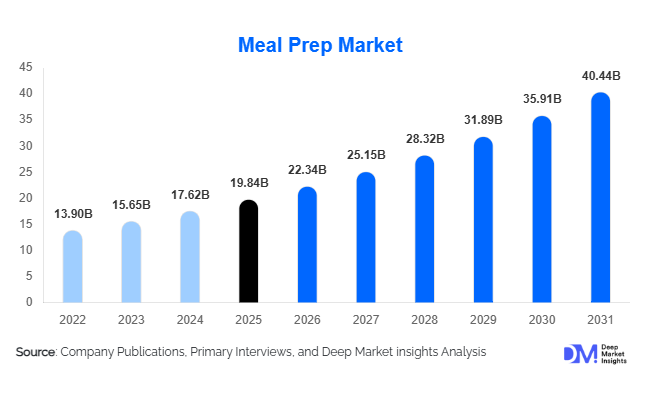
According to Deep Market Insights, the global meal prep market size was valued at USD 19.84 billion in 2025 and is projected to grow from USD 22.34 billion in 2026 to reach USD 40.44 billion by 2031, expanding at a CAGR of 12.6% during the forecast period (2026–2031). The meal prep market growth is primarily driven by rising demand for convenient and healthy eating solutions, increasing adoption of subscription-based food delivery services, and growing consumer preference for personalized nutrition and portion-controlled meals.
Key Market Insights
- Meal prep services are increasingly shifting toward personalized nutrition models, supported by AI-driven dietary recommendations, fitness tracking integration, and customized meal planning.
- Subscription-based meal prep platforms continue to dominate the industry, enabling recurring revenue generation and improved customer retention through flexible meal plans and digital ordering systems.
- North America dominates the global meal prep market, led by high adoption of healthy ready-to-eat meals, strong digital food delivery infrastructure, and growing fitness-oriented food consumption.
- Asia-Pacific remains the fastest-growing regional market, driven by rapid urbanization, rising disposable income, cloud kitchen expansion, and increasing health awareness in China, India, and Southeast Asia.
- Plant-based and high-protein meal categories are witnessing strong growth, supported by rising vegan adoption, sports nutrition trends, and increasing demand for clean-label prepared foods.
- Technological integration across logistics and food preparation operations, including AI-enabled forecasting, automated packaging systems, and smart cold-chain infrastructure, is reshaping operational efficiency across the industry.
Meal Prep Market Latest Trends
Personalized Nutrition and Functional Meal Planning
The global meal prep market is increasingly evolving toward personalized nutrition and health-focused meal customization. Consumers are actively seeking meal solutions tailored to specific dietary requirements such as keto, vegan, diabetic-friendly, gluten-free, sports nutrition, and weight management plans. Meal prep companies are integrating AI-driven recommendation systems, wearable health monitoring synchronization, and nutrition analytics to deliver highly personalized meal experiences. Functional ingredients such as probiotics, adaptogens, immunity boosters, and plant proteins are becoming increasingly common across meal prep offerings. This trend is particularly strong among millennials, fitness enthusiasts, and preventive healthcare consumers who prioritize long-term wellness and nutritional optimization.
Sustainable Packaging and Eco-Friendly Delivery Expansion
Sustainability has emerged as a major strategic trend within the meal prep market. Consumers increasingly prefer meal prep brands using recyclable, compostable, or reusable packaging materials. Governments across Europe and North America are also tightening regulations on single-use plastics and food packaging waste, encouraging companies to adopt environmentally responsible solutions. Meal prep providers are investing in biodegradable containers, locally sourced ingredients, and low-emission delivery networks to strengthen sustainability positioning. Many companies are also implementing food waste reduction technologies, smart inventory systems, and carbon-neutral delivery models to improve environmental performance while enhancing brand differentiation among environmentally conscious consumers.
Meal Prep Market Drivers
Rising Demand for Healthy Convenience Foods
One of the primary growth drivers of the meal prep market is the increasing consumer preference for healthy yet convenient food solutions. Urban consumers globally face increasingly demanding work schedules and limited cooking time, creating strong demand for ready-to-eat and ready-to-cook meal solutions. Meal prep services provide portion-controlled, nutritionally balanced meals while significantly reducing meal planning and cooking effort. This convenience-driven demand is particularly strong among working professionals, students, dual-income households, and younger consumers in metropolitan areas.
Growth of Fitness, Wellness, and Preventive Healthcare Trends
The rapid expansion of the global fitness and wellness industry is significantly supporting meal prep market growth. Consumers are increasingly focused on calorie management, protein intake, muscle recovery, and dietary optimization. High-protein meal plans, keto meals, plant-based nutrition, and sports-focused meal subscriptions are witnessing strong adoption globally. The growing popularity of gyms, fitness apps, wellness programs, and preventive healthcare initiatives is encouraging consumers to adopt structured meal planning systems. Medically tailored meal prep solutions targeting diabetes management, obesity reduction, and cardiovascular health are also expanding rapidly.
Meal Prep Market Restraints
High Operational and Cold-Chain Logistics Costs
Meal prep companies operate within highly time-sensitive supply chains that require efficient refrigeration, rapid delivery infrastructure, and consistent ingredient sourcing. Cold-chain transportation, temperature-controlled storage, and food safety compliance significantly increase operational expenses. Rising fuel prices, labor shortages, and packaging costs continue to pressure operating margins across the industry. Small and mid-sized players particularly face challenges in scaling logistics operations while maintaining product freshness and quality.
Pricing Sensitivity and Consumer Affordability Concerns
Premium meal prep subscriptions remain comparatively expensive compared to traditional grocery-based cooking, especially in price-sensitive developing markets. Economic uncertainty, inflationary pressures, and fluctuating household spending can reduce consumer willingness to commit to recurring subscription plans. While premium consumers remain willing to pay for convenience and customization, broader mass-market adoption remains constrained by affordability concerns. Companies must continuously balance pricing strategies with ingredient quality, delivery efficiency, and profitability.
Meal Prep Industry Key Opportunities
Expansion into Emerging Urban Markets
Emerging economies such as India, Indonesia, Vietnam, Brazil, Mexico, and the UAE present significant untapped growth opportunities for meal prep providers. Rapid urbanization, rising middle-class income levels, increasing smartphone penetration, and growing food delivery ecosystems are accelerating demand for convenient nutrition solutions. Localized menus, affordable subscription plans, and regional cuisine customization are expected to support strong expansion across these high-growth markets. Asia-Pacific is forecast to remain the fastest-growing region globally due to rising digital food ordering adoption and changing urban lifestyles.
Corporate Wellness and Institutional Meal Programs
Corporate meal subscriptions and institutional nutrition services are emerging as major long-term growth opportunities within the market. Companies increasingly invest in employee wellness initiatives to improve productivity, health outcomes, and workforce engagement. Hospitals, schools, universities, airlines, sports organizations, and healthcare facilities are also outsourcing healthy meal planning services to specialized providers. Medically tailored meals and nutrition-focused wellness programs are expected to create recurring contractual revenue opportunities for market participants over the next decade.
Report Scope
| Report Metric | Details |
|---|---|
| Market Size in 2025 | USD 19.84 Billion |
| Market Size in 2026 | USD 22.34 Billion |
| Market Size in 2031 | USD 40.44 Billion |
| CAGR | 12.6% (2026-2031) |
| Base Year for Estimation | 2025 |
| Historical Data | 2022-2024 |
| Forecast Period | 2026-2031 |
| Report Coverage | Revenue Forecast, Competitive Landscape, Supply Chain Disruption, Growth Factors, Environment & Regulatory Landscape and Trends |
| Geographies Covered | North America, Europe, APAC, Middle East and Africa, LATAM |
| Countries Covered | U.S., Canada, U.K., Germany, France, Spain, Italy, Russia, Nordic, Benelux, Rest of Europe, China, Korea, Japan, India, Australia, Singapore, Taiwan, South East Asia, Rest of Asia-Pacific, UAE, Turky, Saudi Arabia, South Africa, Egypt, Nigeria, Rest of MEA, Brazil, Mexico, Argentina, Chile, Colombia, Rest of LATAM |
Explore more data points, trends and opportunities Download Free Sample Report
Offering Type Insights
Ready-to-eat meal prep solutions dominate the market and accounted for nearly 42% of global revenue in 2025. Consumers increasingly prefer fully prepared healthy meals that require minimal preparation time, particularly in urban markets where convenience remains a critical purchasing factor. Microwaveable protein meals, calorie-controlled plans, and chef-curated prepared foods are gaining strong traction across North America and Europe. Ready-to-cook meal kits also continue to expand steadily, supported by consumers seeking cooking engagement while reducing ingredient preparation complexity. Customized meal plans targeting fitness, medical nutrition, and family-oriented consumption patterns are emerging as premium high-growth segments within the market.
Meal Type Insights
Non-vegetarian meal prep remains the largest meal category globally, accounting for nearly 61% of market demand in 2025 due to strong consumer preference for protein-rich meals containing chicken, seafood, turkey, and beef. However, vegan and plant-based meal prep categories are witnessing the fastest growth rates, driven by sustainability concerns, animal welfare awareness, and rising plant-protein consumption trends. Keto, gluten-free, diabetic-friendly, and organic clean-label meal plans are also expanding rapidly as consumers increasingly prioritize health-focused dietary management and specialized nutritional solutions.
Distribution Channel Insights
Online distribution channels dominate the meal prep market and represented approximately 64% of global market revenue in 2025. Direct-to-consumer websites, mobile applications, and third-party delivery platforms enable consumers to access flexible subscription plans, real-time meal customization, and recurring delivery scheduling. Subscription-based digital ordering models continue to strengthen customer retention and revenue predictability for providers. Offline retail expansion through supermarkets, convenience stores, specialty health retailers, and fitness centers is also growing as meal prep brands pursue omnichannel distribution strategies to improve market penetration and consumer accessibility.
Consumer Type Insights
Individual consumers represent the largest customer segment within the meal prep market, accounting for nearly 48% of global demand in 2025. Working professionals remain the dominant user category due to busy lifestyles, increasing health awareness, and limited meal preparation time. Fitness enthusiasts and athletes are also major contributors to demand growth through adoption of high-protein and performance-focused meal plans. Household consumption is steadily expanding as families increasingly adopt weekly meal subscription services for convenience and portion management. Corporate and institutional consumers are also emerging as important demand generators through employee wellness and healthcare nutrition programs.
Packaging Type Insights
Plastic meal containers continue to dominate packaging usage due to cost efficiency and durability during transportation. However, sustainable and compostable packaging solutions accounted for nearly 28% of packaging demand in 2025 and are expanding rapidly due to regulatory pressure and growing environmental awareness. Vacuum-sealed packaging and portion-controlled packaging systems are increasingly utilized to improve shelf life, reduce food waste, and enhance operational efficiency. Premium meal prep providers are increasingly differentiating through eco-friendly packaging innovations and reusable container programs.
End-Use Insights
Residential consumption remains the leading end-use segment and accounted for approximately 52% of total market demand in 2025. The segment continues to benefit from growing urban populations, rising dual-income households, and increasing preference for healthy convenience foods. The fitness and wellness industry is among the fastest-growing end-use sectors globally, driven by rising gym memberships, sports nutrition awareness, and demand for calorie-controlled meal plans. Healthcare and clinical nutrition applications are also expanding rapidly as hospitals and healthcare providers increasingly adopt medically tailored meal solutions for chronic disease management, obesity reduction, and elderly nutrition support.
Explore more data points, trends and opportunities Download Free Sample Report
Meal Prep Market Segmentations
By Offering Type
- Ready-to-Eat Meal Prep
- Ready-to-Cook Meal Kits
- Customized Meal Prep Plans
- Bulk Meal Preparation Services
By Meal Type
- Vegetarian
- Vegan
- Non-Vegetarian
- Keto
- Gluten-Free
- Organic & Clean Label
- Sports Nutrition Meals
- Diabetic-Friendly Meals
By Distribution Channel
- Online Platforms
- Direct-to-Consumer Websites
- Mobile Applications
- Third-Party Delivery Platforms
- Supermarkets & Hypermarkets
- Convenience Stores
- Specialty Health Stores
By Consumer Type
- Working Professionals
- Fitness Enthusiasts & Athletes
- Students
- Households & Families
- Corporate Consumers
- Healthcare & Institutional Consumers
By Packaging Type
- Plastic Containers
- Sustainable & Compostable Packaging
- Vacuum-Sealed Packaging
- Frozen Meal Packaging
- Portion-Control Packaging
Regional Insights
North America
North America remains the dominant regional market and accounted for approximately 44% of global meal prep market revenue in 2025. The United States leads regional demand due to strong adoption of subscription-based meal kits, high-protein prepared meals, and healthy convenience foods. Advanced food delivery infrastructure, widespread digital payment systems, and growing fitness-oriented food consumption continue to support market expansion. Canada is also witnessing strong growth due to rising urbanization and increasing consumer preference for portion-controlled healthy meals.
Europe
Europe represented nearly 27% of global market revenue in 2025, led by strong demand in the United Kingdom, Germany, France, and the Netherlands. Consumers across the region increasingly prioritize sustainable packaging, organic ingredients, and clean-label prepared meals. The UK remains a major market for subscription-based meal kits, while Germany is witnessing rapid growth in vegan and environmentally sustainable meal prep services. France and Italy continue to support premium gourmet meal preparation demand, particularly within urban centers.
Asia-Pacific
Asia-Pacific is the fastest-growing regional market and is projected to expand at a CAGR exceeding 14% through 2031. China, India, Japan, South Korea, Singapore, and Australia are key growth markets. China is benefiting from rapid expansion of food delivery ecosystems and rising middle-class income levels, while India is witnessing strong demand growth driven by urbanization, cloud kitchen expansion, and increasing health awareness among younger consumers. Japan and South Korea continue to lead innovation in portion-controlled and convenience-oriented prepared food systems.
Latin America
Latin America is witnessing steady market expansion led by Brazil and Mexico. Increasing smartphone penetration, rising urban lifestyles, and growing adoption of digital food ordering platforms are supporting meal prep demand. Premium healthy meal subscriptions are particularly gaining traction among upper-middle-income consumers across major metropolitan areas.
Middle East & Africa
The Middle East & Africa region is gradually expanding due to increasing health consciousness, rising expatriate populations, and strong growth in premium hospitality and corporate catering industries. The UAE and Saudi Arabia remain the largest regional markets due to increasing demand for fitness-oriented meal subscriptions and healthy convenience foods. Growing food-tech investment and expansion of cloud kitchen infrastructure are also supporting regional market growth.
Key Players in the Meal Prep Market
- HelloFresh SE
- Blue Apron Holdings Inc.
- Home Chef
- Freshly Inc.
- Sunbasket
- Gousto
- EveryPlate
- Green Chef
- Purple Carrot
- Marley Spoon AG
- Factor75
- Daily Harvest
- Territory Foods
- Snap Kitchen
- Fresh n’ Lean