Offline Meal Delivery Kit Market Size
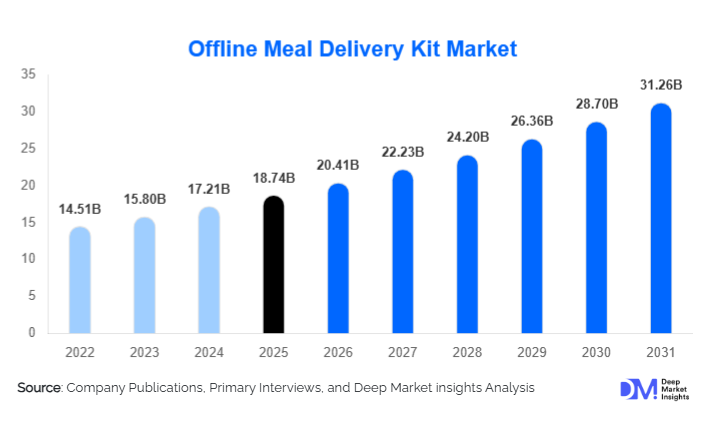
According to Deep Market Insights, the global offline meal delivery kit market size was valued at USD 18.74 billion in 2025 and is projected to grow from USD 20.41 billion in 2026 to reach USD 31.26 billion by 2031, expanding at a CAGR of 8.9% during the forecast period (2026–2031). The offline meal delivery kit market growth is primarily driven by increasing consumer preference for convenient home cooking, expanding organized retail infrastructure, growing demand for fresh ready-to-cook meal solutions, and the rapid adoption of premium meal kits through supermarkets, hypermarkets, and specialty grocery stores.
Key Market Insights
- Subscription meal kits continue to dominate the industry, accounting for nearly 49.4% of global revenue due to strong consumer loyalty and recurring purchases.
- Households remain the largest application segment, contributing approximately 61.5% of total demand as consumers increasingly seek convenient and nutritious meal preparation solutions.
- North America dominates the global market, supported by well-established retail infrastructure, advanced cold-chain logistics, and widespread supermarket penetration.
- Asia-Pacific is the fastest-growing regional market, driven by rapid urbanization, rising disposable incomes, and expanding organized grocery retail across China, India, Japan, and Southeast Asia.
- Retailers are increasingly investing in AI-enabled inventory management and smart refrigeration technologies to reduce food waste and improve product availability.
- Health-focused meal kits including vegan, gluten-free, keto, and protein-rich offerings are becoming major growth categories across offline retail channels.
Offline Meal Delivery Kit Market Latest Trends
Premium Fresh and Health-Oriented Meal Kits Continue to Expand
Consumers are increasingly selecting premium meal kits prepared with organic vegetables, sustainably sourced seafood, antibiotic-free meat, and clean-label ingredients. Retailers continue expanding refrigerated shelf space to accommodate premium ready-to-cook meals while manufacturers invest in recyclable packaging and locally sourced ingredients. Growing consumer awareness regarding healthy eating, portion-controlled meals, and nutritional transparency is accelerating premium meal kit adoption. Supermarkets and specialty grocery stores are introducing wider assortments of chef-inspired recipes, vegetarian meals, and international cuisines, making premium offline meal kits an increasingly attractive alternative to conventional packaged foods.
Technology Modernizes Physical Retail Meal Kit Operations
Technology is becoming a critical differentiator across offline meal delivery kit retailing. Grocery retailers are implementing AI-powered inventory forecasting, automated replenishment systems, QR-enabled recipe instructions, and IoT-enabled refrigeration monitoring to improve operational efficiency and reduce spoilage. Digital shelf management systems help optimize stock availability while consumers increasingly access nutritional information and cooking tutorials through smartphone-enabled QR codes. These innovations are enhancing the shopping experience while allowing retailers to efficiently manage fresh inventory and reduce food waste throughout the supply chain.
Offline Meal Delivery Kit Market Drivers
Growing Consumer Preference for Convenient Home Cooking
Busy lifestyles, increasing urban employment, and rising dual-income households continue driving demand for convenient meal preparation solutions. Consumers increasingly prefer fresh meal kits that eliminate grocery planning while offering restaurant-quality recipes prepared within 30 minutes. Expanding supermarket networks, improved refrigerated logistics, and growing consumer awareness regarding balanced nutrition further support market expansion. Premium meal kits offering personalized recipes, dietary customization, and portion-controlled ingredients continue attracting health-conscious consumers seeking convenience without sacrificing food quality.
Expansion of Organized Grocery Retail
The continued expansion of supermarkets, hypermarkets, premium grocery chains, and specialty food retailers has significantly improved the accessibility of offline meal delivery kits. Retailers are dedicating larger refrigerated sections to fresh ready-to-cook meals while introducing exclusive private-label meal kit brands. Enhanced cold-chain infrastructure, improved product visibility, and promotional pricing strategies are encouraging consumer trial and repeat purchases, strengthening long-term market growth across both developed and emerging economies.
Offline Meal Delivery Kit Market Restraints
Limited Shelf Life and High Cold-Chain Requirements
Fresh ingredients used in offline meal delivery kits require continuous refrigeration and typically maintain relatively short shelf lives. Maintaining cold-chain logistics throughout transportation, warehousing, and retail distribution significantly increases operational costs. Retailers also experience inventory losses from unsold fresh products, particularly during demand fluctuations, while investment requirements for refrigerated storage and temperature-controlled transportation remain substantial barriers for smaller regional distributors.
Inventory Management and Product Waste
Forecasting demand for perishable meal kits remains challenging because purchasing behavior can vary considerably across seasons, promotional campaigns, and regional preferences. Overstocking often leads to product spoilage, while understocking affects customer satisfaction and retailer profitability. Manufacturers and retailers continue investing in predictive inventory systems, demand forecasting software, and optimized supply chain management to minimize waste and improve operational efficiency.
Offline Meal Delivery Kit Industry Key Opportunities
Expansion into Emerging Urban Markets
Rapid urbanization across Asia-Pacific, Latin America, and parts of the Middle East presents significant opportunities for offline meal delivery kit manufacturers. Rising disposable incomes, expanding supermarket penetration, and changing consumer lifestyles are creating favorable conditions for premium convenience foods. Regional retailers are increasingly introducing localized recipes, culturally preferred ingredients, and affordable meal kit formats designed specifically for emerging middle-income consumers.
Growth of Specialized Nutritional Meal Kits
Demand for personalized nutrition continues creating opportunities for manufacturers offering vegan, keto, diabetic-friendly, gluten-free, low-calorie, and high-protein meal kits. Consumers increasingly seek customized dietary solutions supported by transparent ingredient labeling and nutritional guidance. Retailers are expanding dedicated healthy meal sections while collaborating with nutritionists and culinary experts to introduce differentiated product portfolios that appeal to health-conscious shoppers.
Report Scope
| Report Metric | Details |
|---|---|
| Market Size in 2025 | USD 18.74 Billion |
| Market Size in 2026 | USD 20.41 Billion |
| Market Size in 2031 | USD 31.26 Billion |
| CAGR | 8.9% (2026-2031) |
| Base Year for Estimation | 2025 |
| Historical Data | 2022-2024 |
| Forecast Period | 2026-2031 |
| Report Coverage | Revenue Forecast, Competitive Landscape, Supply Chain Disruption, Growth Factors, Environment & Regulatory Landscape and Trends |
| Geographies Covered | North America, Europe, APAC, Middle East and Africa, LATAM |
| Countries Covered | U.S., Canada, U.K., Germany, France, Spain, Italy, Russia, Nordic, Benelux, Rest of Europe, China, Korea, Japan, India, Australia, Singapore, Taiwan, South East Asia, Rest of Asia-Pacific, UAE, Turky, Saudi Arabia, South Africa, Egypt, Nigeria, Rest of MEA, Brazil, Mexico, Argentina, Chile, Colombia, Rest of LATAM |
Explore more data points, trends and opportunities Download Free Sample Report
Type Insights
Subscription meal kits represent the largest product category owing to their recurring purchase model, consistent customer engagement, and broad recipe variety. Weekly menu rotations, standardized ingredient portions, and premium packaging have strengthened customer retention across organized retail channels. One-time purchase meal kits continue attracting consumers seeking flexibility without long-term commitments, particularly during promotional campaigns and seasonal events. Customized meal kits are emerging as the fastest-growing category as consumers increasingly demand personalized dietary preferences, including vegetarian, vegan, keto, gluten-free, diabetic-friendly, and high-protein meal options. Manufacturers are also expanding chef-inspired premium recipes and regional cuisine offerings to further differentiate their portfolios.
Application Insights
Households account for the largest share of the offline meal delivery kit market due to increasing demand for convenient, nutritious, and portion-controlled home cooking solutions. Working professionals and families continue driving adoption as meal kits reduce grocery shopping time while minimizing food waste. Corporate consumers are increasingly utilizing meal kits within employee wellness initiatives, office cafeterias, and business events to promote healthier eating habits. Hospitality and event management companies are also adopting standardized meal kits to improve operational efficiency, maintain food quality consistency, reduce labor requirements, and simplify large-scale catering operations across hotels, conferences, and corporate gatherings.
Distribution Channel Insights
Supermarkets and hypermarkets remain the leading offline distribution channels due to extensive product assortments, established refrigerated infrastructure, and strong consumer footfall. Specialty grocery stores continue expanding premium meal kit selections emphasizing organic ingredients, gourmet recipes, and locally sourced products. Convenience stores are gradually increasing their meal kit offerings to serve busy urban consumers seeking quick meal preparation solutions. Private-label meal kits developed by leading grocery retailers are becoming increasingly popular due to competitive pricing, improved quality, and growing consumer confidence in retailer-owned brands.
Consumer Insights
Urban professionals represent the largest consumer segment, supported by demanding work schedules and increasing preference for convenient home-cooked meals. Young families increasingly purchase meal kits for balanced nutrition, reduced preparation time, and simplified meal planning. Health-conscious consumers continue driving demand for clean-label products featuring fresh vegetables, lean proteins, and reduced preservatives. Older consumers are also adopting meal kits because portion-controlled recipes simplify cooking while supporting healthier dietary habits and minimizing food waste in smaller households.
Explore more data points, trends and opportunities Download Free Sample Report
Offline Meal Delivery Kit Market Segmentations
By Type
- Subscription Kits
- One-Time Purchase Kits
- Customized Meal Kits
By Application
- Households
- Corporate Consumers
- Hospitality & Events
By Distribution Channel
- Supermarkets & Hypermarkets
- Specialty Grocery Stores
- Convenience Stores
- Warehouse Clubs
- Independent Food Retailers
Regional Insights
North America
North America remains the largest regional market for offline meal delivery kits, supported by mature grocery retail infrastructure, advanced refrigerated logistics, and high consumer awareness of convenient meal preparation solutions. The United States contributes the majority of regional revenue, followed by Canada and Mexico. Strong household purchasing power, premium grocery retail expansion, and increasing consumer demand for organic, protein-rich, and specialized dietary meal kits continue supporting regional market leadership. Retailers are also expanding private-label offerings while investing heavily in AI-powered inventory optimization and refrigerated merchandising technologies.
Europe
Europe represents one of the most mature markets, driven by strong demand for fresh ingredients, sustainable packaging, and premium culinary experiences. Germany, the United Kingdom, France, Italy, and the Netherlands continue leading regional consumption through extensive supermarket networks and well-developed cold-chain infrastructure. European consumers increasingly favor locally sourced ingredients, recyclable packaging, vegetarian recipes, and Mediterranean-inspired meal kits, encouraging manufacturers to expand environmentally responsible product portfolios.
Asia-Pacific
Asia-Pacific is projected to record the fastest market growth owing to rapid urbanization, expanding middle-class populations, increasing disposable income, and continued supermarket expansion across China, India, Japan, South Korea, and Australia. Consumers increasingly seek convenient meal preparation options that combine fresh ingredients with regional cuisines. Growing investments in organized grocery retail, refrigerated transportation, and premium convenience foods are expected to further accelerate offline meal delivery kit adoption throughout the region.
Latin America
Latin America is witnessing steady market expansion as organized retail infrastructure continues improving across Brazil, Mexico, Argentina, and Chile. Rising consumer awareness of healthy eating, expanding supermarket chains, and increasing urban employment are encouraging greater adoption of fresh meal kits. Retailers continue introducing localized recipes featuring regional ingredients while affordable pricing strategies help attract first-time consumers across emerging metropolitan markets.
Middle East & Africa
The Middle East & Africa market continues developing through increasing supermarket investments, tourism growth, expanding premium grocery retail, and improving refrigerated logistics. The United Arab Emirates, Saudi Arabia, South Africa, and Egypt remain key contributors to regional demand. Growing consumer preference for premium convenience foods, healthier lifestyles, and international cuisines is encouraging retailers to broaden meal kit assortments while investments in cold-chain infrastructure improve product availability across major urban centers.
Key Players in the Offline Meal Delivery Kit Market
- HelloFresh SE
- Blue Apron Holdings Inc.
- Marley Spoon AG
- Gousto Ltd.
- Sunbasket Inc.
- Home Chef
- Purple Carrot
- Mindful Chef Ltd.
- FreshRealm LLC
- CookUnity Inc.
- EveryPlate
- Green Chef
- Dinnerly
- Hungryroot Inc.
- Riverford Organic Farmers Ltd.