Haute Cuisine Market Size
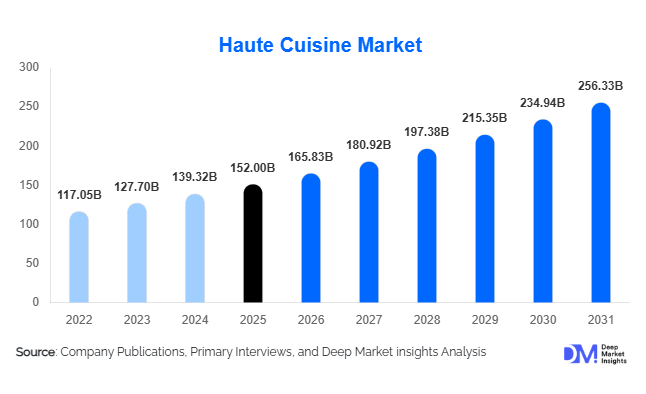
According to Deep Market Insights,The global haute cuisine market size was valued at USD 152.0 billion in 2025 and is projected to grow from USD 165.83 billion in 2026 to reach USD 256.33 billion by 2031, expanding at a CAGR of 9.1% during the forecast period (2026–2031). The haute cuisine market growth is primarily driven by rising global affluence, increasing demand for experiential luxury dining, and the rapid expansion of premium hospitality and culinary tourism across developed and emerging economies.
Key Market Insights
- Haute cuisine is increasingly shifting toward experiential and immersive dining formats, including chef’s table, tasting menus, and storytelling-based culinary experiences.
- Luxury tourism is a primary growth engine, contributing nearly 40% of total demand, with high-spending travelers prioritizing fine dining.
- Europe dominates the global market, accounting for approximately 35% share, supported by strong culinary heritage and Michelin-star ecosystems.
- Asia-Pacific is the fastest-growing region, driven by rising disposable incomes and expanding luxury dining culture in countries such as Japan, China, and India.
- Sustainability and farm-to-table practices are gaining traction, with locally sourced ingredients accounting for over 30% of offerings.
- Technology integration, including digital reservations, AI-based personalization, and immersive dining elements, is reshaping customer engagement.
What are the latest trends in the haute cuisine market?
Rise of Experiential and Immersive Dining
Haute cuisine is evolving beyond traditional fine dining into immersive, multi-sensory experiences. Restaurants are incorporating storytelling, theatrical presentations, and chef interactions to enhance customer engagement. Chef’s table formats and tasting menus have become dominant, allowing diners to experience curated culinary journeys. This trend is particularly strong among younger affluent consumers who prioritize unique experiences over conventional dining. Restaurants are also integrating elements such as soundscapes, lighting design, and cultural narratives to create memorable dining environments, positioning haute cuisine as a form of experiential entertainment.
Shift Toward Sustainable and Local Sourcing
Sustainability has emerged as a defining trend in the haute cuisine market. Restaurants are increasingly adopting farm-to-table models, focusing on seasonal, locally sourced ingredients to reduce environmental impact and ensure freshness. Zero-waste kitchens, ethical sourcing of seafood and meats, and plant-forward menus are gaining prominence. This trend is particularly strong in Europe and North America, where regulatory frameworks and consumer awareness are driving adoption. Sustainable practices are also becoming a key differentiator, enabling restaurants to command premium pricing while aligning with environmentally conscious consumers.
What are the key drivers in the haute cuisine market?
Rising High-Net-Worth Individual (HNWI) Population
The growing number of high-net-worth individuals globally is significantly boosting demand for haute cuisine. These consumers seek exclusive, high-quality experiences and are willing to spend on premium dining. Luxury dining has become a key component of lifestyle spending, particularly in urban centers and global culinary hubs. Emerging wealth in regions such as Asia-Pacific and the Middle East is further accelerating demand, expanding the global customer base for haute cuisine establishments.
Growth of Culinary Tourism
Culinary tourism has become a major driver for the haute cuisine market. Travelers increasingly consider fine dining as a central part of their travel experiences, leading to higher demand for Michelin-starred restaurants and destination dining. Countries such as France, Japan, and Italy are leveraging their culinary heritage to attract international tourists, while emerging destinations are investing in premium dining infrastructure to capture this demand. This trend is contributing to higher revenue generation and global expansion of haute cuisine brands.
What are the restraints for the global market?
High Operational and Ingredient Costs
Haute cuisine establishments operate with high cost structures due to premium ingredients, skilled labor, and luxury infrastructure requirements. The use of specialty ingredients such as truffles, caviar, and Wagyu beef significantly increases operational expenses. Additionally, maintaining high service standards requires continuous investment in staff training and innovation, which can impact profitability, particularly during economic downturns.
Economic Sensitivity and Demand Volatility
The haute cuisine market is highly sensitive to economic fluctuations, as luxury dining is a discretionary expense. During periods of economic uncertainty, consumers tend to reduce spending on premium experiences, leading to demand volatility. This creates challenges for market participants in maintaining consistent revenue streams and long-term growth stability.
What are the key opportunities in the haute cuisine industry?
Expansion in Emerging Luxury Markets
Emerging economies such as India, the UAE, and Southeast Asian countries present significant growth opportunities. Rapid urbanization, increasing disposable incomes, and growing exposure to global culinary trends are driving demand for premium dining experiences. Governments in these regions are also investing in luxury tourism infrastructure, creating favorable conditions for haute cuisine expansion. New entrants can capitalize by introducing localized versions of global cuisines while maintaining international standards.
Technology-Driven Personalization
The integration of technology in haute cuisine offers opportunities for enhanced customer engagement and operational efficiency. AI-driven personalization, digital reservation platforms, and immersive technologies such as AR/VR are transforming the dining experience. Restaurants can leverage data analytics to tailor menus, optimize pricing, and improve customer satisfaction, creating competitive advantages in a highly competitive market.
Report Scope
| Report Metric | Details |
|---|---|
| Market Size in 2025 | USD 152.00 Billion |
| Market Size in 2026 | USD 165.83 Billion |
| Market Size in 2031 | USD 256.33 Billion |
| CAGR | 9.1% (2026-2031) |
| Base Year for Estimation | 2025 |
| Historical Data | 2022-2024 |
| Forecast Period | 2026-2031 |
| Report Coverage | Revenue Forecast, Competitive Landscape, Supply Chain Disruption, Growth Factors, Environment & Regulatory Landscape and Trends |
| Geographies Covered | North America, Europe, APAC, Middle East and Africa, LATAM |
| Countries Covered | U.S., Canada, U.K., Germany, France, Spain, Italy, Russia, Nordic, Benelux, Rest of Europe, China, Korea, Japan, India, Australia, Singapore, Taiwan, South East Asia, Rest of Asia-Pacific, UAE, Turky, Saudi Arabia, South Africa, Egypt, Nigeria, Rest of MEA, Brazil, Mexico, Argentina, Chile, Colombia, Rest of LATAM |
Explore more data points, trends and opportunities Download Free Sample Report
Product Type Insights
The haute cuisine market is characterized by a diverse portfolio of culinary traditions, each contributing uniquely to the global fine dining landscape. French haute cuisine continues to lead the market, accounting for approximately 28% of the total share, underpinned by its historical legacy, rigorous culinary techniques, and dominance in Michelin-starred establishments. Its structured approach to gastronomy, emphasis on precision, and strong institutional backing through culinary schools and chef training programs have enabled it to maintain a leadership position. Additionally, the global recognition of French culinary standards has reinforced its role as a benchmark for fine dining excellence, attracting both chefs and consumers seeking authenticity and prestige.Molecular gastronomy, while still a niche segment, is witnessing notable growth due to advancements in food science and culinary technology. The integration of scientific techniques such as sous-vide cooking, liquid nitrogen freezing, and texture transformation has enabled chefs to push the boundaries of traditional dining. This segment is particularly popular in high-end restaurants that aim to offer experiential dining, where the focus extends beyond taste to include visual presentation and sensory engagement. The leading driver across product types remains the increasing consumer preference for experiential and premium dining, where authenticity, innovation, and storytelling play a critical role in shaping purchasing decisions.
Application Insights
Luxury tourism represents the dominant application segment, accounting for nearly 40% of total market demand, as high-income travelers increasingly prioritize gastronomic experiences as a core component of their journeys. Fine dining has become an integral part of luxury travel itineraries, with tourists seeking out renowned restaurants, celebrity chefs, and destination-specific culinary experiences. The growth of culinary tourism, supported by international travel recovery and the expansion of luxury hospitality infrastructure, continues to drive demand in this segment. The leading driver here is the integration of dining with travel experiences, where food acts as a cultural gateway and a key differentiator for destinations.Special occasion dining, including weddings, anniversaries, and milestone celebrations, is experiencing steady growth. Rising disposable incomes, particularly in emerging economies, and a shift toward experiential spending are encouraging consumers to invest in memorable dining experiences. Restaurants are increasingly offering tailored packages, curated menus, and immersive environments to cater to this demand. The emotional and social value associated with such occasions makes this segment highly resilient and less price-sensitive.Private dining and chef-at-home services are emerging as innovative applications, driven by the demand for exclusivity, personalization, and convenience. High-net-worth individuals are increasingly opting for bespoke culinary experiences within private settings, supported by advancements in service platforms and digital booking systems. This trend gained momentum during periods of restricted mobility and continues to evolve as consumers prioritize privacy and customization. Across all applications, the primary growth driver remains the shift toward experience-driven consumption, where dining is perceived not merely as a necessity but as a lifestyle and status symbol.
Distribution Channel Insights
Direct reservations continue to dominate the distribution landscape, accounting for approximately 55% of total bookings. This dominance is largely attributed to the exclusivity associated with fine dining establishments, where direct engagement with customers helps maintain brand identity and personalized service. Many high-end restaurants prefer direct booking systems to manage customer relationships, control seating arrangements, and offer tailored experiences. The leading driver in this segment is the emphasis on exclusivity and direct customer interaction, which enhances brand loyalty and repeat visits.Online platforms are rapidly gaining traction, supported by digital transformation and changing consumer behavior. These platforms offer convenience, transparency, and access to a wide range of dining options, enabling customers to discover and book experiences with ease. Features such as reviews, ratings, and real-time availability have enhanced user engagement, making online channels increasingly relevant even in the premium segment. The growth of mobile applications and digital payment systems further supports this trend.Membership-based dining clubs are emerging as a niche but influential distribution channel, offering exclusive access to curated culinary events, private tastings, and premium restaurant networks. These clubs cater primarily to affluent consumers seeking unique and personalized experiences. By combining exclusivity with community engagement, they are redefining how high-end dining experiences are accessed and consumed. Overall, the distribution landscape is evolving toward a hybrid model that integrates traditional exclusivity with digital convenience.
End-User Insights
Affluent individuals and high-net-worth consumers remain the largest end-user segment, driven by their strong purchasing power and preference for premium experiences. This group values quality, exclusivity, and brand reputation, making them the primary target audience for haute cuisine establishments. Their spending patterns are less sensitive to economic fluctuations, providing stability to the market.Luxury tourism is the fastest-growing end-user segment, expanding at a CAGR of over 10%. The resurgence of international travel, coupled with the growing popularity of culinary tourism, is driving demand among global travelers. Tourists increasingly seek authentic and immersive dining experiences that reflect the cultural identity of destinations, contributing to the expansion of this segment.Special occasion consumers are also playing a crucial role in market growth. The rising trend of celebrating personal milestones in premium settings reflects a broader shift toward experiential consumption. Consumers are increasingly willing to allocate higher budgets for memorable dining experiences, particularly for events that hold emotional significance. Across all end-user categories, the leading driver is the growing emphasis on lifestyle-oriented spending, where dining serves as a key expression of status, taste, and personal identity.
Explore more data points, trends and opportunities Download Free Sample Report
Haute Cuisine Market Segmentations
By Cuisine Type
- French Haute Cuisine
- Italian Fine Dining Cuisine
- Japanese Kaiseki Cuisine
- Mediterranean Haute Cuisine
- Fusion & Modernist Cuisine
- Molecular Gastronomy
- Regional Premium Cuisines
By Dining Format
- Fine Dining Restaurants
- Luxury Hotel Restaurants
- Chef’s Table Experiences
- Private Chef & Home Dining
- Pop-up Culinary Events
- Tasting Menu / Degustation Dining
By Service Model
- À la Carte Haute Cuisine
- Tasting Menu Experiences
- Seasonal / Farm-to-Table Dining
- Customized Culinary Experiences
By Ingredient Sourcing
- Farm-to-Table / Local Sourcing
- Imported Luxury Ingredients
- Organic & Sustainable Sourcing
- Specialty Ingredients
By End-Use
- Luxury Tourism Consumers
- High-Net-Worth Individuals
- Corporate & Business Dining
- Special Occasion Dining
Regional Insights
Europe
Europe dominates the global haute cuisine market, holding approximately 35% share in 2025, with countries such as France, Italy, and Spain leading the region. France alone contributes nearly 12% of global demand, supported by its unparalleled culinary heritage and the highest concentration of Michelin-starred restaurants worldwide. The region benefits from a well-established fine dining ecosystem, including renowned culinary institutions, a strong supply chain of premium ingredients, and a deeply ingrained dining culture.The primary growth drivers in Europe include sustained international tourism inflows, government support for cultural and culinary heritage, and continuous innovation within traditional cuisines. The region also benefits from a strong domestic consumer base that values quality dining experiences. Additionally, Europe’s position as a global culinary hub attracts top chefs and restaurateurs, further strengthening its market leadership. Seasonal food festivals, wine tourism, and cross-border travel within the region further enhance demand for haute cuisine.
North America
North America accounts for approximately 28% of the global market, with the United States serving as the primary growth engine. Major cities such as New York, Los Angeles, and San Francisco have established themselves as key hubs for fine dining, supported by high disposable incomes and a strong culture of eating out. The region’s diverse population contributes to a dynamic culinary landscape, where traditional and innovative cuisines coexist.Key growth drivers in North America include rising consumer spending on luxury experiences, the influence of celebrity chefs and media, and the rapid adoption of digital reservation platforms. The region also benefits from a strong culture of culinary innovation, with restaurants लगातार experimenting with new concepts and techniques. Furthermore, the presence of global restaurant chains and hospitality groups enhances market accessibility and visibility, attracting both domestic and international consumers.
Asia-Pacific
Asia-Pacific holds around 25% market share and represents the fastest-growing region, with a CAGR exceeding 11%. Japan leads the region with approximately 9% global share, driven by its rich culinary traditions, including Kaiseki dining, and a strong domestic appreciation for fine cuisine. Countries such as China, Singapore, and India are emerging as significant markets, supported by rapid urbanization and increasing disposable incomes.The region’s growth is primarily driven by the expanding middle and upper classes, increasing exposure to global dining trends, and the proliferation of luxury hotels and restaurants. International tourism is also a key contributor, particularly in destinations known for their culinary offerings. Additionally, the integration of technology in dining, including online reservations and digital payments, is accelerating market growth. The blending of traditional and modern culinary practices further enhances the appeal of haute cuisine in this region.
Middle East & Africa
The Middle East, particularly the UAE, has emerged as a significant growth hub for haute cuisine, driven by its strong focus on luxury tourism and high-income population. Cities like Dubai have positioned themselves as global culinary destinations, attracting internationally acclaimed chefs and premium restaurant brands. The region’s hospitality sector continues to expand, supported by large-scale investments and government initiatives aimed at diversifying the economy.Key growth drivers include the influx of international tourists, a high concentration of affluent residents, and the development of world-class infrastructure. The presence of luxury hotels and resorts further supports demand for fine dining experiences. In Africa, the market remains relatively underdeveloped but is gradually expanding due to increasing urbanization, rising incomes, and growing tourism. The emergence of local culinary talent and the promotion of regional cuisines are expected to drive future growth.
Latin America
Latin America is an emerging market for haute cuisine, with countries such as Brazil and Mexico leading regional demand. The region is experiencing gradual growth in fine dining culture, supported by increasing disposable incomes and a growing interest in culinary innovation. Local chefs are gaining international recognition, contributing to the region’s visibility in the global market.The primary growth drivers in Latin America include the expansion of tourism, the rising popularity of gastronomic festivals, and the increasing influence of global dining trends. However, market penetration remains lower compared to developed regions, primarily due to economic constraints and limited infrastructure. Despite these challenges, the region holds significant potential, particularly as investments in hospitality and tourism continue to increase, paving the way for sustained growth in the haute cuisine market.
Key Players in the Haute Cuisine Market
- Alain Ducasse Group
- Gordon Ramsay Restaurants
- Joël Robuchon Group
- Nobu Hospitality
- Wolfgang Puck Fine Dining Group
- Heston Blumenthal Group
- Daniel Boulud Dining Group
- Thomas Keller Restaurant Group
- Jean-Georges Management
- Zuma Restaurants
- D&D London
- STARR Restaurants
- Tetsuya’s Group
- Aqua Restaurant Group
- JKS Restaurants