Takeaway Food Market Size
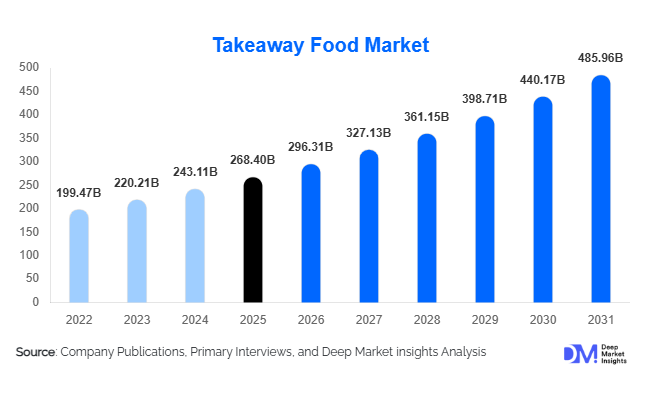
According to Deep Market Insights, the global takeaway food market size was valued at USD 268.4 billion in 2025 and is projected to grow from USD 296.31 billion in 2026 to reach USD 485.96 billion by 2031, expanding at a CAGR of 10.4% during the forecast period (2026–2031). The takeaway food market growth is primarily driven by increasing smartphone penetration, rising consumer preference for convenience-based dining, expansion of digital food delivery ecosystems, and the rapid adoption of cloud kitchen business models globally.
Key Market Insights
- Online delivery platforms continue to dominate the market, supported by app-based ordering, integrated digital payments, and real-time delivery tracking capabilities.
- Cloud kitchens and ghost kitchens are rapidly expanding globally, enabling restaurants to reduce operational costs while improving delivery efficiency and scalability.
- Asia-Pacific dominates the global takeaway food market, led by strong demand from China, India, Indonesia, and Southeast Asian economies.
- North America remains one of the most technologically mature regions, characterized by high average order values, AI-powered logistics, and subscription-based delivery models.
- Healthy, plant-based, and premium takeaway meals are witnessing strong growth, particularly among millennials and Generation Z consumers seeking customized meal experiences.
- Sustainable packaging adoption is accelerating globally, driven by stricter environmental regulations and growing consumer awareness regarding single-use plastic waste.
Takeaway Food Market Latest Trends
Rapid Expansion of Cloud Kitchens and Delivery-Only Models
Cloud kitchens are becoming one of the most transformative trends within the global takeaway food market. Restaurant operators are increasingly investing in delivery-only kitchen facilities that eliminate the need for expensive dine-in infrastructure. These kitchens allow multiple food brands to operate from a single centralized location, significantly improving kitchen utilization and reducing real estate expenses. The model is especially popular across densely populated urban centers in Asia-Pacific, North America, and the Middle East where delivery demand is rising rapidly. Venture capital investment in ghost kitchen startups continues to increase as operators seek scalable, technology-driven foodservice models with faster market entry and improved profitability.
AI-Driven Personalization and Smart Ordering Ecosystems
Artificial intelligence and predictive analytics are increasingly reshaping customer engagement across takeaway food platforms. Food delivery companies are integrating AI-powered recommendation engines, personalized promotions, dynamic pricing systems, and predictive ordering tools to improve customer retention and maximize repeat purchases. Mobile applications now provide intelligent meal suggestions based on previous ordering behavior, dietary preferences, and time-of-day consumption patterns. AI-driven logistics optimization is also helping operators reduce delivery times and improve route efficiency. Smart kitchens equipped with automated cooking systems, inventory management tools, and robotics-assisted preparation technologies are becoming increasingly common among large-scale takeaway food operators.
Takeaway Food Market Drivers
Growing Demand for Convenience-Oriented Dining
Rapid urbanization, changing work lifestyles, and increasing time constraints among consumers are significantly driving demand for takeaway food globally. Working professionals, dual-income households, and younger demographics increasingly prefer ready-to-eat meal solutions that minimize cooking time and provide flexibility. Takeaway food platforms allow consumers to access diverse cuisines quickly through mobile applications, making convenience a primary purchasing factor. Urban consumers increasingly rely on takeaway meals for lunch, dinner, late-night dining, and weekend consumption, supporting consistent order growth across major metropolitan areas.
Digital Transformation of Food Ordering Ecosystems
The widespread adoption of smartphones, affordable internet connectivity, and digital payment systems has transformed the global takeaway food industry. Consumers increasingly prefer app-based ordering platforms that offer seamless payment integration, loyalty rewards, personalized promotions, and real-time delivery tracking. Delivery aggregators and restaurant-owned applications continue investing heavily in user experience optimization, AI-powered engagement tools, and subscription programs to increase customer retention. Emerging economies such as India, Indonesia, Brazil, and Vietnam are experiencing particularly strong growth due to rapid digitalization and expanding middle-class consumer bases.
Takeaway Food Market Restraints
Rising Operational and Delivery Costs
The takeaway food industry faces increasing operational challenges due to rising labor costs, fuel price volatility, food ingredient inflation, and packaging expenses. Delivery platforms continue to experience margin pressure as consumers demand faster delivery times while maintaining low service fees. Restaurant operators also face challenges balancing aggressive promotional discounts with profitability targets. High logistics costs associated with last-mile delivery remain a significant challenge, particularly in suburban and low-density geographic areas where delivery efficiency is lower.
Regulatory and Sustainability Challenges
Governments across North America, Europe, and Asia are implementing stricter regulations related to food safety standards, packaging waste, gig worker rights, and data privacy compliance. Increasing restrictions on single-use plastics are forcing takeaway operators to transition toward sustainable packaging alternatives, which often carry higher costs. Additionally, concerns regarding unhealthy eating habits, excessive packaging waste, and food quality consistency continue to create reputational risks for takeaway food providers. Compliance with evolving environmental and labor regulations is expected to remain a major operational challenge throughout the forecast period.
Takeaway Food Industry Key Opportunities
Expansion of Healthy and Plant-Based Takeaway Meals
Growing consumer preference for healthier lifestyles presents significant opportunities for takeaway food operators to expand plant-based, organic, protein-rich, and calorie-controlled menu offerings. Millennials and Generation Z consumers increasingly prioritize nutritional transparency, clean-label ingredients, and customizable meals. Restaurants that integrate vegan alternatives, sustainable sourcing, and wellness-oriented menus into takeaway formats are expected to attract higher-value consumers and improve brand loyalty. Premium healthy takeaway segments are also enabling operators to increase average order values and differentiate themselves in highly competitive markets.
Corporate and Institutional Meal Solutions
The rising adoption of hybrid work models and flexible office infrastructure is creating new opportunities for corporate meal delivery services. Businesses, co-working spaces, educational institutions, and healthcare facilities increasingly integrate app-based meal ordering systems and employee food subscription programs into workplace operations. This recurring institutional demand provides stable revenue streams for takeaway food operators capable of managing high-volume food preparation and scheduled delivery logistics. Partnerships with universities, hospitals, airports, and entertainment venues are also opening new channels for scalable takeaway meal distribution.
Report Scope
| Report Metric | Details |
|---|---|
| Market Size in 2025 | USD 268.40 Billion |
| Market Size in 2026 | USD 296.31 Billion |
| Market Size in 2031 | USD 485.96 Billion |
| CAGR | 10.4% (2026-2031) |
| Base Year for Estimation | 2025 |
| Historical Data | 2022-2024 |
| Forecast Period | 2026-2031 |
| Report Coverage | Revenue Forecast, Competitive Landscape, Supply Chain Disruption, Growth Factors, Environment & Regulatory Landscape and Trends |
| Geographies Covered | North America, Europe, APAC, Middle East and Africa, LATAM |
| Countries Covered | U.S., Canada, U.K., Germany, France, Spain, Italy, Russia, Nordic, Benelux, Rest of Europe, China, Korea, Japan, India, Australia, Singapore, Taiwan, South East Asia, Rest of Asia-Pacific, UAE, Turky, Saudi Arabia, South Africa, Egypt, Nigeria, Rest of MEA, Brazil, Mexico, Argentina, Chile, Colombia, Rest of LATAM |
Explore more data points, trends and opportunities Download Free Sample Report
Service Model Insights
Online delivery platforms dominate the takeaway food market, accounting for the largest share of global revenue due to widespread smartphone adoption and growing consumer reliance on app-based ordering. Marketplace aggregators continue expanding through subscription programs, integrated payment systems, and AI-driven customer engagement strategies. Offline takeaway remains important among quick-service restaurants and independent food outlets, particularly in emerging markets where in-store ordering and pickup culture remain strong. Drive-through takeaway services continue gaining popularity in North America and parts of Europe due to speed and convenience advantages. Click-and-collect models are also expanding rapidly as restaurants seek to reduce third-party delivery commission expenses while maintaining operational efficiency.
Cuisine Type Insights
Fast food and burgers represent the largest cuisine segment within the global takeaway food market due to affordability, standardized preparation, and strong global franchise expansion. Pizza and Italian cuisine continue to perform strongly because of their suitability for delivery and broad consumer appeal across North America and Europe. Asian cuisine, including Chinese, Japanese, Korean, and Thai food, is witnessing substantial international demand as consumers increasingly seek diverse flavors and fusion meal experiences. Healthy and organic takeaway meals are among the fastest-growing categories, driven by rising wellness awareness and demand for clean-label food products. Vegan and plant-based takeaway menus are also expanding rapidly across urban markets globally.
Order Channel Insights
Mobile application-based ordering dominates the global takeaway food industry, supported by high smartphone penetration and consumer preference for convenience-driven digital ecosystems. Delivery applications increasingly integrate loyalty rewards, personalized recommendations, and subscription-based delivery services to improve customer retention. Website ordering remains relevant among large restaurant chains with strong direct-to-consumer digital infrastructure. Aggregator platforms continue expanding globally by offering consumers broader restaurant access and simplified order management. Smart device and voice-assistant ordering are emerging as innovative channels, particularly in technologically advanced markets such as the United States, Japan, and South Korea.
Consumer Demographic Insights
Millennials account for the largest share of takeaway food consumption globally, driven by digitally integrated lifestyles, urban living patterns, and strong demand for convenience-oriented dining solutions. Generation Z consumers are among the fastest-growing demographic groups due to heavy reliance on mobile applications and willingness to experiment with international cuisines and customized meal options. Working professionals continue representing a major consumer segment as busy schedules and long commuting hours increase dependence on takeaway meals. Families and households contribute significantly to weekend and group ordering demand, while students remain highly active consumers within affordable takeaway and quick-service restaurant categories.
Packaging Type Insights
Paper and fiber-based packaging is rapidly gaining market share due to increasing regulatory restrictions on single-use plastics and growing consumer demand for environmentally sustainable food packaging. Compostable and biodegradable packaging solutions are experiencing strong adoption among premium takeaway brands and environmentally conscious consumers. Plastic packaging still maintains a significant market presence due to cost efficiency and durability advantages, particularly in developing economies. Reusable packaging systems are emerging as an innovative sustainability initiative across several European and North American cities, supported by government-led waste reduction policies and circular economy programs.
Explore more data points, trends and opportunities Download Free Sample Report
Takeaway Food Market Segmentations
By Service Model
- Online Delivery Platforms
- Offline Takeaway
- Drive-Through Takeaway
- Click-and-Collect Services
- Cloud Kitchen Delivery
By Cuisine Type
- Fast Food & Burgers
- Pizza & Italian Cuisine
- Asian Cuisine
- Indian & South Asian Cuisine
- Mexican & Latin American Cuisine
- Healthy & Organic Meals
- Vegan & Plant-Based Takeaway
- Bakery & Café Meals
By Order Channel
- Mobile Application-Based Ordering
- Website Ordering
- Aggregator Platforms
- In-Store Ordering
- Telephone Ordering
- Smart Device & Voice Assistant Ordering
By Consumer Demographic
- Millennials
- Generation Z
- Working Professionals
- Families & Households
- Students
- Senior Consumers
By Packaging Type
- Plastic Packaging
- Paper & Fiber-Based Packaging
- Aluminum Foil & Metal Containers
- Reusable Packaging Systems
- Compostable & Biodegradable Packaging
Regional Insights
Asia-Pacific
Asia-Pacific dominates the global takeaway food market, accounting for nearly 39% of global revenue in 2025. China remains the largest regional market due to strong digital platform integration, extensive mobile payment adoption, and high urban population density. India is one of the fastest-growing takeaway food markets globally, supported by expanding middle-class income, rapid smartphone penetration, and strong growth of cloud kitchen infrastructure across Tier-II and Tier-III cities. Southeast Asian economies including Indonesia, Vietnam, Thailand, and the Philippines are witnessing strong growth due to younger demographics, urbanization, and increasing internet accessibility. Japan and South Korea continue driving premium takeaway demand through advanced digital ordering ecosystems and high consumer spending.
North America
North America represents one of the most mature takeaway food markets globally, accounting for approximately 27% of total market revenue in 2025. The United States dominates regional demand due to strong quick-service restaurant penetration, high average order values, and advanced delivery logistics infrastructure. AI-powered customer engagement, subscription-based meal delivery programs, and smart kitchen technologies are increasingly shaping the U.S. market. Canada continues witnessing strong demand for healthy takeaway meals, premium food categories, and sustainable packaging solutions. Drive-through takeaway models and contactless delivery services remain highly popular across the region.
Europe
Europe accounts for nearly 22% of the global takeaway food market, supported by strong urban takeaway culture and increasing demand for sustainable dining solutions. The United Kingdom remains one of the region’s largest takeaway food markets due to high app-based ordering penetration and strong consumer preference for convenience-oriented meals. Germany and France are witnessing rapid growth in healthy takeaway categories and biodegradable packaging adoption. Southern European countries such as Italy and Spain are increasingly embracing digital takeaway ecosystems, particularly among younger consumers seeking flexible dining solutions. Sustainability regulations across Europe continue accelerating innovation in eco-friendly food packaging and waste reduction systems.
Latin America
Latin America is witnessing gradual expansion within the takeaway food market, led by Brazil and Mexico. Rapid urbanization, increasing smartphone adoption, and growth of quick-service restaurant chains continue supporting regional demand. Brazilian consumers increasingly rely on app-based food ordering platforms, particularly in large metropolitan cities. Mexico is experiencing strong growth in fast-food takeaway and digital ordering ecosystems due to rising middle-class consumption and expanding franchise restaurant infrastructure. Regional delivery startups are also contributing to increased market penetration.
Middle East & Africa
The Middle East & Africa region is experiencing steady growth in takeaway food demand, supported by rising urbanization, tourism expansion, and digital transformation initiatives. The UAE and Saudi Arabia are major regional growth hubs due to premium food delivery demand, high disposable income, and strong smartphone penetration. Government investments in smart city infrastructure and digital payment ecosystems continue supporting takeaway market expansion. South Africa and Egypt are emerging markets driven by improving internet accessibility and expanding urban middle-class populations. Tourism-driven takeaway demand is also increasing across airports, hotels, and entertainment destinations throughout the region.
Key Players in the Takeaway Food Market
- McDonald’s Corporation
- Yum! Brands
- Restaurant Brands International
- Domino’s Pizza Inc.
- Starbucks Corporation
- Chipotle Mexican Grill
- Subway
- Papa John’s International
- The Wendy’s Company
- Inspire Brands
- DoorDash
- Uber Eats
- Delivery Hero
- Just Eat Takeaway.com
- Meituan