Cube Ice Market Size
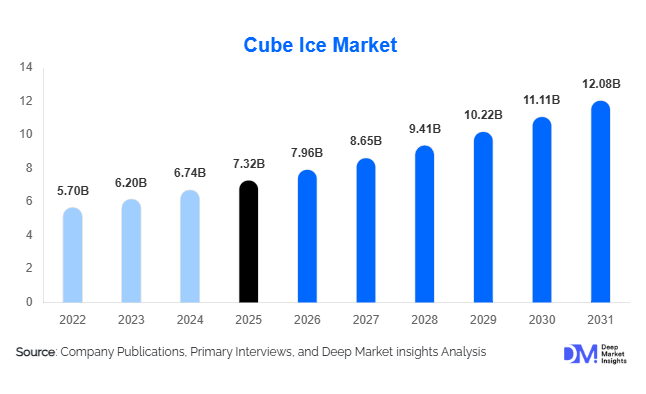
According to Deep Market Insights, the global cube ice market size was valued at USD 7.32 billion in 2025 and is projected to grow from USD 7.96 billion in 2026 to reach USD 12.08 billion by 2031, expanding at a CAGR of 8.7% during the forecast period (2026–2031). The cube ice market growth is primarily driven by the expansion of the global foodservice industry, rising consumption of alcoholic and non-alcoholic beverages, increasing demand for packaged hygienic ice products, and the rapid development of cold-chain logistics infrastructure across emerging economies.
Cube ice continues to remain the most commercially preferred ice format due to its slow-melting properties, ease of handling, and suitability across hospitality, retail, healthcare, seafood transportation, and industrial cooling applications. Growing urbanization and rising disposable incomes are encouraging consumers to spend more on convenience beverages, dining-out experiences, and outdoor entertainment activities, all of which contribute to higher packaged ice consumption globally.
The market is also witnessing increased adoption of automated ice manufacturing systems, energy-efficient refrigeration technologies, and hygienic packaging solutions. Premiumization trends within the beverage industry are driving demand for gourmet and crystal-clear cube ice variants, particularly among luxury hotels, bars, lounges, and cocktail-focused establishments. Asia-Pacific is emerging as the fastest-growing regional market due to rapid expansion of organized foodservice chains and increasing tourism activity, while North America continues to dominate overall market revenues because of strong commercial beverage consumption and mature convenience retail infrastructure.
Key Market Insights
- Packaged cube ice demand is increasingly shifting toward hygienic and premium ice products, particularly across hospitality, healthcare, and beverage applications.
- Quick-service restaurants, bars, cafés, and convenience retail chains are significantly expanding cube ice procurement volumes, creating long-term recurring demand for manufacturers.
- North America dominates the global cube ice market, supported by strong beverage consumption, mature cold-chain infrastructure, and widespread packaged ice adoption.
- Asia-Pacific is the fastest-growing regional market, driven by rapid urbanization, tourism growth, and expansion of organized foodservice ecosystems.
- Premium gourmet cube ice is gaining popularity, especially among luxury hospitality operators and cocktail-focused beverage establishments.
- Technological advancements in automated ice manufacturing and energy-efficient refrigeration systems are improving operational efficiency and hygiene standards globally.
Cube Ice Market Latest Trends
Premium and Gourmet Cube Ice Demand Rising
The global cube ice market is witnessing strong growth in premium and gourmet ice categories, particularly within luxury hospitality, cocktail bars, premium lounges, and high-end restaurants. Beverage presentation has become an increasingly important component of customer experience, encouraging establishments to adopt crystal-clear slow-melting cube ice products. Premium cube ice helps preserve beverage quality, improves visual appeal, and supports premium pricing strategies within the alcoholic beverage industry. Manufacturers are investing in advanced filtration systems, purified water technologies, and specialized freezing methods to produce high-clarity gourmet ice products. This trend is particularly strong in North America, Japan, South Korea, and Western Europe where premium cocktail culture continues to expand.
Automation and Smart Refrigeration Integration
Automation is becoming a major trend across the cube ice manufacturing industry as companies focus on improving operational efficiency, hygiene compliance, and energy management. Manufacturers are increasingly adopting IoT-enabled refrigeration systems, automated packaging lines, and touchless ice dispensing technologies. Smart monitoring systems now allow operators to track refrigeration performance, production volumes, and maintenance schedules in real time. Automated vending and self-service ice dispensing kiosks are also gaining popularity in urban retail environments and fuel stations. Sustainability-focused refrigeration technologies using low-global-warming-potential refrigerants are being integrated into production facilities to comply with tightening environmental regulations and reduce electricity costs.
Cube Ice Market Drivers
Expansion of Global Foodservice and Hospitality Industry
The rapid expansion of hotels, restaurants, cafés, bars, and quick-service restaurant chains is one of the major growth drivers for the cube ice market. Rising urbanization and changing consumer lifestyles are increasing dining-out frequency and beverage consumption worldwide. Hospitality operators require continuous access to hygienic packaged ice products for beverage preparation, food preservation, and customer service applications. Tourism recovery and growth in entertainment venues are further supporting commercial cube ice demand globally. Emerging economies including India, Vietnam, Indonesia, and the UAE are witnessing substantial investments in hospitality infrastructure, creating significant growth opportunities for cube ice manufacturers.
Growing Consumption of Ready-to-Drink Beverages
The increasing popularity of ready-to-drink beverages, cocktails, flavored drinks, and premium alcoholic beverages is accelerating cube ice demand worldwide. Beverage companies and hospitality establishments are prioritizing high-quality ice products to improve customer experience and maintain beverage consistency. Rising youth population, nightlife culture expansion, and social entertainment trends are contributing to higher consumption volumes in urban markets. Convenience retail stores and online beverage delivery services are also boosting retail packaged cube ice sales across developed and emerging economies.
Growth in Cold-Chain Logistics and Seafood Transportation
Cube ice plays a critical role in preserving seafood freshness, meat products, and temperature-sensitive goods during transportation and storage. Expansion of global seafood exports from countries such as Norway, India, Vietnam, Thailand, and Chile is significantly increasing industrial ice demand. Pharmaceutical logistics and biologics transportation are also emerging as important application areas for hygienic cooling products. Governments worldwide are investing heavily in cold-chain modernization and food preservation infrastructure, supporting long-term industrial demand for packaged cube ice products.
Global Market Restraints
High Energy and Refrigeration Costs
Cube ice production is highly energy-intensive due to continuous refrigeration requirements, making electricity one of the largest operational cost components for manufacturers. Rising energy prices, fuel costs, and refrigeration equipment expenses are putting pressure on profit margins, particularly for small and medium-sized regional players. Manufacturers operating in emerging economies with unstable electricity infrastructure often face higher operational risks and maintenance costs. Energy price volatility can also affect retail pricing and overall competitiveness within the packaged ice industry.
Stringent Food Safety and Water Quality Regulations
Cube ice intended for human consumption must comply with strict hygiene and food safety standards related to water purification, packaging, storage, and transportation. Regulatory compliance costs can be substantial for smaller producers lacking modern infrastructure and automated sanitation systems. Contamination risks during transportation and improper cold-chain handling can negatively impact brand reputation and increase liability exposure. Additionally, environmental regulations concerning refrigerant emissions and water usage are becoming stricter globally, requiring manufacturers to invest in sustainable production technologies and compliance systems.
Cube Ice Industry Key Opportunities
Expansion in Emerging Urban Markets
Rapid urbanization and rising disposable incomes across Asia-Pacific, Latin America, and the Middle East are creating major opportunities for cube ice manufacturers. Expansion of cafés, pubs, food courts, cloud kitchens, and organized retail chains in emerging cities is driving consistent demand for packaged ice products. Companies can capitalize on this opportunity by establishing localized production facilities and last-mile distribution networks near high-demand urban consumption centers. Growth in tourism and outdoor entertainment activities is expected to further strengthen demand across emerging economies over the forecast period.
Premium Hospitality and Beverage Industry Integration
The growing popularity of premium alcoholic beverages and luxury hospitality experiences presents significant opportunities for gourmet cube ice manufacturers. Luxury hotels, fine-dining restaurants, cocktail bars, and event management companies are increasingly demanding high-quality crystal-clear cube ice products that enhance beverage presentation and customer experience. Manufacturers investing in specialized premium ice production technologies can command higher margins and differentiate themselves from standard packaged ice suppliers. Customized cube shapes, branded ice products, and high-purity filtration systems are also creating niche premium market opportunities globally.
Report Scope
| Report Metric | Details |
|---|---|
| Market Size in 2025 | USD 7.32 Billion |
| Market Size in 2026 | USD 7.96 Billion |
| Market Size in 2031 | USD 12.08 Billion |
| CAGR | 8.7% (2026-2031) |
| Base Year for Estimation | 2025 |
| Historical Data | 2022-2024 |
| Forecast Period | 2026-2031 |
| Report Coverage | Revenue Forecast, Competitive Landscape, Supply Chain Disruption, Growth Factors, Environment & Regulatory Landscape and Trends |
| Geographies Covered | North America, Europe, APAC, Middle East and Africa, LATAM |
| Countries Covered | U.S., Canada, U.K., Germany, France, Spain, Italy, Russia, Nordic, Benelux, Rest of Europe, China, Korea, Japan, India, Australia, Singapore, Taiwan, South East Asia, Rest of Asia-Pacific, UAE, Turky, Saudi Arabia, South Africa, Egypt, Nigeria, Rest of MEA, Brazil, Mexico, Argentina, Chile, Colombia, Rest of LATAM |
Explore more data points, trends and opportunities Download Free Sample Report
Product Type Insights
Full cube ice dominates the global market with approximately 34% market share due to its superior slow-melting properties and widespread use across hospitality and beverage applications. These cubes are extensively utilized in bars, restaurants, hotels, and convenience retail channels because they preserve beverage flavor and maintain cooling efficiency for longer durations. Half cube ice remains popular in quick-service restaurants and fast beverage dispensing systems due to faster cooling characteristics and compatibility with automated beverage machines. Gourmet and crystal-clear cube ice products are witnessing the fastest growth rates globally, driven by premium cocktail culture and luxury hospitality demand. Nugget and specialty cube variants are also gaining popularity in healthcare facilities, entertainment venues, and customized beverage applications where texture and presentation are important consumer considerations.
Application Insights
Beverage cooling represents the largest application segment, accounting for nearly 41% of the global cube ice market in 2025. Rising consumption of soft drinks, cocktails, alcoholic beverages, and ready-to-drink products continues to support strong demand from commercial foodservice operators. Food preservation applications remain a critical segment, particularly within seafood transportation, meat logistics, and cold-chain distribution industries. Hospitality and catering applications are expanding steadily due to growth in tourism and event management industries globally. Healthcare and pharmaceutical cooling applications are also emerging as important growth areas as medical institutions increasingly adopt hygienic packaged ice products for patient care and biologics transportation. Industrial cooling applications across manufacturing facilities and logistics operations are expected to contribute additional long-term demand stability.
Distribution Channel Insights
Direct B2B supply channels dominate the cube ice market, accounting for approximately 38% of total industry revenues. Hotels, restaurants, cafés, seafood processors, and convenience store chains rely heavily on long-term supply agreements with packaged ice manufacturers to ensure continuous product availability and hygiene compliance. Retail distribution through supermarkets, hypermarkets, and convenience stores remains a major sales channel for household consumption. Online delivery integration is becoming increasingly important in metropolitan areas where consumers order packaged ice products through grocery delivery platforms and food delivery applications. Automated vending and self-service ice dispensing machines are also expanding rapidly in fuel stations, event venues, and urban retail locations, improving accessibility and operational convenience for consumers.
End-Use Industry Insights
Hotels and restaurants collectively represent the largest end-use segment, contributing nearly 29% of total market demand in 2025. Hospitality establishments require large volumes of hygienic packaged cube ice for beverage preparation, food storage, and catering operations. Quick-service restaurants are among the fastest-growing end-use categories due to rapid international expansion and rising consumer demand for convenience food and beverages. Seafood processing and cold-chain logistics industries are also significant industrial consumers of cube ice products, particularly across export-oriented economies. Healthcare facilities are gradually increasing adoption of hygienic packaged ice solutions for medical cooling and patient care applications. Corporate cafeterias, entertainment venues, and institutional foodservice operators are further contributing to diversified end-user demand growth globally.
Explore more data points, trends and opportunities Download Free Sample Report
Cube Ice Market Segmentations
By Product Type
- Full Cube Ice
- Half Cube Ice
- Gourmet Cube Ice
- Crescent Cube Ice
- Dice Cube Ice
- Nugget Cube Ice
- Clear Premium Cube Ice
- Flavored Cube Ice
- Colored Cube Ice
By Application
- Beverage Cooling
- Food Preservation
- Hospitality & Catering
- Seafood & Meat Transportation
- Pharmaceutical Cooling
- Medical & Healthcare Usage
- Event & Entertainment Cooling
- Industrial Temperature Control
By End User
- Hotels & Restaurants
- Quick Service Restaurants (QSRs)
- Bars & Nightclubs
- Household Consumers
- Food Processing Companies
- Fisheries & Seafood Industry
- Healthcare Facilities
- Convenience Retail Chains
- Logistics & Cold Chain Operators
- Corporate & Institutional Cafeterias
By Distribution Channel
- Direct B2B Supply
- Retail Stores
- Online Delivery Platforms
- Vending & Automated Ice Dispensing Machines
- Wholesale Distribution
Regional Insights
North America
North America accounted for approximately 35% of the global cube ice market in 2025, making it the leading regional market. The United States dominates regional demand due to high per capita beverage consumption, mature hospitality infrastructure, and widespread packaged ice adoption across retail and commercial channels. Strong presence of convenience retail chains, bars, restaurants, and entertainment venues continues supporting stable recurring demand. Canada also contributes significantly through seafood transportation, hospitality operations, and organized retail applications. Premium gourmet cube ice products are particularly popular in urban hospitality markets across the United States and Canada.
Europe
Europe remains a mature yet steadily growing cube ice market, supported by developed hospitality industries and premium beverage consumption trends. Germany, the United Kingdom, France, Italy, and Spain represent the largest regional markets due to extensive tourism activity and strong foodservice infrastructure. Demand for gourmet cube ice products is increasing rapidly across luxury cocktail bars and premium restaurants. Northern European countries also generate substantial industrial ice demand through seafood logistics and cold-chain transportation industries. Sustainability regulations are encouraging adoption of energy-efficient refrigeration systems across European manufacturing facilities.
Asia-Pacific
Asia-Pacific is the fastest-growing regional market with forecast CAGR exceeding 10% during the forecast period. China dominates regional demand due to rapid urbanization, rising disposable incomes, and strong expansion of restaurant chains and convenience retail networks. India is emerging as one of the most promising markets due to increasing café culture, tourism growth, and expansion of organized foodservice operations. Japan and South Korea remain major consumers of premium gourmet cube ice products driven by advanced hospitality and beverage presentation standards. Southeast Asian countries including Thailand, Vietnam, Indonesia, and the Philippines are also witnessing increasing demand supported by tourism and nightlife expansion.
Latin America
Latin America is experiencing stable growth led by Brazil and Mexico. Rising urban nightlife culture, tourism activities, and convenience retail penetration are supporting packaged cube ice consumption across the region. Brazil’s expanding beverage industry and hospitality sector remain major contributors to regional demand growth. Mexico is witnessing increasing adoption of packaged ice products across restaurants, bars, and organized retail outlets. Seafood processing industries across coastal Latin American economies are also contributing to industrial demand for cube ice products.
Middle East & Africa
The Middle East & Africa region is witnessing strong growth due to rising hospitality investments, high ambient temperatures, and expansion of tourism infrastructure projects. The UAE and Saudi Arabia remain key regional markets supported by luxury hotels, entertainment complexes, and foodservice expansion. South Africa continues to generate significant demand through hospitality and seafood logistics applications. Increasing investments in cold-chain infrastructure and food preservation technologies across Gulf economies are expected to support long-term market expansion. Rapid growth in tourism-focused infrastructure development is also accelerating commercial cube ice consumption across the region.
Key Players in the Cube Ice Market
- The Ice Co.
- Arctic Glacier
- Reddy Ice Holdings
- Kooler Ice
- ReadyRefresh
- Iceland Ice
- Party Time Ice
- Polar Ice
- Penguin Ice
- Ice Factory of Central Florida
- Southland Ice Company
- Crystal Ice
- Everest Ice and Water Systems
- Bagged Ice Network
- Cold Products Company