Zearalenone Antibody Market Size
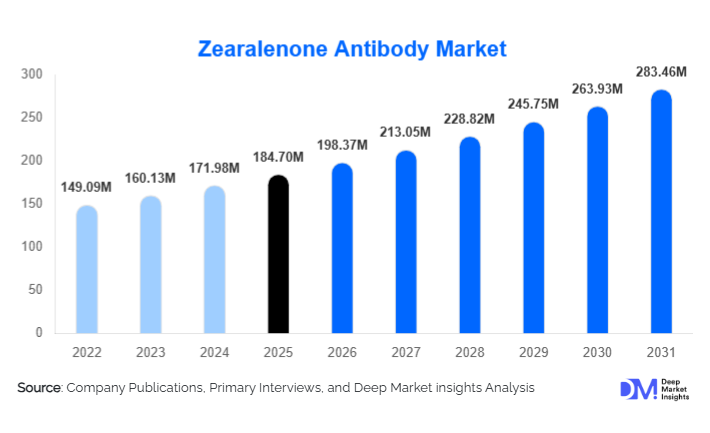
According to Deep Market Insights, the global Zearalenone Antibody market size was valued at USD 184.7 million in 2025 and is projected to grow from USD 198.37 million in 2026 to reach USD 283.46 million by 2031, expanding at a CAGR of 7.4% during the forecast period (2026–2031). The Zearalenone Antibody market growth is primarily driven by the increasing implementation of stringent food safety regulations, rising incidence of mycotoxin contamination in cereals and animal feed, growing adoption of immunoassay-based diagnostic technologies, and expanding investments in food quality assurance laboratories worldwide. Increasing commercialization of monoclonal and recombinant antibodies for high-sensitivity detection is further supporting market expansion across food testing, feed analysis, and research applications.
Key Market Insights
- Monoclonal antibodies dominate the market, accounting for nearly 48.3% of total revenue owing to their superior specificity, reproducibility, and compatibility with ELISA and rapid diagnostic platforms.
- Feed testing remains the leading application, contributing approximately 42.7% of global demand due to expanding livestock production and mandatory feed quality monitoring.
- North America dominates the global market, supported by advanced laboratory infrastructure, stringent regulatory frameworks, and widespread adoption of immunodiagnostic technologies.
- Asia-Pacific is the fastest-growing regional market, driven by expanding food exports, increasing laboratory investments, and strengthening food safety regulations across China, India, Japan, and South Korea.
- Recombinant antibody technologies are gaining significant momentum, offering improved batch consistency, higher analytical sensitivity, and scalable manufacturing capabilities.
- Automation and multiplex mycotoxin detection platforms are reshaping laboratory workflows by enabling simultaneous detection of multiple contaminants with improved operational efficiency.
Zearalenone Antibody Market Latest Trends
Rapid Adoption of Recombinant Antibody Technologies
The industry is witnessing increasing commercialization of recombinant zearalenone antibodies capable of delivering improved batch-to-batch consistency, enhanced affinity, and analytical specificity exceeding 98%. These antibodies are increasingly integrated into automated ELISA systems, fluorescence immunoassays, biosensor platforms, and multiplex analytical solutions. Diagnostic manufacturers are investing heavily in recombinant production technologies to reduce manufacturing variability while improving long-term reagent stability. The growing preference for standardized antibody production is strengthening laboratory confidence and supporting wider adoption across food safety testing laboratories worldwide.
Expansion of High-Throughput Food Safety Testing
Food manufacturers, grain exporters, regulatory agencies, and commercial laboratories are rapidly expanding high-throughput mycotoxin screening capabilities. Automated immunoassay analyzers capable of processing hundreds of samples daily are replacing conventional laboratory workflows. Integration of artificial intelligence-assisted data interpretation, digital laboratory management systems, and portable rapid testing devices is improving analytical efficiency while reducing turnaround time. The increasing deployment of point-of-use testing kits and portable diagnostic devices is further accelerating adoption of zearalenone antibody-based detection technologies across global food and feed supply chains.
Zearalenone Antibody Market Drivers
Increasing Global Focus on Food Safety and Mycotoxin Regulations
Governments and food safety authorities worldwide continue strengthening regulations governing permissible mycotoxin levels in cereals, grains, dairy products, beverages, and animal feed. Mandatory testing requirements for domestic consumption as well as international trade have significantly increased laboratory demand for highly sensitive zearalenone antibodies. Expansion of accredited food testing laboratories, growing investments in quality assurance infrastructure, and increasing awareness regarding foodborne contaminants continue to support long-term market expansion. Rising global grain trade and increasing livestock production are also contributing to higher testing volumes across developed and emerging economies.
Growing Adoption of Immunoassay-Based Diagnostics
ELISA kits, lateral flow assays, fluorescence immunoassays, and biosensor technologies continue replacing conventional analytical techniques for routine screening because of their rapid turnaround time, high sensitivity, lower operational costs, and ease of automation. Food processors, feed manufacturers, research institutes, and inspection agencies increasingly rely on antibody-based diagnostic platforms to improve testing efficiency while maintaining regulatory compliance. Continuous technological innovation is enhancing detection accuracy and expanding application opportunities across diverse end-user industries.
Zearalenone Antibody Market Restraints
High Production and Validation Costs
Manufacturing high-affinity monoclonal and recombinant antibodies requires sophisticated biotechnology infrastructure, extensive validation procedures, and stringent quality control systems. These requirements significantly increase production costs and create barriers for smaller manufacturers entering the market. Long product development timelines, regulatory validation requirements, and complex manufacturing protocols further limit rapid commercialization of innovative antibody products, particularly in price-sensitive emerging markets.
Technical Challenges Associated with Cross-Reactivity
Maintaining high analytical specificity while minimizing cross-reactivity with structurally related mycotoxins remains a major technical challenge for manufacturers. Batch consistency, long-term reagent stability, and reproducibility across different assay platforms require continuous optimization. Variations in sample matrices, environmental conditions, and testing protocols can also influence analytical performance, requiring ongoing product improvements and extensive validation studies.
Zearalenone Antibody Industry Key Opportunities
Expansion of Multiplex Mycotoxin Detection Technologies
Growing demand for simultaneous detection of multiple mycotoxins presents significant opportunities for manufacturers developing multiplex immunoassay platforms. Laboratories increasingly prefer integrated diagnostic systems capable of detecting several contaminants within a single analytical workflow, reducing testing costs while improving laboratory productivity. Continued innovation in biosensors, microfluidics, and automated immunoassay systems is expected to create attractive commercial opportunities throughout the forecast period.
Growing Food Testing Infrastructure in Emerging Economies
Rapid industrialization of food processing industries across Asia-Pacific, Latin America, and the Middle East is encouraging governments to strengthen food safety infrastructure. Increasing investments in accredited testing laboratories, expansion of export-oriented agriculture, and rising implementation of international food safety standards are creating substantial opportunities for antibody manufacturers supplying high-performance analytical reagents for routine mycotoxin monitoring.
Report Scope
| Report Metric | Details |
|---|---|
| Market Size in 2025 | USD 184.70 Million |
| Market Size in 2026 | USD 198.37 Million |
| Market Size in 2031 | USD 283.46 Million |
| CAGR | 7.4% (2026-2031) |
| Base Year for Estimation | 2025 |
| Historical Data | 2022-2024 |
| Forecast Period | 2026-2031 |
| Report Coverage | Revenue Forecast, Competitive Landscape, Supply Chain Disruption, Growth Factors, Environment & Regulatory Landscape and Trends |
| Geographies Covered | North America, Europe, APAC, Middle East and Africa, LATAM |
| Countries Covered | U.S., Canada, U.K., Germany, France, Spain, Italy, Russia, Nordic, Benelux, Rest of Europe, China, Korea, Japan, India, Australia, Singapore, Taiwan, South East Asia, Rest of Asia-Pacific, UAE, Turky, Saudi Arabia, South Africa, Egypt, Nigeria, Rest of MEA, Brazil, Mexico, Argentina, Chile, Colombia, Rest of LATAM |
Explore more data points, trends and opportunities Download Free Sample Report
Type Insights
Monoclonal antibodies accounted for the largest share of the zearalenone antibody market due to their exceptional specificity, high affinity, excellent batch-to-batch reproducibility, and superior analytical accuracy in detecting zearalenone contamination across food and feed samples. The growing demand for reliable mycotoxin detection methods among food testing laboratories, regulatory agencies, grain inspection facilities, and commercial diagnostic manufacturers has significantly strengthened the adoption of monoclonal antibodies. Their compatibility with enzyme-linked immunosorbent assay (ELISA) kits, lateral flow immunoassays, chemiluminescence assays, and other rapid diagnostic platforms further supports widespread commercialization. In addition, increasing regulatory requirements for routine screening of cereals, maize, wheat, barley, animal feed, and processed food products continue to accelerate the utilization of monoclonal antibodies owing to their ability to deliver highly sensitive, reproducible, and standardized analytical results while minimizing false-positive and false-negative outcomes.Recombinant antibodies are projected to witness the fastest growth during the forecast period, driven by continuous advancements in antibody engineering, recombinant DNA technology, and automated biomanufacturing processes. Their superior manufacturing consistency, enhanced stability, scalable production capabilities, and reduced batch variability make them increasingly attractive for next-generation diagnostic platforms. Growing adoption of recombinant antibodies in multiplex immunoassays, biosensors, point-of-care diagnostics, and high-throughput laboratory automation is further accelerating market expansion. Moreover, increasing investments in precision diagnostics, personalized analytical technologies, and synthetic biology are encouraging diagnostic manufacturers to replace conventional antibody production methods with recombinant alternatives capable of delivering improved sensitivity, specificity, and long-term supply reliability.
Application Insights
Feed testing dominated the zearalenone antibody market as livestock producers, feed manufacturers, and veterinary diagnostic laboratories increasingly prioritize routine monitoring of mycotoxin contamination to safeguard animal health, improve feed efficiency, and enhance overall livestock productivity. The growing prevalence of fungal contamination in maize, wheat, barley, and other feed ingredients has intensified demand for highly accurate antibody-based detection technologies. Stringent international regulations governing animal feed safety, rising commercial livestock production, and increasing awareness regarding reproductive disorders caused by zearalenone exposure have further strengthened the adoption of antibody-based immunoassays across feed quality control laboratories. Continuous expansion of global meat, dairy, poultry, and aquaculture industries also contributes significantly to sustained demand for reliable feed testing solutions.Research laboratories continue to generate consistent demand for zearalenone antibodies through ongoing toxicology studies, assay development, biosensor innovation, antibody engineering, molecular biology research, and analytical method validation. Increasing public and private investments in biotechnology research, expanding collaborations between academic institutions and diagnostic manufacturers, and continuous innovation in immunochemistry are supporting the development of highly sensitive detection technologies. Researchers are increasingly utilizing advanced antibody platforms to improve diagnostic precision, evaluate emerging mycotoxins, develop multiplex analytical systems, and enhance food safety monitoring capabilities, thereby contributing to long-term market growth.
Explore more data points, trends and opportunities Download Free Sample Report
Zearalenone Antibody Market Segmentations
By Type
- Monoclonal Antibody
- Polyclonal Antibody
- Recombinant Antibody
By Application
- Food Testing
- Feed Testing
- Research Laboratories
By End User
- Food Testing Laboratories
- Feed Manufacturers
- Research & Academic Institutes
- Diagnostic Kit Manufacturers
- Government & Regulatory Laboratories
Regional Insights
North America
North America accounted for the largest share of the global zearalenone antibody market, supported by advanced biotechnology infrastructure, highly developed diagnostic laboratories, and one of the world's most comprehensive food safety regulatory frameworks. The region benefits from widespread adoption of automated laboratory diagnostics, increasing implementation of rapid immunoassay technologies, and strong investments in biotechnology innovation. The United States generates the majority of regional revenue due to extensive grain cultivation, large-scale livestock production, high testing volumes across food and feed industries, and continuous investments in food quality assurance programs. The presence of leading biotechnology companies, diagnostic manufacturers, contract testing laboratories, and research institutions further accelerates technological advancements and commercial adoption of antibody-based detection solutions. Canada also contributes significantly through expanding food exports, increasing regulatory monitoring initiatives, modernization of analytical laboratories, and growing emphasis on maintaining compliance with international food safety standards. Rising consumer demand for safe food products, increasing incidences of mycotoxin contamination, and continuous investments in agricultural quality control remain key drivers supporting regional market growth.
Europe
Europe represents one of the most mature markets for zearalenone antibodies owing to stringent food safety legislation, well-established analytical testing infrastructure, and extensive regulatory monitoring of mycotoxins throughout the food and feed supply chain. Strict enforcement of maximum allowable mycotoxin limits, increasing compliance requirements for agricultural exports, and continuous surveillance programs have encouraged widespread adoption of antibody-based diagnostic technologies across the region. Germany, France, Italy, and the Netherlands remain major contributors due to their highly developed food processing industries, advanced research capabilities, and strong grain production and export activities. Continuous investments in laboratory modernization, increasing adoption of automated immunoassays, growing emphasis on sustainable food production, and rising demand for certified contaminant-free agricultural products continue driving market expansion. Furthermore, strong collaboration between government agencies, food manufacturers, and research organizations supports continuous innovation in mycotoxin detection technologies throughout Europe.
Asia-Pacific
Asia-Pacific is projected to register the fastest market growth during the forecast period, driven by rapid industrialization of food processing industries, expanding agricultural production, and increasing government investments in food safety infrastructure. China, India, Japan, and South Korea are significantly strengthening laboratory modernization initiatives while expanding regulatory frameworks governing food and feed quality. Rising awareness regarding the health risks associated with mycotoxin contamination, increasing consumption of processed foods, expanding grain exports, and rapid growth of livestock production continue creating substantial demand for advanced antibody-based diagnostic technologies. Growing biotechnology research activities, increasing establishment of commercial testing laboratories, expanding pharmaceutical and life sciences industries, and rising investments in automated diagnostic platforms are further supporting regional market growth. Additionally, favorable government initiatives aimed at improving agricultural quality standards and strengthening export competitiveness continue to accelerate adoption of zearalenone antibody testing across Asia-Pacific.
Latin America
Latin America is experiencing steady market expansion, supported by growing agricultural exports, increasing commercialization of livestock production, and rising implementation of food quality regulations across major economies. Brazil, Argentina, and Mexico remain the primary revenue-generating countries owing to their large-scale production and export of soybeans, corn, wheat, and other cereal crops that require stringent mycotoxin monitoring before international distribution. Increasing modernization of commercial laboratories, expanding feed manufacturing industries, growing awareness regarding foodborne contaminants, and stronger regulatory compliance requirements continue driving demand for antibody-based analytical solutions. Moreover, rising investments in agricultural biotechnology, export certification programs, and food inspection infrastructure are encouraging greater adoption of rapid immunodiagnostic technologies throughout the region.
Middle East & Africa
The Middle East & Africa market is gradually expanding as governments continue investing in food safety infrastructure, laboratory modernization, and agricultural quality improvement initiatives. Rising dependence on imported food products has increased the need for comprehensive mycotoxin screening to ensure compliance with international food safety standards. Saudi Arabia, the United Arab Emirates, and South Africa are strengthening analytical laboratory capabilities through investments in advanced diagnostic technologies, regulatory enforcement, and food inspection programs. Growing urbanization, increasing food consumption, expanding livestock farming, and rising awareness regarding food quality are further supporting market growth. In addition, government efforts to enhance agricultural productivity, facilitate international trade, improve public health protection, and establish internationally accredited testing laboratories continue creating new opportunities for the adoption of zearalenone antibody-based diagnostic solutions across the region.
Company Market Share
The Zearalenone Antibody market share is moderately fragmented, with global biotechnology companies, diagnostic reagent manufacturers, and specialized antibody suppliers competing through continuous product innovation, improved analytical sensitivity, recombinant antibody development, and expansion of food safety testing portfolios. Established manufacturers maintain strong competitive positions through extensive distribution networks, regulatory expertise, and long-standing relationships with food testing laboratories, while emerging biotechnology firms continue introducing high-performance recombinant antibody solutions for next-generation immunodiagnostic platforms.
Key Players in the Zearalenone Antibody Market
- Romer Labs
- Creative Diagnostics
- Abcam
- Thermo Fisher Scientific
- Merck KGaA
- Bio-Rad Laboratories
- Enzo Life Sciences
- Cusabio
- GeneTex
- Cloud-Clone Corp.
- Cell Signaling Technology
- MyBioSource
- Bioss Antibodies
- Abbkine Scientific
- Novus Biologicals