Xanthophyll Market Size
According to Deep Market Insights, the global xanthophyll market size was valued at USD 1.24 billion in 2025 and is projected to grow from USD 1.33 billion in 2026 to reach USD 1.87 billion by 2031, expanding at a CAGR of 7.1% during the forecast period (2026–2031). The xanthophyll market growth is primarily driven by increasing demand for natural antioxidants, expanding applications in eye health supplements, rising adoption of natural food colorants, and growing utilization of carotenoid-based ingredients across nutraceutical, animal nutrition, pharmaceutical, and cosmetic industries. The market continues to benefit from consumer preference for clean-label products, increasing awareness regarding age-related eye disorders, and technological advancements in extraction and microencapsulation processes that improve ingredient stability and bioavailability.
Key Market Insights
- Lutein remains the largest xanthophyll segment, accounting for approximately 32.5% of global market revenue due to its widespread use in eye health supplements and functional nutrition products.
- Marigold flower extract dominates commercial production, contributing more than 40% of global xanthophyll supply owing to favorable cultivation economics in India and China.
- Dietary supplements represent the largest application segment, driven by increasing preventive healthcare spending and growing demand for vision-support formulations.
- Asia-Pacific leads global production and consumption, supported by extensive agricultural production, extraction infrastructure, and expanding nutraceutical manufacturing capabilities.
- Natural colorant substitution is accelerating globally, as food manufacturers replace synthetic pigments with naturally derived xanthophyll ingredients.
- Algae-based xanthophyll production technologies are emerging as a major innovation area, particularly for premium astaxanthin and fucoxanthin applications.
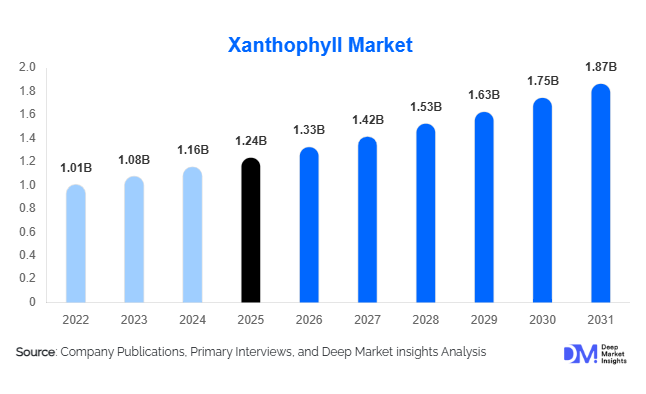
Xanthophyll Market Latest Trends
Growing Adoption of Natural Food Colorants
Food and beverage manufacturers are increasingly replacing synthetic dyes with naturally derived coloring ingredients. Xanthophylls such as lutein, capsanthin, capsorubin, and paprika extracts are gaining widespread acceptance across dairy products, confectionery, beverages, bakery products, and plant-based foods. Regulatory pressure regarding artificial additives, combined with growing consumer demand for clean-label formulations, is accelerating adoption. Major food companies are reformulating products to eliminate artificial colors, creating long-term demand opportunities for xanthophyll producers. Manufacturers are also investing in stabilization technologies that improve heat resistance and shelf-life performance, enabling broader use across processed food applications.
Expansion of Eye Health and Healthy Aging Nutrition
The global rise in digital screen exposure and aging populations has significantly increased demand for eye health ingredients. Lutein and zeaxanthin are among the most clinically studied carotenoids for retinal protection and visual performance. Nutraceutical companies are increasingly launching targeted formulations for macular health, blue-light protection, and healthy aging. Premium supplement brands are combining xanthophylls with omega-3 fatty acids, vitamins, and minerals to create multifunctional health solutions. The growing emphasis on preventive healthcare continues to position xanthophylls as essential ingredients within the expanding healthy aging market.
Xanthophyll Market Drivers
Rising Demand for Preventive Healthcare Products
Preventive healthcare has become one of the strongest growth drivers for the xanthophyll market. Consumers are increasingly investing in nutritional supplements designed to support vision health, cognitive function, immune health, and healthy aging. Lutein and zeaxanthin-based formulations are experiencing robust demand due to growing awareness regarding age-related macular degeneration, cataracts, and digital eye strain. Aging populations across North America, Europe, Japan, and China continue to expand the addressable market for vision-support supplements.
Growing Shift Toward Natural and Clean-Label Ingredients
Food, beverage, and personal care manufacturers are actively transitioning toward natural ingredients that align with consumer preferences for transparency and sustainability. Xanthophylls offer multifunctional benefits as both pigments and antioxidants, making them highly attractive alternatives to synthetic additives. Regulatory support for naturally derived ingredients and increased consumer scrutiny of artificial chemicals are further supporting market growth. The trend is particularly strong across Europe and North America, where clean-label product launches continue to increase annually.
Expansion of Animal Nutrition and Aquaculture Industries
Animal feed applications represent a major growth driver, particularly in poultry and aquaculture sectors. Astaxanthin and canthaxanthin are widely used to improve pigmentation, growth performance, and product quality in salmon, trout, shrimp, and poultry production. Rising global seafood consumption, increasing aquaculture investments, and growing export-oriented animal protein production are driving sustained demand. Emerging aquaculture markets across Asia-Pacific and Latin America are expected to generate significant incremental consumption through the forecast period.
Xanthophyll Market Restraints
Raw Material Supply Volatility
The availability and pricing of marigold flowers, algae biomass, paprika, and other natural feedstocks remain highly dependent on agricultural yields, climatic conditions, and regional production cycles. Seasonal fluctuations can significantly impact production costs and profitability. Supply chain disruptions, labor shortages, and changing weather patterns further contribute to raw material uncertainty, creating operational challenges for manufacturers seeking long-term pricing stability.
Regulatory and Product Approval Challenges
Xanthophyll manufacturers must comply with complex regulatory frameworks governing food additives, dietary supplements, feed ingredients, and health claims. Requirements differ substantially across the United States, European Union, China, Japan, and emerging markets. Clinical substantiation requirements, labeling restrictions, and ingredient approval timelines can delay commercialization and increase compliance costs. Smaller companies often face challenges in navigating regulatory pathways and funding extensive scientific validation studies.
Xanthophyll Industry Key Opportunities
Algae-Based Production and Biotechnology Innovations
Algae-derived astaxanthin and fucoxanthin are attracting significant investment due to their premium positioning, sustainability benefits, and expanding application scope. Advances in fermentation technologies, photobioreactors, and controlled cultivation systems are improving production yields and reducing costs. Governments across Asia, Europe, and North America are supporting biotechnology initiatives that encourage sustainable ingredient manufacturing. Companies investing in algae-based production platforms are expected to benefit from higher margins and growing demand from premium nutraceutical and cosmetic brands.
Expansion into Functional Cosmetics and Beauty Nutrition
The growing nutricosmetics and beauty-from-within industries present substantial opportunities for xanthophyll suppliers. Astaxanthin, fucoxanthin, and lutein are increasingly incorporated into skincare supplements and anti-aging formulations due to their antioxidant and photoprotective properties. Consumer demand for natural beauty solutions continues to rise globally, particularly in Japan, South Korea, Europe, and North America. Product innovation at the intersection of nutrition and cosmetics is expected to create new revenue streams and expand market penetration.
Report Scope
| Report Metric | Details |
|---|---|
| Market Size in 2025 | USD 1.24 Billion |
| Market Size in 2026 | USD 1.33 Billion |
| Market Size in 2031 | USD 1.87 Billion |
| CAGR | 7.1% (2026-2031) |
| Base Year for Estimation | 2025 |
| Historical Data | 2022-2024 |
| Forecast Period | 2026-2031 |
| Report Coverage | Revenue Forecast, Competitive Landscape, Supply Chain Disruption, Growth Factors, Environment & Regulatory Landscape and Trends |
| Geographies Covered | North America, Europe, APAC, Middle East and Africa, LATAM |
| Countries Covered | U.S., Canada, U.K., Germany, France, Spain, Italy, Russia, Nordic, Benelux, Rest of Europe, China, Korea, Japan, India, Australia, Singapore, Taiwan, South East Asia, Rest of Asia-Pacific, UAE, Turky, Saudi Arabia, South Africa, Egypt, Nigeria, Rest of MEA, Brazil, Mexico, Argentina, Chile, Colombia, Rest of LATAM |
Explore more data points, trends and opportunities Download Free Sample Report
Product Type Insights
The global xanthophyll market is segmented into lutein, zeaxanthin, astaxanthin, canthaxanthin, fucoxanthin, and mixed xanthophyll formulations. Among these, lutein emerged as the leading product segment, accounting for approximately 32.5% of global market revenue in 2025. The segment’s dominance is primarily attributed to its well-established clinical benefits for eye health, extensive incorporation in dietary supplements, and strong consumer awareness regarding age-related vision disorders. Growing prevalence of digital eye strain, age-related macular degeneration (AMD), and increasing adoption of preventive healthcare solutions continue to strengthen demand for lutein-based products across both developed and emerging markets.Canthaxanthin continues to maintain a significant position within the global market due to its widespread use in poultry, livestock, and aquaculture feed applications, where it enhances pigmentation and improves product quality characteristics. Meanwhile, fucoxanthin is gaining increasing commercial attention as a high-value specialty ingredient owing to growing research supporting its potential role in weight management, metabolic health, and anti-obesity applications. In addition, mixed xanthophyll blends are witnessing rising adoption as manufacturers increasingly focus on multifunctional formulations that deliver combined benefits related to eye health, antioxidant protection, cognitive wellness, and healthy aging, thereby enhancing formulation flexibility and consumer appeal.
Application Insights
Based on application, the market is categorized into dietary supplements, animal feed, functional foods and beverages, cosmetics and personal care, pharmaceuticals, and clinical nutrition. Dietary supplements accounted for the largest market share of approximately 34.7% in 2025 and are expected to maintain their leadership position throughout the forecast period. The segment’s growth is primarily driven by increasing consumer awareness regarding preventive healthcare, rising prevalence of vision-related disorders, growing demand for healthy aging products, and expanding consumption of nutraceutical supplements globally. Eye health formulations remain the dominant application within the dietary supplement category, supported by increasing screen exposure, aging populations, and heightened focus on maintaining long-term visual performance.Animal feed represents a major revenue-generating application, particularly within poultry and aquaculture industries where xanthophylls are extensively utilized to improve pigmentation, enhance product quality, and support animal health. Functional foods and beverages continue to witness expanding adoption as manufacturers increasingly incorporate xanthophylls as both natural colorants and bioactive ingredients that support consumer demand for clean-label and health-enhancing products. The cosmetics and personal care segment is projected to record robust growth due to increasing interest in antioxidant-rich skincare products, nutricosmetics, and beauty-from-within formulations targeting skin protection and anti-aging benefits.Pharmaceutical and clinical nutrition applications are also gaining momentum as ongoing scientific research continues to validate the broader therapeutic potential of xanthophyll compounds in areas including oxidative stress management, inflammation reduction, cardiovascular health, and cognitive support. The expanding body of clinical evidence is expected to create new opportunities for product development and commercialization across healthcare-focused applications.
Source Insights
Based on source, the xanthophyll market is segmented into marigold flower extract, algae, paprika, microbial and fermentation-derived sources, and synthetic sources. Marigold flower extract dominated the global market in 2025, accounting for approximately 41.2% of total revenue. The segment’s leadership is primarily attributed to its high lutein concentration, favorable extraction economics, established cultivation infrastructure, and widespread commercial availability. India and China continue to serve as major production centers, benefiting from extensive agricultural resources, competitive production costs, and expanding extraction capabilities.Algae-derived xanthophylls are experiencing significant growth and are expected to emerge as one of the fastest-growing source segments during the forecast period. Increasing demand for naturally sourced astaxanthin and fucoxanthin, coupled with rising consumer preference for sustainable and environmentally responsible ingredients, is supporting segment expansion. Algae cultivation technologies also offer improved scalability and production consistency, further enhancing their commercial attractiveness.Paprika extract continues to play an important role in food and beverage applications, particularly as a natural coloring ingredient. Meanwhile, microbial and fermentation-derived xanthophyll production technologies are attracting growing investment due to their potential to provide reliable, scalable, and resource-efficient alternatives to traditional agricultural production systems. Synthetic xanthophylls continue to retain relevance in selected feed applications where cost efficiency and supply consistency remain critical purchasing considerations.
End-Use Industry Insights
The nutraceutical industry accounted for the largest share of global xanthophyll consumption, representing approximately 31.4% of total demand in 2025. The segment’s dominance is primarily driven by rising consumer focus on preventive healthcare, increasing expenditure on wellness products, growing awareness regarding eye health and healthy aging, and the rapid expansion of dietary supplement consumption across global markets. Continuous innovation in functional nutrition products and personalized health solutions is further supporting long-term growth within the nutraceutical sector.The animal nutrition industry remains a vital end-use segment, supported by expanding global poultry production, rising aquaculture investments, and increasing demand for feed additives that improve pigmentation, productivity, and animal health outcomes. Food processing companies are increasingly incorporating xanthophylls as natural colorants and functional ingredients in response to growing consumer preference for clean-label and naturally derived food products.Pharmaceutical manufacturers continue to explore new therapeutic applications for xanthophyll compounds, particularly in areas related to oxidative stress management, vision support, inflammation control, and chronic disease prevention. The cosmetics and personal care industry is expected to remain among the fastest-growing end-use sectors, driven by rising demand for antioxidant-enriched skincare products, nutricosmetics, anti-aging formulations, and beauty supplements designed to support skin health from within.
Explore more data points, trends and opportunities Download Free Sample Report
Xanthophyll Market Segmentations
By Product Type
- Lutein
- Zeaxanthin
- Canthaxanthin
- Astaxanthin
- Capsanthin & Capsorubin
- Fucoxanthin
- Mixed Xanthophyll Blends
- Other Specialty Xanthophylls
By Source
- Marigold Flower Extract
- Algae-Based Xanthophylls
- Paprika Extract
- Microbial/Fermentation-Derived Sources
- Synthetic Xanthophylls
- Other Botanical Sources
By Form
- Powder
- Oil Suspension
- Beadlets
- Emulsions
- Liquid Concentrates
- Encapsulated Formulations
By Function
- Eye Health Ingredients
- Natural Coloring Agents
- Antioxidant Ingredients
- Anti-Inflammatory Ingredients
- Skin Health & Photoprotection Ingredients
- Animal Pigmentation Ingredients
By Application
- Dietary Supplements
- Functional Food & Beverages
- Pharmaceuticals
- Animal Feed
- Cosmetics & Personal Care
- Medical Nutrition
Regional Insights
Asia-Pacific
Asia-Pacific accounted for approximately 38.2% of the global xanthophyll market revenue in 2025, making it the largest regional market. The region benefits from a highly integrated value chain encompassing raw material cultivation, extraction, manufacturing, and end-product commercialization. China and India dominate global production through extensive marigold cultivation, large-scale extraction facilities, and rapidly expanding nutraceutical manufacturing capabilities. Japan remains a major consumer of premium eye health, healthy aging, and functional nutrition products, while South Korea continues to drive demand through advanced cosmetic and nutricosmetic applications. Australia contributes through its well-established nutraceutical and functional food sectors.Regional growth is being driven by rising healthcare expenditure, expanding middle-class populations, increasing prevalence of lifestyle-related health conditions, growing awareness regarding preventive nutrition, and rapid growth in dietary supplement consumption. The expansion of e-commerce health platforms, increasing aging populations across major economies, rising demand for natural ingredients, and strong domestic manufacturing capabilities are further supporting market development. Additionally, the region's leadership in marigold cultivation and cost-effective production provides a significant competitive advantage, positioning Asia-Pacific as both the largest producer and consumer of xanthophyll ingredients globally.
Europe
Europe accounted for approximately 28.4% of global market revenue in 2025, establishing itself as the second-largest regional market. Germany, France, the United Kingdom, Italy, and Spain represent key demand centers supported by mature nutraceutical industries and strong consumer preference for scientifically validated health products. The region maintains a strong focus on sustainability, ingredient traceability, and product quality, which has accelerated adoption of naturally sourced xanthophyll ingredients across food, beverage, supplement, and cosmetic applications.Growth across Europe is primarily driven by increasing demand for clean-label products, favorable regulatory support for natural ingredients, rising adoption of preventive healthcare solutions, and rapidly aging populations seeking healthy aging interventions. Europe also serves as a major innovation hub for carotenoid research, formulation technologies, and advanced extraction processes. Growing investment in sustainable ingredient sourcing, increasing consumer awareness regarding eye health, and continuous product innovation within premium nutraceutical categories are expected to support steady regional expansion throughout the forecast period.
North America
North America represented approximately 24.1% of global market demand in 2025. The United States accounts for the majority of regional consumption due to its highly developed dietary supplement industry, strong purchasing power, and high awareness regarding eye health and preventive wellness. The market is characterized by strong demand for premium nutritional supplements, functional foods, and clinically supported nutraceutical ingredients.Regional growth is being driven by increasing adoption of healthy aging products, growing prevalence of vision-related disorders, rising healthcare costs encouraging preventive health approaches, and strong consumer interest in natural antioxidant ingredients. Continuous innovation by supplement manufacturers, expanding personalized nutrition trends, and robust clinical research activities further support market development. Canada contributes through its growing nutraceutical and functional food sectors, while increasing consumer demand for clean-label and plant-based products continues to create favorable conditions for xanthophyll adoption across the region.
Latin America
Latin America accounted for approximately 5.1% of global market revenue in 2025. Brazil and Mexico remain the largest markets within the region, supported by expanding food processing industries, growing dietary supplement consumption, and increasing investments in animal nutrition. The region continues to experience gradual adoption of functional ingredients as consumer awareness regarding health and wellness improves.Market growth is primarily driven by rising disposable incomes, increasing health consciousness among consumers, growing demand for natural food ingredients, and expanding poultry and aquaculture industries. The increasing penetration of dietary supplements, ongoing modernization of food manufacturing infrastructure, and rising preference for naturally derived colorants are creating additional growth opportunities. Furthermore, strong growth in aquaculture production across several countries is expected to stimulate sustained demand for feed-grade xanthophyll products throughout the forecast period.
Middle East & Africa
The Middle East and Africa accounted for approximately 4.2% of global market demand in 2025. The United Arab Emirates, Saudi Arabia, and South Africa are among the key regional markets, supported by improving healthcare infrastructure, increasing wellness awareness, and growing demand for premium nutritional products. Although the region remains relatively dependent on imports for specialized nutraceutical ingredients, market fundamentals continue to strengthen.Growth is being driven by rising healthcare expenditure, expanding urban populations, increasing prevalence of lifestyle-related diseases, and growing consumer interest in preventive healthcare solutions. Investments in food processing, pharmaceutical manufacturing, and nutraceutical production are gradually improving regional capabilities and supporting market development. In addition, expanding poultry production, increasing demand for feed additives, growing retail availability of dietary supplements, and rising adoption of functional food products are expected to contribute to long-term growth opportunities across the Middle East and Africa.
Key Players in the Xanthophyll Market
- DSM-Firmenich
- BASF SE
- Kemin Industries
- Allied Biotech Corporation
- ExcelVite
- Divi's Laboratories
- Chenguang Biotech Group
- Lycored
- EID Parry
- FMC Corporation
- Fuji Chemical Industries
- AstaReal
- Döhler Group
- Chr. Hansen
- Carotech Berhad