Baby Walnut Oil Market Size
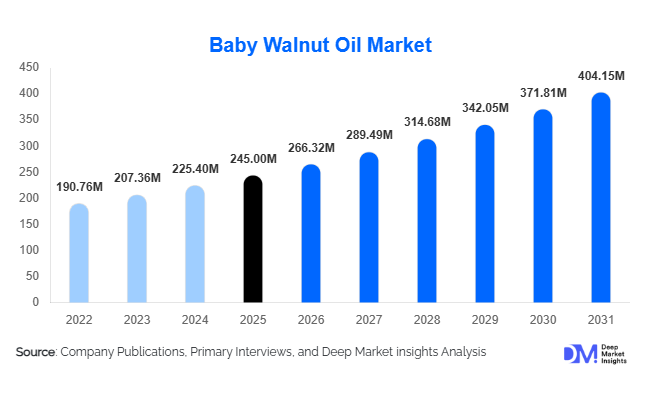
According to Deep Market Insights, the global baby walnut oil market size was valued at approximately USD 245 million in 2025 and is projected to grow from USD 266.32 million in 2026 to reach USD 404.15 million by 2031, expanding at a CAGR of 8.7% during the forecast period (2026–2031). The baby walnut oil market growth is primarily driven by increasing consumer preference for natural infant nutrition products, growing awareness regarding the developmental benefits of omega-3 fatty acids, and rising demand for organic and clean-label baby care products. As parents increasingly prioritize safe, plant-based, and minimally processed ingredients for infant health and wellness, baby walnut oil is gaining traction across complementary feeding, infant skincare, and pediatric wellness applications.
Key Market Insights
- Cold-pressed baby walnut oil dominates the market, accounting for over 60% of global revenue due to superior nutrient retention and consumer preference for minimally processed products.
- Infant nutrition applications represent the largest demand segment, supported by increasing awareness of cognitive development and healthy fat supplementation during early childhood.
- Asia-Pacific leads global consumption, driven by large infant populations, increasing household incomes, and growing adoption of premium baby care products in China and India.
- E-commerce has emerged as the leading distribution channel, enabling direct consumer access to specialized and premium baby walnut oil brands worldwide.
- Organic-certified products are witnessing the fastest growth, benefiting from increasing parental concerns regarding chemical additives, pesticides, and synthetic ingredients.
- Sustainable sourcing and traceability technologies are becoming critical competitive differentiators as consumers demand greater transparency in infant nutrition products.
Baby Walnut Oil Market Latest Trends
Rapid Adoption of Organic and Clean-Label Infant Products
The baby walnut oil industry is experiencing a significant shift toward organic-certified and clean-label formulations. Parents are increasingly scrutinizing product ingredients and selecting infant nutrition and skincare products that are free from synthetic preservatives, artificial fragrances, and chemical additives. Organic baby walnut oil products are benefiting from this trend, particularly in North America and Europe, where regulatory standards and consumer awareness regarding infant health are highly developed. Manufacturers are responding by investing in organic certifications, sustainable walnut sourcing programs, and transparent supply chains that allow consumers to trace products back to their agricultural origins. The trend is also creating opportunities for premium pricing, with organic products often commanding price premiums of 20–40% compared to conventional alternatives.
Expansion of Digital and Direct-to-Consumer Sales Channels
Digital commerce is transforming the baby walnut oil market by enabling specialty brands to reach global consumers without relying heavily on traditional retail networks. Direct-to-consumer (DTC) business models, subscription programs, and social media-driven marketing strategies are helping manufacturers build stronger relationships with parents. E-commerce platforms provide consumers with access to product reviews, ingredient information, pediatric recommendations, and educational content regarding infant nutrition. The convenience of online purchasing, combined with increasing trust in digital healthcare information, has accelerated market penetration across developed and emerging economies alike.
Baby Walnut Oil Market Drivers
Growing Awareness of Infant Brain Development and Nutrition
Scientific studies highlighting the importance of omega-3 fatty acids in infant cognitive development are significantly contributing to market growth. Walnut oil contains alpha-linolenic acid (ALA), a plant-based omega-3 fatty acid that supports neurological development during infancy. Pediatricians, nutritionists, and healthcare organizations increasingly emphasize the role of healthy fats in complementary feeding programs, encouraging greater adoption of baby walnut oil products. This trend is particularly pronounced among educated urban consumers seeking nutritional advantages during early childhood development.
Increasing Demand for Natural Baby Care Solutions
Consumers are increasingly replacing petroleum-based baby oils and synthetic skincare products with natural alternatives. Baby walnut oil is widely recognized for its moisturizing properties, antioxidant content, and skin barrier protection benefits. Demand is expanding across infant massage oils, baby moisturizers, and therapeutic skincare applications. The broader consumer movement toward plant-based wellness products continues to support long-term market expansion.
Rising Premiumization of Baby Care Products
Parents are allocating a growing portion of household spending toward premium infant care products. Premiumization trends are particularly strong in Asia-Pacific, where rising disposable incomes and expanding middle-class populations are encouraging purchases of imported and specialty baby products. Premium baby walnut oil products featuring organic certifications, cold-pressed extraction methods, and pediatric endorsements are experiencing robust growth across both developed and emerging markets.
Baby Walnut Oil Market Restraints
Tree Nut Allergy Concerns
One of the primary challenges facing the baby walnut oil market is consumer concern regarding nut-related allergies. Although many baby walnut oil products undergo processing designed to minimize allergenic risks, parents often remain cautious when introducing nut-derived ingredients into infant diets. Regulatory requirements for allergen labeling further increase compliance costs for manufacturers and can limit product adoption among risk-averse consumers.
Volatility in Walnut Supply and Production Costs
The production of premium baby walnut oil depends heavily on consistent access to high-quality walnut harvests. Climatic variability, drought conditions, agricultural input inflation, and fluctuating walnut yields can impact raw material availability and pricing. Additionally, cold-pressed extraction processes and organic certification requirements increase production costs, resulting in higher retail prices that may limit affordability in price-sensitive markets.
Baby Walnut Oil Industry Key Opportunities
Expansion into Premium Infant Nutrition Products
The growing global infant nutrition industry presents substantial opportunities for baby walnut oil manufacturers. Increasing demand for fortified infant cereals, complementary foods, pediatric nutritional supplements, and plant-based infant nutrition products is creating new avenues for market expansion. As healthcare professionals increasingly emphasize early-life nutritional interventions, manufacturers can leverage walnut oil's omega-3 profile to position products as functional nutrition solutions. Premium infant nutrition categories continue to grow faster than conventional baby food segments across Asia-Pacific, Europe, and North America.
Growth of Emerging Markets
Emerging economies such as China, India, Indonesia, Vietnam, Saudi Arabia, and the UAE are witnessing rapid growth in spending on infant healthcare and wellness products. Rising disposable incomes, urbanization, and increasing awareness regarding infant nutrition are creating attractive opportunities for both domestic and international brands. Local manufacturing partnerships, regional distribution networks, and digital commerce strategies can help companies penetrate these high-growth markets more effectively while reducing supply chain costs.
Innovation in Pediatric Wellness and Skincare Applications
Beyond infant nutrition, baby walnut oil is finding increasing applications in pediatric skincare, baby massage products, eczema management formulations, and therapeutic wellness products. Manufacturers are investing in specialized formulations designed to address infant skin sensitivity and barrier protection needs. These value-added applications create opportunities for product differentiation and higher-margin revenue streams within the broader baby care ecosystem.
Report Scope
| Report Metric | Details |
|---|---|
| Market Size in 2025 | USD 245.00 Million |
| Market Size in 2026 | USD 266.32 Million |
| Market Size in 2031 | USD 404.15 Million |
| CAGR | 8.7% (2026-2031) |
| Base Year for Estimation | 2025 |
| Historical Data | 2022-2024 |
| Forecast Period | 2026-2031 |
| Report Coverage | Revenue Forecast, Competitive Landscape, Supply Chain Disruption, Growth Factors, Environment & Regulatory Landscape and Trends |
| Geographies Covered | North America, Europe, APAC, Middle East and Africa, LATAM |
| Countries Covered | U.S., Canada, U.K., Germany, France, Spain, Italy, Russia, Nordic, Benelux, Rest of Europe, China, Korea, Japan, India, Australia, Singapore, Taiwan, South East Asia, Rest of Asia-Pacific, UAE, Turky, Saudi Arabia, South Africa, Egypt, Nigeria, Rest of MEA, Brazil, Mexico, Argentina, Chile, Colombia, Rest of LATAM |
Explore more data points, trends and opportunities Download Free Sample Report
Product Type Insights
The cold-pressed baby walnut oil segment dominates the global baby walnut oil market, accounting for approximately 61% of total revenue in 2025. Its market leadership is primarily driven by growing consumer preference for minimally processed infant nutrition products that preserve the natural nutritional profile of walnuts. Cold-pressed extraction methods help retain essential omega-3 fatty acids, antioxidants, vitamin E, and bioactive compounds that are increasingly associated with cognitive development, immune support, and overall infant health. Parents are becoming more attentive to ingredient quality and nutritional efficacy, positioning cold-pressed variants as the preferred choice among premium infant nutrition products. The segment also benefits from increasing pediatric recommendations for healthy fat intake during early childhood development and the growing influence of evidence-based nutrition purchasing decisions.Conventional baby walnut oil products continue to maintain a significant presence, particularly in developing economies and price-sensitive consumer segments where affordability remains a critical purchasing factor. These products benefit from broader availability and lower production costs, enabling manufacturers to target mass-market consumers. Meanwhile, blended formulations that combine walnut oil with other infant-safe oils such as almond, olive, or flaxseed oil are gaining market traction. These products offer enhanced nutritional profiles, diversified fatty acid compositions, and improved product functionality, creating opportunities for innovation and product differentiation within the market.
Application Insights
Infant nutrition and complementary feeding applications account for the largest share of the global baby walnut oil market, representing approximately 38% of total industry revenue in 2025. The segment’s leadership is driven by increasing awareness of the importance of essential fatty acids in infant brain development, visual function, and immune system support. As complementary feeding practices become more structured and nutrition-focused across both developed and emerging economies, parents are increasingly incorporating nutrient-rich oils into infant diets. The growing popularity of functional infant nutrition products and pediatric guidance supporting healthy fat consumption continues to strengthen demand within this segment.The skincare and moisturizing segment is experiencing robust expansion as parents increasingly seek plant-based and chemical-free solutions for infant skin care. Growing concerns regarding skin sensitivity, allergies, and exposure to synthetic ingredients have accelerated the adoption of natural oils in baby skincare routines. Furthermore, emerging therapeutic applications focused on infant dermatology, eczema management, skin barrier protection, and anti-inflammatory care are creating new growth opportunities for manufacturers seeking to diversify product portfolios and enter specialized healthcare-oriented segments.
Distribution Channel Insights
E-commerce has emerged as the leading distribution channel, accounting for approximately 31% of global market revenue in 2025. The segment's dominance is supported by the rapid digitalization of retail, increasing smartphone penetration, and the growing tendency of parents to research infant products extensively before purchase. Online platforms provide access to a wide range of domestic and international brands, detailed ingredient information, product reviews, educational content, and subscription-based purchasing options. The convenience of home delivery and the ability to compare product attributes have further strengthened online sales growth.Specialty baby stores and pharmacies continue to play a crucial role in market development, particularly for premium, organic, and pediatrician-recommended products. These channels benefit from higher levels of consumer trust, professional guidance, and product credibility, making them important points of purchase for first-time parents and health-conscious consumers. Supermarkets and hypermarkets maintain substantial market presence owing to their extensive geographic reach, product visibility, and convenience. Their ability to offer multiple product categories under one roof continues to support steady demand.Direct-to-consumer distribution channels are witnessing rapid expansion as manufacturers increasingly invest in digital marketing, brand-owned online stores, personalized customer engagement strategies, and subscription-based purchasing models. These channels allow companies to strengthen customer relationships, improve profit margins, gather consumer insights, and enhance long-term brand loyalty in an increasingly competitive marketplace.
End User Insights
Households and parents represent the largest end-user segment, accounting for approximately 82% of global demand in 2025. The segment’s dominance is driven by rising parental focus on infant nutrition, product safety, ingredient transparency, and preventive healthcare practices. Purchasing decisions are increasingly influenced by scientific evidence, pediatric recommendations, and product certifications, encouraging higher adoption of premium and natural infant wellness products. Growing awareness regarding the long-term health benefits associated with healthy dietary fats continues to reinforce demand among household consumers.Pediatric healthcare institutions and maternity centers are emerging as important secondary demand channels as healthcare professionals increasingly recommend natural nutritional supplements and wellness products to support infant development. The growing integration of nutrition-focused guidance into pediatric care programs is enhancing product acceptance within healthcare settings.Daycare centers, nurseries, and infant care facilities are also becoming increasingly important end users, particularly in urban regions where dual-income households and institutional childcare services are expanding. Rising investments in child wellness programs and improved childcare standards are contributing to growing product utilization across institutional settings. The broader shift toward preventive infant healthcare and early-life nutrition optimization continues to support demand across all end-user categories.
Age Group Insights
Infants aged 6–12 months account for the largest share of global demand, representing approximately 34% of total consumption in 2025. This segment benefits from the transition from exclusive milk feeding to complementary nutrition, a developmental stage during which parents actively seek nutrient-dense food ingredients that support cognitive growth, neurological development, and healthy weight gain. The introduction of diversified diets during this period significantly increases the use of baby walnut oil in infant meals and nutritional preparations.Demand remains strong among infants aged 12–24 months as parents continue to prioritize healthy dietary fats and natural nutritional products throughout key developmental milestones. This age group increasingly consumes a wider variety of foods, creating sustained opportunities for walnut oil incorporation into daily nutrition routines.The 3–6 month segment represents a comparatively smaller share of demand due to the prevalence of exclusive breastfeeding recommendations across many countries. However, increasing parental awareness of infant wellness products continues to create selective demand in certain care applications. Meanwhile, children aged 24–36 months continue to contribute meaningful demand through ongoing use of nutritional supplements, wellness products, and natural dietary ingredients aimed at supporting healthy growth and development.
Explore more data points, trends and opportunities Download Free Sample Report
Baby Walnut Oil Market Segmentations
By Product Type
- Cold-Pressed Baby Walnut Oil
- Refined Baby Walnut Oil
- Organic Certified Baby Walnut Oil
- Conventional Baby Walnut Oil
- Blended Baby Walnut Oil
By Application
- Infant Nutrition & Complementary Feeding
- Baby Massage Oil
- Baby Skin Care & Moisturizing Products
- Baby Hair Care Products
- Therapeutic & Pediatric Care Applications
By Age Group
- 3–6 Months
- 6–12 Months
- 12–24 Months
- 24–36 Months
By Packaging Size
- Up to 100 ml
- 101–250 ml
- 251–500 ml
- Above 500 ml
By Packaging Format
- Glass Bottles
- PET Bottles
- Pouches & Refill Packs
- Specialty Packaging
Regional Insights
Asia-Pacific
Asia-Pacific dominates the global baby walnut oil market, accounting for approximately 39% of total revenue in 2025. The region’s leadership is supported by its large infant population base, rising household incomes, rapid urbanization, expanding middle-class consumer segments, and increasing awareness regarding infant nutrition and wellness. Growing demand for premium baby food products, strong cultural acceptance of natural oils in infant care practices, and the expansion of organized retail and e-commerce platforms further strengthen market growth across the region.China represents the largest individual market globally, contributing nearly 16% of worldwide demand. Growth is supported by increasing premiumization of infant nutrition products, strong consumer preference for high-quality and imported baby care brands, rising expenditure on child health, and growing interest in functional nutrition solutions. India contributes approximately 9% of global demand and remains among the fastest-growing national markets due to rising disposable incomes, expanding urban populations, improving maternal and child healthcare awareness, and increasing adoption of packaged infant nutrition products. Japan, South Korea, and Australia maintain strong demand for premium, organic, and pediatric-approved baby care products, supported by high consumer purchasing power, advanced healthcare systems, and stringent quality standards.
North America
North America accounts for approximately 27% of global market revenue, led primarily by the United States, which contributes nearly 22% of worldwide demand. Regional growth is driven by high consumer spending on infant wellness products, strong awareness regarding early childhood nutrition, increasing demand for organic and clean-label products, and widespread acceptance of functional food ingredients. The growing influence of pediatric nutrition recommendations, rising preference for natural baby care formulations, and continuous product innovation by leading infant nutrition brands further support market expansion.Canada is also experiencing increasing demand for natural and organic infant care products, particularly among health-conscious parents seeking transparency, sustainability, and premium-quality nutritional solutions. The region additionally benefits from a highly developed retail infrastructure and strong penetration of e-commerce channels.
Europe
Europe represents approximately 24% of global market demand and remains one of the most mature markets for premium infant nutrition products. Regional growth is supported by strong consumer awareness regarding infant health, widespread adoption of organic foods, strict regulatory frameworks governing baby products, and increasing preference for sustainable and ethically sourced ingredients. Growing emphasis on preventive healthcare and nutritional quality continues to reinforce demand across European markets.Germany remains the largest regional market due to its strong organic food culture, high purchasing power, and rigorous infant product quality standards. France and the United Kingdom are major contributors, supported by rising demand for premium nutrition products, expanding organic baby food categories, and increasing consumer focus on ingredient transparency. Regulatory requirements emphasizing product safety, traceability, and quality assurance further strengthen consumer confidence and support market growth throughout the region.
Latin America
Latin America accounts for approximately 6% of global demand and represents an emerging growth market for baby walnut oil products. Regional expansion is driven by rising disposable incomes, improving access to healthcare information, increasing urbanization, and growing awareness regarding infant nutrition and developmental health. The gradual shift toward premium baby care products and the increasing availability of imported infant nutrition brands are contributing to market developmentBrazil serves as the largest market within the region, benefiting from its sizable population base and expanding middle-class consumer segment. Argentina and Chile are also contributing to regional growth through improving retail infrastructure, expanding e-commerce adoption, and increasing consumer interest in natural and wellness-oriented infant products. Continued investments in child healthcare and nutrition education programs are expected to support long-term market expansion.
Middle East & Africa
The Middle East & Africa region represents approximately 4% of global market revenue and is gradually emerging as a promising market for premium infant nutrition products. Growth is supported by rising birth rates in several countries, increasing urbanization, improving healthcare access, and growing consumer awareness regarding infant wellness and nutrition. Expanding retail networks and increasing penetration of international baby care brands are also contributing to market development.The United Arab Emirates and Saudi Arabia are the leading markets within the region, benefiting from high-income consumer bases, strong demand for imported premium products, and growing preference for organic and natural infant care solutions. South Africa remains the largest market within Sub-Saharan Africa, supported by expanding urban populations, improving retail accessibility, and rising awareness regarding child health and nutritional development. Government initiatives focused on maternal and infant healthcare improvement are expected to create additional growth opportunities across the region over the forecast period.