Vegan Tuna Market Size
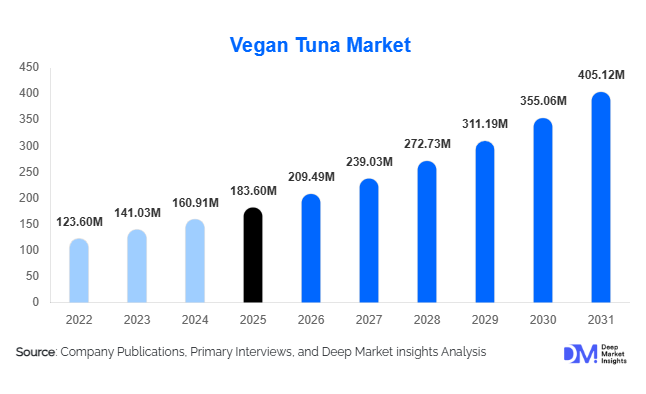
According to Deep Market Insights, the global Vegan Tuna market size was valued at USD 183.6 million in 2025 and is projected to grow from USD 209.49 million in 2026 to reach USD 405.12 million by 2031, expanding at a CAGR of 14.1% during the forecast period (2026– 2031). The Vegan Tuna market growth is primarily driven by increasing consumer preference for sustainable seafood alternatives, rising adoption of plant-based diets, advancements in protein extraction technologies, and growing demand for environmentally responsible food products. This report analyzes Vegan Tuna market segmentation by type, application, regional performance, competitive landscape, and industry expansion patterns.
Key Market Insights
- North America dominates the Vegan Tuna market, accounting for approximately 38.5% market share in 2025, supported by high consumer awareness, strong retail penetration, and advanced plant-based food adoption.
- Asia-Pacific is the fastest-growing Vegan Tuna market region, projected to expand at a CAGR of 17.2% between 2026 and 20311due to rising urbanization, disposable income growth, and increasing vegan consumer groups.
- Pea protein-based Vegan Tuna dominates the type segment, capturing nearly 42% share in 2025 due to superior texture, high protein content, and technological improvements in extrusion processing.
- Retail food products lead application demand, accounting for approximately 48.6% share in 2025, driven by supermarket availability, online grocery expansion, and consumer convenience preferences.
- The U.S. Vegan Tuna market is projected to reach USD 142.5 million by 2031, expanding at a CAGR of 13.8% due to strong demand for plant-based seafood substitutes.
- Technology-driven innovation, including high-moisture extrusion, algae-based ingredients, and improved flavor systems, is reshaping product development and consumer acceptance.
Vegan Tuna Market Latest Trends
Clean Label and Protein Innovation Transforming Product Development
The Vegan Tuna market is experiencing rapid innovation through clean-label formulations, alternative protein technologies, and improved seafood texture replication. Global production exceeded 50 million product units in 2025, with approximately 62% of new product launches emphasizing non-GMO, allergen-conscious, and minimally processed ingredients. Manufacturers are increasingly adopting pea protein, soy protein, and algae-derived ingredients to improve nutritional profiles and sensory performance. High-moisture extrusion technology adoption increased by nearly 28%, enabling manufacturers to achieve fibrous tuna-like textures with protein content ranging from 15–25 grams per serving. Premium Vegan Tuna products are gaining traction across retail and foodservice channels as consumers prioritize sustainable protein sources and healthier seafood alternatives.
Expansion of Foodservice Applications and Sustainable Seafood Demand
Foodservice adoption is becoming a significant Vegan Tuna market trend, with restaurants, cafes, and institutional kitchens increasing usage of plant-based seafood alternatives. The foodservice segment represented approximately 31% of total market demand in 2025, supported by more than 15 million Vegan Tuna servings globally. Around 45% of consumers aged 18–35 expressed interest in reducing conventional seafood consumption, accelerating demand for sustainable tuna alternatives. Restaurants are incorporating Vegan Tuna into sushi, sandwiches, salads, and ready-to-eat meals, while manufacturers are investing in shelf-stable and frozen formats. This shift toward sustainable seafood consumption continues strengthening Vegan Tuna market growth.
Vegan Tuna Market Drivers
Rising Consumer Preference for Sustainable Seafood Alternatives
The increasing global focus on environmental sustainability is a major driver of the Vegan Tuna market. Approximately 54% of consumers show interest in sustainable seafood substitutes, encouraging food companies to expand plant-based seafood portfolios. Global plant-based seafood production increased by nearly 25% between 2022 and 2025, reaching more than 50 million units annually. Consumers are increasingly attracted to Vegan Tuna due to lower environmental impact, cholesterol-free formulations, and ethical food preferences. Retail availability expanded by approximately 30%, improving accessibility across supermarkets and online grocery platforms. These sustainability-driven purchasing patterns continue accelerating Vegan Tuna market expansion.
Growing Adoption of Plant-Based Diets and Alternative Proteins
The rising adoption of vegan, vegetarian, and flexitarian lifestyles is significantly supporting Vegan Tuna market development. More than 11–14% of consumers in developed economies regularly incorporate plant-based seafood alternatives into their diets. Advances in pea protein, soy protein, and functional ingredient technologies have improved nutritional value and product quality. Manufacturers are investing millions of dollars into research and development to create seafood alternatives with better taste, texture, and protein performance. The expansion of plant-based food categories across supermarkets, restaurants, and meal delivery services is strengthening demand for Vegan Tuna products globally.
Vegan Tuna Market Restraints
High Manufacturing Costs and Premium Product Pricing
The Vegan Tuna market faces limitations due to higher production costs compared with conventional seafood products. Plant-based tuna alternatives are generally priced 20–45% higher than traditional tuna due to specialty ingredients, advanced processing systems, and limited economies of scale. Raw materials account for approximately 38% of manufacturing expenses, while processing technologies contribute around 25%. Price sensitivity remains a challenge in emerging economies where adoption penetration remains below 8%. Limited consumer willingness to pay premium prices restricts broader market expansion, particularly among cost-sensitive customer groups.
Consumer Acceptance and Sensory Performance Challenges
Consumer perception regarding taste, texture, and authenticity remains a significant restraint for the Vegan Tuna market. Approximately 35% of first-time buyers identify texture and flavor differences as major concerns compared with conventional tuna products. Developing realistic seafood characteristics requires advanced formulation techniques and investment exceeding USD 1 million per product development cycle for some manufacturers. Around 20% of consumers remain uncertain about plant-based seafood alternatives, limiting faster adoption. Continuous improvement in flavor systems, texture engineering, and nutritional optimization remains essential for increasing Vegan Tuna market penetration.
Vegan Tuna Market Opportunities
Innovation in Functional Ingredients and Emerging Economies
The Vegan Tuna market presents significant opportunities through ingredient innovation and expansion into emerging markets. Asia-Pacific is expected to register the highest growth rate with a 17.2% CAGR from 2026 to 2031, supported by rising disposable income and increasing awareness of sustainable foods. Companies developing algae proteins, fortified formulations, and improved amino acid profiles are positioned to capture growing demand. Online grocery channels represented approximately 18% of Vegan Tuna sales in 2025 and are projected to exceed 30% by 2031, creating additional distribution opportunities.
Expansion of Ready-to-Eat and Convenience Food Categories
The increasing demand for convenient and healthy meal solutions creates new opportunities for Vegan Tuna manufacturers. Ready-to-eat meals accounted for approximately 20.4% market share in 2025, supported by consumer preference for quick preparation and nutritional convenience. Manufacturers are introducing Vegan Tuna-based wraps, bowls, salads, and frozen meals targeting urban consumers. Approximately 10 million ready-meal units containing vegan tuna ingredients were produced in 2025, demonstrating strong category potential. Integration with convenience food markets is expected to accelerate Vegan Tuna market growth through 2031.
Vegan Tuna Market Segmentation
The Vegan Tuna market segmentation is categorized by type and application. Pea protein-based products dominated with approximately 42% market share in 2025, followed by soy-based products at 36%. By application, retail food products represented the largest segment with 48.6% share, supported by increasing supermarket availability, online purchasing, and consumer demand for convenient plant-based seafood alternatives.
Report Scope
| Report Metric | Details |
|---|---|
| Market Size in 2025 | USD 183.60 Million |
| Market Size in 2026 | USD 209.49 Million |
| Market Size in 2031 | USD 405.12 Million |
| CAGR | 14.1% (2026-2031) |
| Base Year for Estimation | 2025 |
| Historical Data | 2022-2024 |
| Forecast Period | 2026-2031 |
| Report Coverage | Revenue Forecast, Competitive Landscape, Supply Chain Disruption, Growth Factors, Environment & Regulatory Landscape and Trends |
| Geographies Covered | North America, Europe, APAC, Middle East and Africa, LATAM |
| Countries Covered | U.S., Canada, U.K., Germany, France, Spain, Italy, Russia, Nordic, Benelux, Rest of Europe, China, Korea, Japan, India, Australia, Singapore, Taiwan, South East Asia, Rest of Asia-Pacific, UAE, Turky, Saudi Arabia, South Africa, Egypt, Nigeria, Rest of MEA, Brazil, Mexico, Argentina, Chile, Colombia, Rest of LATAM |
Explore more data points, trends and opportunities Download Free Sample Report
Product Type Insights
Pea Protein-Based Vegan Tuna
Pea protein-based Vegan Tuna emerged as the leading product segment, accounting for approximately 42% of the global Vegan Tuna market share in 2025, with worldwide production reaching nearly 20 million units. The segment has gained widespread acceptance owing to its superior nutritional profile, neutral flavor, excellent digestibility, and ability to closely replicate the flaky texture and mouthfeel of conventional tuna through advanced high-moisture extrusion technology. Most products provide approximately 18–24 grams of plant-based protein per serving while remaining free from common allergens such as soy and gluten, making them suitable for a broader consumer base. Nearly 65% of premium vegan seafood product launches introduced during 2025 incorporated pea protein as the primary ingredient, reflecting growing manufacturer preference for this versatile protein source. North America and Europe together accounted for nearly 75% of global pea protein-based Vegan Tuna consumption, supported by high consumer awareness, expanding vegan populations, and strong retail penetration. The primary driver behind the dominance of this segment is the increasing consumer preference for allergen-friendly, high-protein, clean-label seafood alternatives that closely mimic the texture, taste, and nutritional value of conventional tuna while aligning with sustainability goals. Continuous innovation in ingredient processing, flavor enhancement technologies, and product formulations is expected to further strengthen the market position of pea protein-based Vegan Tuna throughout the forecast period.
Soy-Based Vegan Tuna
Soy-based Vegan Tuna accounted for approximately 36% of the global market share in 2025, with worldwide production reaching nearly 17 million units. These products primarily utilize textured soy protein technology to recreate the fibrous texture and flaking characteristics of traditional tuna while delivering approximately 15–25 grams of protein per serving. Soy continues to remain one of the most commercially viable plant proteins due to its affordability, complete amino acid profile, widespread availability, and well-established processing technologies. Asia-Pacific manufacturers contributed nearly 45% of global soy-based Vegan Tuna production, benefiting from mature soybean cultivation, integrated processing infrastructure, and competitive manufacturing costs. The segment maintains strong demand across retail supermarkets, foodservice establishments, and private-label product lines, particularly in price-sensitive markets where cost efficiency plays a significant role in purchasing decisions. Continuous improvements in flavor masking, texture optimization, and non-GMO soy formulations are further enhancing consumer acceptance. The combination of scalable production capabilities, reliable raw material availability, and competitive pricing continues to support the sustained growth of soy-based Vegan Tuna worldwide.
Jackfruit-Based Vegan Tuna
Jackfruit-based Vegan Tuna captured approximately 14% of the global market share in 2025, with production exceeding 6 million units worldwide. Unlike protein-focused alternatives, these products rely on naturally fibrous jackfruit pulp to imitate the texture of shredded tuna while providing approximately 3–6 grams of protein per serving. The segment is witnessing increasing popularity among clean-label consumers seeking minimally processed, whole-food ingredients with recognizable labels and natural origins. Annual demand growth has exceeded 15%, supported by rising interest in organic, preservative-free, and sustainable food products. Jackfruit-based Vegan Tuna products are primarily distributed through organic retailers, specialty grocery stores, health food chains, and premium vegan food outlets where consumers demonstrate a greater willingness to pay for natural ingredient formulations. Manufacturers are increasingly combining jackfruit with legumes and plant proteins to improve nutritional value while maintaining authentic texture and taste. Growing awareness of tropical fruit-based meat alternatives and increasing product innovation are expected to further expand the market opportunities for this segment during the forecast period.
Application Insights
Retail food products remained the largest application segment in the global Vegan Tuna market, accounting for approximately 48.6% of total market share in 2025. Supermarkets, hypermarkets, convenience stores, specialty vegan retailers, and rapidly expanding online grocery platforms collectively distributed more than 25 million Vegan Tuna packs globally. The retail segment continues to benefit from expanding shelf space dedicated to plant-based foods, increasing product availability across mainstream grocery chains, rising consumer awareness regarding sustainable seafood alternatives, and frequent product launches featuring improved flavors and nutritional profiles. Foodservice represented the second-largest application, contributing nearly 31% of the market as restaurants, cafés, quick-service chains, hotels, and institutional kitchens increasingly incorporated Vegan Tuna into sushi, sandwiches, wraps, salads, pizzas, poke bowls, and gourmet seafood-inspired dishes to meet evolving consumer preferences. Growing demand for flexitarian menu options and sustainable dining experiences has encouraged foodservice operators to broaden their plant-based offerings. Ready-to-eat meals accounted for approximately 20.4% of the market, supported by the increasing popularity of convenient, high-protein, and nutritionally balanced meal solutions among busy urban consumers. Continuous innovation in frozen meals, meal kits, microwave-ready products, and on-the-go packaged foods is further expanding the application scope of Vegan Tuna across global food industries.
Explore more data points, trends and opportunities Download Free Sample Report
Vegan Tuna Market Segmentations
By Type
- Soy-Based Vegan Tuna
- Pea Protein-Based Vegan Tuna
- Jackfruit-Based Vegan Tuna
By Application
- Retail Food Products
- Foodservice
- Ready-to-Eat Meals
Regional Insights
North America
North America dominated the global Vegan Tuna market by accounting for approximately 38.5% of total revenue in 2025, generating nearly USD 70.7 million. The United States contributed more than 80% of regional demand, supported by a mature plant-based food industry, high consumer awareness, strong purchasing power, and one of the world's most developed retail distribution networks. Regional production exceeded 20 million units annually, with retail accounting for approximately 50% of total consumption, followed by foodservice at 32% and ready-to-eat meals at 18%. The presence of leading plant-based food manufacturers, extensive investments in alternative seafood innovation, and growing collaborations between retailers and food technology companies continue to strengthen market expansion. Rising concerns regarding overfishing, marine ecosystem preservation, mercury contamination in conventional seafood, and greenhouse gas emissions are encouraging consumers to shift toward sustainable seafood alternatives. The primary driver supporting regional market growth is the increasing adoption of plant-based diets combined with continuous product innovation, widespread retail availability, significant investments in food technology, and growing consumer preference for environmentally sustainable protein sources.
Europe
Europe accounted for approximately 31.2% of the global Vegan Tuna market in 2025, supported by robust demand across Germany, the United Kingdom, France, the Netherlands, and several Nordic countries. Regional production reached approximately 16 million units, with Germany contributing nearly 25% of overall European demand owing to its well-established vegan consumer base and advanced food manufacturing capabilities. The region continues to benefit from expanding supermarket assortments, strong private-label development, and increasing availability of premium plant-based seafood products. Consumer preference for ethical food choices, environmentally responsible purchasing decisions, and healthier dietary habits has accelerated market penetration across both retail and foodservice sectors. Government initiatives promoting sustainable food systems, favorable regulatory support for alternative proteins, and corporate sustainability commitments are further encouraging product innovation and investment. The leading driver for regional growth is the combination of strong environmental regulations, rising vegan and flexitarian populations, supportive sustainability policies, and increasing consumer demand for low-carbon, cruelty-free seafood alternatives.
Asia-Pacific
Asia-Pacific represented approximately 21% of the global Vegan Tuna market in 2025 and is projected to register the fastest growth throughout the forecast period, expanding at a CAGR of approximately 17.2%. Regional production exceeded 10 million units, supported by abundant soybean availability, competitive manufacturing capabilities, rapid urbanization, and expanding plant-based food industries. China accounted for approximately 35% of regional demand, while Japan and Australia remained important premium markets driven by innovation and higher consumer spending on alternative protein products. Increasing health consciousness, rising disposable incomes, expanding e-commerce grocery platforms, and greater exposure to global food trends are accelerating the adoption of plant-based seafood products across major metropolitan areas. The region also serves as a significant manufacturing hub for export-oriented Vegan Tuna production due to cost-efficient processing infrastructure and established agricultural supply chains. The primary driver of regional growth is the rapid expansion of plant-based food consumption fueled by urbanization, growing middle-class populations, increasing investments in alternative protein manufacturing, abundant raw material availability, and rising awareness regarding sustainable and healthier dietary choices.
Key Players in the Vegan Tuna Market
- Good Catch Foods
- The Vegetarian Butcher
- Impossible Foods
- Beyond Meat
- OmniFoods
- Nestlé
- Conagra Brands
- Kraft Heinz
- Thai Union Group
- Gathered Foods
- Atlantic Natural Foods
- New Wave Foods