Striped Bass Market Size
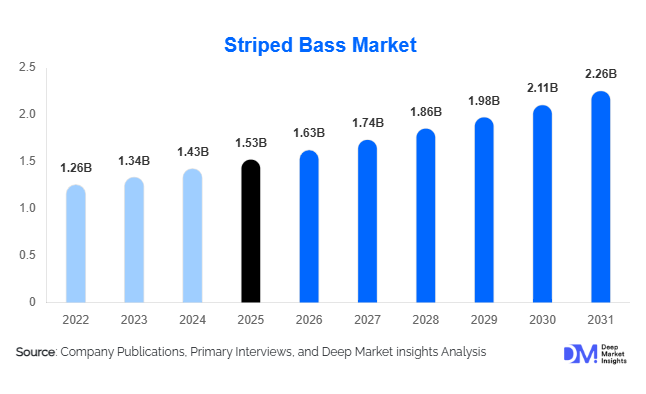
According to Deep Market Insights, the global striped bass market size was valued at USD 1.53 billion in 2025 and is projected to grow from USD 1.63 billion in 2026 to reach USD 2.25 billion by 2031, expanding at a CAGR of 6.7% during the forecast period (2026–2031). The striped bass market growth is primarily driven by increasing global demand for premium seafood proteins, expansion of commercial aquaculture operations, rising consumer preference for sustainable seafood products, and growing adoption of striped bass across foodservice and retail channels. The market continues to benefit from technological advancements in aquaculture production, improved cold-chain logistics, and rising consumption of high-protein, low-fat fish products among health-conscious consumers worldwide.
Key Market Insights
- Farm-raised striped bass accounts for more than 60% of global market revenue, supported by increasing adoption of sustainable aquaculture practices and year-round production capabilities.
- Fresh filleted striped bass remains the leading product category, contributing approximately 38% of global market value due to strong demand from retail seafood counters and premium restaurants.
- North America dominates the global striped bass market, accounting for nearly 56% of worldwide demand, led by the United States.
- Asia-Pacific is the fastest-growing regional market, driven by rising seafood consumption, urbanization, and increasing imports of premium fish species.
- Recirculating Aquaculture Systems (RAS) are transforming commercial production, enabling higher yields, enhanced sustainability, and improved biosecurity.
- Premium seafood retail and online seafood platforms are gaining market share, driven by changing consumer purchasing behavior and demand for traceable seafood products.
Striped Bass Market Latest Trends
Rapid Expansion of Sustainable Aquaculture Production
Sustainable aquaculture continues to reshape the striped bass industry globally. Commercial producers are increasingly investing in advanced farming systems, including recirculating aquaculture systems (RAS), cage farming technologies, automated feeding systems, and water treatment solutions. These technologies enable producers to improve feed conversion efficiency, reduce environmental impacts, and ensure consistent year-round supply. Growing consumer concerns regarding overfishing and marine ecosystem preservation are encouraging retailers and foodservice operators to source certified sustainable farm-raised striped bass. Sustainability certifications, traceability systems, and environmentally responsible production methods are becoming important competitive differentiators. As regulatory restrictions on wild-caught fisheries continue to tighten across several regions, aquaculture-based production is expected to account for an increasing share of global supply.
Growing Demand for Premium and Value-Added Seafood Products
Consumer preferences are increasingly shifting toward convenient, premium-quality seafood offerings. Fresh fillets, portion-controlled products, smoked striped bass, marinated products, and ready-to-cook meal solutions are experiencing strong growth across developed markets. Retailers are expanding premium seafood assortments to cater to health-conscious consumers seeking nutritious alternatives to red meat and processed proteins. Foodservice operators are also incorporating striped bass into premium menu offerings due to its versatility, mild flavor profile, and culinary appeal. The emergence of online seafood retailing and direct-to-consumer delivery platforms is further accelerating demand for high-value striped bass products, particularly in North America, Europe, and Asia-Pacific.
Striped Bass Market Drivers
Rising Consumer Demand for Healthy Protein Sources
The growing global focus on healthy eating habits is significantly supporting striped bass consumption. Consumers are increasingly replacing traditional red meat products with lean seafood proteins that offer nutritional benefits such as high protein content, omega fatty acids, vitamins, and minerals. Striped bass is particularly attractive because of its low-fat profile and premium taste characteristics. Rising awareness of cardiovascular health, weight management, and balanced diets is further encouraging seafood consumption across both developed and emerging markets. As consumers continue prioritizing wellness-oriented food choices, striped bass demand is expected to remain strong across retail and foodservice channels.
Expansion of Commercial Aquaculture Infrastructure
Advancements in aquaculture technology have significantly improved striped bass production economics. Improved breeding programs, disease management practices, feed optimization technologies, and water quality monitoring systems have enabled producers to increase yields while maintaining product quality. Large-scale commercial farms are investing heavily in modern aquaculture facilities capable of supplying growing domestic and export demand. Governments across North America, China, and several European countries are also supporting aquaculture investments to strengthen food security and reduce pressure on wild fisheries. These developments continue to expand the supply base and support market growth.
Striped Bass Market Restraints
High Production and Feed Costs
Feed expenses remain one of the largest cost components within striped bass aquaculture operations, accounting for approximately 40–60% of total production costs. Volatility in fishmeal, soybean meal, and alternative protein ingredient prices can significantly impact producer profitability. Energy-intensive production systems such as recirculating aquaculture facilities further increase operating expenses. Rising labor costs and stringent environmental compliance requirements also add to production costs, creating challenges for smaller market participants.
Fishery Regulations and Supply Constraints
Government regulations aimed at protecting wild striped bass populations continue to influence market dynamics. Commercial harvesting restrictions, catch quotas, seasonal closures, and sustainability requirements can constrain supply availability in key producing regions. While these measures support long-term resource sustainability, they may create short-term supply limitations and contribute to price volatility. Producers must continually adapt to evolving regulatory frameworks and conservation requirements to maintain market access.
Striped Bass Market Industry Key Opportunities
Expansion of Land-Based RAS Aquaculture Facilities
Recirculating aquaculture systems represent one of the most attractive growth opportunities within the striped bass market. These facilities offer greater control over production conditions, lower environmental impact, improved biosecurity, and the ability to operate near major consumption centers. Investors are increasingly attracted to RAS projects due to rising retailer demand for locally sourced, sustainable seafood products. As technological advancements improve operational efficiency, land-based aquaculture is expected to capture a larger share of future production capacity.
Export Market Growth Across Asia and the Middle East
Rising disposable incomes and increasing seafood consumption are creating significant export opportunities for striped bass suppliers. Markets such as China, Japan, South Korea, Singapore, the UAE, and Saudi Arabia are witnessing strong growth in premium seafood imports. Expanding cold-chain infrastructure, favorable trade agreements, and increasing demand from hospitality and foodservice sectors are further supporting export market development. Producers capable of meeting stringent quality and traceability standards are well positioned to capitalize on these emerging opportunities.
Report Scope
| Report Metric | Details |
|---|---|
| Market Size in 2025 | USD 1.53 Billion |
| Market Size in 2026 | USD 1.63 Billion |
| Market Size in 2031 | USD 2.26 Billion |
| CAGR | 6.7% (2026-2031) |
| Base Year for Estimation | 2025 |
| Historical Data | 2022-2024 |
| Forecast Period | 2026-2031 |
| Report Coverage | Revenue Forecast, Competitive Landscape, Supply Chain Disruption, Growth Factors, Environment & Regulatory Landscape and Trends |
| Geographies Covered | North America, Europe, APAC, Middle East and Africa, LATAM |
| Countries Covered | U.S., Canada, U.K., Germany, France, Spain, Italy, Russia, Nordic, Benelux, Rest of Europe, China, Korea, Japan, India, Australia, Singapore, Taiwan, South East Asia, Rest of Asia-Pacific, UAE, Turky, Saudi Arabia, South Africa, Egypt, Nigeria, Rest of MEA, Brazil, Mexico, Argentina, Chile, Colombia, Rest of LATAM |
Explore more data points, trends and opportunities Download Free Sample Report
Product Form Insights
Fresh filleted striped bass emerged as the leading product form segment in the global striped bass market, accounting for approximately 38% of total revenue in 2025. The segment's dominance is primarily driven by increasing consumer preference for convenient, ready-to-cook seafood products that require minimal preparation while maintaining premium quality and nutritional value. Growing urbanization, busy lifestyles, and rising demand for healthy protein sources have encouraged consumers to choose filleted fish products that offer ease of handling and consistent portion sizes. In addition, foodservice operators and premium retailers favor fresh fillets due to their versatility in menu applications, attractive presentation, and ability to meet evolving consumer expectations for fresh and high-quality seafood.Frozen striped bass products are witnessing steady growth as advancements in cold-chain logistics, freezing technologies, and international seafood trade improve product accessibility across distant markets. The segment benefits from its extended shelf life, reduced spoilage risks, and suitability for institutional buyers, restaurants, and large-scale foodservice operators seeking inventory flexibility and supply consistency. Increasing global seafood trade and expanding retail freezer sections are further supporting segment expansion.Value-added product categories, including smoked, marinated, seasoned, and ready-to-cook striped bass products, are among the fastest-growing segments within the market. Growth is being fueled by rising consumer interest in premium convenience foods, innovative seafood offerings, and products that combine superior taste, nutrition, and ease of preparation. Manufacturers are increasingly introducing differentiated products to capture higher margins and cater to evolving consumer preferences for gourmet seafood experiences.
Source Insights
Farm-raised striped bass represents the largest source segment, contributing approximately 61% of global market revenue in 2025. The segment's leadership is primarily supported by the increasing adoption of aquaculture practices that ensure reliable year-round supply, consistent product quality, traceability, and production scalability. As demand for seafood continues to rise globally, aquaculture producers are investing in advanced farming systems, recirculating aquaculture technologies, disease management solutions, and sustainable feed innovations to improve productivity and meet stringent retailer and regulatory requirements. Growing emphasis on food security and sustainable seafood production further strengthens the long-term outlook for farm-raised striped bass.
Wild-caught striped bass continues to serve an important premium market niche, particularly among consumers who associate wild fisheries with authenticity, natural sourcing, and superior taste characteristics. Demand remains relatively strong within upscale restaurants, specialty seafood retailers, and premium hospitality channels where product differentiation is highly valued. However, increasingly stringent fishing quotas, conservation regulations, environmental concerns, and stock management measures are expected to constrain future supply growth. As a result, the market is expected to witness a gradual shift toward greater dependence on aquaculture production to satisfy expanding global demand.
Distribution Channel Insights
Supermarkets and hypermarkets account for approximately 31% of global striped bass sales, making them the leading distribution channel in 2025. The segment's dominance is largely driven by extensive product availability, strong consumer footfall, competitive pricing strategies, and growing investment in fresh seafood departments. Large retail chains continue to expand premium seafood assortments and enhance cold-chain infrastructure to meet rising consumer demand for fresh, healthy, and sustainably sourced fish products. Increasing consumer preference for one-stop shopping experiences further supports the growth of this distribution channel.Online seafood platforms are emerging as one of the fastest-growing distribution channels, supported by the rapid expansion of e-commerce grocery purchasing, direct-to-consumer delivery services, and digital retail ecosystems. Consumers increasingly value the convenience of home delivery, access to premium seafood products, and transparent sourcing information provided through online platforms. Improvements in refrigerated logistics and last-mile delivery capabilities are further accelerating online seafood sales globally.Specialty seafood retailers continue to maintain strong market positions, particularly within premium and high-quality product categories. These outlets differentiate themselves through expert customer service, superior product selection, customized seafood preparation, and specialized sourcing programs that appeal to discerning consumers seeking premium seafood experiences.
End-Use Insights
Restaurants represent the largest end-use segment, accounting for approximately 34% of global striped bass demand in 2025. The segment's leadership is primarily driven by the fish's versatility, premium market positioning, and widespread use across diverse culinary applications. Premium seafood restaurants, fine dining establishments, sushi chains, coastal hospitality venues, and upscale foodservice operators increasingly feature striped bass on menus due to its desirable texture, mild flavor profile, and broad consumer appeal. Rising global dining-out expenditure and continued expansion of premium foodservice establishments further support segment growth.Household consumption continues to expand steadily as consumers increasingly incorporate seafood into balanced diets focused on health, wellness, and high-quality protein intake. Growing awareness regarding the nutritional benefits of fish consumption, including omega-3 fatty acids and lean protein content, is encouraging greater retail demand for striped bass products across developed and emerging markets.The seafood processing industry is also emerging as an increasingly important end-use category. Processors utilize striped bass in the production of smoked fish, frozen portions, marinated products, ready-to-eat meals, and other value-added seafood offerings designed to address growing consumer demand for convenience-oriented food products.
Explore more data points, trends and opportunities Download Free Sample Report
Striped Bass Market Segmentations
By Product Form
- Fresh Whole Striped Bass
- Fresh Filleted Striped Bass
- Fresh Steaks & Portions
- Frozen Whole Striped Bass
- Frozen Fillets
- Frozen Value-Added Portions
- Smoked Striped Bass
- Marinated/Ready-to-Cook Striped Bass
- Canned & Processed Striped Bass
By Source
- Wild-Caught Striped Bass
- Farm-Raised Striped Bass
By Aquaculture Production System
- Pond Aquaculture
- Cage & Net-Pen Aquaculture
- Recirculating Aquaculture Systems
- Flow-Through Systems
By Species Category
- Atlantic Striped Bass
- Hybrid Striped Bass
- Other Commercial Striped Bass Varieties
By Preservation Type
- Live Fish
- Chilled Fresh
- Frozen
- Processed & Shelf-Stable
Regional Insights
North America
North America remains the largest regional striped bass market, accounting for approximately 56% of global consumption in 2025. The United States alone represents nearly 47% of worldwide demand, supported by strong seafood consumption patterns, a well-established aquaculture industry, and a highly developed foodservice sector. The region benefits from advanced cold-chain infrastructure, extensive retail distribution networks, and increasing consumer preference for high-protein and nutrient-rich seafood products. Growing health consciousness, rising demand for sustainably sourced seafood, and continuous expansion of premium seafood offerings across retail and restaurant channels are key factors supporting market growth.Commercial aquaculture expansion continues to strengthen domestic supply capabilities, while investments in sustainable farming technologies improve production efficiency and environmental performance. Canada contributes to regional growth through aquaculture investments, expanding seafood imports, and growing consumer interest in premium fish products. Mexico is emerging as a developing market supported by tourism industry expansion, rising disposable incomes, increasing seafood consumption, and growing demand from hotels, restaurants, and hospitality establishments serving both domestic and international visitors.
Europe
Europe accounts for approximately 18% of global market revenue and remains a significant consumer of premium seafood products. Major markets including the United Kingdom, Germany, France, Italy, and Spain demonstrate strong demand across retail seafood, hospitality, and foodservice sectors. The region's mature seafood culture and high consumer awareness regarding nutrition continue to support striped bass consumption.Key regional growth drivers include increasing consumer preference for sustainably sourced seafood, rising demand for traceable and certified fish products, and growing emphasis on environmental responsibility throughout the seafood value chain. Stringent food safety standards and sustainability regulations encourage retailers and suppliers to invest in transparent sourcing practices, enhancing consumer confidence. Furthermore, the expansion of premium retail seafood offerings, growth in seafood-focused dining experiences, and rising popularity of Mediterranean-style diets are expected to support long-term market development across Europe.
Asia-Pacific
Asia-Pacific represents approximately 16% of global demand and is projected to record the fastest growth rate during the forecast period. Rapid economic development, rising disposable incomes, urbanization, and changing dietary preferences are significantly increasing seafood consumption across the region. Consumers are increasingly shifting toward premium protein products as living standards improve and health awareness strengthens.China remains the primary growth engine within the region, driven by expanding middle-class populations, increasing seafood imports, growth in modern retail channels, and rising demand for premium seafood products. Japan and South Korea continue to represent important markets due to their established seafood consumption culture and strong preference for high-quality fish products. Australia demonstrates stable demand through both retail and foodservice channels, supported by growing consumer interest in healthy diets. India is emerging as a promising long-term growth market owing to rapid urbanization, increasing disposable incomes, expanding organized retail, rising seafood awareness, and substantial investments in hospitality and foodservice infrastructure. The growth of e-commerce seafood platforms across the region is further enhancing product accessibility and market penetration.
Latin America
Latin America accounts for approximately 5% of global market value and continues to present attractive growth opportunities. Brazil and Chile represent the region's largest markets, benefiting from expanding middle-class populations, increasing seafood consumption, and growing awareness of the health benefits associated with fish-based diets.Regional growth is being driven by improving retail infrastructure, rising urbanization, and increasing consumer expenditure on premium food products. Chile's highly developed seafood industry, advanced export capabilities, and efficient cold-chain infrastructure create favorable conditions for premium seafood distribution and market expansion. Additionally, the growth of tourism activities, restaurant sector development, and increasing demand for nutritious protein alternatives are contributing to greater striped bass consumption throughout the region.
Middle East & Africa
The Middle East and Africa collectively account for approximately 5% of global striped bass demand. Although currently representing a smaller share of the global market, the region is expected to experience steady growth due to rising incomes, rapid urban development, and increasing consumer interest in premium seafood products.The United Arab Emirates and Saudi Arabia serve as the primary growth markets, supported by strong purchasing power, expanding luxury hospitality sectors, and increasing demand for premium imported seafood. Ongoing investments in tourism infrastructure, international hotel developments, fine dining establishments, and high-end retail formats continue to create favorable demand conditions. Consumers across Gulf Cooperation Council countries are increasingly seeking premium and healthy protein options, further supporting market expansion.Within Africa, South Africa remains a key market due to its relatively developed seafood industry, modern retail sector, and growing consumer preference for premium seafood products. Rising urbanization, improving cold-chain capabilities, expanding modern food retail networks, and increasing awareness of seafood's nutritional benefits are expected to contribute to future market growth across the broader Middle East and Africa region.
Key Players in the Striped Bass Market
- Kent SeaTech Corporation
- Pacifico Aquaculture
- Stavis Seafoods
- Amacore B.V.
- The Town Dock
- Euclid Fish Company
- A&H Seafood Market Partners
- Ocean Beauty Seafoods
- Cooke Aquaculture
- Clear Springs Foods
- Santa Monica Seafood
- Inland Seafood
- Fortune Fish & Gourmet
- Seattle Fish Company
- Beaver Street Fisheries