Global Chicken Feet Market Size
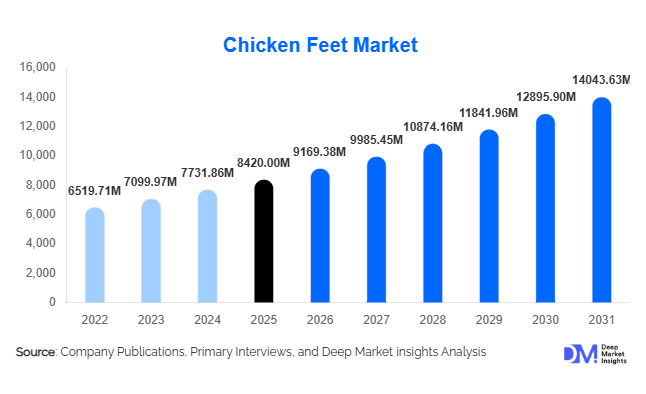
According to Deep Market Insights, the global chicken feet market size was valued at USD 8,420 million in 2026 and is projected to grow from USD 9,169.38 million in 2026 to reach USD 14,043.63 million by 2031, expanding at a CAGR of 8.9% during the forecast period (2026–2031). The market growth is primarily driven by rising demand from Asia-Pacific culinary consumption hubs, expanding frozen poultry export infrastructure, and increasing utilization of chicken feet in pet food and collagen-based industrial applications.
Once considered a low-value poultry by-product, chicken feet have evolved into a globally traded commodity supported by advanced cold-chain logistics and strong export demand from China, Hong Kong, Vietnam, and African countries. Increasing monetization of poultry by-products in major exporting nations such as Brazil and the United States has further strengthened supply-side economics, transforming the market into a structured international trade segment.
Key Market Insights
- Asia-Pacific dominates global demand, accounting for over half of total consumption due to strong culinary integration in China, Vietnam, and Indonesia.
- Frozen chicken feet remain the dominant product form due to long shelf life and suitability for international trade logistics.
- Export-oriented supply chains are expanding rapidly across Brazil, the United States, and Thailand, strengthening global trade flows.
- Pet food and collagen industries are emerging high-growth segments, particularly in North America and Europe.
- Value-added processed chicken feet products are gaining traction in urban retail and foodservice channels.
- Cold-chain infrastructure improvements are enabling long-distance global trade, reducing spoilage and improving export efficiency.
Global Chicken Feet Market Latest Trends
Shift Toward Value-Added and Processed Products
The market is witnessing a structural shift from raw frozen products to processed and ready-to-eat chicken feet formats. Urbanization and changing consumption patterns are driving demand for marinated, vacuum-packed, and pre-cooked variants. These products generate significantly higher margins and are increasingly targeted at younger consumers and convenience-oriented households, particularly in Asia-Pacific urban centers.
Expansion of Non-Food Applications
Chicken feet are increasingly used in pet food and nutraceutical industries. In North America and Europe, dried chicken feet are widely used as natural chew treats for pets, while collagen extraction from poultry by-products is growing rapidly in cosmetics, supplements, and biomedical applications. This diversification is reducing dependence on traditional food consumption cycles and improving market resilience.
Cold Chain and Export Infrastructure Enhancement
Advancements in freezing technology, IoT-based cold-chain monitoring, and containerized logistics have significantly improved global trade efficiency. Exporters are increasingly investing in automated processing plants and blast freezing systems, enabling consistent supply to distant markets such as China and Africa while maintaining product quality.
Global Chicken Feet Market Drivers
Strong Cultural Consumption in Asia-Pacific
Cultural acceptance remains the strongest driver of demand, particularly in China, Hong Kong, Vietnam, and Indonesia. Chicken feet are widely consumed in traditional dishes such as dim sum, soups, and braised preparations. Rising urban populations and expanding foodservice sectors are further reinforcing steady consumption growth.
Growth of Global Poultry Export Ecosystems
Major poultry-producing nations such as Brazil and the United States have developed highly efficient export-oriented processing systems. Investments in slaughtering, freezing, and packaging infrastructure have enabled large-scale monetization of poultry by-products, significantly increasing global supply availability.
Rising Demand from Pet Food and Collagen Industries
The growing premium pet food market and collagen-based nutraceutical industry are creating strong alternative demand channels. Chicken feet provide a cost-effective raw material source for collagen extraction and natural pet treats, supporting high-margin industrial applications.
Global Chicken Feet Market Restraints
Strict Food Safety and Import Regulations
International trade is constrained by stringent sanitary and phytosanitary regulations, including veterinary inspections and disease-control requirements. Compliance costs remain high, particularly for small and mid-scale exporters, limiting market entry.
Supply Volatility Due to Poultry Disease Risks
Outbreaks such as avian influenza can disrupt poultry production and reduce by-product availability. Feed cost fluctuations and production cycles also contribute to price instability, affecting export consistency and market stability.
Global Chicken Feet Market Opportunities
Expansion of Export-Oriented Trade Networks
Rising demand from China, Vietnam, and Africa is encouraging exporters to expand certified processing facilities. Countries such as Brazil and Thailand are strengthening halal and export compliance systems, enabling access to premium international markets.
Growth of Value-Added Product Innovation
Processed chicken feet products such as marinated snacks, ready-to-eat packs, and flavored variants are creating strong revenue opportunities. These products command higher margins (20–35% above frozen variants) and are gaining popularity in urban retail channels.
Industrial Diversification into Collagen and Pet Food
Expanding use of chicken feet in collagen extraction and premium pet food manufacturing is creating high-value industrial demand. This diversification is expected to significantly enhance revenue streams beyond traditional food consumption.
Report Scope
| Report Metric | Details |
|---|---|
| Market Size in 2025 | USD 8420.00 Million |
| Market Size in 2026 | USD 9169.38 Million |
| Market Size in 2031 | USD 14043.63 Million |
| CAGR | 8.9% (2026-2031) |
| Base Year for Estimation | 2025 |
| Historical Data | 2022-2024 |
| Forecast Period | 2026-2031 |
| Report Coverage | Revenue Forecast, Competitive Landscape, Supply Chain Disruption, Growth Factors, Environment & Regulatory Landscape and Trends |
| Geographies Covered | North America, Europe, APAC, Middle East and Africa, LATAM |
| Countries Covered | U.S., Canada, U.K., Germany, France, Spain, Italy, Russia, Nordic, Benelux, Rest of Europe, China, Korea, Japan, India, Australia, Singapore, Taiwan, South East Asia, Rest of Asia-Pacific, UAE, Turky, Saudi Arabia, South Africa, Egypt, Nigeria, Rest of MEA, Brazil, Mexico, Argentina, Chile, Colombia, Rest of LATAM |
Explore more data points, trends and opportunities Download Free Sample Report
Product Type Insights
Frozen chicken feet represent the largest product type segment in the global chicken feet market, primarily due to their extended shelf life, ease of transportation, and ability to maintain product quality during international shipping. The growing volume of cross-border poultry trade, particularly between major exporting countries such as Brazil, the United States, and Thailand and key importing nations across Asia, continues to strengthen demand for frozen products. Advanced freezing technologies, improved cold chain logistics, and increasing investments in refrigerated storage infrastructure further support the dominance of this segment by ensuring year-round product availability and reducing spoilage. Frozen chicken feet are widely preferred by importers, wholesalers, foodservice operators, and processing facilities owing to their convenience, compliance with international food safety regulations, and suitability for long-distance distribution.Semi-processed chicken feet occupy a significant share of the market as exporters increasingly favor products that balance processing efficiency with flexibility for destination-specific customization. Cleaning, trimming, and removal of outer skin improve export readiness while allowing buyers to perform additional processing based on local culinary preferences and regulatory requirements. This format has gained strong acceptance among international processors and distributors due to reduced labor costs and improved product consistency. Meanwhile, value-added chicken feet products, including seasoned, marinated, cooked, vacuum-packed, and ready-to-eat offerings, represent the fastest-growing product category. Rising urbanization, changing consumer lifestyles, increasing demand for convenience foods, premium packaged meat products, and expansion of modern retail channels are accelerating the adoption of these products, particularly in developed and emerging urban markets. Raw chicken feet continue to serve domestic wet markets and local supply chains where freshly slaughtered poultry remains highly preferred, although their market share remains comparatively limited because of shorter shelf life and restricted transportation capabilities.
Application Insights
Human consumption remains the dominant application segment in the global chicken feet market, supported by strong culinary traditions, widespread cultural acceptance, and increasing demand for protein-rich poultry products across Asia-Pacific, Africa, and several Latin American countries. Chicken feet are extensively utilized in traditional cuisines, soups, braised dishes, snacks, and dim sum preparations, making them an important source of revenue for poultry processors seeking to maximize carcass utilization. Rising disposable incomes, expanding urban populations, increasing restaurant penetration, and the growing popularity of ethnic cuisines across international markets continue to strengthen demand within this segment, making human consumption the leading application category.The pet food application is witnessing rapid growth, particularly across North America and Europe, where manufacturers are increasingly incorporating chicken feet into natural pet treats and functional chew products due to their high protein content and dental health benefits. Growing pet humanization trends, increasing consumer preference for minimally processed ingredients, and expanding premium pet food portfolios are supporting market expansion. Industrial applications, including collagen extraction, gelatin manufacturing, pharmaceutical ingredients, and nutraceutical production, are emerging as high-value opportunities as industries capitalize on the natural collagen present in chicken feet for cosmetic, healthcare, and food processing applications. Additionally, the use of chicken feet in animal feed contributes to sustainable poultry processing by maximizing by-product utilization, reducing food waste, and supporting circular economy initiatives within the livestock industry.
Distribution Channel Insights
B2B industrial supply accounts for the largest share of the global chicken feet market, driven by extensive international trade between poultry processors, exporters, importers, wholesalers, food manufacturers, and large-scale foodservice operators. The segment benefits from rising global poultry exports, established cold chain infrastructure, long-term procurement contracts, and increasing demand from meat processors and industrial buyers. Large-volume commercial transactions enable cost efficiencies, supply consistency, and regulatory compliance, making B2B industrial supply the dominant distribution channel across the global market.Foodservice procurement continues to expand steadily as restaurants, hotels, catering companies, and quick-service restaurant chains increasingly incorporate chicken feet into traditional and specialty menu offerings, particularly across Asia-Pacific. The continued growth of organized foodservice establishments, tourism, and ethnic dining concepts supports sustained demand from commercial kitchens. Retail distribution through supermarkets, hypermarkets, specialty meat stores, and convenience stores is also expanding as consumers increasingly purchase hygienically packaged frozen and processed chicken feet for home preparation. Furthermore, e-commerce platforms are gaining traction by providing consumers with greater product accessibility, home delivery services, and wider availability of premium and value-added chicken feet products. Direct export contracts remain fundamental to global market operations, facilitating stable supply relationships between major producing and importing countries while ensuring product traceability and consistent quality standards.
Explore more data points, trends and opportunities Download Free Sample Report
Chicken Feet Market Segmentations
By Product Type
- Raw Fresh Chicken Feet
- Frozen Chicken Feet
- Semi-Processed Chicken Feet
- Value-Added Chicken Feet
By Processing Level
- Unprocessed Chicken Feet
- Semi-Processed Chicken Feet
- Fully Processed Chicken Feet
By Application
- Human Consumption
- Pet Food Industry
- Collagen & Nutraceutical Applications
- Animal Feed & By-products
By Distribution Channel
- B2B Industrial Supply
- Foodservice
- Retail
- Online/E-commerce Platforms
By Trade Orientation
- Export-Oriented Markets
- Domestic Consumption Markets
Regional Insights
Asia-Pacific
Asia-Pacific dominates the global chicken feet market and represents both the largest consumption and import region, led by China, which accounts for nearly 28% of global demand. Strong culinary integration, deep-rooted consumer preferences, and widespread use of chicken feet in traditional cuisine continue to sustain high consumption levels across the region. Rapid urbanization, rising disposable incomes, expanding foodservice networks, and increasing demand for processed poultry products further strengthen regional growth. Additionally, growing investments in cold chain logistics, expanding modern retail infrastructure, increasing imports from leading exporting countries, and continuous product innovation in ready-to-cook and ready-to-eat poultry products are accelerating market expansion. Emerging economies such as Vietnam, Indonesia, Thailand, and the Philippines continue to register robust demand due to population growth, rising protein consumption, and the expansion of organized foodservice and retail sectors.
North America
North America serves primarily as a major production and export hub for the global chicken feet market, supplying substantial volumes to Asia-Pacific, Africa, and the Middle East. The United States leads regional production owing to its highly developed poultry industry, advanced processing facilities, and efficient export infrastructure. Regional growth is supported by increasing poultry production, improvements in processing technologies, expanding export agreements, and rising investments in cold storage and logistics. Domestic demand is also gradually increasing through expanding ethnic consumer populations, growing popularity of authentic Asian cuisine, and rising consumption of natural pet treats. Furthermore, increasing utilization of poultry by-products for collagen extraction and premium pet food manufacturing contributes to additional market opportunities across the region.
Europe
Europe plays a dual role as a regulated exporter and an increasingly important industrial processing region within the global chicken feet market. Countries including Germany, the Netherlands, Poland, and France are strengthening their position through advanced poultry processing capabilities and growing investments in value-added applications such as collagen extraction, gelatin manufacturing, and premium pet food production. Regional growth is supported by increasing demand for sustainable utilization of poultry by-products, stringent food safety standards that enhance export quality, technological advancements in processing, and rising investments in nutraceutical and pharmaceutical ingredients derived from animal proteins. Although export volumes remain relatively moderate because of strict regulatory requirements, growing industrial applications continue to generate new revenue opportunities across the region.
Latin America
Latin America, led by Brazil, remains one of the world's most important supply regions for chicken feet due to its cost-efficient poultry production, abundant raw material availability, competitive labor costs, and well-established export infrastructure. Brazil continues to strengthen its leadership through expanding processing capacity, improving international trade relationships, and maintaining high sanitary standards required by importing countries. Regional growth is driven by increasing poultry production, favorable export policies, investments in cold chain logistics, rising processing efficiency, and growing demand from major importing markets across Asia and Africa. Argentina and other regional producers are also expanding export capabilities, further supporting Latin America's position as one of the fastest-growing supply bases in the global market.
Middle East & Africa
The Middle East & Africa region is emerging as an important import market for chicken feet, supported by rising population growth, increasing demand for affordable animal protein, and expanding food distribution networks. Growth across Africa is driven by improving urbanization, rising household incomes, increasing poultry consumption, and expanding cold storage infrastructure that enables greater availability of imported frozen products. In the Middle East, strong demand for halal-certified poultry products, growing foodservice industries, increasing tourism, and strategic positioning as a global trade and re-export hub continue to stimulate market expansion. Ongoing investments in food security initiatives, import diversification strategies, and modern retail development are expected to further strengthen regional demand over the forecast period.
Key Players in the Global Chicken Feet Market
- JBS S.A.
- Tyson Foods Inc.
- Cargill Inc.
- BRF S.A.
- WH Group Limited
- Charoen Pokphand Foods
- Pilgrim’s Pride Corporation
- Perdue Farms Inc.
- Sanderson Farms
- New Hope Liuhe Co. Ltd.