Tongkat Ali Powder Market Size
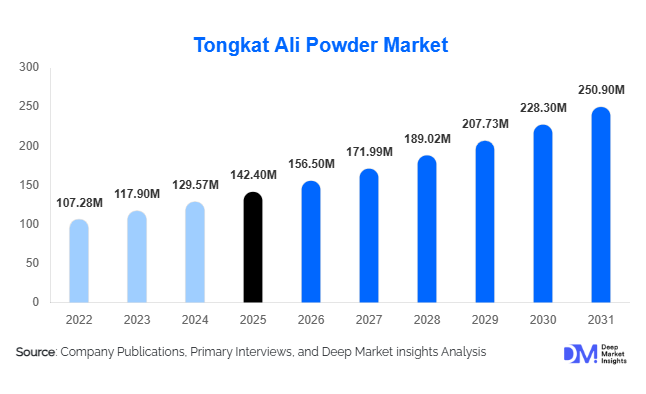
According to Deep Market Insights, the global Tongkat Ali Powder market size was valued at USD 142.4 million in 2025 and is projected to grow from USD 156.50 million in 2026 to reach USD 250.90 million by 2031, expanding at a CAGR of 9.9% during the forecast period (2026–2031). The Tongkat Ali Powder market growth is primarily driven by rising consumer demand for natural testosterone-support supplements, increasing adoption of herbal adaptogens in sports nutrition formulations, and expanding utilization of standardized botanical extracts in premium nutraceutical products. Growing awareness regarding men's health, healthy aging, stress management, and physical performance enhancement has transformed Tongkat Ali from a traditional Southeast Asian medicinal herb into a globally traded functional ingredient. Manufacturers are increasingly investing in high-potency extracts, scientific validation, sustainable cultivation programs, and quality standardization to meet the evolving requirements of nutraceutical, pharmaceutical, and functional food companies worldwide.
Key Market Insights
- Dietary supplements account for the largest application segment, representing approximately 53% of global demand due to strong adoption in men's health and vitality products.
- Standardized high-potency extracts are gaining market share rapidly, as manufacturers focus on clinically supported formulations with consistent eurycomanone content.
- Asia-Pacific dominates the global market, supported by raw material production leadership in Malaysia and Indonesia and growing domestic consumption across China, India, and Southeast Asia.
- North America remains the largest consuming region outside Asia, with the United States accounting for nearly one-quarter of global demand.
- India is emerging as the fastest-growing country market, driven by expanding nutraceutical consumption and rising consumer awareness of herbal wellness products.
- Functional beverages and adaptogenic formulations are creating new growth opportunities, enabling Tongkat Ali to expand beyond traditional capsule and tablet formats.
- E-commerce channels continue to accelerate global penetration, allowing manufacturers to reach health-conscious consumers directly while supporting premium product positioning.
Tongkat Ali Powder Market Latest Trends
Shift Toward Standardized and Clinically Validated Extracts
The Tongkat Ali Powder industry is witnessing a significant transition from conventional root powders toward standardized extracts with verified concentrations of bioactive compounds, particularly eurycomanone. Nutraceutical companies increasingly prioritize ingredients supported by clinical research and laboratory validation, enabling stronger efficacy claims and greater consumer confidence. Standardized extracts also provide improved consistency between production batches, supporting quality assurance and regulatory compliance requirements. As competition intensifies in the men's health and sports nutrition sectors, manufacturers are leveraging scientific substantiation to differentiate products and justify premium pricing strategies. This trend is expected to accelerate as global supplement regulations become more stringent and consumers demand greater transparency regarding ingredient composition and sourcing practices.
Expansion into Functional Foods and Beverages
Functional food and beverage manufacturers are increasingly incorporating Tongkat Ali Powder into energy drinks, wellness beverages, adaptogenic coffees, nutritional bars, and ready-to-consume health products. The growing consumer preference for convenient wellness solutions is creating demand for ingredient formats that extend beyond capsules and tablets. Beverage manufacturers are investing in improved solubility technologies and flavor-masking techniques to facilitate broader integration into mainstream functional products. This trend is particularly prominent among younger consumers seeking natural energy support, stress management, and performance enhancement through everyday consumption formats. The convergence of adaptogens, botanical ingredients, and personalized nutrition is expected to create substantial opportunities for Tongkat Ali ingredient suppliers over the next decade.
Tongkat Ali Powder Market Drivers
Growing Demand for Natural Testosterone Support
Increasing consumer interest in natural alternatives to synthetic hormone-support products remains one of the strongest growth drivers for the Tongkat Ali Powder market. Men aged 35 years and older are increasingly seeking botanical ingredients that support vitality, physical performance, and healthy aging. Scientific research highlighting Tongkat Ali's potential role in supporting testosterone levels and overall wellness has strengthened consumer confidence and expanded market adoption. This trend is particularly evident in North America, Europe, Australia, and emerging Asian markets where preventive health spending continues to increase.
Rapid Growth of Sports Nutrition Industry
The global sports nutrition industry continues to create substantial demand for Tongkat Ali Powder as fitness enthusiasts, athletes, and active lifestyle consumers seek plant-based performance ingredients. Manufacturers are increasingly incorporating Tongkat Ali into pre-workout supplements, recovery formulations, testosterone-support products, and endurance-focused nutritional blends. The shift away from controversial synthetic performance enhancers has further strengthened demand for natural alternatives. Rising gym participation, expanding fitness communities, and increased focus on physical performance continue to support ingredient consumption globally.
Expansion of Premium Nutraceutical Markets
Premium nutraceutical categories are growing faster than traditional dietary supplements across most developed markets. Consumers increasingly value quality certifications, traceability, clinically validated ingredients, and premium formulations. Tongkat Ali Powder benefits directly from this trend due to its positioning as a high-value botanical ingredient. Premiumization allows manufacturers to command higher margins while investing in sustainable sourcing, advanced extraction technologies, and scientific research programs.
Tongkat Ali Powder Market Restraints
Supply Chain Concentration and Raw Material Constraints
The majority of global Tongkat Ali raw material supply originates from Malaysia and Indonesia, creating significant supply concentration risks. Environmental regulations, sustainable harvesting requirements, agricultural limitations, and weather-related disruptions can affect raw material availability and pricing. Such concentration increases procurement risks for international manufacturers and may restrict long-term scalability if cultivation programs fail to expand sufficiently.
Quality Standardization Challenges
The industry continues to face challenges associated with inconsistent extract ratios, variable active compound concentrations, and occasional product adulteration. Differences in extraction methodologies and quality testing standards create uncertainty among buyers, particularly pharmaceutical and large nutraceutical companies. Addressing these challenges requires substantial investments in laboratory testing, authentication technologies, and standardized production processes, increasing operational costs across the value chain.
Tongkat Ali Powder Industry Key Opportunities
Expansion of Men's Health and Healthy Aging Products
The global men's health supplement industry presents one of the largest opportunities for Tongkat Ali Powder manufacturers. Demand for products addressing energy support, vitality, healthy aging, hormonal balance, and reproductive wellness continues to expand globally. Aging populations in North America, Europe, Japan, South Korea, and China are expected to drive sustained demand for scientifically supported herbal ingredients. Companies that invest in clinical validation and premium formulations are likely to capture significant market share within this high-growth segment.
Functional Beverage and Adaptogen Market Integration
The rapid expansion of functional beverages creates substantial opportunities for ingredient suppliers. Adaptogenic coffees, wellness shots, performance beverages, and stress-management drinks increasingly incorporate botanical ingredients with scientifically supported benefits. Tongkat Ali Powder manufacturers that develop water-soluble extracts and beverage-compatible formulations can access entirely new revenue streams beyond conventional dietary supplement applications. Strategic partnerships between ingredient suppliers and beverage brands are expected to accelerate market penetration.
Report Scope
| Report Metric | Details |
|---|---|
| Market Size in 2025 | USD 142.40 Million |
| Market Size in 2026 | USD 156.50 Million |
| Market Size in 2031 | USD 250.90 Million |
| CAGR | 9.9% (2026-2031) |
| Base Year for Estimation | 2025 |
| Historical Data | 2022-2024 |
| Forecast Period | 2026-2031 |
| Report Coverage | Revenue Forecast, Competitive Landscape, Supply Chain Disruption, Growth Factors, Environment & Regulatory Landscape and Trends |
| Geographies Covered | North America, Europe, APAC, Middle East and Africa, LATAM |
| Countries Covered | U.S., Canada, U.K., Germany, France, Spain, Italy, Russia, Nordic, Benelux, Rest of Europe, China, Korea, Japan, India, Australia, Singapore, Taiwan, South East Asia, Rest of Asia-Pacific, UAE, Turky, Saudi Arabia, South Africa, Egypt, Nigeria, Rest of MEA, Brazil, Mexico, Argentina, Chile, Colombia, Rest of LATAM |
Explore more data points, trends and opportunities Download Free Sample Report
Product Type Insights
Conventional Tongkat Ali Powder continues to dominate the global market, accounting for approximately 58% share, primarily driven by its cost efficiency, wide availability, and strong integration into mainstream dietary supplement formulations. Its established supply chains and scalable production processes make it the preferred choice for mass-market nutraceutical manufacturers, particularly in price-sensitive regions and high-volume product categories. The leading driver supporting this segment is the continued expansion of general wellness and vitality supplements, where affordability and formulation flexibility are prioritized over certification-based differentiation. However, organic-certified variants are witnessing accelerated adoption as consumer preferences shift toward clean-label, traceable, and sustainably sourced botanical ingredients. This momentum is strongest in premium wellness markets such as North America and Europe, where regulatory frameworks and consumer awareness increasingly favor certified natural products. The growth of this segment is primarily driven by rising demand for transparency, sustainability labeling, and premium positioning in functional health products. In response, manufacturers are investing in advanced traceability systems, sustainable sourcing programs, and third-party certifications to strengthen brand credibility and capture higher-margin opportunities within the premium supplement category.
Extract Concentration Insights
Among extract concentration categories, the 100:1 extract powder segment leads the global market with approximately 42% share, owing to its optimal balance between potency, cost efficiency, and formulation convenience. This concentration level allows manufacturers to deliver effective dosages in smaller serving sizes, which aligns strongly with modern consumer preferences for easy-to-consume, high-efficacy supplements. The primary driver for this segment is the increasing demand for standardized and clinically positioned botanical extracts in performance nutrition and men’s health formulations, where consistency and measurable efficacy are critical. Higher concentration extracts also enable stronger brand differentiation and premium pricing strategies, particularly in competitive nutraceutical markets. Meanwhile, ultra-high concentration extracts above 100:1 are emerging as a niche but fast-growing category, supported by demand in advanced sports nutrition, testosterone-support products, and high-performance wellness formulations. Growth in this sub-segment is largely driven by increasing consumer interest in scientifically backed, high-potency ingredients and the expanding role of evidence-based supplementation in fitness and aging-related health management.
Application Insights
Dietary supplements remain the dominant application segment, accounting for approximately 53% of global Tongkat Ali Powder demand, driven by widespread consumer adoption of preventive healthcare practices and daily wellness supplementation. Within this segment, the leading growth driver is the rising focus on men’s health, vitality enhancement, stress management, and healthy aging solutions, which continue to expand globally across both developed and emerging markets. Sports nutrition represents the fastest-growing application segment, fueled by increasing participation in fitness activities, rising demand for natural performance enhancers, and growing preference for plant-based alternatives to synthetic compounds. This growth is further supported by the integration of Tongkat Ali into pre-workout and endurance-enhancing formulations targeting athletic performance and recovery. Functional foods and beverages are also gaining traction as manufacturers innovate with convenient delivery formats such as ready-to-drink beverages and fortified nutrition products, driven by consumer demand for on-the-go wellness solutions. Pharmaceutical applications, while still emerging, are gradually expanding as scientific research continues to validate the bioactive properties of Tongkat Ali, supporting its potential role in evidence-based therapeutic formulations.
Distribution Channel Insights
Direct B2B ingredient supply remains the dominant distribution channel with approximately 39% market share, reflecting the structured nature of the nutraceutical supply chain and the strong reliance of manufacturers on bulk ingredient procurement. The leading driver in this segment is the increasing vertical integration between raw material suppliers and finished product manufacturers, enabling long-term contracts, improved supply stability, and enhanced margin optimization. This model is particularly important for large-scale supplement producers seeking consistent quality and traceability in botanical ingredients. Online retail channels are experiencing rapid growth, driven by the expansion of direct-to-consumer wellness brands, digital health platforms, and subscription-based supplement models that prioritize convenience and personalized nutrition. Specialty health stores and pharmacies continue to play a crucial role in premium product distribution, particularly in regions where consumer trust and professional recommendations influence purchasing behavior. Contract manufacturing organizations are also becoming increasingly significant, supporting product innovation, formulation development, and faster market entry for emerging supplement brands.
End-Use Industry Insights
Nutraceutical companies represent the largest end-use segment, accounting for approximately 48% of global Tongkat Ali Powder consumption, driven by sustained demand for men’s health, energy enhancement, stress reduction, and healthy aging formulations. The key growth driver for this segment is the global shift toward preventive healthcare and natural supplementation, which continues to expand product pipelines and ingredient utilization across established supplement brands. Sports nutrition manufacturers represent the fastest-growing end-user category, supported by rising fitness awareness, increasing gym participation, and strong consumer preference for natural performance-enhancing ingredients that support endurance, strength, and recovery. Functional food and beverage producers are also emerging as important adopters, driven by the growing demand for integrated nutrition solutions that combine taste, convenience, and wellness benefits in everyday consumption formats. Pharmaceutical companies, while still a smaller segment, are gradually increasing their involvement as ongoing clinical research strengthens the scientific credibility of Tongkat Ali’s bioactive compounds, opening opportunities for future therapeutic applications and evidence-based herbal medicine development.
Explore more data points, trends and opportunities Download Free Sample Report
Tongkat Ali Powder Market Segmentations
By Product Type
- Conventional Tongkat Ali Powder
- Organic Certified Tongkat Ali Powder
By Extract Concentration Ratio
- Raw Root Powder
- 20:1 Extract Powder
- 50:1 Extract Powder
- 100:1 Extract Powder
- Above 100:1 Standardized Extract Powder
By Standardization Type
- Non-Standardized Powder
- Eurycomanone Standardized Powder
- Eurycomanone Standardized Powder
By Source
- Wild-Harvested Tongkat Ali
- Plantation/Cultivated Tongkat Ali
By Application
- Dietary Supplements
- Sports Nutrition Products
- Functional Food Ingredients
- Functional Beverages
- Pharmaceutical Preparations
- Traditional Medicine Products
- Personal Care & Cosmetics
Regional Insights
Asia-Pacific
Asia-Pacific holds approximately 39% of the global Tongkat Ali Powder market and remains the central hub for both production and consumption, with Malaysia and Indonesia serving as the primary sources of raw material cultivation and export. The leading driver of regional growth is the strong integration of traditional herbal medicine practices with modern nutraceutical innovation, particularly in countries such as China and India where herbal wellness adoption is rapidly expanding. China represents a major consumption market supported by rising health awareness and premium supplement demand, while India is emerging as the fastest-growing national market due to increasing disposable income, urbanization, and widespread acceptance of Ayurvedic and herbal wellness solutions. Japan, South Korea, Australia, Singapore, and Thailand further contribute to regional growth through strong demand for high-quality standardized extracts and clinically validated formulations, driven by advanced healthcare awareness and premium wellness consumption trends.
North America
North America accounts for approximately 29% of global demand, with the United States representing the largest single-country market globally. Regional growth is primarily driven by rising consumer focus on men’s health optimization, fitness performance, and natural alternatives to synthetic supplements. The leading driver is the strong penetration of premium dietary supplement brands combined with advanced e-commerce ecosystems that enable widespread product accessibility and consumer education. High healthcare expenditure and strong wellness culture further support sustained demand across sports nutrition and healthy aging segments. Canada is also witnessing steady growth, supported by increasing consumer preference for botanical-based ingredients and expanding awareness of natural performance and vitality supplements.
Europe
Europe contributes approximately 21% of the global market, with key demand centers including Germany, the United Kingdom, France, Italy, and the Netherlands. The primary growth driver in this region is the increasing consumer preference for scientifically validated, high-quality botanical supplements supported by stringent regulatory standards and strong trust in certified health products. Germany demonstrates particularly strong demand for clinically backed formulations, while the United Kingdom benefits from rapid expansion of digital wellness platforms and e-commerce-driven supplement sales. Across Europe, rising demand for natural health solutions, combined with regulatory emphasis on product safety, traceability, and quality assurance, continues to favor premium Tongkat Ali formulations with standardized potency and verified sourcing.
Latin America
Latin America accounts for approximately 6% of global demand, with Brazil serving as the dominant market due to its large population base and strong fitness and sports nutrition culture. Regional growth is primarily driven by increasing awareness of natural performance-enhancing ingredients, rising middle-class income levels, and expanding access to dietary supplements through modern retail channels. Argentina and Chile are also emerging markets, supported by growing nutraceutical penetration and increasing consumer interest in preventive health and wellness-oriented lifestyles. The expansion of gym culture and sports participation further strengthens demand for performance-focused botanical supplements across the region.
Middle East & Africa
The Middle East & Africa region contributes approximately 5% of global market revenue, with the United Arab Emirates and Saudi Arabia leading demand due to high purchasing power and strong interest in premium health and wellness products. The primary driver of regional growth is rising health consciousness combined with increasing adoption of imported dietary supplements and functional nutrition products. South Africa represents the largest market in Africa, supported by expanding retail availability, growing urban wellness trends, and increasing consumer acceptance of herbal supplements. Overall regional growth is further supported by improving distribution networks, rising e-commerce penetration, and stronger partnerships between global nutraceutical companies and local distributors, enabling wider product accessibility and market expansion.
Key Players in the Tongkat Ali Powder Market
- UL Prospector
- Biotropics Malaysia
- Nutra Green Biotechnology
- AKARALI Group
- PhytoGaia
- Xi'an Greena Biotech
- Herbagus
- Hainan NicePal
- Nootropics Depot
- Herbolab
- Akar Herbs
- Naturalin Bio-Resources
- Xi'an Lyphar Biotech
- Bioalpha Holdings
- Nova Laboratories