Sustainable Coffee Market Size
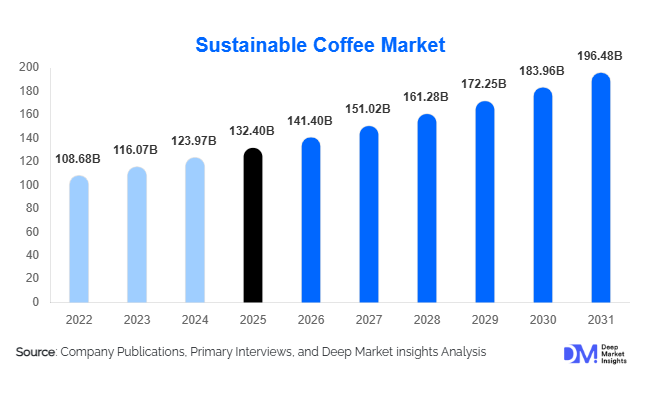
According to Deep Market Insights, the global sustainable coffee market size was valued at USD 132.4 billion in 2025 and is projected to grow from USD 141.4 billion in 2026 to reach USD 196.8 billion by 2031, expanding at a CAGR of 6.8% during the forecast period (2026–2031). The market is experiencing steady growth as consumers, retailers, and foodservice companies increasingly prioritize environmentally responsible, ethically sourced, and traceable coffee products. Rising adoption of certified coffee, growing specialty coffee consumption, increasing investments in regenerative agriculture, and stringent sustainability regulations governing agricultural imports are accelerating market expansion. Coffee producers and multinational brands are also integrating climate-resilient farming, carbon reduction initiatives, and digital traceability technologies into their supply chains to meet evolving consumer expectations and corporate environmental, social, and governance (ESG) commitments.
Key Market Insights
- Rainforest Alliance-certified coffee represents the largest certification segment, supported by broad adoption among multinational coffee companies and retailers following the integration of UTZ certification standards.
- Household consumption accounts for the largest share of sustainable coffee demand, driven by the rapid adoption of premium home brewing equipment, subscription coffee services, and increasing consumer awareness of ethical sourcing.
- Europe dominates the global sustainable coffee market, accounting for approximately 35.6% of global revenue in 2025 owing to strict sustainability regulations and widespread consumer acceptance of certified coffee.
- Asia-Pacific is the fastest-growing regional market, supported by expanding specialty café culture, rising disposable incomes, and growing premium coffee consumption across China, India, South Korea, and Southeast Asia.
- Arabica remains the preferred sustainable coffee species, contributing over 70% of global sustainable coffee sales due to superior quality, specialty applications, and premium pricing.
- Digital traceability, blockchain-enabled certification verification, satellite monitoring, and regenerative agriculture are becoming key competitive differentiators across global coffee supply chains.
Sustainable Coffee Market Trends
Regenerative Coffee Farming Becoming the Industry Standard
The sustainable coffee industry is rapidly transitioning beyond conventional certification programs toward regenerative agricultural practices that improve biodiversity, restore soil health, enhance carbon sequestration, and strengthen climate resilience. Coffee growers are increasingly integrating agroforestry systems, shade-grown cultivation, cover cropping, organic fertilization, and water conservation technologies into production systems. Major coffee buyers are supporting these initiatives through long-term sourcing agreements, sustainability financing, and farmer training programs designed to improve productivity while reducing environmental impact. Regenerative farming also enables coffee producers to participate in voluntary carbon markets, creating additional revenue opportunities beyond coffee sales. As climate change continues to threaten coffee-growing regions, regenerative production methods are expected to become a central pillar of long-term supply chain sustainability.
Digital Traceability Reshaping Sustainable Coffee Supply Chains
Digital technologies are transforming transparency across the sustainable coffee value chain. Blockchain platforms, artificial intelligence, satellite imagery, QR-code product authentication, and Internet of Things (IoT)-enabled farm monitoring solutions allow coffee companies to verify origin, monitor environmental performance, and demonstrate compliance with international sustainability regulations. Consumers increasingly expect complete transparency regarding farm location, production practices, carbon footprint, and farmer compensation before making purchasing decisions. Digital traceability also improves supply chain efficiency by reducing fraud, simplifying certification audits, enhancing inventory management, and strengthening relationships between producers, exporters, roasters, retailers, and end consumers. These technologies are expected to play a critical role as governments implement increasingly stringent due diligence requirements for agricultural imports.
Sustainable Coffee Market Drivers
Growing Consumer Preference for Ethically Sourced Premium Coffee
Consumers worldwide are increasingly prioritizing sustainability, transparency, and social responsibility when purchasing coffee products. Millennials and Generation Z consumers demonstrate a particularly strong willingness to pay premium prices for certified coffee that supports fair farmer compensation, biodiversity conservation, and environmentally responsible cultivation practices. Premium cafés, specialty coffee retailers, supermarkets, and online platforms continue expanding certified product portfolios to meet changing purchasing behavior. Coffee companies are responding by investing in certified sourcing, recyclable packaging, carbon-neutral operations, and direct-trade partnerships, strengthening consumer confidence while supporting long-term market growth.
Corporate Sustainability Commitments Accelerating Certified Coffee Procurement
Multinational coffee companies, foodservice chains, hotels, and institutional buyers have established ambitious responsible sourcing targets as part of broader ESG strategies. These commitments are driving substantial investments in regenerative agriculture, climate-smart farming, farmer livelihood programs, and digital traceability infrastructure. Long-term procurement contracts encourage coffee-producing cooperatives to pursue sustainability certifications while improving production quality and supply reliability. Increasing adoption of sustainable procurement policies by governments, corporations, and hospitality companies continues expanding demand for certified coffee across retail and commercial channels.
Sustainable Coffee Market Restraints
High Certification and Compliance Costs for Smallholder Farmers
Although sustainable coffee commands premium pricing, certification remains financially challenging for many smallholder producers. Compliance with international sustainability standards requires ongoing investments in farm audits, documentation, worker welfare, environmental monitoring, and infrastructure improvements. Many producers depend on cooperative support, development funding, or multinational purchasing programs to offset certification expenses. Without adequate financial assistance, certification costs may discourage participation among smaller farms, limiting certified coffee supply despite growing global demand.
Climate Change Increasing Production Risks
Climate change continues to represent one of the greatest long-term challenges for the global sustainable coffee market. Rising temperatures, irregular rainfall, prolonged droughts, floods, and increasing prevalence of pests and diseases threaten coffee yields across major producing regions. Arabica cultivation is particularly vulnerable to changing climatic conditions, forcing producers to invest in climate-resilient coffee varieties, irrigation systems, shade management, and regenerative farming techniques. Production volatility contributes to fluctuations in green coffee prices and creates uncertainty throughout the global coffee supply chain.
Sustainable Coffee Market Opportunities
Expansion of Carbon-Neutral and Regenerative Coffee Programs
Growing global commitments toward net-zero emissions are creating substantial opportunities for coffee companies investing in regenerative agriculture and carbon-neutral production systems. Coffee plantations incorporating agroforestry, biodiversity restoration, and carbon sequestration practices can generate additional income through sustainability premiums and voluntary carbon markets. Governments, development organizations, and multinational buyers are increasing investments in regenerative coffee programs that improve climate resilience while strengthening long-term supply security. Companies capable of demonstrating measurable reductions in greenhouse gas emissions are expected to gain significant competitive advantages as sustainability reporting requirements continue expanding worldwide.
Rapid Growth of Premium Coffee Consumption Across Emerging Markets
Asia-Pacific and the Middle East represent attractive growth opportunities for sustainable coffee producers as premium coffee consumption accelerates among urban middle-class consumers. Countries including China, India, South Korea, the United Arab Emirates, and Saudi Arabia are experiencing rapid expansion of specialty cafés, premium retail coffee sales, and ethically sourced beverage consumption. Younger consumers increasingly associate sustainability certifications with premium quality, food safety, and responsible production, encouraging retailers and international coffee brands to introduce broader portfolios of certified products. Continued urbanization, rising disposable incomes, and expanding café culture are expected to sustain above-average market growth across these emerging regions throughout the forecast period.
Report Scope
| Report Metric | Details |
|---|---|
| Market Size in 2025 | USD 132.4 Billion |
| Market Size in 2026 | USD 141.40 Billion |
| Market Size in 2031 | USD 196.48 Billion |
| CAGR | 6.8% (2026-2031) |
| Base Year for Estimation | 2025 |
| Historical Data | 2022-2024 |
| Forecast Period | 2026-2031 |
| Report Coverage | Revenue Forecast, Competitive Landscape, Supply Chain Disruption, Growth Factors, Environment & Regulatory Landscape and Trends |
| Geographies Covered | North America, Europe, APAC, Middle East and Africa, LATAM |
| Countries Covered | U.S., Canada, U.K., Germany, France, Spain, Italy, Russia, Nordic, Benelux, Rest of Europe, China, Korea, Japan, India, Australia, Singapore, Taiwan, South East Asia, Rest of Asia-Pacific, UAE, Turky, Saudi Arabia, South Africa, Egypt, Nigeria, Rest of MEA, Brazil, Mexico, Argentina, Chile, Colombia, Rest of LATAM |
Explore more data points, trends and opportunities Download Free Sample Report
Certification Type Insights
Rainforest Alliance-certified coffee dominates the sustainable coffee market, accounting for approximately 34.2% of global revenue in 2025. The certification has become the preferred sustainability standard among multinational coffee companies due to its comprehensive framework covering environmental conservation, climate resilience, biodiversity protection, responsible labor practices, and farm traceability. Following the integration of the UTZ certification program, Rainforest Alliance significantly expanded its certified producer network across Brazil, Colombia, Vietnam, Peru, Honduras, and Ethiopia, ensuring a stable supply of certified beans for global markets. Fairtrade-certified coffee continues to hold a significant share by emphasizing fair pricing and improved livelihoods for coffee-growing communities, while Organic-certified coffee is experiencing robust growth owing to increasing consumer demand for chemical-free agricultural products. Emerging certifications such as Carbon Neutral, Bird Friendly, and Regenerative Coffee are gaining momentum as companies strengthen their climate commitments and seek measurable environmental outcomes throughout their supply chains.
Product Type Insights
Ground coffee remains the largest product segment, contributing nearly 39.8% of the global sustainable coffee market in 2025. Consumers continue to favor ground coffee due to its convenience, affordability, and compatibility with a wide range of home brewing methods, including drip coffee makers, French presses, and pour-over systems. The expansion of premium retail offerings and specialty coffee brands has further reinforced this segment's leadership. Whole bean coffee is witnessing strong growth among enthusiasts seeking freshness and customized grinding experiences, particularly in developed markets with high penetration of home espresso machines. Sustainable coffee pods and capsules are rapidly expanding as manufacturers introduce recyclable and compostable capsule technologies to address environmental concerns associated with single-serve coffee consumption. Meanwhile, ready-to-drink (RTD) sustainable coffee is emerging as one of the fastest-growing product categories, driven by increasing demand for convenient premium beverages among younger consumers and urban professionals.
Coffee Species Insights
Arabica sustainable coffee accounts for approximately 72.6% of the market, making it the dominant coffee species globally. Arabica beans are widely preferred due to their superior aroma, balanced acidity, and premium flavor profile, making them the primary choice for specialty coffee roasters and international café chains. Sustainable Arabica cultivation is concentrated in Latin America and East Africa, where producers have adopted certifications and regenerative farming practices to secure premium export opportunities. Robusta coffee maintains an important position in instant coffee manufacturing and commercial blends because of its higher caffeine content, stronger flavor, and improved productivity under warmer climatic conditions. Blended coffee products continue gaining popularity among manufacturers seeking to balance flavor characteristics, production costs, and supply chain resilience.
Roast Level Insights
Medium roast coffee leads the market with an estimated 46.4% share of global sustainable coffee sales. Consumers widely appreciate medium roasts for their balanced flavor, moderate acidity, and ability to preserve the unique characteristics of coffee origin. Specialty coffee retailers and premium café chains increasingly promote medium roast products as they highlight bean quality while appealing to a broad consumer base. Light roast coffee continues expanding within the specialty segment as consumers seek origin-specific tasting notes and higher antioxidant retention. Dark roast coffee maintains steady demand among espresso consumers and traditional coffee markets, while specialty roast profiles are gaining popularity through artisanal coffee brands offering limited-edition and single-origin selections.
Farming Practice Insights
Agroforestry-based coffee cultivation represents the leading farming practice, accounting for approximately 37.1% of the sustainable coffee market. Integrating coffee plants with native shade trees improves biodiversity, enhances soil fertility, supports carbon sequestration, conserves water resources, and increases resilience against climate change. Governments, certification organizations, and multinational coffee buyers increasingly encourage agroforestry systems through financial incentives and long-term procurement programs. Organic farming continues to witness strong growth as consumers seek pesticide-free coffee, while regenerative agriculture is emerging as the fastest-growing farming practice due to its focus on restoring ecosystems, improving soil carbon storage, and strengthening long-term agricultural productivity. Biodynamic farming remains a niche but premium segment serving specialty coffee markets.
Distribution Channel Insights
Supermarkets and hypermarkets account for approximately 41.3% of global sustainable coffee sales, making them the dominant distribution channel. Large retail chains continue expanding shelf space dedicated to certified coffee while introducing private-label sustainable products to capture growing consumer demand. Their extensive distribution networks, competitive pricing strategies, and promotional campaigns have significantly improved product accessibility. Specialty coffee retailers remain important for premium and single-origin products, offering knowledgeable customer service and curated selections. Online retail has emerged as the fastest-growing channel as consumers increasingly purchase coffee through brand websites, e-commerce marketplaces, and subscription services that provide recurring deliveries and personalized product recommendations. Direct-to-consumer business models are further strengthening customer loyalty while enabling coffee brands to communicate sustainability stories directly to consumers.
End-Use Insights
Household consumption dominates the sustainable coffee market with an estimated 56.7% share of global demand in 2025. The growing popularity of home brewing equipment, premium coffee subscriptions, and specialty coffee culture has significantly increased retail purchases of certified coffee products. Consumers are increasingly willing to pay premium prices for ethically sourced coffee that aligns with their environmental and social values. Cafés and coffee chains represent the fastest-growing end-use segment as international and regional operators expand premium sustainable coffee offerings to differentiate themselves within highly competitive foodservice markets. Hotels, restaurants, corporate offices, educational institutions, and healthcare facilities are also increasing procurement of certified coffee under broader sustainable sourcing initiatives. Food and beverage manufacturers continue incorporating certified coffee into ready-to-drink beverages, desserts, confectionery, dairy alternatives, and functional food products, creating new revenue opportunities for sustainable coffee suppliers.
Packaging Insights
Flexible pouches account for approximately 43.5% of global sustainable coffee packaging, supported by their lightweight construction, lower transportation costs, and reduced environmental footprint compared to rigid alternatives. Manufacturers increasingly utilize recyclable mono-material structures and compostable films to align packaging with broader sustainability commitments. Paper bags continue gaining popularity among specialty coffee brands due to their premium appearance and renewable material composition. Aluminum coffee capsules remain important within the premium single-serve segment, with manufacturers investing in closed-loop recycling systems to improve circularity. Bulk commercial packaging maintains strong demand among foodservice operators and institutional buyers, while innovative biodegradable packaging materials are expected to witness significant adoption throughout the forecast period.
Price Positioning Insights
The premium segment accounts for approximately 44.8% of global sustainable coffee revenue, reflecting consumers' willingness to pay higher prices for superior quality, traceability, and certified sourcing. Premium products frequently feature single-origin beans, specialty roasting profiles, direct-trade relationships, and environmentally responsible packaging. Mid-premium coffee represents the largest volume segment by household penetration, balancing affordability with sustainability credentials. Ultra-premium and specialty coffee continue experiencing rapid expansion among affluent consumers seeking exclusive micro-lot offerings, rare origins, and customized roasting profiles. Economy sustainable coffee remains comparatively smaller but is expanding as retailers introduce affordable certified private-label products that improve accessibility among mainstream consumers.
Business Model Insights
Branded consumer coffee represents the leading business model, contributing approximately 58.9% of global sustainable coffee sales. Established coffee companies leverage strong brand recognition, global distribution networks, and long-term sourcing partnerships to commercialize certified coffee across retail and foodservice channels. Direct-trade coffee continues gaining momentum among specialty roasters by establishing long-term relationships with coffee producers, improving transparency, and ensuring higher farmer incomes. Private-label sustainable coffee is expanding rapidly as supermarkets introduce competitively priced certified products under their own brands. Cooperative-based supply chains remain fundamental to sustainable coffee production by enabling smallholder farmers to achieve certification, improve quality standards, access export markets, and negotiate favorable purchasing agreements with international buyers. Contract manufacturing also continues supporting market expansion as retailers and emerging coffee brands outsource production while focusing on marketing and distribution activities.
Explore more data points, trends and opportunities Download Free Sample Report
Sustainable Coffee Market Segmentations
By Certification Type
- Organic Certified Coffee
- Fairtrade Certified Coffee
- Rainforest Alliance Certified Coffee
- UTZ Certified Coffee (Legacy Certified Products)
- Smithsonian Bird Friendly Coffee
- Certified Shade-Grown Coffee
- Carbon Neutral / Climate Positive Coffee
- Multi-Certified Coffee
By Product Type
- Whole Bean Coffee
- Ground Coffee
- Instant Coffee
- Coffee Pods & Capsules
- Ready-to-Drink (RTD) Sustainable Coffee
- Certified Green Coffee Beans
By Farming Practice
- Organic Farming
- Agroforestry Coffee
- Shade-Grown Coffee
- Regenerative Coffee Farming
- Biodynamic Coffee Farming
By Distribution Channel
- Supermarkets & Hypermarkets
- Specialty Coffee Retailers
- Convenience Stores
- Online Retail
- Direct-to-Consumer (D2C)
- Foodservice Distributors
- Wholesale/B2B Supply
By End Use
- Household Consumption
- Cafés & Coffee Chains
- Hotels & Resorts
- Restaurants
- Corporate Offices
- Institutional Buyers
- Food & Beverage Manufacturing
- Airlines, Railways & Travel Catering
Regional Insights
Europe
Europe dominates the global sustainable coffee market, accounting for approximately 35.6% of global revenue in 2025. The region's leadership is supported by high consumer awareness regarding ethical sourcing, stringent environmental regulations, and widespread adoption of sustainability certifications across retail and foodservice channels. The European Union's increasing focus on deforestation-free supply chains, carbon footprint reduction, and corporate sustainability reporting has further accelerated demand for certified coffee imports. Germany represents the largest national market within Europe, contributing nearly 22% of regional demand, driven by strong retail penetration of Fairtrade, Organic, and Rainforest Alliance-certified coffee. The United Kingdom continues to experience robust demand through specialty coffee retailers, premium supermarkets, and expanding café chains. France and Italy benefit from well-established coffee cultures, with consumers increasingly choosing sustainably sourced espresso and premium blends. The Netherlands, Switzerland, Belgium, Sweden, Denmark, and Norway also represent mature markets where sustainability has become a primary purchasing criterion for both households and institutional buyers.
North America
North America accounts for approximately 28.8% of the global sustainable coffee market, making it the second-largest regional market. The United States contributes nearly 82% of regional revenue, supported by high per-capita coffee consumption, premium specialty coffee demand, and growing adoption of certified products across supermarkets, cafés, and online retail channels. Consumers increasingly value transparency regarding coffee origin, farmer welfare, and environmental impact, encouraging multinational brands to expand responsibly sourced product portfolios. Canada continues to demonstrate strong growth owing to high consumer awareness of ethical sourcing, increasing organic food consumption, and widespread availability of certified coffee through national retail chains. The region also benefits from extensive investments in digital traceability, regenerative agriculture partnerships, and sustainable packaging innovations undertaken by leading coffee companies.
Asia-Pacific
Asia-Pacific represents the fastest-growing regional market, projected to expand at a CAGR of approximately 8.5% during the forecast period. Rising disposable incomes, rapid urbanization, expanding specialty café culture, and increasing appreciation for premium beverages are driving sustainable coffee consumption across the region. China leads regional growth with increasing demand for premium coffee among younger urban consumers and the rapid expansion of domestic coffee chains. India is emerging as one of the most attractive growth markets due to rising café penetration, increasing disposable income, and expanding domestic production of certified Arabica coffee. Japan remains one of the world's largest coffee importers, with consumers demonstrating strong preference for premium quality and sustainably sourced products. South Korea continues experiencing rapid expansion of specialty coffee culture, while Australia and New Zealand maintain mature markets characterized by high-quality artisanal coffee and strong consumer support for ethical sourcing. Southeast Asian countries, including Indonesia, Vietnam, Thailand, and Malaysia, are also strengthening their positions as both sustainable coffee producers and growing domestic consumer markets.
Latin America
Latin America accounts for approximately 9.8% of global market revenue while serving as the world's largest sustainable coffee production hub. Brazil remains the dominant producer of certified coffee globally and continues investing in climate-smart agriculture, digital farm management, and regenerative cultivation practices to strengthen export competitiveness. Colombia maintains a leading position in specialty Arabica production through producer cooperatives and internationally recognized sustainability programs. Peru, Honduras, Guatemala, and Mexico continue expanding certified production capacity to meet increasing demand from Europe and North America. Domestic coffee consumption is also increasing across several Latin American countries as consumers become more aware of premium and sustainably produced coffee. Export-oriented investments in processing facilities, traceability systems, and quality improvement initiatives continue supporting long-term regional market growth.
Middle East & Africa
The Middle East & Africa currently account for approximately 6.1% of global sustainable coffee market revenue, although the region is expected to register one of the highest growth rates during the forecast period. The United Arab Emirates and Saudi Arabia are witnessing rapid expansion of premium coffee shops, specialty roasters, and ethically sourced beverage offerings as consumer spending on premium foodservice experiences continues increasing. Ethiopia remains one of the world's most important producers of sustainable Arabica coffee and continues strengthening exports through improved certification coverage and value-added processing. Kenya, Uganda, Tanzania, and Rwanda are investing in specialty coffee exports and sustainable production systems to enhance global competitiveness. South Africa represents the region's largest consumer market, supported by growing café culture and increasing demand for premium imported coffee. Government initiatives promoting agricultural sustainability, export diversification, and farmer income improvement are expected to further strengthen the region's position in global sustainable coffee supply chains.
Key Players in the Sustainable Coffee Market
- Nestlé S.A.
- JDE Peet's N.V.
- Starbucks Corporation
- The J.M. Smucker Company
- Lavazza Group
- Tchibo GmbH
- illycaffè S.p.A.
- Strauss Group Ltd.
- Melitta Group
- Löfbergs Group
- Paulig Group
- Massimo Zanetti Beverage Group
- Tata Consumer Products Limited
- Café Britt
- Dallmayr Group