Global Bottled Milk Tea Market Size
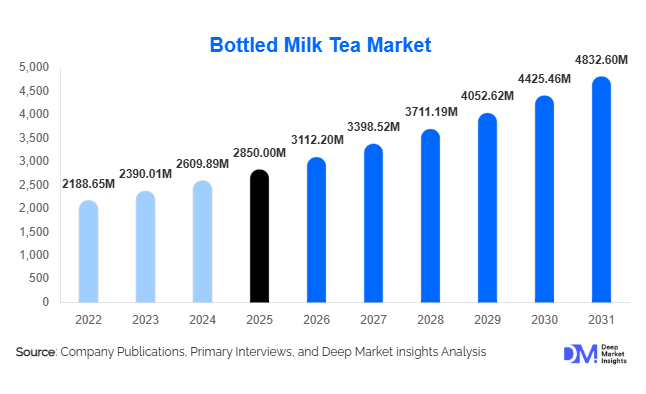
According to Deep Market Insights, the global bottled milk tea market size was valued at USD 2,850 million in 2026 and is projected to grow from USD 3,112.20 million in 2026 to reach USD 4,832.60 million by 2031, expanding at a CAGR of 9.2% during the forecast period (2026–2031). The bottled milk tea market growth is primarily driven by the rising global demand for ready-to-drink (RTD) beverages, increasing popularity of Asian tea culture, rapid urbanization, and growing consumer preference for convenient, flavored, and premium beverage options. Expanding retail distribution networks, e-commerce penetration, and continuous flavor innovation such as brown sugar, matcha, and fruit-infused milk teas are further accelerating global adoption.
Key Market Insights
- Flavored bottled milk tea dominates global consumption, with strong demand for brown sugar, matcha, and fruit-based variants among younger consumers.
- Asia-Pacific remains the largest regional market, supported by deep-rooted tea culture and strong manufacturing ecosystems in China, Japan, and Taiwan.
- North America is the fastest-growing adoption region, driven by café culture expansion and increasing popularity of Asian beverages.
- Convenience-led consumption is a key demand driver, with bottled milk tea increasingly replacing freshly prepared café beverages.
- E-commerce and quick-commerce channels are reshaping distribution, enabling rapid urban delivery and subscription-based beverage consumption.
- Health-conscious reformulations are gaining traction, with low-sugar and functional milk tea variants expanding rapidly.
Global Bottled Milk Tea Market Latest Trends
Premiumization and Flavor Innovation
Manufacturers are increasingly focusing on premium bottled milk tea offerings with innovative flavors such as brown sugar boba, roasted oolong milk tea, taro blends, and seasonal fruit infusions. This trend is reshaping the market from a mass beverage category into a premium indulgence segment. Limited-edition releases and café-inspired formulations are also driving repeat purchases and strengthening brand loyalty, particularly among Gen Z and millennial consumers.
Health-Oriented and Functional Milk Tea Products
The growing demand for healthier beverages is pushing manufacturers to introduce low-sugar, plant-based, and functional bottled milk teas enriched with probiotics, collagen, and vitamins. Clean-label formulations and reduced-calorie options are gaining traction in North America and Europe, where regulatory pressure and consumer awareness around sugar intake are increasing. This shift is expanding the consumer base beyond traditional indulgence-focused buyers.
Global Bottled Milk Tea Market Drivers
Rising Demand for Ready-to-Drink Beverages
The increasing preference for convenience-based consumption is one of the strongest growth drivers. Busy urban lifestyles are encouraging consumers to shift from freshly prepared beverages to portable bottled alternatives. Bottled milk tea fits seamlessly into on-the-go consumption habits, especially in metropolitan regions with high work-life intensity.
Global Expansion of Asian Beverage Culture
The worldwide popularity of bubble tea and Asian café culture has significantly boosted bottled milk tea demand. As Asian cuisine becomes mainstream across North America and Europe, bottled milk tea benefits from strong cultural acceptance and curiosity-driven trial among non-Asian consumers, particularly younger demographics.
Rapid Product Innovation and Branding Strategies
Continuous innovation in flavors, packaging formats, and brand positioning is accelerating market growth. Companies are investing heavily in aesthetic packaging, influencer-driven marketing, and seasonal product launches, making bottled milk tea a lifestyle beverage rather than just a functional drink.
Global Bottled Milk Tea Market Restraints
Health Concerns Over Sugar Content
High sugar levels in traditional bottled milk tea formulations are raising concerns among health-conscious consumers and regulators. Sugar taxes and labeling regulations in several countries are forcing manufacturers to reformulate products, which may increase production costs and limit flavor authenticity.
Cold Chain and Shelf Stability Limitations
Maintaining product freshness and consistency remains a challenge, particularly in emerging markets with weak cold chain infrastructure. Bottled milk tea requires controlled storage conditions in some formulations, increasing logistics costs and limiting distribution reach in rural or underdeveloped regions.
Global Bottled Milk Tea Market Opportunities
Expansion of Functional and Wellness Beverages
The integration of health-focused ingredients such as probiotics, plant-based milk, and herbal extracts presents a major opportunity. Functional bottled milk teas targeting digestion, immunity, and energy enhancement are expected to attract a broader health-conscious consumer base globally.
E-commerce and Direct-to-Consumer Growth
Digital retail platforms and quick-commerce services are transforming beverage distribution. Subscription-based models, influencer marketing, and personalized product bundles are enabling brands to build stronger consumer loyalty and increase repeat purchases.
Emerging Market Penetration
Rising disposable incomes in Southeast Asia, the Middle East, and parts of Latin America are creating new demand centers. Localization of flavors and affordable packaging strategies will help brands penetrate untapped markets and expand global reach significantly.
Report Scope
| Report Metric | Details |
|---|---|
| Market Size in 2025 | USD 2850.00 Million |
| Market Size in 2026 | USD 3112.20 Million |
| Market Size in 2031 | USD 4832.60 Million |
| CAGR | 9.2% (2026-2031) |
| Base Year for Estimation | 2025 |
| Historical Data | 2022-2024 |
| Forecast Period | 2026-2031 |
| Report Coverage | Revenue Forecast, Competitive Landscape, Supply Chain Disruption, Growth Factors, Environment & Regulatory Landscape and Trends |
| Geographies Covered | North America, Europe, APAC, Middle East and Africa, LATAM |
| Countries Covered | U.S., Canada, U.K., Germany, France, Spain, Italy, Russia, Nordic, Benelux, Rest of Europe, China, Korea, Japan, India, Australia, Singapore, Taiwan, South East Asia, Rest of Asia-Pacific, UAE, Turky, Saudi Arabia, South Africa, Egypt, Nigeria, Rest of MEA, Brazil, Mexico, Argentina, Chile, Colombia, Rest of LATAM |
Explore more data points, trends and opportunities Download Free Sample Report
Product Type Insights
The global bottled milk tea market is strongly led by flavored variants, which account for approximately 46% of total revenue. This dominance is primarily driven by continuous flavor innovation, particularly the strong consumer appeal of brown sugar, matcha, taro, and fruit-infused milk tea profiles. The expansion of café-inspired ready-to-drink formats and the growing preference for indulgent yet convenient beverages further reinforce the leadership of flavored milk tea across both developed and emerging markets. Classic milk tea continues to maintain a stable presence; however, its share is gradually being diluted as consumers increasingly shift toward differentiated and experimental flavor experiences that better align with evolving taste preferences and lifestyle-oriented consumption patterns.From a packaging perspective, PET bottles remain the dominant format, accounting for nearly 52% of the market share due to their cost efficiency, durability, and suitability for mass-market distribution. Their lightweight nature and strong compatibility with high-volume retail and convenience-driven consumption further enhance their adoption. Meanwhile, aseptic cartons and cans are gaining increasing traction, particularly within premium product lines and export-oriented supply chains, as they offer improved shelf stability, enhanced product protection, and stronger alignment with sustainability-driven packaging transitions.
Application Insights
Retail consumption continues to represent the most dominant application segment, accounting for nearly 70% of global demand. This leadership is driven by the strong consumer preference for at-home and on-the-go beverage consumption, supported by expanding retail availability and increasing penetration of ready-to-drink milk tea products across supermarkets, convenience outlets, and digital grocery platforms. The convenience factor, combined with lifestyle-driven consumption habits and rising urbanization, continues to reinforce retail as the primary growth engine for the market.Foodservice applications, including cafés, quick service restaurants, and specialty beverage chains, are witnessing steady growth through hybrid distribution models that combine dine-in experiences with take-away and packaged RTD offerings. This channel benefits from the growing café culture and the increasing popularity of branded beverage experiences. Institutional demand, although still a niche segment, is gradually expanding across airlines, corporate environments, educational institutions, and the hospitality sector, where bottled milk tea is increasingly being positioned as a premium beverage option within curated menus and service offerings.
Distribution Channel Insights
Supermarkets and hypermarkets remain the leading distribution channel, contributing approximately 38% of total market share. Their dominance is supported by strong product visibility, wide assortment availability, and the influence of impulse purchasing behavior within organized retail environments. These channels continue to serve as a critical platform for brand building and mass-market penetration, particularly in urban and semi-urban regions.Online retail is the fastest-growing distribution channel, driven by the rapid expansion of e-commerce ecosystems, quick-commerce platforms, and mobile-based grocery delivery services. The increasing consumer preference for doorstep delivery, combined with digital promotions and personalized product recommendations, is significantly accelerating online adoption. Convenience stores and vending machines continue to play an essential role within dense urban consumption networks, offering immediate accessibility and reinforcing on-the-go purchasing behavior, especially among younger consumer segments.
Explore more data points, trends and opportunities Download Free Sample Report
Bottled Milk Tea Market Segmentations
By Product Type
- Classic Milk Tea
- Flavored Milk Tea
- Functional / Health-Oriented Milk Tea
By Packaging Type
- PET Bottles
- Glass Bottles
- Cans
- Aseptic Cartons
- Tetra Pak Packaging
By Distribution Channel
- Supermarkets & Hypermarkets
- Convenience Stores
- Online Retail / E-commerce
- Specialty Tea Cafés & QSR Chains
- Vending Machines
By Sugar Content
- Regular Sugar
- Low Sugar
- Sugar-Free / Diet Variants
By End Use
- Individual / Retail Consumption
- Foodservice
- Institutional
Regional Insights
Asia-Pacific
Asia-Pacific leads the global bottled milk tea market with approximately 58% share in 2025, establishing itself as the core production and consumption hub for the category. China accounts for nearly 32% of global consumption, followed by Japan, South Korea, and Taiwan. The region’s leadership is strongly supported by deep-rooted tea culture, high per capita tea consumption, and continuous product innovation driven by established beverage ecosystems. Rapid urbanization, rising disposable incomes, and the strong influence of bubble tea and café-style beverage culture are further accelerating demand. Additionally, the presence of advanced manufacturing capabilities and highly efficient supply chains enables large-scale production and widespread domestic and international distribution, reinforcing Asia-Pacific’s dominant position in the global market.
North America
North America holds approximately 18% of the global market share, with the United States representing the primary demand center. Growth in the region is driven by the increasing influence of Asian culinary culture, expanding café and specialty beverage chains, and the rising popularity of ready-to-drink Asian-inspired beverages. Consumer preferences are increasingly shifting toward convenient, flavored, and premium beverage experiences, supported by a strong culture of on-the-go consumption. The growing focus on functional and better-for-you beverages, combined with innovation in dairy and plant-based milk tea alternatives, continues to strengthen market expansion across the region.
Europe
Europe accounts for around 14% of the global market, with key demand concentrated in the United Kingdom, Germany, and France. Regional growth is driven by multicultural urban populations, increasing exposure to global beverage trends, and rising demand for premium, clean-label, and health-oriented drinks. Sustainability considerations are also playing a significant role in shaping product innovation and packaging choices, encouraging manufacturers to adopt environmentally responsible materials and production practices. The expanding interest in Asian-inspired beverages among younger demographics further supports steady market penetration across European urban centers.
Latin America
Latin America contributes approximately 6% to the global market, with Brazil and Mexico emerging as the key demand drivers. Growth in the region is supported by rapid urbanization, a growing young population, and increasing exposure to international food and beverage trends. The adoption of bottled milk tea is being influenced by Westernized consumption patterns, expanding modern retail infrastructure, and the rising popularity of convenient, ready-to-drink beverages. Affordability and accessibility remain important factors, with manufacturers focusing on localized flavor adaptations to strengthen regional acceptance.
Middle East & Africa
The Middle East & Africa region holds nearly 4% of the global market share, with the United Arab Emirates and Saudi Arabia leading consumption. Market growth is primarily driven by a high expatriate population, strong tourism activity, and the rapid expansion of premium retail and hospitality sectors. Hot climatic conditions further support demand for chilled and refreshing beverage options, positioning bottled milk tea as an attractive alternative within the ready-to-drink category. Increasing investment in modern retail infrastructure and the growing presence of international foodservice brands are further enhancing product visibility and regional market penetration.
Key Players in the Global Bottled Milk Tea Market
- Uni-President Enterprises
- Tingyi (Master Kong)
- Nongfu Spring
- Vitasoy
- Ito En
- PepsiCo
- The Coca-Cola Company
- Suntory Beverage & Food
- F&N Foods
- Wahaha
- Pokka Sapporo
- TH Milk
- Amul
- Lipton (Ekaterra)
- Yakult Honsha