Global Pumpkin Ale Market Size
According to Deep Market Insights, the global pumpkin ale market size was valued at USD 842.6 million in 2026 and is projected to grow from USD 916.75 million in 2027 to reach USD 1397.64 million by 2031, expanding at a CAGR of 8.8% during the forecast period (2026–2031). The market growth is primarily driven by rising consumer preference for craft and seasonal beers, increasing premiumization of alcoholic beverages, expanding distribution through retail and e-commerce channels, and continuous innovation in flavor profiles and limited-edition brewing formats.
Key Market Insights
- Craft breweries dominate global production, accounting for nearly 69% share, as consumers increasingly prefer authentic, small-batch seasonal beers.
- North America leads global demand, supported by strong seasonal beer culture and high concentration of craft breweries in the United States.
- Asia-Pacific is the fastest-growing region, driven by rising disposable income, urbanization, and growing acceptance of imported craft beers.
- Aluminum cans are replacing glass bottles due to sustainability benefits, lower logistics costs, and growing e-commerce penetration.
- Millennials remain the largest consumer group, while Generation Z is emerging as the fastest-growing demographic for flavored alcoholic beverages.
- Foodservice & hospitality is the fastest-growing end-use segment, driven by seasonal menus and premium beer pairings in restaurants and bars.
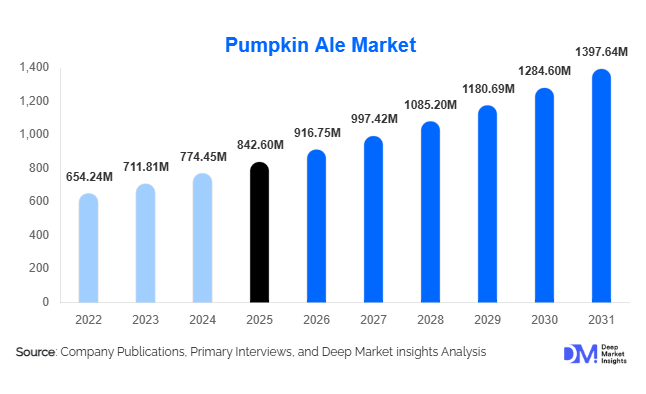
global pumpkin ale market latest trends
Seasonal Premiumization and Limited-Edition Innovation
The global pumpkin ale market is increasingly shifting toward premium and limited-edition offerings. Breweries are focusing on barrel-aged variants, imperial pumpkin ales, organic formulations, and specialty spice blends incorporating cinnamon, nutmeg, vanilla, and maple. This trend is driven by consumer willingness to pay higher prices for exclusivity and authenticity. Seasonal scarcity continues to play a critical role in boosting demand, as consumers actively anticipate autumn releases. Breweries are also extending seasonal availability windows, allowing pumpkin ale to transition from a strictly autumn product into a longer-duration specialty category.
Expansion of Digital Sales and Direct-to-Consumer Channels
E-commerce platforms and brewery direct-to-consumer (DTC) sales are reshaping distribution dynamics in the pumpkin ale market. Online alcohol marketplaces, subscription beer clubs, and mobile ordering systems have significantly improved accessibility. Breweries are leveraging digital marketing campaigns to pre-sell seasonal batches and build consumer anticipation ahead of peak demand periods. Social media engagement and influencer-driven promotions are further strengthening brand visibility. This shift toward digital channels is especially important in urban markets where consumers increasingly prefer convenience and home delivery of premium alcoholic beverages.
global pumpkin ale market drivers
Rising Demand for Craft and Flavored Beers
One of the strongest growth drivers is the rising global demand for craft beer and flavored alcoholic beverages. Consumers, especially younger demographics, are moving away from mass-produced lagers toward unique and experimental beer styles. Pumpkin ale benefits from its seasonal identity and flavor complexity, making it a preferred choice among craft beer enthusiasts. Breweries are expanding portfolios with innovative variants such as pumpkin IPA, pumpkin stout, and spice-infused ales, further boosting category expansion.
Expansion of Retail and Hospitality Distribution Networks
The growing presence of supermarkets, specialty liquor stores, e-commerce platforms, and hospitality outlets has significantly improved product availability. Seasonal shelf placements during autumn festivals, Halloween, and Thanksgiving periods create strong retail visibility. Additionally, restaurants, pubs, and hotels are increasingly incorporating pumpkin ale into seasonal menus, enhancing on-premise consumption. This omnichannel expansion ensures higher market penetration across both developed and emerging economies.
global pumpkin ale market restraints
Strong Seasonality Limiting Year-Round Sales
The pumpkin ale market is heavily seasonal, with the majority of sales concentrated during autumn months, particularly in North America and Europe. This creates challenges in production planning, inventory management, and revenue stability for breweries. Outside the peak season, demand drops significantly, limiting year-round profitability. While some breweries are attempting to extend availability periods, consumer association of pumpkin ale with fall remains a structural limitation.
Raw Material Price Volatility and Regulatory Pressure
Fluctuations in the cost of pumpkins, malted barley, hops, spices, packaging materials, and energy significantly impact production costs. Climate variability further affects agricultural yields, creating supply instability. Additionally, strict alcohol regulations, taxation policies, labeling requirements, and advertising restrictions in multiple countries increase compliance costs. These factors collectively constrain profitability, particularly for small and mid-sized craft breweries.
global pumpkin ale industry key opportunities
Expansion into Emerging International Markets
Emerging economies in Asia-Pacific and Latin America present strong growth opportunities for pumpkin ale producers. Rising disposable incomes, urbanization, and increasing exposure to Western craft beer culture are driving demand for premium imported beverages. Countries such as China, India, Japan, South Korea, Brazil, and Mexico are witnessing increasing acceptance of specialty beer categories. Strategic distribution partnerships and localized marketing campaigns can significantly enhance global expansion opportunities.
Growth of Sustainable and Organic Brewing Practices
Sustainability is becoming a key differentiator in the global beer industry. Consumers increasingly prefer environmentally responsible brands using organic ingredients, recyclable packaging, and energy-efficient brewing processes. Pumpkin ale producers adopting sustainable sourcing of pumpkins and spices, along with carbon-neutral brewing practices, are gaining competitive advantage. Retailers are also prioritizing sustainable suppliers, making eco-friendly production an important long-term growth opportunity.
Report Scope
| Report Metric | Details |
|---|---|
| Market Size in 2025 | USD 842.60 Million |
| Market Size in 2026 | USD 916.75 Million |
| Market Size in 2031 | USD 1397.64 Million |
| CAGR | 8.8% (2026-2031) |
| Base Year for Estimation | 2025 |
| Historical Data | 2022-2024 |
| Forecast Period | 2026-2031 |
| Report Coverage | Revenue Forecast, Competitive Landscape, Supply Chain Disruption, Growth Factors, Environment & Regulatory Landscape and Trends |
| Geographies Covered | North America, Europe, APAC, Middle East and Africa, LATAM |
| Countries Covered | U.S., Canada, U.K., Germany, France, Spain, Italy, Russia, Nordic, Benelux, Rest of Europe, China, Korea, Japan, India, Australia, Singapore, Taiwan, South East Asia, Rest of Asia-Pacific, UAE, Turky, Saudi Arabia, South Africa, Egypt, Nigeria, Rest of MEA, Brazil, Mexico, Argentina, Chile, Colombia, Rest of LATAM |
Explore more data points, trends and opportunities Download Free Sample Report
Product Type Insights
The pumpkin ale market is segmented into traditional pumpkin ale, pumpkin stout, pumpkin porter, pumpkin India Pale Ale (IPA), pumpkin sour ale, farmhouse-style pumpkin ale, and other specialty seasonal variants. Traditional pumpkin ale continues to dominate the global market owing to its strong consumer recognition, long-standing seasonal appeal, and widespread availability across retail and on-premise channels. Its balanced combination of pumpkin flavor, warming spices, and moderate alcohol content aligns closely with consumer preferences during autumn festivities, making it the preferred choice among both loyal craft beer enthusiasts and casual seasonal consumers. The segment's leadership is further supported by recurring annual product launches from established breweries, strong brand loyalty, extensive promotional campaigns during the fall season, and broad shelf presence in supermarkets, liquor stores, and brewery taprooms. Meanwhile, pumpkin stout and pumpkin porter are witnessing steady demand in premium markets due to their rich roasted malt characteristics and higher alcohol content, appealing to consumers seeking more complex flavor profiles. Pumpkin IPA has emerged as one of the fastest-growing categories as younger consumers increasingly gravitate toward hop-forward and experimental craft beer styles. At the same time, pumpkin sour ales and farmhouse-inspired variants continue to expand within niche craft beer communities, driven by innovation in fermentation techniques, barrel aging, specialty spice blends, and limited-edition seasonal releases. Continuous product innovation across all beer styles is enabling breweries to differentiate their offerings, command premium pricing, and attract consumers seeking unique seasonal drinking experiences.
Application Insights
The pumpkin ale market is categorized into household consumption, foodservice and hospitality, entertainment venues and festivals, corporate and institutional events, and export applications. Household consumption remains the dominant application segment, as consumers traditionally purchase pumpkin ale for personal enjoyment during the autumn season, family gatherings, Halloween celebrations, Thanksgiving festivities, and other seasonal occasions. The segment benefits from increasing at-home premium beverage consumption, greater availability of seasonal products through retail channels, and growing consumer preference for craft beverages that enhance festive experiences. Foodservice and hospitality applications continue to expand as restaurants, gastropubs, breweries, hotels, and premium bars increasingly incorporate seasonal craft beers into their beverage menus to attract customers seeking limited-time offerings. Entertainment venues, beer festivals, and seasonal events further contribute to market growth by promoting experiential consumption and encouraging product sampling. Corporate functions, private celebrations, and institutional events are also adopting premium craft beer selections to elevate guest experiences. Additionally, export applications are growing steadily as international distributors and specialty retailers import seasonal pumpkin ales to satisfy rising global demand for premium American-style craft beverages.
Distribution Channel Insights
The market is segmented into supermarkets and hypermarkets, specialty liquor stores, e-commerce platforms, brewery taprooms, convenience stores, and other retail channels. Supermarkets and hypermarkets account for the largest market share due to their extensive product assortment, strong seasonal merchandising strategies, widespread geographic presence, and ability to generate high sales volumes during the autumn season. The leading position of this segment is further supported by high consumer footfall, attractive promotional campaigns, convenient one-stop shopping experiences, and strategic placement of seasonal beverage displays that encourage impulse purchases. Specialty liquor stores remain important distribution channels for premium, limited-edition, and craft-exclusive pumpkin ale offerings, serving consumers seeking greater product variety and expert recommendations. E-commerce and direct-to-consumer sales continue to record robust growth as digital purchasing behavior accelerates and breweries expand their online retail capabilities. Brewery taprooms also play a significant role by offering exclusive seasonal releases, fresh small-batch products, tasting experiences, and direct consumer engagement that strengthen brand loyalty. The continued integration of omnichannel retail strategies is improving product accessibility, expanding consumer reach, and supporting sustained market growth across developed and emerging regions.
Consumer Insights
The pumpkin ale market is segmented into Millennials, Generation Z, Generation X, and Baby Boomers and older consumers. Millennials represent the largest consumer segment due to their strong affinity for craft beverages, willingness to explore seasonal and premium products, and preference for authentic brand experiences. The dominance of this segment is driven by higher spending on premium alcoholic beverages, growing participation in social gatherings and seasonal celebrations, increasing interest in locally brewed craft beers, and a strong appreciation for innovative flavor combinations. Generation Z is emerging as the fastest-growing consumer group, supported by social media influence, digital marketing campaigns, and increasing demand for unique and experimental beverage experiences. Generation X continues to maintain stable demand for both traditional and premium pumpkin ale products, reflecting its purchasing power and preference for quality seasonal offerings. Meanwhile, older consumers generally favor classic pumpkin ale styles with familiar flavor profiles and tend to make selective but premium seasonal purchases. Across all consumer groups, purchasing decisions are increasingly influenced by product authenticity, sustainable brewing practices, premium ingredients, locally sourced raw materials, attractive packaging, and memorable seasonal consumption experiences.
Explore more data points, trends and opportunities Download Free Sample Report
Pumpkin Ale Market Segmentations
By Product Type
- Traditional Pumpkin Ale
- Pumpkin IPA
- Pumpkin Stout
- Pumpkin Porter
- Pumpkin Sour Ale
- Farmhouse & Specialty Pumpkin Ale
By Application
- Household Consumption
- Foodservice & Hospitality
- Entertainment & Festival Events
- Corporate & Institutional Events
- Export & International Trade
By Distribution Channel
- Supermarkets & Hypermarkets
- Specialty Liquor Stores
- Convenience Stores
- E-commerce & Direct-to-Consumer
- Brewery Taprooms
By Consumer
- Generation Z
- Millennials
- Generation X
- Baby Boomers
Regional Insights
North America
North America dominates the global pumpkin ale market, with the United States accounting for the largest regional share, followed by Canada. The region benefits from a highly developed craft brewing industry, deeply rooted seasonal consumption traditions, and strong consumer awareness of specialty beer styles. Pumpkin ale has become an integral part of autumn culture, particularly during Halloween, Thanksgiving, Oktoberfest celebrations, and other seasonal festivities, creating recurring annual demand. The region also enjoys well-established distribution networks, high disposable incomes, and continuous product innovation from both multinational breweries and independent craft producers. Regional growth is primarily driven by the expansion of craft breweries, increasing consumer preference for premium seasonal beverages, strong participation in beer festivals, frequent limited-edition product launches, growing demand for locally brewed products, and continuous innovation in flavor profiles, brewing techniques, and packaging formats.
Europe
Europe represents a mature yet steadily expanding market, led by the United Kingdom, Germany, France, Belgium, and the Netherlands. Consumers across the region are increasingly embracing American-style craft beers, including pumpkin ale, as part of broader premium and specialty beverage trends. Europe's long-established beer culture, high purchasing power, sophisticated retail infrastructure, and growing appreciation for imported craft beverages continue to support market development. Regional breweries are also introducing pumpkin-inspired seasonal offerings tailored to local taste preferences. Market growth is driven by rising consumer interest in premium craft beer experiences, increasing imports of specialty seasonal beverages, expanding craft brewery investments, growing tourism, higher spending on premium alcoholic drinks, and greater availability of seasonal products through both on-premise and off-premise distribution channels.
Asia-Pacific
Asia-Pacific is the fastest-growing regional market, driven by Japan, China, India, South Korea, and Australia. Rapid urbanization, rising disposable incomes, expanding middle-class populations, and increasing exposure to international food and beverage trends are accelerating demand for premium imported craft beers, including pumpkin ale. Japan remains the leading premium consumption market due to its mature craft beer industry and consumer willingness to pay for high-quality specialty beverages, while China and India are emerging as major growth opportunities because of expanding young adult populations and evolving drinking preferences. Australia and South Korea continue to strengthen regional demand through vibrant craft brewing sectors and premium hospitality industries. Regional growth is supported by increasing westernization of consumer lifestyles, rapid expansion of craft breweries, growing hospitality and tourism sectors, wider retail availability of imported beers, rising e-commerce penetration, and increasing consumer demand for unique seasonal beverage experiences.
Latin America
Latin America is gradually emerging as an attractive market for pumpkin ale, led by Brazil, Mexico, Argentina, and Chile. The region is witnessing continuous growth in craft beer consumption as consumers increasingly seek premium, differentiated, and imported alcoholic beverages. Brazil represents the largest regional market due to its expanding network of microbreweries, growing urban consumer base, and rising interest in specialty seasonal beers. Mexico, Argentina, and Chile are also experiencing increasing adoption of craft beer culture through premium restaurants, specialty retailers, and independent breweries. Regional market growth is driven by expanding craft brewing investments, rising disposable incomes, increasing urbanization, greater consumer awareness of premium international beer styles, expanding tourism, and the growing presence of specialty beverage retailers and hospitality establishments.
Middle East & Africa
The Middle East & Africa remains a relatively niche market due to varying regulatory environments governing alcoholic beverages; however, premium tourism-driven destinations continue to create growth opportunities. South Africa leads regional consumption through its well-developed craft beer industry and expanding premium beverage market, while the United Arab Emirates and several Gulf countries generate demand through luxury hotels, international restaurants, expatriate communities, and tourism-related hospitality services. Although overall consumption remains comparatively limited, premium imported seasonal beers are gradually gaining visibility among affluent consumers. Regional growth is supported by expanding tourism activities, increasing investments in luxury hospitality, rising demand for premium imported beverages within permitted markets, growing craft beer awareness, and continued development of upscale restaurants, hotels, and entertainment venues catering to international visitors.
Key Players in the Global Pumpkin Ale Market
- Boston Beer Company
- Elysian Brewing
- New Belgium Brewing
- Shipyard Brewing Company
- Anheuser-Busch InBev
- Sierra Nevada Brewing Co.
- Schlafly Beer
- Rogue Ales & Spirits
- Southern Tier Brewing Company
- Avery Brewing Company