Global Kaoliang Liquor Market Size
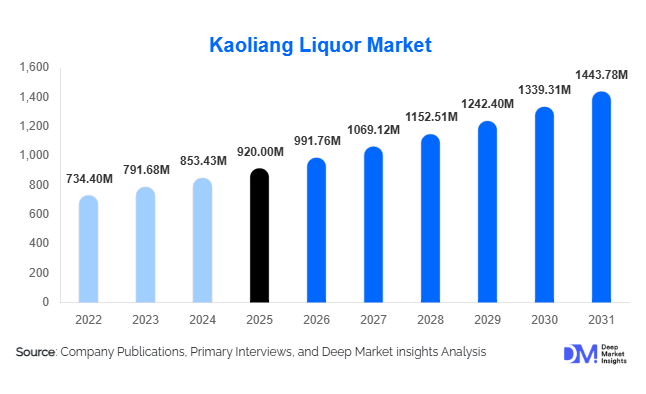
According to Deep Market Insights, the global Kaoliang liquor market size was valued at USD 920 million in 2026 and is projected to grow from USD 991.76 million in 2026 to reach USD 1,443.78 million by 2031, expanding at a CAGR of 7.8% during the forecast period (2026–2031). The market growth is primarily driven by rising global demand for premium Asian spirits, increasing consumer preference for heritage-based alcoholic beverages, and the rapid expansion of export channels including duty-free retail, e-commerce platforms, and international hospitality adoption.
Key Market Insights
- Premiumization is the dominant market force, with aged and collectible Kaoliang variants driving disproportionate revenue compared to volume-based products.
- Asia-Pacific dominates global consumption, led by China and Taiwan, which collectively account for the majority of demand and production.
- Hospitality and mixology adoption is accelerating, with global bars increasingly integrating Kaoliang into modern cocktail menus.
- Export demand is rising steadily, particularly in the United States, Japan, Singapore, and Europe, supported by diaspora and premium spirits interest.
- E-commerce and duty-free channels are expanding rapidly, enabling premium product accessibility across global markets.
Kaoliang Liquor Market Latest Trends
Premiumization and Collectible Spirit Growth
The Kaoliang liquor market is witnessing a strong shift toward premium and ultra-premium products, including aged variants, limited editions, and heritage packaging. Consumers are increasingly associating value with aging time, craftsmanship, and exclusivity rather than volume-based consumption. This trend mirrors global whisky and cognac markets, where scarcity and brand storytelling significantly enhance pricing power and consumer loyalty. Premium gifting culture in East Asia further reinforces this trend, especially during festivals, weddings, and corporate events.
Global Expansion of Asian Spirits in Mixology
Kaoliang liquor is gradually entering global cocktail culture, particularly in high-end bars and Asian fusion restaurants across North America, Europe, and developed Asia-Pacific markets. Bartenders are experimenting with Kaoliang due to its high alcohol content and distinctive flavor profile, positioning it as a substitute for other high-proof spirits. This evolution is expanding consumer awareness beyond traditional markets and helping reposition Kaoliang as a modern premium spirit rather than a niche regional beverage.
Digital Commerce and Travel Retail Expansion
E-commerce platforms and duty-free retail channels are playing a transformative role in Kaoliang distribution. Online alcohol marketplaces now enable global consumers to access premium imported spirits directly, while airports and travel retail hubs act as key first-touchpoints for international consumers. Tourism-driven purchases often convert into long-term demand, making travel retail a strategic growth channel for manufacturers.
Kaoliang Liquor Market Drivers
Rising Global Demand for Premium Spirits
The global shift toward premium alcoholic beverages is a major growth driver for the Kaoliang liquor market. Consumers are increasingly willing to pay higher prices for authenticity, heritage, and craftsmanship. This has significantly benefited aged and premium Kaoliang segments, which command strong margins and growing demand across both domestic and export markets.
Expansion of Export and International Awareness
Increasing globalization of Asian cuisine and beverage culture has improved awareness of Kaoliang liquor internationally. Strategic marketing efforts, collaborations with global mixologists, and expansion into luxury hospitality channels are supporting international adoption. Key markets such as the United States, Japan, and the United Kingdom are witnessing steady growth in premium Kaoliang imports.
Growth of E-commerce and Direct-to-Consumer Sales
The rise of digital retail platforms has enabled manufacturers to reach global consumers directly without relying solely on traditional distributors. Online sales of premium spirits, subscription-based alcohol delivery services, and targeted digital marketing campaigns are helping expand consumer base, particularly among younger, tech-savvy demographics.
Kaoliang Liquor Market Restraints
Limited Global Awareness and Strong Regional Concentration
Despite growing exports, Kaoliang liquor remains heavily concentrated in China and Taiwan. Limited familiarity in Western markets restricts large-scale adoption. Consumers often perceive it as a strong and niche spirit, which slows mainstream penetration compared to whisky or vodka.
Regulatory Barriers and High Alcohol Restrictions
International expansion is constrained by varying alcohol import regulations, high taxation in certain countries, and strict labeling requirements. Additionally, high alcohol content can limit marketing and retail placement in several global markets, creating challenges for brand visibility and consumer trial.
Kaoliang Liquor Industry Key Opportunities
Expansion into Luxury Hospitality and Fine Dining
The growing number of premium restaurants and luxury hotels worldwide presents a significant opportunity for Kaoliang liquor adoption. Integration into curated beverage menus and cocktail programs allows brands to reach affluent consumers in experiential settings, improving trial rates and brand recognition.
Tourism-Driven Brand Exposure
Distillery tourism, airport duty-free retail, and cultural heritage branding are creating strong consumer exposure opportunities. Visitors who experience Kaoliang liquor during travel often become repeat buyers in their home countries, making tourism a powerful long-term demand driver.
Report Scope
| Report Metric | Details |
|---|---|
| Market Size in 2025 | USD 920.00 Million |
| Market Size in 2026 | USD 991.76 Million |
| Market Size in 2031 | USD 1443.78 Million |
| CAGR | 7.8% (2026-2031) |
| Base Year for Estimation | 2025 |
| Historical Data | 2022-2024 |
| Forecast Period | 2026-2031 |
| Report Coverage | Revenue Forecast, Competitive Landscape, Supply Chain Disruption, Growth Factors, Environment & Regulatory Landscape and Trends |
| Geographies Covered | North America, Europe, APAC, Middle East and Africa, LATAM |
| Countries Covered | U.S., Canada, U.K., Germany, France, Spain, Italy, Russia, Nordic, Benelux, Rest of Europe, China, Korea, Japan, India, Australia, Singapore, Taiwan, South East Asia, Rest of Asia-Pacific, UAE, Turky, Saudi Arabia, South Africa, Egypt, Nigeria, Rest of MEA, Brazil, Mexico, Argentina, Chile, Colombia, Rest of LATAM |
Explore more data points, trends and opportunities Download Free Sample Report
Product Type Insights
The premium and aged Kaoliang liquor segment dominates the global Kaoliang liquor market, accounting for the largest share of revenue due to its superior quality, extended aging process, rich flavor profile, and strong association with cultural heritage and prestige. Premium variants are widely preferred for ceremonial occasions, festive celebrations, corporate gifting, and luxury consumption, particularly across China and Taiwan where premium baijiu products symbolize prosperity, respect, and social status. Rising disposable incomes, increasing consumer preference for authentic premium spirits, and growing demand for collectible alcoholic beverages continue to strengthen this segment. Limited-edition and vintage Kaoliang liquor releases further enhance market value by attracting collectors and high-net-worth consumers seeking exclusive products. Traditional Kaoliang liquor continues to account for substantial consumption volumes owing to its affordability and widespread acceptance in domestic markets. Meanwhile, flavored, infused, and lower-alcohol variants are witnessing increasing popularity among younger consumers and international drinkers looking for smoother taste profiles and modern drinking experiences. Manufacturers are continuously introducing innovative flavors and contemporary packaging to broaden consumer appeal while maintaining the traditional identity of Kaoliang liquor. The emergence of ultra-premium collectible editions, particularly through luxury retail and duty-free channels, is creating attractive high-margin opportunities for producers seeking product differentiation and premium brand positioning.
Application Insights
Household consumption remains the dominant application segment in the global Kaoliang liquor market, primarily driven by deep-rooted cultural traditions, family celebrations, religious ceremonies, weddings, festivals, and gifting customs throughout East Asia. The segment continues to lead due to the strong role Kaoliang liquor plays during major holidays and social gatherings, where it is regarded as a symbol of hospitality, celebration, and respect. Rising disposable income, increasing spending on premium alcoholic beverages, and growing consumer appreciation for traditional spirits further reinforce household demand. Hospitality represents the fastest-growing application segment as luxury hotels, premium restaurants, bars, and cocktail lounges increasingly incorporate Kaoliang liquor into innovative beverage offerings and signature cocktails. The expanding premium dining industry, international tourism, and growing consumer interest in authentic Asian spirits are accelerating adoption across hospitality establishments worldwide. Corporate and institutional consumption maintains stable growth, supported by business banquets, executive gifting, official events, and corporate celebrations, particularly across China and Taiwan where premium spirits continue to play an important role in professional relationship-building and ceremonial occasions.
Distribution Channel Insights
Specialty liquor stores and duty-free outlets collectively dominate the distribution landscape due to their ability to offer extensive premium product portfolios, expert customer guidance, product authenticity, and exclusive limited-edition offerings. These channels remain the preferred purchasing destination for premium Kaoliang liquor buyers seeking aged, collectible, and imported products. Duty-free stores also benefit from strong international traveler demand and luxury gifting purchases, particularly across major international airports in Asia-Pacific. Online retail is emerging as the fastest-growing distribution channel, driven by increasing consumer preference for convenient shopping, expanding cross-border e-commerce platforms, wider product accessibility, secure digital payment infrastructure, and improving alcohol e-commerce regulations in several countries. Digital marketing, personalized recommendations, and direct consumer engagement are enabling brands to strengthen online sales while expanding their international customer base. Direct-to-consumer sales are also experiencing significant growth as manufacturers invest in branded e-commerce websites, premium membership programs, digital brand experiences, and international fulfillment capabilities, allowing producers to improve customer loyalty, strengthen brand positioning, and achieve higher profit margins through reduced reliance on traditional retail intermediaries.
Explore more data points, trends and opportunities Download Free Sample Report
Kaoliang Liquor Market Segmentations
By Product Type
- Traditional Kaoliang Liquor
- Premium & Aged Kaoliang Liquor
- Flavored Kaoliang Liquor
- Low-Alcohol Kaoliang Liquor
- Ultra-Premium & Collectible Kaoliang Liquor
By Application
- Household Consumption
- Hospitality (Hotels, Restaurants & Bars)
- Corporate & Institutional Gifting
- Duty-Free & Travel Retail
- Special Events & Ceremonies
By Distribution Channel
- Specialty Liquor Stores
- Supermarkets & Hypermarkets
- Online Retail
- Duty-Free Stores
- Direct-to-Consumer (D2C)
- Convenience Stores
Regional Insights
Asia-Pacific
Asia-Pacific dominates the global Kaoliang liquor market and represents the largest revenue-generating region, led by China and Taiwan, where Kaoliang liquor has deep cultural, historical, and economic significance. Strong consumer preference for traditional grain spirits, extensive use during festivals and family celebrations, growing premiumization trends, and increasing demand for luxury gifting continue to drive regional market expansion. Taiwan serves as a major production and export hub, supported by internationally recognized distilleries, established manufacturing expertise, and strong export networks across Asia and other international markets. China contributes the largest consumption volume owing to its vast consumer base, rising disposable income, expanding middle-class population, and enduring demand for premium traditional spirits during social and business occasions. Government support for food and beverage exports, expanding tourism, growing duty-free retail, and increasing international recognition of premium Asian spirits further strengthen the region's long-term growth prospects.
North America
North America represents one of the fastest-growing regional markets, primarily driven by the United States and Canada. Rising multicultural populations, expanding Asian diaspora communities, increasing consumer interest in premium imported spirits, and growing appreciation for authentic international alcoholic beverages are supporting market growth. The rapid expansion of craft cocktail culture, premium bars, luxury restaurants, and fine dining establishments has encouraged bartenders and mixologists to incorporate Kaoliang liquor into innovative cocktail menus. Increasing availability through specialty liquor retailers, online alcohol platforms, and premium hospitality venues, combined with rising disposable income and growing consumer willingness to explore niche spirits, continues to accelerate regional demand. Import partnerships and marketing initiatives focused on educating consumers about traditional Asian spirits are expected to further support market expansion.
Europe
Europe is witnessing steady market growth, led by the United Kingdom, Germany, France, and several Western European countries where consumer interest in premium imported spirits continues to increase. Growing popularity of Asian cuisine, expanding Asian fusion restaurants, and the development of premium cocktail culture have significantly improved awareness and consumption of Kaoliang liquor. Rising demand for authentic international spirits, increasing premiumization within the alcoholic beverage industry, and growing participation in experiential drinking trends are encouraging distributors to expand product availability across retail and hospitality channels. Strong tourism activity, international food festivals, and premium beverage exhibitions further contribute to market development, while increasing consumer preference for unique, heritage-based spirits supports long-term regional growth.
Middle East & Africa
The Middle East & Africa market remains relatively niche but is experiencing gradual expansion, particularly across the United Arab Emirates and South Africa. Growth is primarily supported by expanding luxury hospitality infrastructure, increasing international tourism, premium hotel developments, and the presence of large duty-free retail networks serving international travelers. Rising numbers of expatriates, business travelers, and affluent consumers seeking premium imported alcoholic beverages are contributing to demand where alcohol regulations permit consumption. The development of upscale restaurants, luxury resorts, and international dining destinations continues to create opportunities for premium Kaoliang liquor brands. Growing airport retail sales and premium gifting demand further support regional market expansion.
Latin America
Latin America represents an emerging market with gradually increasing demand, primarily led by Brazil and Mexico. Market growth is driven by expanding urban middle-class populations, increasing exposure to international food and beverage cultures, and growing demand for premium imported spirits among affluent consumers. The expansion of luxury hotels, premium restaurants, and upscale cocktail bars has created favorable opportunities for introducing Kaoliang liquor to consumers seeking distinctive alcoholic beverages. Rising tourism, increasing disposable incomes, greater availability through specialty liquor retailers, and growing interest in premium international spirits are expected to support steady long-term market development across the region. Strategic distribution partnerships and expanding import networks are also improving product accessibility and strengthening future growth opportunities.
Key Players in the Kaoliang Liquor Market
- Kinmen Kaoliang Liquor Inc.
- Taiwan Tobacco & Liquor Corporation
- Kweichow Moutai Co., Ltd.
- Wuliangye Yibin Co., Ltd.
- Luzhou Laojiao Co., Ltd.
- Yanghe Distillery Co., Ltd.
- Shanxi Xinghuacun Fen Wine Factory
- Gujing Distillery Co., Ltd.
- Guizhou Guotai Liquor Group
- Sichuan Jiannanchun Group