Spirulina Market Size
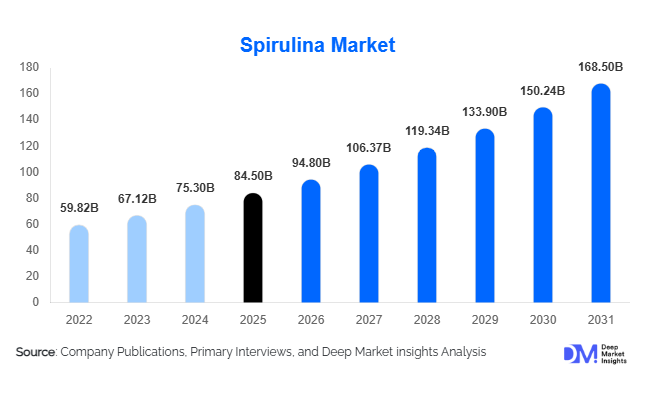
According to Deep Market Insights, the global spirulina market size was valued at USD 84.5 billion in 2025 and is projected to grow from USD 94.8 billion in 2026 to reach USD 168.5 billion by 2031, expanding at a CAGR of 12.2% during the forecast period (2026–2031). The spirulina market growth is primarily driven by increasing demand for plant-based proteins, rising consumer preference for preventive healthcare products, growing adoption of clean-label ingredients, and expanding applications of spirulina across nutraceuticals, food and beverages, cosmetics, pharmaceuticals, and animal nutrition industries.
Key Market Insights
- Spirulina is increasingly being adopted as a sustainable alternative protein source, driven by rising vegan populations and environmental concerns associated with traditional animal proteins.
- Nutraceuticals and dietary supplements dominate the market, supported by strong consumer demand for immunity boosters, sports nutrition products, detox supplements, and wellness-focused formulations.
- North America remains the largest market, led by high dietary supplement consumption, strong e-commerce penetration, and increasing demand for functional superfoods.
- Asia-Pacific is the fastest-growing region, driven by expanding spirulina cultivation capacities in China and India alongside rising regional health awareness.
- Natural food colorant applications are accelerating globally, with spirulina-derived phycocyanin increasingly replacing synthetic blue dyes in beverages, confectionery, and dairy products.
- Technological advancements in photobioreactor cultivation and algae extraction are improving product purity, scalability, contamination control, and commercial profitability.
spirulina market latest trends
Natural Food Colorants Driving New Demand
The increasing global shift away from synthetic food additives is significantly accelerating demand for spirulina-derived natural pigments. Phycocyanin, the natural blue pigment extracted from spirulina, is increasingly used in confectionery, dairy products, beverages, frozen desserts, and functional foods. Regulatory scrutiny surrounding artificial food dyes in North America and Europe is encouraging major food manufacturers to reformulate products using natural alternatives. Spirulina extracts are becoming particularly attractive because they provide vibrant coloration while simultaneously supporting clean-label positioning and nutritional enhancement. Food brands are also utilizing spirulina pigments to improve consumer perception regarding sustainability and ingredient transparency. Investments in advanced extraction technologies and pigment stabilization techniques are increasing rapidly as companies seek to improve heat stability, shelf life, and scalability of natural spirulina colorants.
Rise of Premium Organic Spirulina Products
Organic spirulina is rapidly emerging as one of the fastest-growing segments within the global market. Consumers increasingly prefer non-GMO, pesticide-free, and sustainably cultivated algae-based ingredients that align with wellness and environmental goals. Premium spirulina brands are focusing on organic certifications, traceable sourcing, and environmentally friendly cultivation systems to attract health-conscious consumers. This trend is particularly strong in the United States, Germany, France, Japan, and South Korea, where consumers are willing to pay premium prices for high-purity algae supplements. Companies are also launching spirulina gummies, flavored powders, capsules, and ready-to-drink wellness beverages targeted toward mainstream retail consumers. E-commerce platforms are playing a critical role in accelerating adoption of branded premium spirulina products globally.
spirulina market drivers
Growing Demand for Plant-Based Protein and Functional Nutrition
The rapid global expansion of vegan, vegetarian, and flexitarian diets is significantly supporting spirulina demand across food, beverage, and nutraceutical industries. Spirulina contains approximately 55–70% protein concentration along with essential amino acids, antioxidants, vitamins, and minerals, making it one of the most nutrient-dense plant-based ingredients commercially available. Food manufacturers are increasingly integrating spirulina into protein powders, energy bars, meal replacements, dairy alternatives, and functional beverages to meet rising consumer demand for sustainable nutrition. Growing interest in preventive healthcare and active lifestyles is also accelerating consumption of spirulina-based immunity boosters, detox products, and sports nutrition supplements. The ingredient’s sustainable cultivation profile, requiring less land and water compared to traditional agriculture, further strengthens its adoption within environmentally conscious food systems.
Expansion of Clean-Label and Natural Ingredient Markets
Consumers globally are increasingly prioritizing clean-label products with recognizable, minimally processed ingredients. Spirulina aligns strongly with these preferences due to its natural nutritional profile and multifunctional application potential. Food manufacturers are replacing synthetic additives and artificial colors with algae-derived ingredients to improve product positioning and comply with evolving regulatory requirements. In cosmetics, spirulina’s antioxidant and anti-inflammatory properties are supporting increased use in anti-aging skincare, natural haircare, and wellness-oriented personal care formulations. Governments and regulatory agencies are also encouraging sustainable and natural ingredient usage, indirectly supporting market growth. Rising consumer willingness to pay premium prices for organic, non-GMO, and sustainably sourced products is further strengthening commercial opportunities across multiple end-use industries.
spirulina market restraints
High Production and Processing Costs
Spirulina production remains relatively expensive due to the controlled cultivation environment, water treatment requirements, harvesting complexity, and drying technologies needed to maintain product quality and nutritional integrity. Advanced cultivation systems such as closed photobioreactors offer superior purity and contamination control but require substantial capital investment and energy consumption. These high operational costs limit affordability and create pricing pressures for manufacturers competing in cost-sensitive markets. Smaller producers often face difficulties achieving economies of scale while complying with international quality certifications and export standards.
Contamination Risks and Regulatory Compliance Challenges
Spirulina cultivation is highly sensitive to contamination from heavy metals, harmful microorganisms, and environmental pollutants. Product contamination can significantly impact consumer trust and create export restrictions, especially in highly regulated markets such as Europe and North America. Regulatory requirements regarding food safety, organic certification, nutritional labeling, and algae cultivation standards vary across countries, complicating global market expansion strategies. Manufacturers lacking advanced testing infrastructure and quality assurance capabilities may struggle to maintain consistent product standards, limiting long-term competitiveness within the global spirulina market.
spirulina industry key opportunities
Expansion of Spirulina in Functional Food and Beverage Applications
The rapid growth of the global functional food and beverage industry presents significant opportunities for spirulina manufacturers. Food companies are increasingly incorporating spirulina into protein beverages, fortified snacks, dairy alternatives, nutritional powders, bakery products, and wellness-focused ready-to-drink formulations. Consumers are seeking products that combine nutritional functionality with natural ingredient profiles, positioning spirulina as a high-potential superfood ingredient. Beverage companies are also utilizing spirulina pigments in smoothies, energy drinks, and natural wellness shots to improve visual appeal while supporting clean-label marketing claims. As the global functional food industry continues expanding, spirulina suppliers with strong formulation capabilities and scalable production systems are expected to benefit significantly.
Government Support for Sustainable Algae Cultivation
Governments and biotechnology agencies globally are increasingly supporting algae cultivation initiatives due to spirulina’s role in sustainable nutrition, food security, and low-carbon agriculture. Countries such as India and China are investing in algae biotechnology infrastructure, research programs, and commercial cultivation projects to strengthen domestic nutritional security and export competitiveness. Spirulina cultivation requires significantly lower land, freshwater, and environmental resources compared to conventional protein production systems, aligning strongly with sustainability-focused public policies. International nutrition programs are also incorporating spirulina into anti-malnutrition initiatives, particularly in developing economies. This growing institutional support creates opportunities for public-private partnerships, large-scale cultivation expansion, and long-term institutional supply contracts.
Report Scope
| Report Metric | Details |
|---|---|
| Market Size in 2025 | USD 84.5 Billion |
| Market Size in 2026 | USD 94.8 Billion |
| Market Size in 2031 | USD 168.5 Billion |
| CAGR | 12.2% (2026-2031) |
| Base Year for Estimation | 2025 |
| Historical Data | 2022-2024 |
| Forecast Period | 2026-2031 |
| Report Coverage | Revenue Forecast, Competitive Landscape, Supply Chain Disruption, Growth Factors, Environment & Regulatory Landscape and Trends |
| Geographies Covered | North America, Europe, APAC, Middle East and Africa, LATAM |
| Countries Covered | U.S., Canada, U.K., Germany, France, Spain, Italy, Russia, Nordic, Benelux, Rest of Europe, China, Korea, Japan, India, Australia, Singapore, Taiwan, South East Asia, Rest of Asia-Pacific, UAE, Turky, Saudi Arabia, South Africa, Egypt, Nigeria, Rest of MEA, Brazil, Mexico, Argentina, Chile, Colombia, Rest of LATAM |
Explore more data points, trends and opportunities Download Free Sample Report
Product Type Insights
Spirulina powder dominates the global market, accounting for the largest revenue share due to its extensive use across nutraceuticals, sports nutrition products, functional beverages, and food processing applications. Powdered spirulina offers superior formulation flexibility, easier transportation, and longer shelf life compared to liquid formats, making it highly preferred by industrial buyers. Spirulina tablets and capsules represent another significant segment, particularly among retail consumers seeking convenient daily supplementation formats. Demand for gummies and flavored spirulina products is also rising rapidly as manufacturers target mainstream wellness consumers and younger demographics. Spirulina extracts, especially phycocyanin-based formulations, are experiencing accelerated growth due to increasing demand for natural food colorants and premium cosmetic ingredients. Granules and flakes remain niche but are gaining traction in specialty health food applications and aquaculture feed formulations.
Application Insights
Nutraceuticals and dietary supplements remain the leading application segment within the spirulina market, accounting for nearly 39% of global demand in 2025. Spirulina is widely utilized in immunity boosters, detox supplements, sports nutrition products, and weight management formulations due to its high protein and antioxidant content. The food and beverage industry is rapidly expanding spirulina usage in functional beverages, healthy snacks, bakery products, dairy alternatives, and fortified foods. Cosmetics and personal care applications are also witnessing strong growth, supported by increasing use of spirulina in anti-aging skincare, natural face masks, and wellness-oriented beauty products. Animal feed and aquaculture applications are emerging as high-potential segments because spirulina improves immunity, pigmentation, and nutritional quality in poultry, aquaculture, and pet nutrition products. Pharmaceutical and biotechnology applications are additionally expanding as algae-based ingredients gain scientific and commercial validation.
Distribution Channel Insights
B2B industrial sales dominate the spirulina market, accounting for the majority of global revenues as food, supplement, cosmetic, and feed manufacturers procure spirulina in bulk quantities for product formulation. Nutraceutical companies remain the largest industrial buyers due to growing global demand for wellness supplements and functional nutrition products. Online retail and e-commerce platforms are experiencing rapid expansion, particularly for branded spirulina powders, tablets, gummies, and wellness drinks targeted toward direct consumers. E-commerce growth is being driven by increasing digital health awareness, influencer-led marketing, subscription wellness models, and consumer preference for convenient home delivery. Specialty health stores and pharmacies continue to maintain strong market presence in premium supplement categories, while supermarkets and hypermarkets are gradually increasing shelf space for algae-based nutrition products. Direct-to-consumer strategies are also becoming increasingly important for premium organic spirulina brands seeking stronger customer engagement and higher profit margins.
End-Use Insights
Nutraceutical manufacturers remain the largest end-use segment in the global spirulina market due to increasing demand for immunity support, sports nutrition, preventive healthcare, and wellness supplementation products. Food processing companies are rapidly increasing spirulina integration into plant-based protein foods, natural beverages, fortified snacks, and clean-label product lines. Cosmetic manufacturers are utilizing spirulina in anti-aging skincare, detox beauty products, and natural cosmetic formulations because of its antioxidant and anti-inflammatory properties. Animal feed manufacturers are increasingly incorporating spirulina into aquaculture feed, poultry nutrition, and premium pet food formulations to improve immunity and nutritional performance. Pharmaceutical companies are also exploring algae-derived bioactive compounds for specialized therapeutic and nutraceutical applications. Biotechnology firms remain active in algae extraction technologies, pigment development, and sustainable protein innovation, supporting long-term commercial diversification across the spirulina ecosystem.
Explore more data points, trends and opportunities Download Free Sample Report
Spirulina Market Segmentations
By Product Type
- Spirulina Powder
- Spirulina Tablets & Capsules
- Spirulina Liquid & Extracts
- Spirulina Granules & Flakes
- Spirulina Gummies & Functional Formats
By Source Species
- Arthrospira Platensis
- Arthrospira Maxima
- Other Spirulina Species
By Nature
- Conventional Spirulina
- Organic Spirulina
- Non-GMO Spirulina
- Vegan Certified Spirulina
By Cultivation Method
- Open Pond Cultivation
- Closed Photobioreactor Cultivation
- Hybrid Cultivation Systems
By Application
- Nutraceuticals & Dietary Supplements
- Food & Beverage
- Cosmetics & Personal Care
- Animal Feed & Aquaculture
- Pharmaceuticals
- Agriculture & Biostimulants
- Biofuel & Industrial Biotechnology
Regional Insights
North America
North America accounted for approximately 37% of the global spirulina market in 2025, making it the largest regional market worldwide. The United States dominates regional demand due to strong dietary supplement consumption, advanced retail infrastructure, and rising consumer preference for plant-based superfoods. Functional nutrition trends, sports supplementation, and preventive healthcare awareness continue to support strong spirulina adoption across nutraceutical and wellness industries. Canada is also experiencing steady growth driven by increasing vegan populations and premium organic supplement consumption. Strong e-commerce penetration and clean-label food innovation further strengthen North America’s position as a key spirulina consumption hub.
Europe
Europe represents nearly 26% of the global spirulina market, supported by strong demand for organic foods, sustainable nutrition, and natural cosmetic ingredients. Germany remains the largest market in the region due to its advanced organic food industry and mature nutraceutical sector. France has emerged as a significant producer of premium organic spirulina, while the United Kingdom is witnessing increasing demand for vegan wellness products and functional foods. Regulatory restrictions on synthetic food additives are accelerating use of spirulina-derived natural pigments across European food manufacturing industries. Sustainability-focused consumer behavior and strong adoption of clean-label products continue supporting regional market expansion.
Asia-Pacific
Asia-Pacific is the fastest-growing regional market with projected CAGR exceeding 14% during the forecast period. China and India dominate global spirulina production due to favorable climatic conditions, lower manufacturing costs, and expanding government support for algae cultivation. China remains one of the world’s largest exporters of spirulina powder and extracts, supplying nutraceutical manufacturers across North America and Europe. India is emerging rapidly as both a production and consumption market due to rising health awareness, expanding supplement manufacturing, and increasing investment in biotechnology industries. Japan and South Korea are major importers of premium spirulina products used in functional foods, cosmetics, and anti-aging wellness formulations.
Latin America
Latin America accounts for a smaller but steadily growing share of the global spirulina market, led primarily by Brazil and Argentina. Rising awareness regarding preventive nutrition, growing fitness culture, and increasing adoption of natural supplements are supporting regional demand. Brazil is witnessing increasing spirulina usage across sports nutrition and functional food applications, particularly among urban middle-class consumers. Expanding aquaculture industries within the region are also contributing to rising spirulina demand for feed applications.
Middle East & Africa
The Middle East & Africa region currently represents a relatively smaller market share but offers strong long-term growth potential. The UAE and Saudi Arabia are witnessing rising demand for premium imported wellness products and dietary supplements due to increasing health consciousness and high disposable incomes. Several African countries are exploring spirulina cultivation to address nutritional deficiencies and food security challenges. Government-backed nutrition programs and NGO-supported algae farming initiatives are supporting local production development across select African markets. South Africa is additionally emerging as a regional hub for natural wellness product consumption and specialty nutrition distribution.
Key Players in the Spirulina Market
- DIC Corporation
- Cyanotech Corporation
- Parry Nutraceuticals
- Earthrise Nutritionals
- Sensient Technologies Corporation
- Fuqing King Dnarmsa Spirulina Co. Ltd.
- Far East Bio-Tec Co. Ltd.
- Dongtai City Spirulina Bio-engineering Co. Ltd.
- Naturex SA
- ALGATECH Ltd.
- Zhejiang Binmei Biotechnology
- Inner Mongolia Rejuve Biotech
- Hydrolina Biotech
- Green-A Biological Engineering
- Algenol Biotech