Spices And Herbs Market Size
According to Deep Market Insights, the global spices and herbs market size was valued at USD 30.80 billion in 2025 and is projected to grow from USD 32.74 billion in 2026 to reach USD 44.44 billion by 2031, expanding at a CAGR of 6.3% during the forecast period (2026–2031). The spices and herbs market growth is primarily driven by increasing global demand for natural flavoring ingredients, rapid expansion of processed food consumption, rising preference for clean-label products, and growing use of spices and herbs in nutraceutical and wellness applications.
Key Market Insights
- Consumer preference is rapidly shifting toward natural and clean-label food ingredients, increasing the adoption of spices and herbs across packaged foods, beverages, and seasoning applications.
- Organic and sustainably sourced spices are witnessing accelerated demand, particularly in North America and Europe where consumers prioritize traceability and chemical-free products.
- Asia-Pacific dominates the global market, led by India, China, Vietnam, and Indonesia due to large-scale spice production, exports, and expanding domestic food processing industries.
- North America remains a high-value consumption market, supported by rising demand for ethnic cuisines, premium seasoning blends, and functional food ingredients.
- Food processing applications account for the largest market share, driven by increasing production of ready meals, snacks, sauces, frozen foods, and instant products.
- Technological advancements in steam sterilization, cryogenic grinding, and extraction technologies are improving spice quality, shelf life, and export compliance globally.
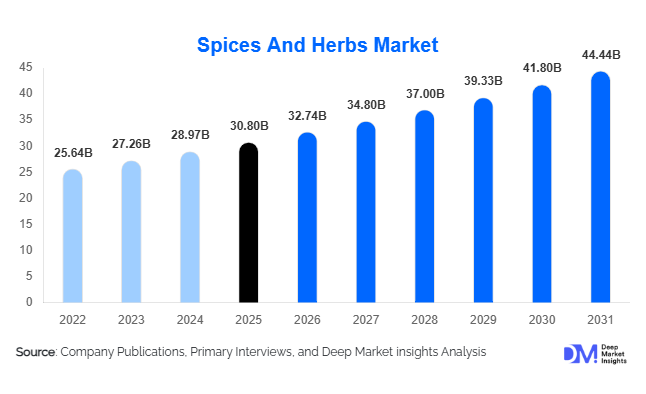
spices and herbs market latest trends
Growing Demand for Organic and Clean-Label Spices
Consumers are increasingly preferring organic and clean-label spices as awareness regarding food safety, chemical residues, and health-oriented nutrition continues to rise globally. Food manufacturers are replacing artificial flavor enhancers and synthetic additives with natural spice ingredients such as turmeric, garlic, oregano, basil, cinnamon, and ginger. Organic certification, sustainable farming practices, and traceability systems are becoming important differentiators in premium retail markets. Supermarkets and specialty food retailers are expanding shelf space for certified organic spice products, while private-label brands are increasingly introducing clean-label seasoning portfolios. The trend is particularly strong in North America and Europe, where consumers are willing to pay premium prices for sustainably sourced and ethically produced herbs and spices.
Expansion of Functional and Wellness-Oriented Applications
The integration of spices and herbs into functional foods, nutraceuticals, and wellness beverages is becoming a major industry trend. Ingredients such as turmeric, ginger, garlic, cinnamon, and chili extracts are increasingly used in immunity-support products, anti-inflammatory supplements, digestive health formulations, and herbal beverages. The popularity of Ayurveda, plant-based wellness, and preventive healthcare is accelerating demand for spice-derived bioactive compounds and oleoresins. Beverage manufacturers are launching herbal teas, turmeric lattes, detox drinks, and botanical wellness beverages that incorporate functional spice ingredients. Technological advancements in extraction and freeze-drying are further enabling manufacturers to commercialize higher-value spice concentrates with improved potency, flavor retention, and shelf stability.
spices and herbs market drivers
Rising Global Consumption of Processed and Convenience Foods
The rapid expansion of the global processed food industry is one of the primary drivers of the spices and herbs market. Increasing urbanization, changing lifestyles, and rising demand for ready-to-eat meals, frozen foods, snacks, sauces, and instant foods are boosting industrial consumption of seasoning ingredients. Food manufacturers increasingly rely on customized spice blends and powdered herbs to maintain standardized flavor profiles across large-scale production. Powdered spices are particularly preferred due to ease of handling, longer shelf life, and compatibility with automated food processing systems. The growing penetration of international fast-food chains and packaged food brands in emerging economies is further supporting long-term market demand.
Increasing Popularity of Ethnic and International Cuisines
Globalization of food culture and rising exposure to international cuisines are significantly increasing spice and herb consumption worldwide. Indian, Mexican, Mediterranean, Thai, Korean, and Middle Eastern cuisines are gaining popularity across North America and Europe, driving demand for cumin, turmeric, oregano, paprika, basil, coriander, and chili products. Social media food trends, culinary tourism, and international restaurant chains are influencing consumers to experiment with authentic flavors at home. Foodservice operators and packaged food manufacturers are also launching region-specific seasoning blends and ethnic meal kits to capitalize on changing consumer preferences.
global market restraints
Volatility in Raw Material Prices
The spices and herbs industry remains highly dependent on agricultural production cycles and climatic conditions, resulting in significant price volatility for raw materials. Spices such as vanilla, cardamom, pepper, saffron, and cloves are particularly vulnerable to rainfall variability, pest attacks, and crop diseases. Supply disruptions caused by climate change and geopolitical instability can substantially impact production volumes and export availability. Price fluctuations create procurement challenges for manufacturers and reduce margin stability across the supply chain.
Stringent Food Safety and Export Regulations
International markets such as the United States and the European Union maintain strict regulations regarding pesticide residues, microbial contamination, heavy metals, and adulteration in spice products. Compliance with food safety standards often requires investments in steam sterilization, laboratory testing, traceability systems, and quality certification programs. Small-scale farmers and processors in developing countries frequently face operational and financial barriers in meeting these standards. Product recalls and export rejections due to contamination concerns continue to pose reputational and financial risks for exporters globally.
spices and herbs industry key opportunities
Growth in Nutraceutical and Functional Food Applications
The growing demand for preventive healthcare and plant-based wellness products is creating significant opportunities for spice and herb manufacturers. Curcumin, ginger extracts, garlic concentrates, and herbal formulations are increasingly incorporated into dietary supplements, immunity products, and functional beverages. Consumers are actively seeking natural ingredients associated with antioxidant, anti-inflammatory, digestive, and metabolic health benefits. This trend is encouraging investments in extraction technologies, standardized botanical ingredients, and pharmaceutical-grade spice derivatives. Companies focusing on value-added spice extracts and wellness-focused product portfolios are expected to gain substantial long-term growth opportunities.
Expansion of Export-Oriented Production and Premium Spice Blends
Export demand for premium and ethnic spice products is increasing significantly across developed economies. India, Vietnam, Indonesia, and China are strengthening their global export capabilities through agricultural modernization, improved food safety infrastructure, and government-supported spice development programs. Increasing demand for gourmet seasoning blends, regional spice mixes, and private-label culinary products is creating opportunities for new entrants and established manufacturers alike. E-commerce channels are also enabling specialty spice brands to directly access international consumers, expanding global market reach for premium and artisanal products.
Report Scope
| Report Metric | Details |
|---|---|
| Market Size in 2025 | USD 30.80 Billion |
| Market Size in 2026 | USD 32.74 Billion |
| Market Size in 2031 | USD 44.44 Billion |
| CAGR | 6.3% (2026-2031) |
| Base Year for Estimation | 2025 |
| Historical Data | 2022-2024 |
| Forecast Period | 2026-2031 |
| Report Coverage | Revenue Forecast, Competitive Landscape, Supply Chain Disruption, Growth Factors, Environment & Regulatory Landscape and Trends |
| Geographies Covered | North America, Europe, APAC, Middle East and Africa, LATAM |
| Countries Covered | U.S., Canada, U.K., Germany, France, Spain, Italy, Russia, Nordic, Benelux, Rest of Europe, China, Korea, Japan, India, Australia, Singapore, Taiwan, South East Asia, Rest of Asia-Pacific, UAE, Turky, Saudi Arabia, South Africa, Egypt, Nigeria, Rest of MEA, Brazil, Mexico, Argentina, Chile, Colombia, Rest of LATAM |
Explore more data points, trends and opportunities Download Free Sample Report
Product Type Insights
Spices account for the largest share of the global market, led by pepper, turmeric, chili, cumin, and cinnamon products. Pepper remains one of the most widely traded and consumed spice categories globally due to its extensive usage in household cooking, processed foods, and foodservice applications. Turmeric is witnessing strong growth due to rising consumer awareness regarding its functional and medicinal properties. Within herbs, oregano, basil, parsley, and thyme dominate consumption due to increasing popularity of Mediterranean and Italian cuisines. Mixed seasoning blends are also gaining traction as consumers increasingly seek convenience-oriented flavor solutions for home cooking and ready-to-cook meals.
Application Insights
Food processing remains the dominant application segment within the spices and herbs market, accounting for a substantial share of industrial consumption globally. Manufacturers of snacks, sauces, ready meals, bakery products, frozen foods, and instant foods increasingly utilize spice blends and powdered herbs to improve flavor consistency and product differentiation. Foodservice applications are also expanding rapidly due to growth in restaurants, quick-service chains, and catering industries. Nutraceutical and pharmaceutical applications are emerging as high-growth segments as herbs and spices are increasingly incorporated into immunity supplements, herbal remedies, digestive health products, and functional beverages. Cosmetic and personal care applications are also growing steadily, particularly for herbal extracts and essential oils.
Distribution Channel Insights
Supermarkets and hypermarkets dominate retail distribution of spices and herbs due to their wide product availability, strong brand visibility, and consumer preference for packaged and certified products. Specialty stores continue to perform strongly in premium and organic spice categories, particularly in developed markets. Online retail and e-commerce channels are witnessing rapid growth as consumers increasingly purchase gourmet spices, imported herbs, and wellness-oriented seasoning products through digital platforms. Direct procurement and B2B distribution channels remain highly important for industrial food manufacturers and foodservice operators that require bulk quantities and customized spice blends.
Form Insights
Powdered and ground spices account for the largest market share globally due to ease of use, extended shelf life, and compatibility with industrial food processing systems. Powdered products are widely utilized in seasoning blends, instant foods, and packaged meals. Whole spices continue to maintain strong demand in traditional cooking applications and premium culinary markets due to better flavor retention and freshness perception among consumers. Extracts and oleoresins are rapidly gaining popularity in functional food, beverage, nutraceutical, and pharmaceutical industries because of their concentrated flavor profiles and bioactive properties. Freeze-dried and fresh herbs are also experiencing growing demand in premium retail and foodservice segments.
End-Use Industry Insights
The food manufacturing industry represents the largest end-use sector for spices and herbs globally, driven by rapid expansion of packaged food production and growing demand for convenience-oriented products. The HoReCa sector remains a major consumer due to increasing global restaurant penetration and rising consumer preference for international cuisines. Pharmaceutical and nutraceutical industries are emerging as important end users as herbal formulations and spice-derived extracts gain popularity in preventive healthcare applications. Cosmetic manufacturers are also incorporating herbal ingredients and essential oils into skincare, haircare, and aromatherapy products, supporting diversification of end-use demand.
Explore more data points, trends and opportunities Download Free Sample Report
Spices And Herbs Market Segmentations
By Product Type
- Spices
- Herbs
- Seasoning Blends
- Spice Extracts & Oleoresins
- Essential Oils
By Nature
- Conventional
- Organic
- Non-GMO Certified
- Sustainably Sourced
By Form
- Whole
- Powdered/Ground
- Crushed & Flakes
- Paste & Puree
- Extracts & Oleoresins
- Freeze-Dried
By Application
- Food Processing
- Foodservice & HoReCa
- Household/Retail Consumption
- Beverages
- Nutraceuticals & Supplements
- Pharmaceuticals & Ayurveda
- Cosmetics & Personal Care
- Pet Food
By Distribution Channel
- Supermarkets & Hypermarkets
- Convenience Stores
- Specialty Stores
- Online Retail/E-Commerce
- B2B/Industrial Sales
- Wholesale Distribution
Regional Insights
Asia-Pacific
Asia-Pacific dominates the global spices and herbs market, accounting for approximately 41% of global revenue in 2025. India remains the world’s largest producer and exporter of turmeric, chili, cumin, coriander, and cardamom, while Vietnam leads global pepper exports. China dominates garlic and ginger processing and exports, supported by extensive agricultural infrastructure and processing capacity. Rising domestic consumption, population growth, urbanization, and expanding processed food industries continue to strengthen regional demand. Asia-Pacific is also projected to remain the fastest-growing regional market due to increasing food manufacturing investments and export-oriented production expansion.
North America
North America represents one of the largest premium consumption markets globally, accounting for nearly 24% of global market share. The United States dominates regional demand due to increasing consumption of ethnic cuisines, packaged foods, premium seasoning blends, and organic spices. Consumer preference for clean-label and wellness-oriented food products is accelerating demand for natural herbs and spices across retail and industrial applications. Mexican and Asian cuisine popularity continues to support rising consumption of cumin, chili, oregano, basil, and paprika products across the region.
Europe
Europe accounts for a significant share of global spice imports and consumption, led by Germany, the United Kingdom, France, Italy, and Spain. Demand is driven by processed food manufacturing, premium culinary applications, and increasing consumer preference for sustainable and traceable ingredients. Organic spices and herbs are witnessing particularly strong growth across the region due to strict food safety standards and growing health-conscious consumer behavior. Mediterranean cuisine popularity also supports strong herb consumption, particularly oregano, basil, thyme, and rosemary.
Latin America
Latin America is witnessing steady market growth, supported by increasing urbanization and expansion of processed food industries. Brazil and Mexico represent the largest regional markets due to strong culinary traditions and growing packaged food demand. Chili, paprika, garlic, and oregano remain widely consumed across regional cuisines. The foodservice industry and quick-service restaurant expansion are further contributing to increasing industrial spice consumption across Latin America.
Middle East & Africa
The Middle East & Africa region continues to demonstrate strong demand for spices and herbs due to deeply rooted culinary traditions and increasing hospitality sector expansion. Saudi Arabia, the UAE, Egypt, and South Africa represent major regional consumption markets. Imports account for a substantial share of regional supply, particularly for premium spices and seasoning blends. Growing tourism activity, rising restaurant penetration, and increasing demand for ethnic cuisines are supporting long-term market growth across the region.
Key Players in the Spices And Herbs Market
- McCormick & Company
- Kerry Group
- Olam International
- Döhler Group
- Everest Spices
- MDH Spices
- Ajinomoto Co., Inc.
- Sensient Technologies
- Associated British Foods
- ARIAKE JAPAN Co., Ltd.
- DS Group
- Baria Pepper
- B&G Foods
- Goya Foods
- Takasago International Corporation