Global Black Vinegar Market Size
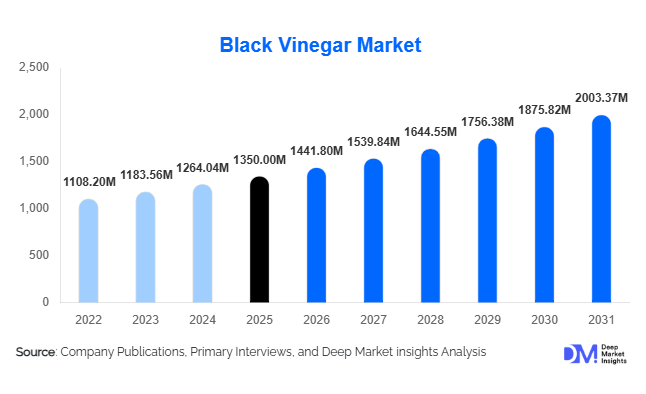
According to Deep Market Insights, the global black vinegar market size was valued at USD 1,350 million in 2026 and is projected to grow from USD 1,441.80 million in 2026 to reach USD 2,003.37 million by 2031, expanding at a CAGR of 6.8% during the forecast period (2026–2031). The black vinegar market growth is primarily driven by the rising global demand for fermented and functional foods, increasing popularity of Asian cuisine worldwide, and expanding adoption of clean-label, naturally brewed condiments across household, foodservice, and nutraceutical applications. Growing awareness of gut health benefits and the premiumization of traditional fermented products are further strengthening global demand dynamics.
Key Market Insights
- Functional food positioning is accelerating demand, with black vinegar increasingly used in wellness beverages and digestive health products.
- Asia-Pacific remains the production and consumption hub, led by China and Japan’s strong fermentation heritage and export capacity.
- Foodservice expansion is a key demand driver, especially with the global rise of sushi bars, ramen chains, and Asian fusion restaurants.
- E-commerce penetration is reshaping distribution, enabling global access to niche and premium black vinegar brands.
- Premium aged and organic variants are gaining traction in developed markets such as North America and Europe.
- Cross-border trade of ethnic food products is increasing, boosting import volumes in non-Asian regions.
Black Vinegar Market Latest Trends
Functional Food and Wellness Integration
Black vinegar is increasingly being incorporated into functional food and wellness categories due to its natural fermentation profile rich in amino acids and organic acids. Manufacturers are developing vinegar-based health drinks, detox formulations, and dietary supplements targeting digestive health and metabolism support. This trend is especially strong in Japan and China, where traditional medicine principles align with modern health-focused consumption. In Western markets, black vinegar is being positioned as a natural probiotic-supporting ingredient, expanding its relevance beyond culinary usage.
Premiumization and Organic Product Expansion
The market is witnessing strong growth in aged, organic, and artisanal black vinegar products. Consumers are showing willingness to pay premium prices for traditionally fermented vinegar aged over multiple years. This is particularly prominent in Japan’s kurozu segment and China’s premium Zhenjiang vinegar category. Brands are increasingly focusing on organic certification, reduced additives, and traditional brewing methods to differentiate products in competitive retail environments. Luxury food positioning is also helping expand export opportunities in Europe and North America.
Black Vinegar Market Drivers
Rising Global Demand for Fermented Foods
Consumer awareness regarding gut health and natural fermentation benefits is significantly driving demand for black vinegar. Its acetic acid content and antioxidant properties make it a preferred choice in health-oriented diets. This shift toward probiotic-rich and clean-label foods is boosting consumption across both developed and emerging economies.
Expansion of Asian Cuisine Worldwide
The global proliferation of Asian restaurants is a major growth driver. Black vinegar is a key ingredient in Chinese, Japanese, and Korean culinary preparations. The expansion of sushi chains, ramen restaurants, and Asian fusion dining in North America and Europe is increasing commercial demand significantly, especially in foodservice applications.
Growth of E-commerce Grocery Channels
Online grocery platforms are enabling global accessibility of niche condiments like black vinegar. Cross-border e-commerce is allowing consumers to purchase authentic Asian brands, significantly expanding demand beyond traditional geographic boundaries and supporting small and medium manufacturers in global expansion.
Black Vinegar Market Restraints
Limited Awareness in Western Markets
Despite growing penetration, black vinegar remains relatively unfamiliar to mainstream consumers in Western countries. Limited awareness restricts mass-market adoption and confines demand largely to niche ethnic food segments and specialty stores.
Production Constraints Due to Long Fermentation Cycles
Traditional black vinegar production requires long fermentation and aging periods, which limits scalability and increases production costs. This creates supply-side constraints and restricts rapid capacity expansion compared to industrial vinegar alternatives.
Black Vinegar Industry Key Opportunities
Expansion into Functional Beverage Industry
The growing global functional beverage market presents a major opportunity for black vinegar integration. Manufacturers are developing vinegar-based health drinks targeting digestion, detoxification, and immunity support. This diversification beyond culinary applications is expected to significantly expand the consumer base.
Growth of Foodservice and Global Restaurant Chains
The rapid expansion of Asian foodservice chains globally is driving bulk demand for black vinegar. Standardized packaging formats and foodservice-grade products present strong opportunities for manufacturers to build long-term institutional contracts with restaurants, hotels, and catering services.
Premium Organic Export Markets
Rising demand for organic and aged food products in Europe and North America is creating export opportunities for premium black vinegar brands. Producers focusing on traditional brewing methods and certified organic production are gaining competitive advantage in high-value markets.
Report Scope
| Report Metric | Details |
|---|---|
| Market Size in 2025 | USD 1350.00 Million |
| Market Size in 2026 | USD 1441.80 Million |
| Market Size in 2031 | USD 2003.37 Million |
| CAGR | 6.8% (2026-2031) |
| Base Year for Estimation | 2025 |
| Historical Data | 2022-2024 |
| Forecast Period | 2026-2031 |
| Report Coverage | Revenue Forecast, Competitive Landscape, Supply Chain Disruption, Growth Factors, Environment & Regulatory Landscape and Trends |
| Geographies Covered | North America, Europe, APAC, Middle East and Africa, LATAM |
| Countries Covered | U.S., Canada, U.K., Germany, France, Spain, Italy, Russia, Nordic, Benelux, Rest of Europe, China, Korea, Japan, India, Australia, Singapore, Taiwan, South East Asia, Rest of Asia-Pacific, UAE, Turky, Saudi Arabia, South Africa, Egypt, Nigeria, Rest of MEA, Brazil, Mexico, Argentina, Chile, Colombia, Rest of LATAM |
Explore more data points, trends and opportunities Download Free Sample Report
Product Type Insights
The global black vinegar market is strongly shaped by deep-rooted culinary traditions and evolving health-oriented consumption patterns. Traditional Chinese black vinegar continues to dominate the market, contributing approximately 38% of global share in 2025. Its leadership is primarily driven by centuries-old culinary heritage, large-scale domestic production ecosystems in China, cost-efficient manufacturing, and strong export channels that supply both Asian diaspora markets and increasingly mainstream international food retailers. Its versatility in cooking applications and consistent flavor profile further reinforce its sustained demand across household and foodservice sectors.Organic black vinegar represents a smaller but rapidly expanding category, driven by the global clean-label movement, rising disposable incomes in developed markets, and increasing scrutiny of food processing standards. Demand is particularly strong among urban consumers seeking chemical-free, sustainably produced fermented ingredients. Blended and flavored variants are also emerging, especially in Western markets, where manufacturers are actively localizing taste profiles to align with regional palates and expanding usage beyond traditional Asian cuisine into fusion and contemporary culinary formats.Rice-based vinegar remains the most widely used raw material type due to its smooth acidity, balanced flavor profile, and abundant availability across Asia-Pacific production hubs. Its dominance is reinforced by integrated rice supply chains, cost advantages in fermentation, and its adaptability across both traditional recipes and modern processed food applications.
Application Insights
Household consumption continues to represent the largest application segment, supported by the entrenched role of black vinegar in everyday cooking across Asian households. Its demand is driven by cultural food practices, increasing home cooking trends, and growing awareness of fermented ingredients as healthier flavoring alternatives compared to synthetic condiments. The familiarity of black vinegar in traditional dishes ensures steady baseline demand across both rural and urban populations.The foodservice segment is emerging as the fastest-growing application area, primarily fueled by the global expansion of Asian restaurants, fusion dining concepts, and quick-service chains incorporating Asian-inspired flavors. Increasing consumer exposure to international cuisines and rising demand for authentic taste experiences are encouraging chefs to adopt black vinegar as a key ingredient in dressings, dipping sauces, and marinades, significantly amplifying its commercial usage.Food processing applications are also expanding steadily as manufacturers incorporate black vinegar into packaged sauces, ready-to-eat meals, and marinade formulations to enhance flavor complexity and differentiate product offerings. Additionally, the nutraceutical segment is gaining traction, supported by growing consumer interest in functional foods and beverages. Vinegar-based supplements and wellness drinks are increasingly marketed for their perceived benefits in digestion support, metabolic balance, and overall wellness, positioning black vinegar within the broader functional nutrition landscape.
Distribution Channel Insights
Supermarkets and hypermarkets remain the leading distribution channel, supported by their extensive retail penetration, strong supply chain networks, and ability to offer a wide range of domestic and imported brands under one roof. Their dominance is particularly strong in urban centers where organized retail infrastructure is well developed, enabling consumers to easily access both mainstream and premium vinegar variants.Online retail is experiencing the fastest growth, driven by the expansion of e-commerce platforms, increasing digital grocery adoption, and the rise of cross-border trade in specialty food products. Consumers are increasingly drawn to online channels due to wider product variety, competitive pricing, and accessibility to niche organic and imported black vinegar brands that may not be available in physical stores.Specialty Asian grocery stores continue to play a crucial role, especially in multicultural urban markets where demand for authentic regional ingredients remains strong. These outlets benefit from consumer trust in authenticity and curated product selections. Meanwhile, foodservice distributors are gaining importance as institutional demand rises from restaurants, hotels, and catering services, where consistent bulk supply and reliable logistics are critical to operational efficiency.
Explore more data points, trends and opportunities Download Free Sample Report
Black Vinegar Market Segmentations
By Product Type
- Traditional Chinese Black Vinegar
- Japanese Black Vinegar (Kurozu)
- Korean Black Vinegar Variants
- Blended & Flavored Black Vinegar
By Nature
- Conventional Black Vinegar
- Organic Black Vinegar
By Raw Material Source
- Rice-Based Black Vinegar
- Wheat-Based Black Vinegar
- Sorghum-Based Black Vinegar
- Mixed Grain Black Vinegar
By Production Process
- Traditional Natural Fermentation
- Industrial/Accelerated Fermentation
By Distribution Channel
- Supermarkets & Hypermarkets
- Specialty Asian Grocery Stores
- Online Retail / E-commerce Platforms
- Foodservice Distributors
- Convenience Stores
Regional Insights
Asia-Pacific
Asia-Pacific remains the dominant regional market, accounting for approximately 63% share in 2025, underpinned by strong cultural integration of black vinegar in daily diets and well-established production ecosystems. China leads both production and consumption, driven by large-scale manufacturing capabilities, strong domestic demand, and expanding export infrastructure that supplies global markets. Japan contributes significantly through its premium kurozu segment, supported by a strong health and wellness culture and consumer preference for functional fermented foods. South Korea demonstrates steady demand through traditional culinary usage and growing interest in health-oriented condiments, while India is emerging as a promising market, fueled by increasing exposure to Asian cuisines, rapid urbanization, and the expansion of modern retail channels that are introducing international food ingredients to a wider consumer base.
North America
North America holds around 15% of the global market share, with the United States leading regional consumption. Growth in this region is primarily driven by increasing popularity of Asian cuisine, rising multicultural food adoption, and a strong shift toward health-conscious eating habits. Expanding foodservice industries, particularly Asian fusion restaurants and fast-casual dining formats, are significantly boosting demand. Canada is also witnessing steady growth supported by diverse immigration-driven food preferences and a rising inclination toward international and functional food ingredients.
Europe
Europe accounts for nearly 12% of the global market, with key demand concentrated in the United Kingdom, Germany, and France. Growth is being supported by increasing consumer interest in fermented foods, probiotics, and natural flavor enhancers as part of broader wellness trends. Additionally, the diversification of ethnic cuisine offerings and the rising popularity of Asian dining experiences across urban centers are contributing to stronger market penetration. The expansion of organic and specialty food retail channels further reinforces demand for premium black vinegar variants across European markets.
Latin America
Latin America represents approximately 4% of global share, with Brazil and Mexico leading regional demand. Market growth is gradual but steadily improving, driven by urbanization, rising middle-class incomes, and increasing exposure to international culinary influences through restaurants and global food media. The gradual integration of Asian flavors into mainstream dining and the expansion of modern retail infrastructure are supporting the early-stage adoption of black vinegar across urban consumer segments.
Middle East & Africa
The Middle East & Africa region accounts for nearly 6% of the market, with the United Arab Emirates and Saudi Arabia emerging as key demand centers. Growth is strongly supported by a robust hospitality sector, high disposable income levels, and a large expatriate population with diverse culinary preferences. The expansion of luxury hotels, international restaurant chains, and premium food retail outlets is driving increased adoption of black vinegar, particularly in urban hospitality and foodservice applications.
Key Players in the Black Vinegar Market
- Zhenjiang Hengshun Vinegar Industry Co.
- Lee Kum Kee
- Mizkan Holdings
- Kikkoman Corporation
- Marukan Vinegar Co.
- Otafuku Sauce Co.
- Daesang Corporation