Fruit And Vegetable Enzymes Market Size
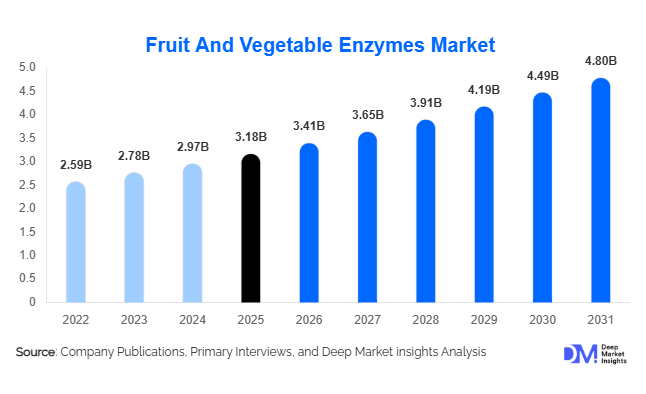
According to Deep Market Insights, the global Fruit And Vegetable Enzymes market size was valued at USD 3.18 billion in 2025 and is projected to grow from USD 3.41 billion in 2026 to reach USD 4.80 billion by 2031, expanding at a CAGR of 7.1% during the forecast period (2026–2031). The Fruit And Vegetable Enzymes market growth is primarily driven by rising demand for natural processing ingredients, increasing adoption of clean-label food technologies, expanding processed food production, and growing utilization of enzymes across food, beverage, animal feed, and pharmaceutical industries.
Key Market Insights
- North America dominates the Fruit And Vegetable Enzymes market, accounting for approximately 36.4% market share in 2025, while Asia-Pacific is projected to register the fastest growth with a CAGR of 8.5% during the forecast period.
- Proteases represent the leading enzyme type segment, contributing nearly 41.8% share of the market, while Cellulases are expected to witness the fastest growth with a CAGR of 7.8%.
- Food & Beverages dominate application demand, representing approximately 58.6% market share, supported by increasing juice processing, beverage clarification, and fruit extraction activities.
- India is emerging as a high-growth market, projected to reach approximately USD 0.74 billion by 2031 with a CAGR of nearly 9.1%, supported by food processing expansion and biotechnology investments.
- Technological advancements in precision fermentation and enzyme engineering are improving enzyme purity, efficiency, and industrial scalability, accelerating adoption across global processing industries.
Fruit And Vegetable Enzymes Market Latest Trends
Growing Adoption of Clean-Label and Natural Processing Enzymes
The Fruit And Vegetable Enzymes industry is witnessing strong adoption of natural and biotechnology-derived processing solutions as food manufacturers shift toward clean-label products. Global commercial enzyme production exceeded 515 thousand metric tons in 2025, with food and beverage applications accounting for nearly 58.6% of total consumption. More than 71% of premium beverage manufacturers have adopted enzyme-based clarification and extraction technologies to improve product quality, reduce processing time, and enhance yield. Pectinases, cellulases, and proteases are increasingly replacing traditional chemical processing methods due to improved efficiency and consumer preference for sustainable ingredients. The increasing penetration of enzyme-assisted fruit extraction, juice clarification, and vegetable processing technologies continues strengthening the Fruit And Vegetable Enzymes market.
Precision Fermentation and Advanced Enzyme Engineering Expansion
Technological advancements in precision fermentation are reshaping enzyme manufacturing by improving consistency, scalability, and functional performance. More than 62% of new enzyme production investments are focused on sustainable biotechnology platforms, while advanced fermentation systems have improved enzyme recovery rates by approximately 15%. Commercial enzyme formulations now achieve purity levels exceeding 98%, supporting pharmaceutical-grade and specialty food applications. AI-assisted enzyme optimization, microbial engineering, and automated fermentation processes are increasingly being adopted across manufacturing facilities producing more than 1.6 billion tons of processed fruit and vegetable products annually. These technology shifts are expected to continue driving the Fruit And Vegetable Enzymes market expansion.
Fruit And Vegetable Enzymes Market Drivers
Rising Demand for Processed Food and Beverage Products
The increasing consumption of processed food and beverages is one of the major drivers supporting Fruit And Vegetable Enzymes market expansion. Global processed food production exceeded 2.5 billion tons in 2025, creating significant demand for enzymes used in extraction, clarification, texture improvement, and shelf-life enhancement. More than 70% of industrial juice manufacturers utilize pectinase-based processing solutions, improving extraction efficiency by 18–22% and reducing production cycles by nearly 30%. Beverage companies are increasingly investing in enzyme technologies to meet consumer demand for natural ingredients and premium-quality products. The rapid expansion of functional beverages, fruit concentrates, and plant-based foods continues strengthening demand for Fruit And Vegetable Enzymes.
Increasing Biotechnology Investment and Sustainable Processing
Growing investment in biotechnology is accelerating the adoption of advanced enzyme solutions across multiple industries. Global biotechnology investments exceeded USD 18 billion in 2025, supporting innovation in enzyme engineering, fermentation systems, and sustainable production methods. Industrial enzyme adoption among large-scale processors surpassed 68%, while renewable processing technologies are reducing environmental impact by improving energy efficiency. Manufacturers are increasingly replacing synthetic additives with biological processing aids, creating additional opportunities for enzyme suppliers. The shift toward sustainable food production and resource-efficient manufacturing remains a key driver for the Fruit And Vegetable Enzymes market.
Fruit And Vegetable Enzymes Market Restraints
High Production Costs and Raw Material Price Volatility
The Fruit And Vegetable Enzymes market faces challenges due to fluctuating raw material costs and complex biotechnology production requirements. Agricultural feedstock prices increased by approximately 11% during 2025, while fermentation media costs increased by nearly 9%. Manufacturing energy expenses represent around 18–22% of total production costs, creating pricing pressure for enzyme manufacturers. Additionally, enzyme stabilization materials contribute approximately 12% of operational expenses, affecting profit margins for smaller producers. These cost-related challenges may limit adoption among price-sensitive industries and developing markets.
Regulatory Complexity and Standardization Issues
Different regulatory frameworks across global markets create challenges for enzyme manufacturers. More than 65 countries maintain separate approval standards for industrial enzymes, increasing commercialization timelines by approximately 8–18 months. Product testing requirements may involve more than 200 laboratory evaluations, while compliance expenses account for nearly 4–6% of annual operating costs. Variations in food safety regulations and labeling requirements continue creating barriers for international market expansion.
Fruit And Vegetable Enzymes Market Opportunities
Expansion in Emerging Food Processing Economies
Emerging economies present significant opportunities for Fruit And Vegetable Enzymes manufacturers due to expanding food processing industries and increasing biotechnology adoption. Developing markets recorded processed food production growth exceeding 9% annually, while enzyme penetration remains below 45% in several regions. Countries including India, China, Brazil, and Southeast Asian economies are increasing investments in fruit processing, beverage manufacturing, and agricultural value chains. Rising urbanization, growing packaged food consumption, and government support for food technology modernization are expected to create new growth opportunities.
Growth of Pharmaceutical and Nutraceutical Applications
The pharmaceutical and nutraceutical sectors are creating new opportunities through demand for high-purity enzyme formulations. Pharmaceutical applications accounted for approximately 12.8% market share in 2025, with production exceeding 62 thousand metric tons. Enzymes with purity levels above 99% are increasingly used in specialty formulations, digestive health products, and biotechnology applications. The rising popularity of functional nutrition and preventive healthcare solutions is expected to expand enzyme utilization beyond traditional food processing applications.
Fruit And Vegetable Enzymes Market Segmentation
The Fruit And Vegetable Enzymes market segmentation is categorized by type and application, with type-based products contributing nearly 56% of total market value. Proteases dominate enzyme production, while food and beverage applications represent the largest consumption category with approximately 58.6% share. Increasing demand for customized enzyme formulations is driving diversification across industrial applications.
Report Scope
| Report Metric | Details |
|---|---|
| Market Size in 2025 | USD 3.18 Billion |
| Market Size in 2026 | USD 3.41 Billion |
| Market Size in 2031 | USD 4.80 Billion |
| CAGR | 7.1% (2026-2031) |
| Base Year for Estimation | 2025 |
| Historical Data | 2022-2024 |
| Forecast Period | 2026-2031 |
| Report Coverage | Revenue Forecast, Competitive Landscape, Supply Chain Disruption, Growth Factors, Environment & Regulatory Landscape and Trends |
| Geographies Covered | North America, Europe, APAC, Middle East and Africa, LATAM |
| Countries Covered | U.S., Canada, U.K., Germany, France, Spain, Italy, Russia, Nordic, Benelux, Rest of Europe, China, Korea, Japan, India, Australia, Singapore, Taiwan, South East Asia, Rest of Asia-Pacific, UAE, Turky, Saudi Arabia, South Africa, Egypt, Nigeria, Rest of MEA, Brazil, Mexico, Argentina, Chile, Colombia, Rest of LATAM |
Explore more data points, trends and opportunities Download Free Sample Report
Type Insights
Frozen fish balls accounted for the largest share of the global fish balls market due to their extended shelf life, excellent product stability, ease of storage, and cost-efficient transportation across domestic and international supply chains. The ability to preserve product quality over long distances has made frozen fish balls the preferred choice for exporters, foodservice operators, and modern retail channels. Growing investments in cold-chain logistics, rapid expansion of frozen food sections in supermarkets, and increasing international trade of processed seafood products continue to strengthen the dominance of this segment. In addition, manufacturers are introducing premium frozen fish balls made with higher fish content, natural ingredients, clean-label formulations, and innovative flavor profiles to cater to evolving consumer preferences. The rising demand for convenient, ready-to-cook seafood products among busy urban households further accelerates adoption, while technological advancements in freezing and packaging help maintain texture, freshness, and nutritional quality.Ready-to-eat fish balls are witnessing the fastest growth as consumers increasingly seek convenient meal solutions that require minimal preparation. Rising urbanization, busy lifestyles, growing workforce participation, and increasing preference for on-the-go snacks have significantly boosted demand for microwave-ready and fully cooked seafood products. Food manufacturers are responding through innovative packaging technologies, single-serve portions, premium seasoning options, healthier formulations with reduced sodium, and region-specific flavors. The rapid growth of convenience stores, supermarkets, online grocery platforms, and quick-commerce delivery services is further enhancing product accessibility, making ready-to-eat fish balls an increasingly attractive option for modern consumers.
Application Insights
Foodservice dominated the global fish balls market and remains the leading application segment due to the widespread use of fish balls across restaurants, hotpot chains, quick-service restaurants, cafés, institutional catering, hotels, food courts, and street food vendors. The segment's leadership is primarily driven by the increasing popularity of Asian cuisine worldwide, expanding restaurant chains specializing in seafood-based dishes, and the consistent demand for affordable, protein-rich menu offerings. Fish balls are extensively incorporated into soups, noodles, curries, skewers, hotpot meals, seafood platters, and snack menus because of their versatility, standardized quality, ease of preparation, and cost-effectiveness. Continuous expansion of the hospitality industry, tourism sector, cloud kitchens, and food delivery platforms further strengthens demand from commercial foodservice establishments, ensuring sustained market leadership.Food processing represents another important application area, with manufacturers incorporating fish balls into frozen ready meals, instant noodles, seafood snacks, meal kits, canned products, and packaged convenience foods. The growing processed food industry, rising demand for value-added seafood products, and continuous product innovation are encouraging food processors to utilize fish balls as versatile ingredients across multiple product categories. Increasing investments in automated food manufacturing and expanding global demand for convenience foods are expected to further support this segment throughout the forecast period.
Explore more data points, trends and opportunities Download Free Sample Report
Fruit And Vegetable Enzymes Market Segmentations
By Type
- Proteases
- Pectinases
- Cellulases
By Application
- Food & Beverages
- Animal Feed
- Pharmaceuticals
Regional Insights
Asia-Pacific
Asia-Pacific dominated the global fish balls market and is expected to maintain its leadership throughout the forecast period owing to abundant marine resources, well-established seafood processing industries, extensive aquaculture production, and deeply rooted seafood consumption traditions. China remains both the largest producer and consumer of fish balls, while Thailand, Vietnam, Indonesia, Malaysia, Japan, the Philippines, and South Korea contribute significantly to regional manufacturing capacity, exports, and product innovation. The region benefits from an integrated seafood value chain supported by modern processing facilities, competitive labor costs, and strong export capabilities. Rapid urbanization, increasing disposable income, rising demand for frozen convenience foods, and expanding modern retail networks continue to stimulate domestic consumption. Continuous investments in seafood processing automation, advanced freezing technologies, cold-chain logistics, and export-oriented infrastructure have further strengthened regional competitiveness. Government initiatives supporting fisheries development, sustainable aquaculture, seafood exports, and food processing modernization, combined with the rapid expansion of supermarkets, e-commerce grocery platforms, and foodservice chains, remain key drivers accelerating regional market growth.
North America
North America represents a mature and steadily expanding market driven by the growing popularity of Asian cuisine, increasing consumption of frozen seafood products, and strong demand from both foodservice and organized retail sectors. The United States and Canada continue witnessing rising consumer preference for high-protein, convenient, and premium-quality seafood products that align with healthier dietary habits. The rapid expansion of Asian restaurant chains, sushi outlets, hotpot restaurants, and multicultural foodservice establishments has significantly increased commercial demand for fish balls. Retail growth is supported by well-developed cold-chain infrastructure, advanced food distribution systems, and widespread availability through supermarkets, warehouse clubs, specialty seafood retailers, and online grocery platforms. Additional regional growth is being driven by rising immigrant populations, increasing household consumption of frozen convenience foods, growing adoption of clean-label seafood products, technological advancements in frozen food preservation, and continuous innovation in premium seafood offerings.
Europe
Europe continues to experience steady market growth supported by increasing seafood consumption, evolving multicultural food preferences, and rising imports of processed seafood products. Countries including the United Kingdom, Germany, France, Spain, Italy, and the Netherlands serve as major consumption centers due to their developed retail sectors and expanding international foodservice industry. Consumers are increasingly exploring authentic Asian cuisines, driving higher demand for fish balls across restaurants, specialty food retailers, and supermarkets. The region's stringent food safety regulations and emphasis on product quality have encouraged manufacturers to invest in premium ingredients, sustainable sourcing practices, and certified seafood products. Growth is further supported by rising health consciousness, increasing preference for protein-rich frozen meals, expansion of organized retail chains, growing popularity of convenience foods, and higher consumer willingness to purchase sustainably certified seafood products with transparent traceability.
Latin America
Latin America is witnessing gradual but consistent expansion in the fish balls market, supported by increasing urbanization, modernization of food retail infrastructure, and growing consumer awareness regarding the nutritional benefits of seafood. Brazil, Mexico, Chile, Peru, and Argentina are strengthening seafood processing capabilities while investing in improved freezing technologies and distribution networks. Rising disposable income, changing dietary patterns, and increasing adoption of convenient frozen food products are creating favorable market conditions. Expansion of supermarket chains, improving cold storage infrastructure, and the growing presence of international foodservice brands are enhancing product accessibility across urban centers. Additional regional growth is driven by expanding seafood exports, government initiatives supporting fisheries development, increasing investments in cold-chain logistics, and greater consumer interest in affordable, value-added seafood products suitable for home consumption.
Middle East & Africa
The Middle East & Africa is projected to register the fastest growth during the forecast period owing to rapid urbanization, expanding modern retail infrastructure, increasing seafood imports, and rising demand for convenient protein-rich food products. Saudi Arabia, the UAE, South Africa, Egypt, Qatar, and Kuwait are emerging as important consumption markets supported by growing hospitality industries, expanding tourism activities, and increasing penetration of international supermarket chains. Rising middle-class populations, higher disposable incomes, and changing dietary preferences toward nutritious convenience foods continue to stimulate demand for frozen seafood products. Significant investments in food security initiatives, cold storage facilities, refrigerated transportation, logistics infrastructure, and modern food processing capabilities are improving product availability throughout the region. Furthermore, expanding quick-service restaurants, increasing adoption of frozen ready-to-cook meals, supportive government investments in food supply resilience, and continued growth in organized retail are expected to sustain strong regional market expansion over the coming years.
Top Players in Fruit And Vegetable Enzymes Market
- Novonesis
- DSM-Firmenich
- Kerry Group
- BASF SE
- International Flavors & Fragrances Inc.
- Advanced Enzyme Technologies Ltd.
- Amano Enzyme Inc.
- AB Enzymes GmbH
- Chr. Hansen Holding A/S
- Biocatalysts Ltd.