Global Exotic Fats Market Size
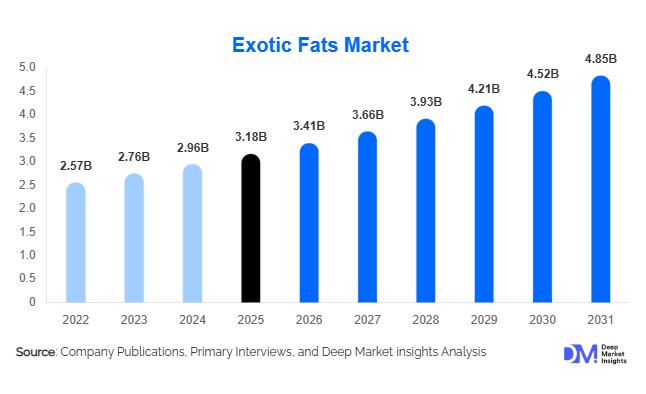
According to Deep Market Insights, the global exotic fats market size was valued at USD 3.18 billion in 2026 and is projected to grow from USD 3.41 billion in 2026 to reach USD 4.85 billion by 2031, expanding at a CAGR of 7.3% during the forecast period (2026–2031). The exotic fats market growth is primarily driven by increasing demand for cocoa butter alternatives in confectionery manufacturing, rising adoption of natural and plant-based ingredients in cosmetics, and growing preference for specialty fats with enhanced functional properties across food, pharmaceutical, and personal care applications.
Exotic fats are gaining importance as high-value specialty lipids derived from tropical plant sources such as shea, illipe, sal, kokum, mango kernel, murumuru, and cupuaçu. These fats provide unique melting characteristics, texture enhancement, oxidative stability, and emollient properties, making them suitable for premium chocolate products, bakery formulations, skincare products, pharmaceutical excipients, and nutraceutical applications. The market is benefiting from increasing cocoa price volatility, which has encouraged chocolate manufacturers to adopt cocoa butter equivalents (CBEs) and cocoa butter substitutes to optimize production economics. At the same time, the clean beauty movement is accelerating demand for natural exotic butters in premium skincare and personal care formulations.
Key Market Insights
- Cocoa butter equivalents represent the largest application segment, supported by rising chocolate production and the need for cost-efficient specialty fats with similar functional characteristics to cocoa butter.
- Shea butter dominates the exotic fats market by product type, owing to its extensive usage across confectionery, cosmetics, pharmaceuticals, and personal care industries.
- Europe remains the largest regional market, driven by established chocolate manufacturing hubs, strong specialty ingredient demand, and high adoption of sustainable sourcing practices.
- Asia-Pacific is the fastest-growing market, supported by expanding chocolate manufacturing, increasing disposable income, and rising consumption of premium skincare products.
- Sustainable sourcing and traceability are becoming key competitive factors, with global manufacturers investing in responsible supply chains and farmer partnerships.
- Advanced processing technologies including fractionation and enzymatic modification are enabling customized exotic fat formulations with improved melting profiles and broader industrial applications.
exotic fats market latest trends
Sustainable and Ethical Sourcing of Exotic Fats
Sustainability has become one of the most influential trends shaping the global exotic fats market. Manufacturers and end-use companies are increasingly prioritizing responsibly sourced raw materials due to rising consumer awareness and stricter environmental expectations. Shea, illipe, sal, and other tropical fats are often sourced from regions where supply chains involve smallholder farmers, making ethical sourcing programs increasingly important. Companies are investing in farmer training, certification programs, digital traceability systems, and transparent procurement models to improve supply reliability while supporting rural communities. European chocolate manufacturers and premium cosmetic brands are particularly focused on sustainable sourcing practices as part of broader ESG commitments.
Rising Adoption of Cocoa Butter Equivalents in Chocolate Manufacturing
The increasing volatility of cocoa prices has accelerated the adoption of exotic fats as functional alternatives to traditional cocoa butter. Cocoa butter equivalents manufactured using shea stearin, illipe butter, sal fat, and other specialty lipid fractions are being increasingly incorporated into chocolate formulations to maintain desired texture, gloss, snap, and melting characteristics. This trend is particularly important for mass-market chocolate producers seeking cost optimization without compromising consumer experience. Growing chocolate consumption in emerging economies, especially across Asia-Pacific and the Middle East, is further increasing demand for specialty fats used in confectionery applications.
Expansion of Natural Ingredients in Cosmetics and Personal Care
The clean beauty movement is significantly expanding demand for exotic fats across skincare, haircare, and personal care industries. Ingredients such as shea butter, murumuru butter, mango butter, and kokum butter are increasingly preferred because of their moisturizing properties, natural positioning, and compatibility with vegan and organic product categories. Premium cosmetic brands are incorporating exotic butters into anti-aging creams, body lotions, lip care products, conditioners, and luxury skincare products. Increasing consumer preference for botanical ingredients is encouraging manufacturers to expand product portfolios and develop specialized cosmetic-grade exotic fats.
Technological Innovation in Specialty Fat Processing
Processing innovation is transforming the exotic fats industry by enabling manufacturers to develop customized products with improved functionality. Advanced fractionation, enzymatic interesterification, and refining technologies allow producers to control melting points, crystallization behavior, texture, and stability. These technologies are helping exotic fats compete more effectively with conventional vegetable oils while expanding their use in high-value applications. Manufacturers are increasingly investing in automated processing facilities, quality control systems, and digital supply chain monitoring to improve consistency and meet stricter industrial requirements.
exotic fats market drivers
Growth of Global Chocolate and Confectionery Manufacturing
The expansion of the global chocolate and confectionery industry remains the primary growth driver for exotic fats. Chocolate manufacturers increasingly utilize cocoa butter equivalents and cocoa butter substitutes to manage production costs, improve formulation flexibility, and address cocoa supply challenges. Rising chocolate consumption in emerging economies, particularly China, India, Indonesia, and Middle Eastern countries, is creating additional demand for specialty fats. Premium chocolate brands are also expanding product ranges, increasing the requirement for customized fats that deliver specific sensory and functional characteristics.
Increasing Demand for Natural and Plant-Based Cosmetic Ingredients
The rapid growth of natural skincare and clean beauty categories is creating strong demand for exotic fats. Consumers are increasingly seeking products formulated with recognizable, plant-derived ingredients, encouraging cosmetic companies to replace synthetic emollients with botanical alternatives. Shea butter, mango butter, murumuru butter, and kokum butter are gaining popularity due to their moisturizing properties, skin compatibility, and premium market positioning. The expansion of vegan cosmetics, organic skincare, and sustainable beauty products is expected to remain a major contributor to exotic fats market growth.
Rising Demand for Specialty Functional Ingredients Across Industries
Beyond food and cosmetics, exotic fats are finding increasing applications in pharmaceuticals, nutraceuticals, and specialty formulations due to their stability and functional characteristics. Pharmaceutical manufacturers utilize certain exotic fats as excipients in topical formulations, ointments, and controlled-release products. Nutraceutical companies are also exploring specialty lipids for functional foods and wellness products. Growing demand for high-performance natural ingredients across multiple industries is encouraging manufacturers to diversify product applications and expand processing capabilities.
exotic fats market restraints
Limited Raw Material Availability and Supply Chain Challenges
The exotic fats market faces significant supply chain challenges due to dependence on geographically concentrated tropical crops. Shea nuts, illipe nuts, sal seeds, kokum seeds, and other specialty raw materials are largely sourced from specific regions in Africa, Asia, and South America. Climate variability, changing weather patterns, inconsistent harvesting practices, and infrastructure limitations can impact supply availability. These factors create price fluctuations and increase procurement risks for manufacturers dependent on stable raw material supply.
High Production Costs Compared with Conventional Vegetable Oils
Exotic fats typically command premium pricing due to specialized harvesting processes, limited production volumes, and additional refining requirements. Conventional vegetable oils such as palm, soybean, and sunflower oil remain lower-cost alternatives for many applications, creating competitive pressure in price-sensitive markets. While exotic fats offer superior functionality, manufacturers must justify higher costs through performance advantages, sustainability benefits, or premium product positioning. This pricing challenge can restrict adoption among smaller food processors and cost-focused manufacturers.
exotic fats industry key opportunities
Premium Chocolate Market Expansion in Emerging Economies
The rapid development of premium chocolate markets in Asia-Pacific, Latin America, and the Middle East presents significant opportunities for exotic fat manufacturers. Rising disposable incomes, urbanization, and changing consumer preferences are increasing demand for high-quality confectionery products. Countries such as China, India, Indonesia, and the UAE are witnessing investments in modern chocolate manufacturing facilities, creating new demand for cocoa butter equivalents and specialty confectionery fats. Companies that establish regional processing capabilities and develop customized formulations suited to local manufacturers can capture significant growth opportunities.
Growth of Sustainable Beauty and Personal Care Applications
The expansion of sustainable beauty products provides a major opportunity for exotic fat suppliers. Consumers are increasingly choosing skincare and personal care products based on natural origin, ethical sourcing, and environmental responsibility. Exotic butters such as shea, mango, murumuru, and kokum are becoming premium ingredients in luxury skincare, haircare, and wellness products. Manufacturers investing in certified sustainable supply chains, organic product lines, and cosmetic-grade processing capabilities are positioned to benefit from this rapidly growing segment.
Development of Value-Added Processing in Producing Countries
Countries producing exotic fat raw materials are increasingly focusing on domestic processing rather than exporting unprocessed materials. Government initiatives supporting agricultural modernization, rural employment, and export-oriented food ingredient industries are encouraging investment in local refining and fractionation facilities. Expanding value-added processing capabilities in Africa, India, and Southeast Asia can improve supply chain efficiency, increase producer incomes, and create new opportunities for regional manufacturers to compete globally.
Report Scope
| Report Metric | Details |
|---|---|
| Market Size in 2025 | USD 3.18 Billion |
| Market Size in 2026 | USD 3.41 Billion |
| Market Size in 2031 | USD 4.85 Billion |
| CAGR | 7.3% (2026-2031) |
| Base Year for Estimation | 2025 |
| Historical Data | 2022-2024 |
| Forecast Period | 2026-2031 |
| Report Coverage | Revenue Forecast, Competitive Landscape, Supply Chain Disruption, Growth Factors, Environment & Regulatory Landscape and Trends |
| Geographies Covered | North America, Europe, APAC, Middle East and Africa, LATAM |
| Countries Covered | U.S., Canada, U.K., Germany, France, Spain, Italy, Russia, Nordic, Benelux, Rest of Europe, China, Korea, Japan, India, Australia, Singapore, Taiwan, South East Asia, Rest of Asia-Pacific, UAE, Turky, Saudi Arabia, South Africa, Egypt, Nigeria, Rest of MEA, Brazil, Mexico, Argentina, Chile, Colombia, Rest of LATAM |
Explore more data points, trends and opportunities Download Free Sample Report
Product Type Insights
Shea Butter dominates the global exotic fats market, accounting for approximately 31.8% of total market revenue in 2025. The segment maintains leadership due to its broad application base across confectionery, cosmetics, pharmaceuticals, and personal care industries. Shea butter is widely utilized in cocoa butter equivalent production because of its favorable triglyceride composition, compatibility with cocoa butter, and ability to deliver desirable texture and melting characteristics in chocolate formulations. In the cosmetics industry, shea butter remains one of the most preferred natural moisturizers due to its skin-conditioning properties and premium consumer perception. Strong supply networks across West Africa, increasing sustainability certification programs, and rising demand for natural ingredients continue supporting market growth.Mango butter, murumuru butter, kokum butter, and cupuaçu butter represent rapidly growing specialty segments, particularly in premium cosmetics and clean-label personal care applications. These products benefit from increasing consumer preference for exotic botanical ingredients and differentiated skincare formulations. Illipe butter and sal fat maintain strong relevance in confectionery applications due to their similarity to cocoa butter properties and suitability for specialized chocolate manufacturing.
Source Insights
Plant-based exotic fats represent the dominant source category, accounting for approximately 96.5% of the global exotic fats market in 2025. The dominance of plant-derived fats is supported by increasing demand for renewable, vegan, and naturally sourced ingredients across food, cosmetics, and pharmaceutical applications. Tropical plant sources including shea nuts, mango kernels, kokum seeds, sal seeds, and illipe nuts provide commercially valuable lipid profiles that can be processed into specialized fats with targeted functional properties.Animal-derived specialty fats represent a very limited share of the market due to changing consumer preferences, sustainability concerns, and regulatory pressure. Food manufacturers and cosmetic companies are increasingly shifting toward botanical alternatives as part of clean-label strategies. The plant-based segment is expected to maintain its dominance throughout the forecast period as sustainability commitments become increasingly important in global ingredient procurement.
Processing Technology Insights
Fractionation technology represents the largest processing segment, accounting for approximately 38.4% of the global exotic fats market in 2025. Fractionation enables manufacturers to separate high-value lipid fractions with specific melting characteristics, making it essential for cocoa butter equivalents, confectionery fats, and premium cosmetic ingredients. The technology allows manufacturers to optimize texture, stability, and compatibility with end-use formulations while improving product consistency.Enzymatic interesterification is emerging as one of the fastest-growing technologies due to its ability to create customized specialty fats with precise functional characteristics. Manufacturers are increasingly adopting enzymatic processes to develop tailored formulations for chocolate coatings, bakery applications, and pharmaceutical products. Advanced refining and purification technologies are also gaining importance as buyers demand higher purity standards, improved shelf stability, and consistent performance across industrial applications.
Application Insights
Cocoa Butter Equivalents (CBEs) represent the largest application segment, contributing approximately 42.6% of global exotic fats market revenue in 2025. The segment benefits from strong demand from chocolate manufacturers seeking alternatives to traditional cocoa butter amid increasing cocoa price volatility and supply uncertainty. CBEs provide similar melting behavior, gloss, texture, and sensory characteristics while improving production economics. Growing chocolate consumption in emerging markets is further strengthening demand for specialty confectionery fats.Cosmetics and personal care applications represent the second-largest application segment and one of the fastest-growing areas. Rising consumer interest in natural skincare, vegan beauty products, and premium formulations is increasing demand for exotic butters. Pharmaceutical applications are also expanding due to the use of specialty fats as excipients in topical formulations, while bakery and dairy alternative applications are gaining traction due to increasing demand for functional plant-based ingredients.
Distribution Channel Insights
Direct industrial supply channels dominate the exotic fats market, accounting for approximately 72.3% of global sales in 2025. Large food manufacturers, cosmetic companies, and pharmaceutical companies generally purchase exotic fats directly from specialty ingredient producers through long-term supply agreements. These relationships allow buyers to secure consistent quality, traceability, technical support, and customized formulations.Specialty ingredient distributors remain important for medium-sized manufacturers that require smaller volumes and regional supply support. Online B2B ingredient marketplaces are gradually expanding as digital procurement platforms improve accessibility for smaller businesses. However, direct industrial relationships remain the preferred purchasing model due to strict quality requirements, regulatory compliance needs, and the specialized nature of exotic fat applications.
End-Use Industry Insights
The food and beverage industry represents the largest end-use segment, accounting for approximately 56.9% of global exotic fats demand in 2025. Chocolate and confectionery manufacturing represent the primary consumption area, followed by bakery products, frozen desserts, dairy alternatives, and specialty processed foods. The segment continues expanding due to rising chocolate consumption, demand for premium confectionery products, and increasing utilization of cocoa butter alternatives.The cosmetics and personal care industry is the fastest-growing end-use segment, supported by rising consumer demand for natural skincare and clean beauty products. Premium skincare brands are increasingly incorporating exotic butters into moisturizers, anti-aging products, haircare formulations, and wellness products. Pharmaceutical and nutraceutical industries are also emerging growth areas as manufacturers explore plant-derived specialty lipids for functional formulations.
Explore more data points, trends and opportunities Download Free Sample Report
Exotic Fats Market Segmentations
By Product Type
- Shea Butter
- Illipe Butter
- Kokum Butter
- Mango Butter
- Murumuru Butter
- Cupuaçu Butter
- Sal Fat
- Other Exotic Plant-Based Fats
By Source
- Plant-Based Exotic Fats
- Animal-Derived Specialty Fats
By Processing Technology
- Fractionation
- Refining and Purification
- Enzymatic Interesterification
- Blending and Customized Formulation
By Application
- Cocoa Butter Equivalents (CBEs)
- Chocolate and Confectionery Products
- Cosmetics and Personal Care
- Bakery and Processed Foods
- Pharmaceutical Formulations
- Nutraceutical Applications
By End-Use Industry
- Food and Beverage Industry
- Cosmetics and Personal Care Industry
- Pharmaceutical Industry
- Nutraceutical and Functional Food Industry
Regional Insights
Europe
Europe remains the largest regional market for exotic fats, accounting for approximately 35.4% of global market share in 2025. The region’s leadership is primarily driven by its advanced chocolate manufacturing industry, strong specialty ingredient infrastructure, and high adoption of sustainable sourcing practices. Germany represents the largest European market, accounting for approximately 9.2% of global demand, supported by its large confectionery sector and strong presence of chocolate manufacturers.Belgium, Switzerland, France, the Netherlands, Italy, and the United Kingdom are also significant consumers. Belgium and Switzerland maintain strong demand due to their premium chocolate manufacturing capabilities, while France and Germany show increasing consumption of sustainable cosmetic ingredients. European companies are among the strongest adopters of certified sustainable exotic fats due to regulatory requirements and consumer expectations around responsible sourcing.
Asia-Pacific
Asia-Pacific represents the fastest-growing regional market, accounting for approximately 28.1% of global exotic fats demand in 2025. The region is projected to expand at a CAGR exceeding 8.5% during the forecast period, supported by rising chocolate consumption, expanding personal care industries, and increasing investments in specialty ingredient manufacturing.China represents the largest Asia-Pacific market, accounting for approximately 10.1% of global demand. Growth is driven by expanding confectionery production, premium chocolate consumption, and increasing demand for imported cosmetic ingredients. India is emerging as a high-growth market due to its strong position in kokum and mango kernel fat production, expanding food processing industry, and rapidly growing beauty and personal care market.Japan and South Korea represent mature but premium markets, with strong demand for specialty cosmetic ingredients and advanced skincare products. Indonesia and Malaysia benefit from established vegetable oil processing infrastructure and increasing investments in specialty fat manufacturing capabilities.
North America
North America represents a significant market for exotic fats, supported by strong demand from premium chocolate manufacturers, natural cosmetics companies, and specialty food producers. The United States dominates regional consumption due to its large confectionery industry, advanced ingredient processing capabilities, and strong consumer preference for clean-label products.Demand in the U.S. is increasingly influenced by premium skincare trends, sustainable sourcing requirements, and growing adoption of cocoa butter alternatives among chocolate manufacturers. Canada represents a smaller but steadily expanding market, supported by rising demand for organic cosmetics and specialty food ingredients.
Latin America
Latin America is becoming an important emerging market for exotic fats due to its role as both a producer and consumer region. Brazil leads regional demand, supported by its large cosmetics industry and availability of native exotic fats such as murumuru and cupuaçu butter. Mexico is experiencing increased demand due to expanding chocolate manufacturing and processed food production.Argentina, Colombia, and Chile are gradually increasing consumption of premium skincare products and specialty food ingredients. Regional manufacturers are also investing in domestic processing capabilities to increase value addition and reduce dependence on imported finished ingredients.
Middle East & Africa
The Middle East & Africa region plays a strategic role in the global exotic fats market due to its position as a major raw material production hub and emerging consumer market. West African countries including Ghana, Nigeria, Burkina Faso, Mali, and Côte d'Ivoire are among the leading sources of shea-based raw materials.South Africa represents the largest regional consumer market due to its developed food processing and cosmetics industries. Gulf countries including the UAE and Saudi Arabia are experiencing increasing demand for exotic fats due to expanding premium chocolate manufacturing, luxury cosmetics consumption, and growing imports of specialty ingredients.
Key Players in the Exotic Fats Market
- AAK AB
- Bunge Global
- Wilmar International
- Fuji Oil Holdings
- IOI Corporation
- Cargill
- Olam Group
- Musim Mas
- Kemin Industries
- Sime Darby Plantation
- Manorama Industries
- Martek Biosciences
- Fuji Oil Europe
- Ghana Specialty Fats Producers
- Indian Specialty Fat Manufacturers