Global Cake Softener Market Size
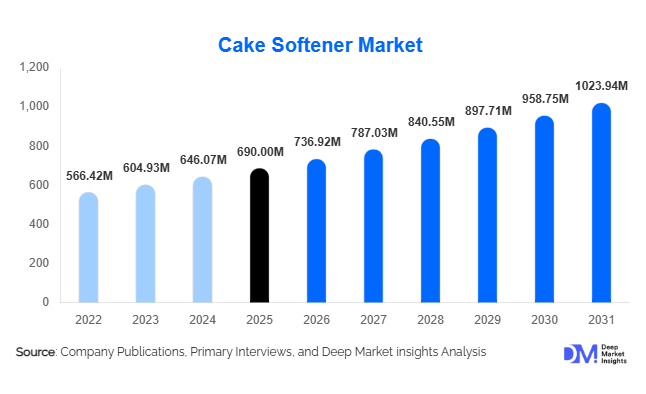
According to Deep Market Insights, the global cake softener market size was valued at USD 690 million in 2025 and is projected to grow from USD 736.92 million in 2026 to reach USD 1,023.94 million by 2031, expanding at a CAGR of 6.8% during the forecast period (2026–2031). The cake softener market growth is primarily driven by the increasing consumption of packaged bakery products, expansion of industrial bakery manufacturing, rising demand for extended shelf-life bakery solutions, and growing adoption of advanced emulsifier and enzyme-based bakery ingredients.
Key Market Insights
- Emulsifier-based cake softeners dominate the global market, accounting for the largest share due to their proven ability to improve crumb softness, batter stability, and cake volume in industrial bakery production.
- Industrial bakeries represent the largest end-use segment, driven by large-scale production of packaged cakes, muffins, cupcakes, and frozen bakery products requiring consistent texture and extended freshness.
- Asia-Pacific is the largest and fastest-growing regional market, supported by rapid bakery sector expansion, rising disposable income, and increasing adoption of Western-style baked goods in China and India.
- Clean-label and enzyme-based cake softeners are gaining strong momentum, as manufacturers respond to consumer demand for natural ingredients and reduced synthetic additives.
- Packaged bakery products are becoming a major demand driver, as retailers and manufacturers seek solutions that maintain softness and quality during transportation and extended shelf periods.
- Technology integration in bakery ingredient development, including enzyme engineering, precision fermentation, and multifunctional improver systems, is reshaping product innovation strategies.
Global Cake Softener Market Latest Trends
Shift Toward Clean-Label and Natural Cake Softener Solutions
The global bakery industry is experiencing a significant transition toward clean-label formulations, creating strong demand for natural and minimally processed cake softeners. Consumers are increasingly examining ingredient lists and avoiding products containing artificial additives, pushing manufacturers to replace conventional emulsifiers with enzyme-based solutions, plant-derived ingredients, and fermentation-derived alternatives. Bakery ingredient suppliers are investing in advanced formulations that provide similar functionality to traditional softeners while meeting clean-label expectations. Natural emulsifiers, enzyme blends, and multifunctional bakery improvers are becoming increasingly important in premium bakery applications where ingredient transparency and product positioning influence purchasing decisions.
Growth of Multifunctional Bakery Improvers
Bakery manufacturers are increasingly adopting multifunctional cake softener systems that deliver multiple benefits, including improved softness, moisture retention, batter stability, volume enhancement, and extended shelf life. Instead of using multiple individual ingredients, industrial bakeries are shifting toward customized solutions combining emulsifiers, enzymes, hydrocolloids, and processing aids. These integrated systems improve production efficiency, reduce formulation complexity, and provide consistent quality across large-scale manufacturing operations. The trend is particularly prominent among multinational bakery producers and private-label manufacturers supplying supermarkets and foodservice chains.
Global Cake Softener Market Drivers
Rising Demand for Packaged Bakery Products
The increasing consumption of packaged cakes, muffins, cupcakes, and ready-to-eat bakery products is one of the strongest growth drivers for the cake softener market. Urbanization, changing lifestyles, and growing preference for convenience foods have increased demand for bakery products with longer shelf life and consistent quality. Cake softeners help manufacturers maintain softness, freshness, and consumer appeal throughout distribution networks. The expansion of supermarkets, convenience stores, and online grocery platforms has further increased the need for bakery products capable of maintaining quality during extended storage periods. Emerging markets are experiencing particularly strong demand as packaged bakery consumption shifts from traditional bakery purchases toward branded and industrially manufactured products.
Expansion of Industrial Bakery Manufacturing
The growth of industrial bakeries worldwide is significantly increasing demand for functional cake ingredients. Large-scale bakery manufacturers require precise ingredient solutions that can deliver uniform texture, improved processing efficiency, and reduced production losses. Automated bakery production lines depend heavily on consistent ingredient performance, making cake softeners an essential component in commercial manufacturing. Expansion of bakery production facilities in Asia-Pacific, Latin America, and the Middle East is creating new opportunities for ingredient suppliers. As bakery companies scale operations and enter export markets, demand for advanced cake softener systems is expected to continue increasing.
Growing Premiumization of Cakes and Desserts
Rising consumer preference for premium cakes, specialty desserts, and high-quality bakery products is encouraging manufacturers to invest in advanced softening technologies. Consumers increasingly associate softness, freshness, and superior texture with product quality, particularly in premium cakes sold through cafés, boutique bakeries, and online platforms. Cake manufacturers are using specialized softeners to enhance sensory characteristics and differentiate products in competitive markets. The growth of celebration cakes, customized desserts, and premium bakery chains is creating additional demand for high-performance cake softening solutions.
Global Cake Softener Market Restraints
Regulatory Pressure on Food Additives
Increasing regulatory scrutiny regarding food additives and emulsifiers represents a major challenge for cake softener manufacturers. Authorities across developed markets are reviewing permitted ingredients and encouraging reductions in synthetic additives. While traditional emulsifiers remain widely used, manufacturers face pressure to develop alternatives that provide similar functionality while meeting evolving regulatory requirements. Reformulation efforts require significant research investment and may increase production costs, particularly for smaller ingredient suppliers with limited innovation capabilities.
Raw Material Price Volatility
The cake softener industry is affected by fluctuations in the prices of key raw materials, including vegetable oils, palm derivatives, lecithin, specialty enzymes, and other functional ingredients. Agricultural supply disruptions, weather-related production issues, and geopolitical factors can impact ingredient availability and manufacturing costs. Rising raw material prices can pressure supplier margins and increase pricing challenges for bakery manufacturers. Companies are increasingly focusing on supply chain diversification, alternative ingredient sourcing, and production efficiency improvements to manage cost volatility.
Global Cake Softener Industry Key Opportunities
Expansion of Enzyme-Based and Clean-Label Cake Softeners
The transition toward clean-label bakery products presents a major opportunity for manufacturers developing enzyme-based and naturally derived cake softener solutions. Enzymes offer advantages such as improved crumb structure, delayed staling, and enhanced freshness while aligning with consumer preference for recognizable ingredients. Bakery manufacturers are actively seeking alternatives to traditional emulsifiers, particularly in premium and health-oriented product categories. Companies investing in biotechnology, fermentation-based ingredient production, and natural formulation technologies are positioned to capture higher-value market segments. The growing popularity of organic, vegan, and minimally processed bakery products will continue supporting demand for next-generation cake softening solutions.
Increasing Bakery Industrialization in Emerging Markets
Emerging economies provide significant growth opportunities due to rapid expansion of organized bakery manufacturing and rising consumption of packaged cakes. Countries such as India, China, Indonesia, Brazil, and Middle Eastern markets are witnessing increased investment in automated bakery facilities. These manufacturers require advanced ingredients capable of improving consistency, reducing waste, and extending product shelf life. Local production expansion, food processing incentives, and growing retail penetration are creating favorable conditions for cake softener suppliers. Companies establishing regional technical support centers and manufacturing capabilities can benefit from long-term demand growth in these markets.
Technological Innovation in Bakery Ingredient Systems
Advancements in enzyme engineering, precision fermentation, and customized bakery formulations are creating new opportunities for market participants. Manufacturers are developing multifunctional cake improvers that combine softening, moisture retention, and processing benefits into single solutions. Artificial intelligence-based formulation optimization and advanced testing methods are also improving product development efficiency. These technologies enable ingredient suppliers to offer customized solutions tailored to specific cake types, production processes, and regional consumer preferences, strengthening their competitive positioning.
Report Scope
| Report Metric | Details |
|---|---|
| Market Size in 2025 | USD 690.00 Million |
| Market Size in 2026 | USD 736.92 Million |
| Market Size in 2031 | USD 1023.94 Million |
| CAGR | 6.8% (2026-2031) |
| Base Year for Estimation | 2025 |
| Historical Data | 2022-2024 |
| Forecast Period | 2026-2031 |
| Report Coverage | Revenue Forecast, Competitive Landscape, Supply Chain Disruption, Growth Factors, Environment & Regulatory Landscape and Trends |
| Geographies Covered | North America, Europe, APAC, Middle East and Africa, LATAM |
| Countries Covered | U.S., Canada, U.K., Germany, France, Spain, Italy, Russia, Nordic, Benelux, Rest of Europe, China, Korea, Japan, India, Australia, Singapore, Taiwan, South East Asia, Rest of Asia-Pacific, UAE, Turky, Saudi Arabia, South Africa, Egypt, Nigeria, Rest of MEA, Brazil, Mexico, Argentina, Chile, Colombia, Rest of LATAM |
Explore more data points, trends and opportunities Download Free Sample Report
Product Type Insights
Emulsifier-based cake softeners dominate the global market, accounting for approximately 58.4% of the global cake softener market share in 2025. These products remain widely preferred due to their established functionality, cost efficiency, and ability to improve cake volume, aeration, crumb softness, and moisture retention during industrial production. Conventional emulsifiers such as mono- and diglycerides, DATEM, SSL, and polyglycerol esters continue to be extensively used by large bakery manufacturers because they provide predictable performance across automated production environments.Enzyme-based cake softeners represent the fastest-growing product category, supported by rising demand for clean-label bakery products and reduced dependence on synthetic additives. Enzyme systems help manufacturers achieve improved freshness retention, delayed staling, and enhanced texture while aligning with evolving consumer preferences. Although their current market share remains smaller than emulsifier-based solutions, enzyme-based products are gaining adoption among premium bakery manufacturers and companies targeting natural ingredient positioning.Hydrocolloid-based and specialty blended cake softeners are also gaining traction in specific applications where manufacturers require improved moisture management, freeze-thaw stability, and customized texture performance. These solutions are particularly relevant in frozen bakery products and premium dessert applications where maintaining product quality throughout the supply chain is critical.
Form Insights
Powder cake softeners represent the leading formulation segment, accounting for approximately 52.6% market share in 2025. Powder formulations are preferred by industrial bakeries because of their superior storage stability, longer shelf life, easier transportation, and compatibility with automated dry ingredient handling systems. These products are particularly popular among bakery premix manufacturers and large-scale cake producers operating across multiple geographic markets.Liquid cake softeners are increasingly used in specialty bakery applications where rapid dispersion, precise dosing, and formulation flexibility are required. They are particularly suitable for high-volume bakeries producing premium cakes, sponge products, and customized desserts. However, higher transportation costs and storage requirements limit their adoption compared with powder alternatives.Gel and paste-based cake softeners occupy niche segments, primarily serving artisanal bakeries, specialty cake producers, and applications requiring enhanced texture control. These formats provide excellent dispersion and functionality but remain limited in large-scale industrial production.
Application Insights
Sponge cakes represent the largest cake application segment, accounting for approximately 36.8% of the global cake softener market in 2025. Sponge cakes require precise control over aeration, volume development, moisture retention, and crumb softness, making cake softeners an essential ingredient in commercial production. The growing popularity of packaged sponge cakes, celebration cakes, and ready-to-eat desserts is supporting continued demand in this category.Layer cakes and specialty cakes represent important growth segments due to rising demand for premium desserts, customized cakes, and bakery café products. These applications require advanced softening systems to maintain texture quality, especially when products contain multiple layers, fillings, or decorative components.Muffins, cupcakes, and snack cakes are also expanding applications, driven by convenience food trends and increasing consumption among younger consumers. Manufacturers producing individually packaged bakery products increasingly rely on cake softeners to extend freshness and improve consumer experience.
Distribution Channel Insights
Direct sales to industrial bakery manufacturers represent the dominant distribution channel for cake softeners, accounting for the majority of market volume. Large bakery companies typically establish long-term supply agreements with ingredient manufacturers to ensure consistent quality, technical support, and customized formulation development. This channel remains highly important because industrial customers require application assistance and regulatory compliance support.Specialty ingredient distributors play an important role in serving small and medium-sized bakeries by providing access to multiple ingredient suppliers, technical guidance, and regional availability. Distributor networks are particularly significant in emerging markets where local bakery manufacturers may lack direct relationships with multinational ingredient producers.Online ingredient platforms and digital procurement channels are gradually emerging as additional sales channels, particularly among smaller bakery businesses and food entrepreneurs. Digital ordering systems provide easier access to specialty cake softeners and allow manufacturers to reach fragmented customer segments.
End-User Insights
Industrial bakeries dominate cake softener consumption, accounting for approximately 61.5% of global market demand in 2025. These companies use cake softeners extensively to improve manufacturing consistency, increase production efficiency, and maintain product freshness across large distribution networks. The growth of packaged cakes, frozen bakery products, and private-label bakery brands has significantly increased demand from industrial users.Commercial bakeries and bakery chains represent a rapidly expanding segment due to the growth of cafés, dessert outlets, and premium bakery concepts worldwide. These businesses increasingly require specialized cake softeners to produce consistent products while maintaining artisan-style quality. The expansion of online bakery platforms is also encouraging small and medium bakeries to adopt professional-grade ingredients.Foodservice operators, including hotels, restaurants, and catering companies, represent a smaller but stable demand segment. Growth in hospitality industries, particularly in Asia-Pacific and the Middle East, is creating additional opportunities for cake softener suppliers serving professional kitchens.
Explore more data points, trends and opportunities Download Free Sample Report
Cake Softener Market Segmentations
By Product Type
- Emulsifier-Based Cake Softeners
- Enzyme-Based Cake Softeners
- Hydrocolloid-Based Cake Softeners
- Specialty Blended Cake Softeners
By Form
- Powder Cake Softeners
- Liquid Cake Softeners
- Gel/Paste Cake Softeners
By Function
- Crumb Softening
- Moisture Retention
- Shelf-Life Extension
- Volume Enhancement
- Batter Stability Improvement
By Cake Application
- Sponge Cakes
- Layer Cakes
- Muffins and Cupcakes
- Snack Cakes
- Frozen Cakes and Desserts
- Specialty and Premium Cakes
By End User
- Industrial Bakeries
- Commercial Bakeries and Bakery Chains
- Foodservice Operators
- Bakery Premix Manufacturers
Product Type Insights
Emulsifier-based cake softeners dominate the global market, accounting for approximately 58.4% of the global cake softener market share in 2025. These products remain widely preferred due to their established functionality, cost efficiency, and ability to improve cake volume, aeration, crumb softness, and moisture retention during industrial production. Conventional emulsifiers such as mono- and diglycerides, DATEM, SSL, and polyglycerol esters continue to be extensively used by large bakery manufacturers because they provide predictable performance across automated production environments.Enzyme-based cake softeners represent the fastest-growing product category, supported by rising demand for clean-label bakery products and reduced dependence on synthetic additives. Enzyme systems help manufacturers achieve improved freshness retention, delayed staling, and enhanced texture while aligning with evolving consumer preferences. Although their current market share remains smaller than emulsifier-based solutions, enzyme-based products are gaining adoption among premium bakery manufacturers and companies targeting natural ingredient positioning.Hydrocolloid-based and specialty blended cake softeners are also gaining traction in specific applications where manufacturers require improved moisture management, freeze-thaw stability, and customized texture performance. These solutions are particularly relevant in frozen bakery products and premium dessert applications where maintaining product quality throughout the supply chain is critical.
Form Insights
Powder cake softeners represent the leading formulation segment, accounting for approximately 52.6% market share in 2025. Powder formulations are preferred by industrial bakeries because of their superior storage stability, longer shelf life, easier transportation, and compatibility with automated dry ingredient handling systems. These products are particularly popular among bakery premix manufacturers and large-scale cake producers operating across multiple geographic markets.Liquid cake softeners are increasingly used in specialty bakery applications where rapid dispersion, precise dosing, and formulation flexibility are required. They are particularly suitable for high-volume bakeries producing premium cakes, sponge products, and customized desserts. However, higher transportation costs and storage requirements limit their adoption compared with powder alternatives.Gel and paste-based cake softeners occupy niche segments, primarily serving artisanal bakeries, specialty cake producers, and applications requiring enhanced texture control. These formats provide excellent dispersion and functionality but remain limited in large-scale industrial production.
Application Insights
Sponge cakes represent the largest cake application segment, accounting for approximately 36.8% of the global cake softener market in 2025. Sponge cakes require precise control over aeration, volume development, moisture retention, and crumb softness, making cake softeners an essential ingredient in commercial production. The growing popularity of packaged sponge cakes, celebration cakes, and ready-to-eat desserts is supporting continued demand in this category.Layer cakes and specialty cakes represent important growth segments due to rising demand for premium desserts, customized cakes, and bakery café products. These applications require advanced softening systems to maintain texture quality, especially when products contain multiple layers, fillings, or decorative components.Muffins, cupcakes, and snack cakes are also expanding applications, driven by convenience food trends and increasing consumption among younger consumers. Manufacturers producing individually packaged bakery products increasingly rely on cake softeners to extend freshness and improve consumer experience.
Distribution Channel Insights
Direct sales to industrial bakery manufacturers represent the dominant distribution channel for cake softeners, accounting for the majority of market volume. Large bakery companies typically establish long-term supply agreements with ingredient manufacturers to ensure consistent quality, technical support, and customized formulation development. This channel remains highly important because industrial customers require application assistance and regulatory compliance support.Specialty ingredient distributors play an important role in serving small and medium-sized bakeries by providing access to multiple ingredient suppliers, technical guidance, and regional availability. Distributor networks are particularly significant in emerging markets where local bakery manufacturers may lack direct relationships with multinational ingredient producers.Online ingredient platforms and digital procurement channels are gradually emerging as additional sales channels, particularly among smaller bakery businesses and food entrepreneurs. Digital ordering systems provide easier access to specialty cake softeners and allow manufacturers to reach fragmented customer segments.
End-User Insights
Industrial bakeries dominate cake softener consumption, accounting for approximately 61.5% of global market demand in 2025. These companies use cake softeners extensively to improve manufacturing consistency, increase production efficiency, and maintain product freshness across large distribution networks. The growth of packaged cakes, frozen bakery products, and private-label bakery brands has significantly increased demand from industrial users.Commercial bakeries and bakery chains represent a rapidly expanding segment due to the growth of cafés, dessert outlets, and premium bakery concepts worldwide. These businesses increasingly require specialized cake softeners to produce consistent products while maintaining artisan-style quality. The expansion of online bakery platforms is also encouraging small and medium bakeries to adopt professional-grade ingredients.Foodservice operators, including hotels, restaurants, and catering companies, represent a smaller but stable demand segment. Growth in hospitality industries, particularly in Asia-Pacific and the Middle East, is creating additional opportunities for cake softener suppliers serving professional kitchens.
Latin America
Latin America represents an emerging market for cake softeners, accounting for approximately 6.4% of the global market share in 2025. Growth in the region is supported by increasing consumption of packaged bakery products, expansion of modern retail channels, and rising investment in food processing infrastructure. Countries such as Brazil, Mexico, Argentina, and Colombia are driving regional demand as bakery manufacturers adopt industrial production methods and improve product quality standards.Brazil represents the largest cake softener market in Latin America due to its strong domestic bakery industry and high consumer demand for cakes, sweet baked goods, and snack products. The expansion of supermarket bakery sections and packaged food manufacturers is increasing demand for functional ingredients that improve product consistency and shelf stability.Mexico is experiencing strong growth due to its expanding bakery export industry, increasing consumption of packaged cakes, and growing presence of international bakery brands. Manufacturers are increasingly investing in modern production facilities, creating additional opportunities for cake softener suppliers.
Middle East & Africa
The Middle East & Africa region represents approximately 4.4% of the global cake softener market in 2025 and is expected to demonstrate steady growth due to urbanization, hospitality sector expansion, and rising demand for premium bakery products.The Gulf Cooperation Council countries, particularly Saudi Arabia and the UAE, represent the strongest markets due to high consumption of premium desserts, growth of international bakery chains, and expansion of hotels and foodservice businesses. The region relies significantly on imported bakery ingredients, creating opportunities for global cake softener manufacturers.South Africa leads demand in Africa due to its developed food processing sector and established bakery manufacturing industry. Other African markets are expected to witness gradual growth as urban populations increase and packaged food consumption expands.
Key Players in the Global Cake Softener Market
- IFF
- Kerry Group
- ADM
- Corbion
- Puratos
- Associated British Foods
- DSM-Firmenich
- Novonesis
- Cargill
- Ingredion
- BASF
- Bakels Group
- Lesaffre
- Azelis
- Tate & Lyle