Camelina Cooking Oil Market Size
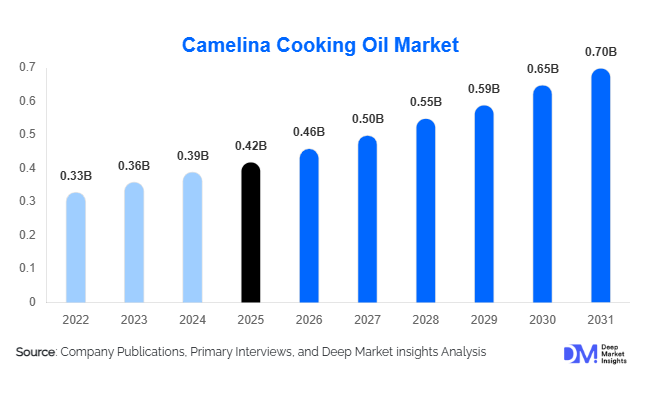
According to Deep Market Insights, the Global Camelina Cooking Oil market size was valued at USD 0.42 billion in 2025 and is projected to grow from USD 0.46 billion in 2026 to reach USD 0.70 billion by 2031, expanding at a CAGR of 8.9% during the forecast period (2026–2031). The Camelina Cooking Oil market growth is primarily driven by rising consumer preference for plant-based edible oils, increasing demand for omega-rich functional ingredients, growing adoption of sustainable oilseed crops, and expanding applications across food processing and nutraceutical industries. The report provides detailed market segmentation analysis, competitive landscape assessment, historical evaluation from 2022–2024, and forecast analysis covering industry developments through 2031.
Key Market Insights
- North America dominates the Camelina Cooking Oil market, accounting for approximately 38% market share in 2025, supported by large-scale camelina cultivation, advanced processing infrastructure, and strong demand for specialty edible oils.
- Asia-Pacific is the fastest-growing region, projected to expand at a CAGR of 10.4% from 2026–2031, driven by rising health awareness, increasing food processing demand, and growing adoption in India and China.
- Organic Camelina Oil dominates the type segment, representing nearly 46% revenue share in 2025, due to increasing consumer preference for certified organic and clean-label cooking oils.
- Food Processing is the leading application segment, contributing approximately 42% market share, supported by increasing usage in bakery products, packaged foods, sauces, and functional food formulations.
- Emerging markets including India and China are expected to contribute significantly, with Asia-Pacific Camelina Cooking Oil market value projected to reach approximately USD 260 million by 2031.
- Global camelina seed production exceeded 1.2 million metric tons in 2025, reflecting expanding agricultural adoption and increasing availability of raw materials for edible oil extraction.
Camelina Cooking Oil Market Latest Trends
Sustainable and Functional Oil Adoption Accelerating
The Camelina Cooking Oil market is experiencing increasing adoption due to growing consumer interest in sustainable agriculture, functional nutrition, and clean-label food products. Global camelina seed production increased from approximately 0.8 million metric tons in 2022 to more than 1.2 million metric tons in 2025, representing over 50% production growth within three years. Producers are adopting advanced cold-press extraction technologies that improve oil recovery efficiency by approximately 15–20% while maintaining nutritional compounds such as alpha-linolenic acid, tocopherols, and antioxidants. Organic cultivation adoption expanded by nearly 18% annually across major producing regions, increasing premium segment penetration. Food manufacturers and specialty oil brands are increasingly incorporating camelina oil into sustainable product portfolios, strengthening Camelina Cooking Oil market expansion.
Technology Integration in Processing and Food Applications
Technological advancements in extraction, refining, and storage systems are reshaping the Camelina Cooking Oil market landscape. Modern processing facilities are improving oxidation control and extending shelf stability by approximately 25–30%, enabling broader industrial usage. Food processing companies consumed more than 500 thousand metric tons of camelina-derived products in 2025, accounting for approximately 42% of total market demand. Nutraceutical manufacturers represented nearly 23% application share, supported by increasing demand for omega-3-rich ingredients. Digital traceability systems, improved farming analytics, and sustainable production technologies are becoming increasingly important across the supply chain, reinforcing long-term Camelina Cooking Oil market development.
Camelina Cooking Oil Market Drivers
Growing Demand for Omega-Rich Plant-Based Cooking Oils
Increasing health awareness and consumer preference for nutrient-rich edible oils represent major growth drivers for the Camelina Cooking Oil market. Approximately 65% of premium edible oil consumers actively seek products with functional health benefits, while demand for plant-based oils increased by nearly 8% annually between 2022 and 2025. Camelina oil contains approximately 30–40% alpha-linolenic acid, making it attractive among consumers seeking healthier alternatives to conventional cooking oils. Food manufacturers increased adoption of functional oil ingredients by nearly 20% during 2025, supported by demand for clean-label formulations. Rising awareness regarding sustainable nutrition and plant-derived ingredients continues strengthening Camelina Cooking Oil market growth.
Expansion of Functional Food and Specialty Ingredient Applications
The increasing integration of camelina oil into functional foods, bakery products, dietary supplements, and fortified food products is accelerating market expansion. Food processing applications accounted for approximately 42% market share in 2025, with industrial consumption exceeding 500 thousand metric tons. Manufacturers are increasingly using camelina oil to improve nutritional profiles while meeting consumer expectations for sustainable ingredients. The nutraceutical sector represented approximately 23% of demand, supported by growing interest in plant-based omega supplements. Rising investment in specialty food manufacturing and increasing adoption among premium food brands continue driving Camelina Cooking Oil market development.
Camelina Cooking Oil Market Restraints
Limited Consumer Awareness and Restricted Production Scale
Limited consumer awareness and comparatively smaller cultivation volumes remain key restraints affecting the Camelina Cooking Oil market. Camelina production represents less than 1% of global oilseed production, with approximately 1.2 million metric tons produced in 2025 compared with more than 600 million metric tons of major oilseed crops globally. Consumer awareness remains below 40% in several emerging economies, restricting retail adoption. Processing infrastructure is concentrated primarily in North America and Europe, where more than 60% of commercial capacity is located. These supply limitations increase production costs and create challenges for broader Camelina Cooking Oil market penetration.
Higher Production Costs Compared With Conventional Oils
The Camelina Cooking Oil market faces challenges due to higher cultivation and processing expenses compared with conventional edible oils. Production costs are estimated to be approximately 20–35% higher due to specialized farming practices, certification requirements, and limited economies of scale. Camelina oil prices remain approximately 1.5–2 times higher than mainstream vegetable oils, limiting adoption among price-sensitive consumers. Approximately 55% of global camelina processing capacity remains concentrated among specialized producers, creating supply dependency risks. Competition from established oils such as sunflower, olive, and flaxseed oil continues influencing Camelina Cooking Oil market competitiveness.
Camelina Cooking Oil Market Opportunities
Growing Sustainable Agriculture and Premium Oil Demand
The increasing focus on sustainable agriculture creates significant opportunities for the Camelina Cooking Oil market. Camelina cultivation areas expanded by approximately 25% between 2022 and 2025, supported by farmer interest in alternative oilseed crops and environmentally sustainable farming models. Emerging markets including India and China are expected to generate more than USD 150 million in incremental revenue by 2031. Investments in organic certification, cold extraction technology, and specialty food applications are enabling producers to target premium consumer segments. Expanding sustainable food initiatives and rising demand for environmentally responsible edible oils are expected to create new growth opportunities for Camelina Cooking Oil market expansion.
Increasing Integration Into Nutraceutical and Functional Food Markets
The growing functional nutrition industry presents additional opportunities for the Camelina Cooking Oil market. Demand from nutraceutical manufacturers increased by approximately 15% annually, driven by consumer interest in plant-based supplements and omega-rich ingredients. Encapsulated oils, fortified beverages, and dietary products are increasingly incorporating camelina oil as a nutritional component. Improved extraction technologies and product innovation are enabling manufacturers to develop higher-value applications. The expanding overlap between edible oils, wellness products, and functional foods is expected to strengthen future Camelina Cooking Oil market growth.
Report Scope
| Report Metric | Details |
|---|---|
| Market Size in 2025 | USD 0.42 Billion |
| Market Size in 2026 | USD 0.46 Billion |
| Market Size in 2031 | USD 0.70 Billion |
| CAGR | 8.9% (2026-2031) |
| Base Year for Estimation | 2025 |
| Historical Data | 2022-2024 |
| Forecast Period | 2026-2031 |
| Report Coverage | Revenue Forecast, Competitive Landscape, Supply Chain Disruption, Growth Factors, Environment & Regulatory Landscape and Trends |
| Geographies Covered | North America, Europe, APAC, Middle East and Africa, LATAM |
| Countries Covered | U.S., Canada, U.K., Germany, France, Spain, Italy, Russia, Nordic, Benelux, Rest of Europe, China, Korea, Japan, India, Australia, Singapore, Taiwan, South East Asia, Rest of Asia-Pacific, UAE, Turky, Saudi Arabia, South Africa, Egypt, Nigeria, Rest of MEA, Brazil, Mexico, Argentina, Chile, Colombia, Rest of LATAM |
Explore more data points, trends and opportunities Download Free Sample Report
Product Type Insights
Organic Camelina Oil dominates the Camelina Cooking Oil market due to strong consumer preference for certified sustainable and minimally processed edible oils. Organic products represent approximately 46% of total revenue, supported by premium pricing, organic retail expansion, and increasing demand from health-focused consumers. Conventional Camelina Oil remains important for industrial users due to higher production volume, cost advantages, and suitability for large-scale food processing. Refined Camelina Oil is gaining traction among manufacturers requiring improved stability, standardized quality, and longer shelf life. Technological improvements in extraction efficiency, filtration systems, and storage solutions are enabling producers to enhance product performance while expanding applications across household, commercial, and nutritional segments.
Application Insights
Food Processing remains the leading application area within the Camelina Cooking Oil market, accounting for approximately 42% market share due to increasing usage in packaged foods, bakery products, sauces, and functional food formulations. Household cooking applications represent nearly 35% of demand, supported by growing awareness of healthy cooking oils and increased availability through retail and digital platforms. Nutraceutical applications contribute approximately 23%, driven by rising demand for plant-based supplements and omega-rich nutritional products. The expanding role of camelina oil across culinary, industrial, and wellness applications demonstrates its growing importance as a multifunctional edible oil ingredient in global food markets.
Distribution Channel Insights
Retail supermarkets, specialty health food stores, and online commerce platforms represent major distribution channels for the Camelina Cooking Oil market. Online sales channels are expanding rapidly, with digital penetration increasing by approximately 25% between 2022 and 2025 due to consumer preference for convenient purchasing and access to specialty oils. Direct-to-consumer brands are strengthening market visibility through digital marketing, subscription models, and educational campaigns focused on nutritional benefits. Specialty retailers continue attracting premium consumers seeking organic and cold-pressed products, while food ingredient distributors remain important for industrial buyers. The combination of offline and online channels is improving product accessibility and supporting broader Camelina Cooking Oil market penetration.
Explore more data points, trends and opportunities Download Free Sample Report
Camelina Cooking Oil Market Segmentations
By Type
- Organic Camelina Oil
- Conventional Camelina Oil
- Refined Camelina Oil
By Application
- Household Cooking
- Food Processing
- Nutraceuticals
By Distribution Channel
- Supermarkets and Hypermarkets
- Specialty Health Food Stores
- Online Retail Platforms
- Direct-to-Consumer Channels
- Food Ingredient Distributors
Regional Insights
North America
North America dominates the global Camelina Cooking Oil market, accounting for approximately 38% market share in 2025, with market revenue estimated at nearly USD 160 million. The region processed more than 500 thousand metric tons of camelina seeds during 2025, supported by advanced agricultural practices, established processing infrastructure, and increasing demand for sustainable edible oils. The United States and Canada contributed more than 85% of regional production, with Canada emerging as a major cultivation hub due to large-scale camelina farming programs. Food processing represented approximately 45% of regional demand, while household cooking accounted for nearly 32% and nutraceutical applications contributed approximately 23%.
Europe
Europe represented the second-largest regional market for Camelina Cooking Oil, accounting for approximately 30% market share in 2025 with revenue estimated at nearly USD 125 million. The region processed approximately 350 thousand metric tons of camelina seeds annually, supported by strong demand for organic ingredients, sustainable agriculture practices, and clean-label food products. Germany, France, the United Kingdom, and Poland collectively contributed more than 70% of regional consumption. Food processing applications represented nearly 40% of demand, household cooking contributed approximately 38%, and nutraceutical usage accounted for nearly 22%.
Asia-Pacific
Asia-Pacific is projected to become the fastest-growing region in the Camelina Cooking Oil market, expanding at a CAGR of approximately 10.4% between 2026 and 2031. The region accounted for approximately 22% market share in 2025, generating revenue of nearly USD 92 million. Camelina seed processing volume exceeded 250 thousand metric tons in 2025, supported by increasing agricultural experimentation, rising food processing activity, and growing awareness of functional cooking oils. China, India, Japan, and Australia represented the leading contributors to regional demand.
Latin America
The Latin American Camelina Cooking Oil market is primarily driven by food processing applications, which accounted for approximately 48% of regional demand. Household cooking represented nearly 30%, while nutraceutical applications contributed approximately 22%. Increasing consumer interest in premium edible oils and sustainable ingredients is gradually improving adoption. Although awareness remains lower compared with North America and Europe, expanding specialty food distribution networks and rising demand for functional ingredients are expected to support regional market growth through 2031.
Middle East & Africa
The regional application split included food processing at approximately 40%, household cooking at 35%, and nutraceutical applications at approximately 25%. Specialty edible oil demand increased by nearly 9% annually, while premium retail channels expanded by approximately 20% during 2025. Limited local cultivation capacity remains a challenge; however, sustainable agriculture projects and rising demand for healthy cooking oils are expected to create long-term opportunities for the Camelina Cooking Oil market across Middle East and Africa.
Key Players in the Camelina Cooking Oil Market
- Cargill
- Bunge Global
- Archer Daniels Midland Company
- Louis Dreyfus Company
- AgMotion
- Three Farmers Products
- Siberian Camelina Oil Company
- Smart Earth Camelina
- Nature's Crops International
- Avena Foods
- Bio Planète
- Olé! Mexican Foods