Flour Treatment Agent Market Size
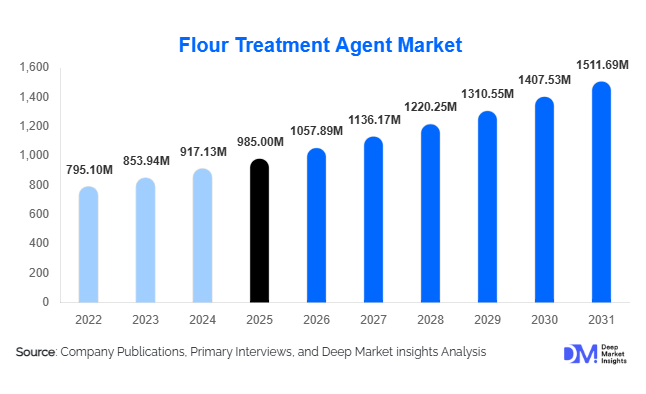
According to Deep Market Insights, the global flour treatment agent market size was valued at approximately USD 1,057.89 million in 2026 and is projected to grow to reach USD 1,511.69 million by 2031, expanding at a CAGR of 7.4% during the forecast period (2026–2031). The flour treatment agent market growth is primarily driven by the rising demand for processed bakery products, expansion of industrial bakeries, increasing adoption of enzyme-based flour improvers, and the transition toward clean-label and natural food ingredients across global food manufacturing industries.
Key Market Insights
- Enzyme-based flour treatment agents are becoming the fastest-growing product category, supported by increasing regulatory restrictions on synthetic additives and rising demand for clean-label bakery ingredients.
- Asia-Pacific dominates the global flour treatment agent market, accounting for the largest regional share due to expanding bakery manufacturing capacity, increasing packaged food consumption, and growing investments in food processing industries.
- Industrial bakeries represent the largest end-use segment, driven by the requirement for consistent dough quality, improved production efficiency, and extended shelf life of bakery products.
- Natural and bio-based flour treatment agents are gaining market penetration, as manufacturers increasingly replace chemical additives with fermentation-derived ingredients and advanced enzyme solutions.
- Customized multifunctional flour improver systems are emerging as a key trend, enabling bakery manufacturers to improve dough strength, texture, softness, and processing efficiency through single ingredient solutions.
- Technological innovation in biotechnology and enzyme engineering is reshaping the competitive landscape, allowing manufacturers to develop high-performance solutions for bread, frozen bakery, gluten-free products, and specialty bakery applications.
Flour Treatment Agent Market Latest Trends
Shift Toward Clean-Label and Natural Flour Treatment Solutions
The global flour treatment agent industry is witnessing a significant transition from conventional chemical additives toward natural and bio-based solutions. Consumer preference for clean-label food products, increased transparency in ingredient labeling, and regulatory restrictions on certain synthetic additives are encouraging bakery manufacturers to adopt enzyme-based and naturally derived flour improvers.
Enzymes such as amylases, xylanases, proteases, and glucose oxidase are gaining popularity because they improve dough performance while allowing manufacturers to maintain cleaner ingredient declarations. Food producers are increasingly replacing traditional oxidizing agents with natural alternatives such as ascorbic acid and fermentation-derived solutions. This trend is particularly strong in developed markets such as North America and Europe, where consumers actively seek products with fewer artificial ingredients.
Ingredient manufacturers are investing heavily in biotechnology research to develop advanced flour treatment systems that deliver the same or improved functional performance compared with conventional additives. This shift is expected to remain one of the most influential trends shaping the flour treatment agent market through 2031.
Growth of Customized Multifunctional Flour Improver Systems
Bakery manufacturers are increasingly moving away from single-function additives and adopting customized multifunctional flour treatment systems that combine several performance benefits. Industrial bakeries require ingredients that can improve dough elasticity, fermentation stability, volume, softness, and shelf life simultaneously while reducing formulation complexity.
Customized flour improvers are becoming particularly important for large-scale bakery producers operating across multiple regions where wheat quality and flour characteristics vary significantly. Ingredient suppliers are developing application-specific solutions for bread, frozen dough, cakes, biscuits, noodles, and specialty bakery products.
Advanced formulation technologies, digital bakery testing platforms, and improved enzyme combinations are enabling suppliers to provide highly targeted solutions. This trend is increasing collaboration between ingredient manufacturers and bakery companies, shifting relationships from transactional supply models toward long-term technical partnerships.
Flour Treatment Agent Market Drivers
Rising Demand for Packaged and Processed Bakery Products
The expansion of the global bakery industry is one of the strongest drivers supporting flour treatment agent market growth. Increasing urbanization, changing lifestyles, higher disposable income, and growing preference for convenient food products are accelerating consumption of packaged bread, cakes, biscuits, pastries, and ready-to-bake bakery products.
Industrial bakery manufacturers rely heavily on flour treatment agents to maintain consistent product quality across high-volume production facilities. These ingredients improve dough handling characteristics, enhance loaf volume, maintain softness, and extend product shelf life, making them essential for large-scale bakery operations.
The rapid growth of frozen bakery products is further increasing demand because flour improvers help maintain dough stability during freezing, transportation, and storage. Emerging markets in Asia-Pacific, Latin America, and the Middle East are witnessing particularly strong demand as modern retail channels and bakery chains expand.
Increasing Adoption of Enzyme-Based Flour Improvers
The growing adoption of enzyme-based solutions is significantly accelerating market expansion. Baking enzymes provide functional advantages while supporting clean-label product development, making them increasingly attractive to food manufacturers seeking alternatives to chemical additives.
Amylases improve crumb softness and freshness retention, xylanases enhance dough flexibility and processing properties, and glucose oxidase strengthens gluten networks. These benefits are encouraging industrial bakeries and flour mills to incorporate enzyme solutions into their production processes.
Regulatory pressure against certain flour additives is further accelerating this transition. Manufacturers are increasingly investing in biotechnology platforms and fermentation capabilities to develop next-generation enzyme-based flour treatment products with improved functionality and sustainability benefits.
Expansion of Industrial Flour Milling and Bakery Manufacturing Capacity
Increasing investments in flour milling infrastructure and bakery production facilities are creating strong demand for flour treatment agents. Large flour mills are adopting these solutions to standardize flour quality, compensate for variations in wheat characteristics, and improve performance for downstream bakery customers.This trend is particularly important in countries dependent on imported wheat, where flour quality can vary based on supply sources. Flour treatment agents enable manufacturers to achieve consistent baking performance despite raw material differences.
The expansion of multinational bakery chains, quick-service restaurants, and private-label food manufacturers is also supporting demand. These companies require standardized ingredient performance across multiple markets, increasing reliance on advanced flour treatment technologies.
Flour Treatment Agent Market Restraints
Regulatory Restrictions on Synthetic Flour Additives
Stringent regulations surrounding food additives represent a key challenge for the flour treatment agent market. Several countries have restricted or banned specific chemical flour improvers due to concerns regarding food safety and consumer acceptance.Restrictions on ingredients such as potassium bromate and azodicarbonamide have forced manufacturers to reformulate products and invest in alternative solutions. While this creates opportunities for natural and enzyme-based products, the transition requires significant research investment, product testing, and regulatory approvals.
Smaller manufacturers often face difficulties adapting quickly due to limited research capabilities and higher reformulation costs, creating competitive pressure within the market.
Raw Material Price Volatility and Supply Chain Challenges
Flour treatment agent manufacturers face challenges due to fluctuations in raw material prices, particularly for enzymes, specialty chemicals, fermentation substrates, and emulsifier components. Changes in agricultural commodity prices, energy costs, and global logistics conditions can directly impact production expenses.
Supply chain disruptions affecting specialty ingredients can create shortages and increase manufacturing costs. Smaller market participants are particularly vulnerable due to limited purchasing power and dependence on external suppliers. Maintaining stable sourcing networks and improving supply chain resilience remain important priorities for industry participants.
Flour Treatment Agent Industry Key Opportunities
Expansion of Clean-Label and Bio-Based Ingredient Solutions
The transition toward clean-label food products represents one of the most significant opportunities in the global flour treatment agent market. Consumers are increasingly demanding bakery products made with recognizable ingredients and fewer artificial additives, encouraging manufacturers to replace conventional chemical flour improvers with natural alternatives.This trend is creating opportunities for companies specializing in enzyme-based solutions, fermentation-derived ingredients, plant-based emulsifiers, and naturally sourced dough conditioners. Manufacturers capable of providing high-performance alternatives while maintaining clean ingredient declarations are positioned to capture premium market opportunities.
Regulatory changes across North America, Europe, and parts of Asia are further accelerating adoption of natural flour treatment solutions. Companies investing in biotechnology capabilities, enzyme research, and sustainable ingredient development can strengthen their competitive position and benefit from higher-value product segments.
Growth Opportunities in Emerging Bakery Markets
Rapid expansion of bakery industries in emerging economies is creating significant opportunities for flour treatment agent manufacturers. Countries including China, India, Indonesia, Vietnam, Brazil, and Mexico are experiencing increased consumption of packaged bread, biscuits, cakes, pastries, and frozen bakery products due to urbanization and changing dietary patterns.As industrial bakery production expands, manufacturers require advanced flour treatment solutions to improve product consistency, optimize manufacturing efficiency, and extend shelf life. Companies establishing local production facilities, technical service centers, and regional distribution networks can benefit from rising demand.
Government support for food processing industries, modernization of flour milling infrastructure, and investments in manufacturing capabilities are expected to further accelerate market development. Localized product development based on regional wheat quality and baking requirements will become a key competitive advantage.
Innovation in Specialty Bakery and Functional Food Applications
The development of specialty bakery products represents another major opportunity area for flour treatment agent suppliers. Growing demand for gluten-free products, high-protein breads, fortified bakery items, and functional foods is creating the need for specialized flour treatment solutions.These products often face technical challenges related to texture, structure, moisture retention, and shelf stability. Advanced enzymes and multifunctional improvers can help manufacturers overcome these challenges while improving product quality.
The rise of health-focused bakery categories and premium baked goods is allowing ingredient suppliers to develop application-specific solutions with higher margins. Companies focusing on innovation and technical support are expected to gain stronger customer relationships within these emerging segments.
Report Scope
| Report Metric | Details |
|---|---|
| Market Size in 2025 | USD 985.00 Million |
| Market Size in 2026 | USD 1057.89 Million |
| Market Size in 2031 | USD 1511.69 Million |
| CAGR | 7.4% (2026-2031) |
| Base Year for Estimation | 2025 |
| Historical Data | 2022-2024 |
| Forecast Period | 2026-2031 |
| Report Coverage | Revenue Forecast, Competitive Landscape, Supply Chain Disruption, Growth Factors, Environment & Regulatory Landscape and Trends |
| Geographies Covered | North America, Europe, APAC, Middle East and Africa, LATAM |
| Countries Covered | U.S., Canada, U.K., Germany, France, Spain, Italy, Russia, Nordic, Benelux, Rest of Europe, China, Korea, Japan, India, Australia, Singapore, Taiwan, South East Asia, Rest of Asia-Pacific, UAE, Turky, Saudi Arabia, South Africa, Egypt, Nigeria, Rest of MEA, Brazil, Mexico, Argentina, Chile, Colombia, Rest of LATAM |
Explore more data points, trends and opportunities Download Free Sample Report
Product Type Insights
Enzyme-based flour treatment agents dominate the market, accounting for approximately 32% of global market share in 2025. The segment leads due to increasing demand for clean-label ingredients, improved baking performance, and regulatory restrictions on several synthetic additives. Baking enzymes such as amylases, xylanases, proteases, and glucose oxidase provide multiple benefits, including improved dough elasticity, better fermentation performance, enhanced loaf volume, and extended freshness.Oxidizing agents continue to maintain demand in specific markets due to their cost efficiency and established performance characteristics. However, their market share is gradually declining as food manufacturers shift toward natural alternatives. Emulsifiers represent another important category, supporting dough conditioning, texture improvement, and shelf-life extension in industrial bakery applications.Reducing agents, including L-cysteine and other dough-modifying ingredients, are primarily used in applications requiring improved machinability and dough relaxation. Meanwhile, flour bleaching agents have experienced slower growth due to regulatory limitations and declining consumer preference for heavily processed ingredients.
Source Insights
Natural and bio-based flour treatment agents represent the leading source category, accounting for approximately 55% of global market demand in 2025. The segment is expanding rapidly due to increasing consumer awareness regarding food ingredients and growing demand for sustainable manufacturing practices.Bio-based solutions derived from microbial fermentation, enzymes, and natural sources are increasingly replacing synthetic additives in premium bakery products. Food manufacturers are prioritizing ingredients that support clean-label claims while delivering consistent production performance.Synthetic flour treatment agents continue to hold importance in price-sensitive markets because of their lower cost and established functionality. However, adoption is expected to decline gradually as regulatory requirements and consumer expectations continue shifting toward natural formulations.
Function Insights
Dough conditioning and strengthening represent the largest functional application segment, accounting for approximately 38% of the global flour treatment agent market in 2025. Industrial bakeries heavily rely on these solutions to improve dough handling, gluten development, fermentation stability, and production efficiency.Flour treatment agents help manufacturers overcome variations in wheat quality and maintain consistent product characteristics across different production batches. This functionality is particularly important for multinational bakery companies operating multiple manufacturing facilities globally.Other important functions include shelf-life extension, flour whitening, texture enhancement, and processing efficiency improvement. Growing demand for extended freshness in packaged bakery products is increasing adoption of multifunctional flour treatment systems.
Application Insights
Bread applications represent the largest segment of the flour treatment agent market, accounting for approximately 42% of global demand in 2025. Bread remains a staple food category worldwide, and commercial bread manufacturers extensively use flour treatment agents to improve softness, volume, texture, and shelf stability.The packaged bread industry is expanding due to changing lifestyles, increased urbanization, and growth of convenience food consumption. Frozen bread and ready-to-bake bread products are also generating additional demand because flour improvers help maintain quality during storage and transportation.Biscuits, cookies, cakes, pastries, noodles, pasta, pizza bases, and tortillas represent additional application areas. Specialty applications such as gluten-free bakery products and high-protein foods are emerging as high-growth segments due to increasing consumer interest in health-oriented foods.
End-use Industry Insights
Industrial bakeries represent the largest end-use segment of the global flour treatment agent market, accounting for approximately 48% of total market demand in 2025. Large-scale bakery manufacturers use flour improvers extensively to maintain consistent quality, reduce production losses, and optimize manufacturing efficiency.Flour mills are another important end-use segment, as they increasingly adopt treatment agents to improve flour functionality before supplying commercial bakeries. Export-oriented flour producers particularly rely on these technologies to meet international quality standards.The frozen bakery industry is expected to be one of the fastest-growing application areas. Rising demand for convenience foods, supermarket bakery sections, and food delivery services is increasing the need for flour treatment agents that maintain dough stability during freezing and reheating processes.Emerging applications include gluten-free bakery products, functional foods, plant-based bakery items, and high-protein baked goods. These categories require specialized ingredient technologies, creating additional growth opportunities for innovative flour treatment agent manufacturers.
Distribution Channel Insights
Direct B2B sales dominate the flour treatment agent distribution landscape, accounting for approximately 60% of market distribution in 2025. Industrial bakeries and flour mills generally prefer direct partnerships with ingredient manufacturers due to the technical nature of flour treatment solutions.Direct supply relationships allow manufacturers to provide customized formulations, application testing, technical support, and continuous product optimization. Large food companies often establish long-term contracts with ingredient suppliers to ensure consistent supply and quality.Ingredient distributors remain important for small and medium-sized bakeries that require smaller quantities and broader product access. Online B2B platforms are gradually gaining traction by improving supplier visibility and simplifying procurement processes, particularly among smaller food manufacturers.
Explore more data points, trends and opportunities Download Free Sample Report
Flour Treatment Agent Market Segmentations
By Product Type
- Enzymes
- Oxidizing Agents
- Emulsifiers
- Reducing Agents
- Flour Bleaching Agents
By Source
- Natural/Bio-Based Flour Treatment Agents
- Synthetic Flour Treatment Agents
By Function
- Dough Conditioning and Strengthening
- Dough Relaxation and Processing Improvement
- Texture and Volume Enhancement
- Shelf-Life Extension
- Flour Whitening and Appearance Improvement
- Processing Efficiency Enhancement
By Application
- Bread and Bread Products
- Cakes and Pastries
- Biscuits and Cookies
- Noodles and Pasta
- Pizza Bases and Flatbreads
- Frozen Bakery Products
- Bakery Premixes and Specialty Bakery Products
By End-Use Industry
- Industrial Bakeries
- Flour Mills
- Food Processing Companies
- Foodservice and Quick-Service Restaurants
- Retail and Artisan Bakeries
- Household Baking Ingredients
Regional Insights
Asia-Pacific
Asia-Pacific dominates the global flour treatment agent market, accounting for approximately 38% of global market share in 2025. The region represents the largest demand center due to rapid expansion of industrial bakeries, increasing consumption of packaged bakery products, and rising investments in food processing infrastructure. Growing urban populations, higher disposable incomes, and changing dietary preferences are accelerating demand for bread, cakes, biscuits, pastries, and frozen bakery products across major Asian economies.Japan and South Korea represent mature but technologically advanced markets. These countries demonstrate strong demand for premium bakery products, functional ingredients, and advanced enzyme-based flour treatment solutions. Manufacturers in these markets prioritize product quality, clean-label positioning, and innovative bakery formulations.
North America
North America represents the second-largest regional market, accounting for approximately 27% of global flour treatment agent market share in 2025. The region benefits from a highly developed bakery industry, strong packaged food consumption, and increasing demand for clean-label ingredients.The United States is the largest North American market, representing approximately 22% of global market demand in 2025. Growth is supported by large-scale industrial bakeries, extensive frozen bakery production, and increasing consumer preference for healthier and minimally processed foods. U.S. manufacturers are actively replacing synthetic additives with enzyme-based and natural flour treatment solutions to meet clean-label expectations.Canada represents a stable market supported by commercial bakery production, flour milling activities, and growing demand for premium bakery products. The country is witnessing increasing adoption of natural flour improvers as food manufacturers align with evolving consumer preferences.
Europe
Europe accounts for approximately 22% of global flour treatment agent market share in 2025 and remains one of the most innovation-driven markets. The region’s strict food safety regulations and strong consumer preference for natural ingredients are encouraging the adoption of enzyme-based flour treatment technologies.Germany is one of the largest European markets due to its strong bakery culture, advanced food manufacturing sector, and demand for high-quality bread products. Industrial bakeries are increasingly adopting customized flour treatment solutions to improve efficiency and maintain consistent product quality.The United Kingdom is witnessing growth due to rising consumption of packaged bakery products and increasing demand for additive-free formulations. Clean-label flour improvers are gaining popularity among manufacturers seeking premium positioning.France and Italy remain important markets due to their established bakery industries and demand for specialty breads, pastries, and premium bakery products. Adoption is primarily driven by innovation in artisanal and industrial bakery segments.
Latin America
Latin America represents approximately 8% of global flour treatment agent market share in 2025 and is expected to witness steady growth due to increasing bakery consumption and modernization of food processing industries.Brazil is the largest market in the region, supported by its significant wheat milling industry, expanding packaged food sector, and growing demand for standardized flour quality. Industrial bakeries are increasingly adopting flour treatment solutions to improve production efficiency.Mexico is another important growth market, driven by increasing consumption of bread, tortillas, and processed bakery products. Integration with North American food supply chains is supporting adoption of advanced ingredient technologies.
Middle East & Africa
The Middle East & Africa region represents approximately 5% of global flour treatment agent demand in 2025 but offers strong future growth potential due to population growth, urbanization, and increasing investment in food manufacturing capabilities.Turkey is a strategically important market due to its large flour milling industry and position as one of the world’s major flour exporters. Flour treatment agents are increasingly used to improve flour quality and meet export specifications.Saudi Arabia, UAE, and other Gulf countries are experiencing rising demand due to increasing consumption of bakery products and investments in modern food processing facilities. In Africa, countries such as South Africa, Egypt, and Nigeria are witnessing growing adoption as packaged food consumption expands and local bakery industries modernize.
Key Players in the Flour Treatment Agent Market
- International Flavors & Fragrances Inc. (IFF)
- Kerry Group plc
- Koninklijke DSM N.V.
- Novonesis A/S
- Archer Daniels Midland Company (ADM)
- Cargill Incorporated
- Associated British Foods plc
- Corbion N.V.
- Puratos Group
- Lesaffre Group
- Angel Yeast Co., Ltd.
- Bakels Group
- Ingredion Incorporated
- AB Mauri
- Givaudan SA