Royal Icing Market Size
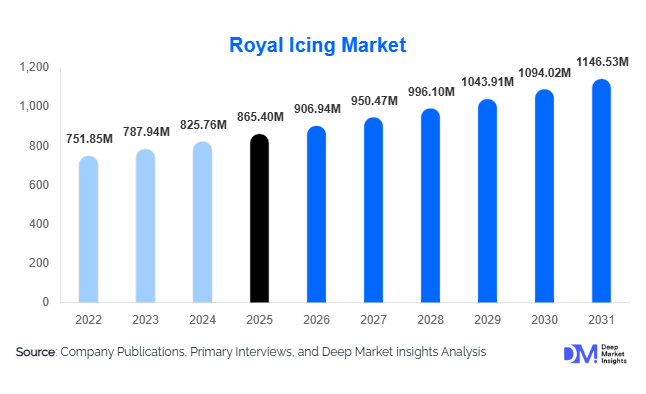
According to Deep Market Insights, the global royal icing market size was valued at USD 865.4 million in 2025 and is projected to grow from USD 906.94 million in 2026 to reach USD 1,146.53 million by 2031, expanding at a CAGR of 4.8% during the forecast period (2026–2031). The royal icing market growth is primarily driven by increasing demand for decorated bakery products, expansion of commercial bakeries, rising home baking participation, and growing adoption of premium, clean-label, and customized icing solutions across global confectionery applications.
Key Market Insights
- North America dominates the royal icing market, accounting for approximately 37.8% market share in 2025, supported by strong bakery culture, premium confectionery demand, and high household baking adoption.
- Asia-Pacific is the fastest-growing regional market, projected to expand at a CAGR of 6.3% through 2031 due to urbanization, café expansion, and increasing disposable income.
- Powder Mix dominates by product type, representing around 46.5% market share due to longer shelf life, cost efficiency, and high adoption among commercial bakery manufacturers.
- Commercial bakeries remain the largest application segment, contributing approximately 58.7% of global demand with increasing usage in cakes, cookies, pastries, and customized desserts.
- India is emerging as a high-growth country market, projected to reach approximately USD 112.4 million by 2034 with a CAGR of 7.1%.
- Clean-label formulations, vegan alternatives, and automated decorating technologies are reshaping product development strategies across the royal icing industry.
Royal Icing Market Latest Trends
Premium Bakery Decoration and Customization Growth
The royal icing market is witnessing increased demand for customized bakery decoration solutions as consumer preferences shift toward personalized cakes, themed cookies, and premium confectionery products. Global decorated bakery production exceeded 148 million tons annually, with premium decorated products representing nearly 14% of total bakery sales. Commercial bakeries are adopting advanced icing systems with improved texture control, faster application speed, and enhanced color consistency. Ready-to-use royal icing formulations recorded adoption rates exceeding 41% among premium bakery operators, while automated decorating systems increased usage by approximately 18% compared with 2023. These developments are accelerating innovation and strengthening royal icing market expansion.
Clean-Label and Plant-Based Formulation Adoption
Manufacturers are increasingly focusing on natural ingredients, allergen-free formulations, and plant-based alternatives to meet changing consumer preferences. Clean-label royal icing products achieved adoption rates of nearly 29% globally, while vegan formulation production exceeded 18 thousand metric tons in 2025. Food manufacturers are replacing synthetic additives with natural colors, improved stabilizers, and alternative protein sources to enhance product appeal. Sustainable packaging and reduced additive formulations are also gaining traction among specialty bakeries and foodservice providers, supporting long-term royal icing market development.
Royal Icing Market Drivers
Growing Consumption of Decorated Bakery Products
Increasing consumer spending on celebration cakes, cookies, pastries, and premium desserts is a major growth driver for the royal icing market. Global bakery production surpassed 148 million tons, with decorated bakery products representing a rapidly expanding premium category. Online customized cake sales increased by approximately 19% in 2025, while commercial bakery investments grew by more than 11%. Royal icing provides superior decorative precision, stability, and visual appeal, making it an essential ingredient for professional bakers. Rising demand for wedding cakes, festive desserts, and personalized bakery products continues supporting royal icing market growth.
Expansion of Home Baking and Digital Retail Channels
The growing popularity of home baking is creating new demand opportunities for retail royal icing products. Household baking participation exceeded 31% in developed markets, while online baking ingredient sales increased by approximately 22% during 2025. Consumer-friendly packaging, ready-to-use formats, and easy preparation methods are improving product accessibility. Social media-driven baking trends and online tutorials are encouraging consumers to experiment with decorative techniques, expanding royal icing market penetration across household applications.
Royal Icing Market Restraints
Raw Material Price Volatility
Fluctuations in sugar, egg-based ingredients, and stabilizer costs remain key challenges for royal icing manufacturers. Sugar prices increased by nearly 15% during 2024–2025, while egg ingredient costs rose by approximately 12% in major producing regions. Raw materials account for more than 54% of total manufacturing costs, creating pressure on production margins. Small and medium-sized manufacturers face additional challenges due to limited purchasing power and supply chain instability, restricting overall royal icing market growth.
Product Stability and Storage Challenges
Royal icing products require strict moisture and temperature control to maintain quality and consistency. Finished formulations typically require water activity levels below 0.65, while transportation and storage issues contribute to product losses ranging between 2% and 4%. Humidity-sensitive distribution environments increase logistics expenses by nearly 9%, particularly in tropical regions. These operational challenges create barriers for manufacturers seeking wider geographic expansion within the royal icing market.
Royal Icing Industry Key Opportunities
Growth of Premium and Specialty Bakery Segments
The expansion of premium bakery products presents significant opportunities for royal icing manufacturers. Luxury cakes, artisan cookies, and specialty desserts are increasing demand for customized icing textures, colors, and flavors. Premium bakery categories are growing as consumers prioritize visually attractive and personalized food experiences. Manufacturers developing organic, vegan, and specialty formulations can address evolving consumer preferences and strengthen their position in the royal icing market.
Expansion Across Emerging Markets
Emerging economies including India, China, and Southeast Asian countries represent major growth opportunities due to rising urbanization and expanding bakery retail networks. Asia-Pacific production reached approximately 44 thousand metric tons in 2025, with regional demand expected to grow at a 6.3% CAGR. Increasing café culture, online food delivery platforms, and growing celebration spending are accelerating adoption of decorative bakery ingredients, creating new opportunities for royal icing market expansion.
Report Scope
| Report Metric | Details |
|---|---|
| Market Size in 2025 | USD 865.40 Million |
| Market Size in 2026 | USD 906.94 Million |
| Market Size in 2031 | USD 1146.53 Million |
| CAGR | 4.8% (2026-2031) |
| Base Year for Estimation | 2025 |
| Historical Data | 2022-2024 |
| Forecast Period | 2026-2031 |
| Report Coverage | Revenue Forecast, Competitive Landscape, Supply Chain Disruption, Growth Factors, Environment & Regulatory Landscape and Trends |
| Geographies Covered | North America, Europe, APAC, Middle East and Africa, LATAM |
| Countries Covered | U.S., Canada, U.K., Germany, France, Spain, Italy, Russia, Nordic, Benelux, Rest of Europe, China, Korea, Japan, India, Australia, Singapore, Taiwan, South East Asia, Rest of Asia-Pacific, UAE, Turky, Saudi Arabia, South Africa, Egypt, Nigeria, Rest of MEA, Brazil, Mexico, Argentina, Chile, Colombia, Rest of LATAM |
Explore more data points, trends and opportunities Download Free Sample Report
Product Type Insights
The powder mix segment dominated the global royal icing market, accounting for approximately 46.5% of total revenue in 2025, with production exceeding 91 thousand metric tons. Its market leadership is primarily driven by its superior shelf stability, which extends up to 24 months, enabling manufacturers, distributors, and retailers to reduce product wastage while supporting large-scale inventory management. Powder mixes also offer lower transportation and storage costs due to reduced weight and packaging efficiency compared to liquid formulations. Additionally, they provide greater flexibility in preparation, allowing professional bakers and foodservice operators to adjust consistency according to specific decorating requirements. The product's long shelf life, ease of export, and compatibility with automated bakery production systems have further strengthened its adoption across commercial bakeries, industrial food manufacturers, and ingredient suppliers. Ready-to-Use (RTU) royal icing accounted for approximately 34.8% of the market, with production reaching nearly 68 thousand metric tons. This segment continues to gain traction among premium bakeries, specialty cake decorators, and artisan confectioners seeking consistent texture, reduced preparation time, and immediate application. The convenience of ready-to-use formulations minimizes labor requirements while ensuring uniform decorative quality across large production batches. Meanwhile, Custom Formulation represented approximately 18.7% of market share, producing nearly 37 thousand metric tons. Demand within this segment is expanding among industrial bakery manufacturers and private-label suppliers requiring customized colors, flavors, sweetness levels, allergen-free formulations, vegan ingredients, and clean-label compositions to address evolving consumer preferences and specialized product applications.
Application Insights
Commercial bakeries remained the largest application segment in the global royal icing market, accounting for approximately 58.7% of total demand and consuming more than 115 thousand metric tons in 2025. The segment's dominance is primarily driven by the continuous expansion of industrial bakery production, increasing consumption of premium decorated cakes and cookies, and the growing demand for standardized decorative finishes across retail bakery chains. Large-scale bakery manufacturers extensively utilize royal icing for cakes, cookies, pastries, gingerbread products, cupcakes, seasonal confectionery, and festive bakery items due to its superior decorative precision, excellent adhesion, glossy finish, structural stability, and extended durability during transportation and retail display. Rising consumer spending on celebration cakes, customized desserts, and premium confectionery products has further accelerated commercial adoption worldwide. Foodservice applications accounted for approximately 24.6% of the market, supported by increasing demand from hotels, cafés, restaurants, catering companies, dessert boutiques, and quick-service bakery chains seeking premium decorative solutions that enhance product presentation and customer experience. The growing hospitality sector and expansion of premium dessert menus continue to stimulate consumption within this segment. Household applications represented nearly 16.7% of market share, benefiting from the sustained popularity of home baking, DIY cake decoration, social media baking communities, online baking tutorials, and the expanding availability of royal icing products through e-commerce and specialty retail channels. Increasing consumer interest in personalized celebrations, festive baking activities, and hobby baking continues to support steady growth in residential usage.
Explore more data points, trends and opportunities Download Free Sample Report
Royal Icing Market Segmentations
By Type
- Ready-to-Use
- Powder Mix
- Custom Formulation
By Application
- Commercial Bakeries
- Household
- Foodservice
By Distribution Channel
- Online Retail
- Supermarkets and Hypermarkets
- Specialty Baking Stores
- Direct Sales and B2B Distribution
Regional Insights
North America
North America dominated the global royal icing market, accounting for approximately 37.8% of total revenue in 2025, with production exceeding 74 thousand metric tons. The United States contributed nearly 82% of regional production, followed by Canada and Mexico. The region's leadership is supported by its highly developed commercial bakery industry, widespread consumption of premium cakes, cookies, cupcakes, and seasonal confectionery products, along with a well-established network of bakery ingredient manufacturers and distribution channels. Strong demand from commercial bakeries, premium dessert brands, supermarket bakeries, and household baking communities continues to sustain market expansion. Ready-to-use royal icing formulations remain particularly popular because they improve operational efficiency, reduce labor requirements, and provide consistent decorating performance. Regional growth is further driven by increasing consumer preference for customized celebration cakes, rising demand for premium bakery decoration products, expanding e-commerce sales of baking ingredients, continuous product innovation in clean-label and allergen-free formulations, growing popularity of home baking influenced by digital content creators, and ongoing investments in automated bakery manufacturing technologies that enhance production capacity and product quality.
Europe
Europe accounted for nearly 29.6% of the global royal icing market, with production exceeding 58 thousand metric tons in 2025. Germany, the United Kingdom, France, Italy, and Spain collectively generated more than 76% of regional production. The market benefits from Europe's long-established confectionery traditions, strong artisanal bakery culture, premium patisserie sector, and widespread consumer preference for decorative bakery products during festive occasions and celebrations. Demand for premium-quality cake decorating ingredients continues to increase across both commercial and artisan bakeries. Regional manufacturers are actively investing in clean-label formulations, natural colorants, plant-based ingredients, reduced-artificial additive products, and sustainable packaging solutions to align with evolving consumer preferences and regulatory standards. Growth is additionally supported by expanding premium bakery retail chains, increasing tourism-driven demand for specialty desserts, rising consumption of handcrafted confectionery products, innovation in bakery decoration technologies, and the continued popularity of customized celebration cakes throughout Western and Central Europe.
Asia-Pacific
Asia-Pacific represented approximately 22.4% of the global royal icing market in 2025 and is projected to register the fastest regional growth with a 6.3% CAGR during the forecast period. China, India, Japan, South Korea, and Australia collectively contributed more than 81% of regional production. Rapid urbanization, rising disposable incomes, increasing westernization of bakery consumption, expanding café chains, and growing expenditure on birthdays, weddings, festivals, and celebration events continue to drive market demand. The region is witnessing substantial growth in premium bakery outlets, online bakery businesses, and specialty dessert chains, creating higher demand for decorative icing products. Increasing penetration of international bakery franchises, expansion of organized retail, rising popularity of home baking among younger consumers, growing adoption of baking as a recreational activity, and continuous investments in food processing infrastructure further support regional expansion. India is expected to emerge as one of the fastest-growing national markets, reaching approximately USD 112.4 million by 2034, supported by rapid growth in premium bakery retail, increasing consumer spending on celebration cakes, and expanding availability of baking ingredients through digital commerce platforms.
Latin America
Latin America accounted for nearly 6% of global market demand, with regional production exceeding 12 thousand metric tons in 2025. Brazil, Mexico, and Argentina remain the leading contributors owing to their expanding commercial bakery industries and increasing consumption of decorated bakery products. Commercial bakery applications continue to dominate regional demand, while household baking is steadily expanding due to greater accessibility of baking ingredients through online retail channels and the influence of social media baking content. Regional growth is further supported by rising urban populations, increasing disposable income, expansion of modern supermarket bakery formats, growing demand for celebration cakes and customized desserts, improving food retail infrastructure, and the continuous development of premium bakery chains across major metropolitan areas. Investments by regional bakery manufacturers in product innovation and decorative confectionery solutions are also strengthening long-term market prospects.
Middle East & Africa
The Middle East & Africa accounted for approximately 4.2% of the global royal icing market, with production exceeding 8 thousand metric tons in 2025. Growth across the region is supported by increasing investments in hospitality infrastructure, rising demand for premium desserts, and the rapid expansion of bakery chains across the UAE, Saudi Arabia, South Africa, and other major economies. Foodservice applications represent a significant proportion of regional consumption owing to continuous development of hotels, cafés, restaurants, luxury catering services, and premium dessert outlets. The region is also benefiting from rising tourism activities, increasing expenditure on weddings and special occasions, growing adoption of western-style bakery products, expansion of modern retail and supermarket bakery sections, higher consumer preference for visually appealing premium confectionery, and increasing investments in local food manufacturing capabilities, all of which continue to support sustained growth in the royal icing market.
Key Players in the Royal Icing Market
- Dawn Foods
- Rich Products Corporation
- Wilton Brands LLC
- Barry Callebaut
- Bakels Group
- Puratos Group
- CSM Ingredients
- Dr. Oetker
- PME Cake Ltd.
- Orchard Valley Foods
- Renshaw Baking
- Satin Fine Foods
- CK Products LLC
- LorAnn Oils
- Cake Craft Company