Global Saccharomyces siccum Market Size
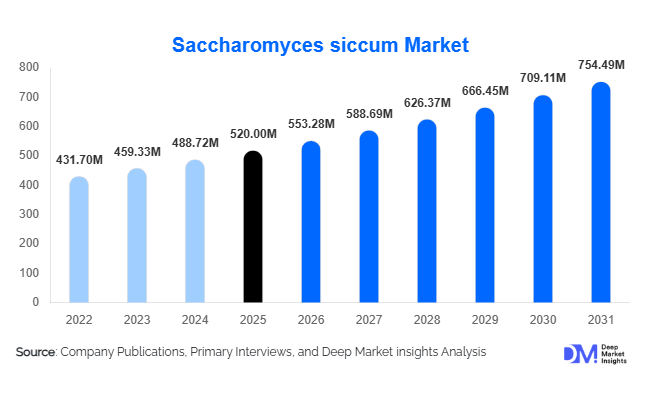
According to Deep Market Insights, the global Saccharomyces siccum market size was valued at USD 520 million in 2026 and is projected to grow from USD 553.28 million in 2027 to reach USD 754.49 million by 2031, expanding at a CAGR of 6.4% during the forecast period (2026–2031). The market growth is primarily driven by the rising adoption of industrial fermentation technologies, increasing demand for bio-based manufacturing systems, and expanding applications across food biotechnology, nutraceuticals, pharmaceuticals, and industrial bio-production systems.
Key Market Insights
- Industrial fermentation remains the backbone of demand, with Saccharomyces siccum widely used in enzyme, ethanol, and organic acid production.
- Shift toward bio-based and sustainable manufacturing is accelerating adoption across chemical and pharmaceutical industries.
- Asia-Pacific dominates global consumption due to strong fermentation infrastructure and low-cost production ecosystems.
- Powder and inactive yeast forms lead the market owing to stability, scalability, and ease of transportation.
- Nutraceutical and functional food applications are expanding rapidly due to rising demand for probiotic and clean-label ingredients.
- Technological advancements in drying and strain engineering are improving efficiency and expanding commercial viability.
Global Saccharomyces siccum Market Latest Trends
Expansion of Bio-Manufacturing and Fermentation-Based Production
The market is witnessing a strong shift toward industrial biotechnology, where microbial fermentation is replacing chemical synthesis across multiple industries. Saccharomyces siccum is increasingly used in controlled fermentation systems for producing enzymes, amino acids, biofuels, and organic acids. Governments in Europe and Asia-Pacific are actively supporting bioeconomy initiatives, encouraging large-scale adoption of fermentation-based production systems and strengthening demand for stable yeast strains.
Growth in Nutraceutical and Functional Ingredient Applications
Demand for microbiome-friendly and functional food ingredients is driving adoption of Saccharomyces siccum in nutraceutical formulations. Its stability in dry form makes it suitable for capsules, powders, and probiotic blends. Increasing consumer preference for clean-label products, digestive health supplements, and immune-boosting formulations is expanding commercial applications across North America, Europe, and urban Asia-Pacific markets.
Global Saccharomyces siccum Market Drivers
Rising Demand for Sustainable Bio-Based Industrial Systems
The global transition toward sustainable manufacturing is a key driver of market growth. Industries are increasingly replacing petrochemical processes with microbial fermentation systems, where Saccharomyces siccum plays a crucial catalytic role. This shift is reinforced by regulatory pressure for carbon reduction and corporate ESG commitments, particularly in developed economies.
Expansion of Pharmaceutical and Biotechnology Applications
The pharmaceutical industry is increasingly relying on yeast-based systems for enzyme production, metabolite synthesis, and research applications. Saccharomyces siccum is valued for its reproducibility, stability, and scalability in controlled environments, making it suitable for standardized bioprocessing in pharmaceutical manufacturing and R&D ecosystems.
Growth in Industrial Fermentation and Bioenergy Production
Bioethanol production and renewable energy initiatives are expanding globally, particularly in Asia-Pacific and Latin America. Saccharomyces siccum plays a key role in fermentation efficiency and yield optimization, making it a preferred biological agent in large-scale industrial biofuel production systems.
Global Saccharomyces siccum Market Restraints
Lack of Standardized Market Definition and Awareness
The market faces challenges due to limited standardization, as Saccharomyces siccum is often grouped under broader yeast categories. This reduces market visibility, complicates pricing benchmarks, and limits targeted investment flows into this specific segment.
High Production and Processing Costs
Advanced drying technologies, strain stabilization, and genetic optimization increase production costs. This makes Saccharomyces siccum less competitive in price-sensitive markets where conventional yeast products remain widely available at lower costs.
Global Saccharomyces siccum Market Opportunities
Expansion of Industrial Biotechnology Infrastructure
Rapid expansion of biorefineries and fermentation-based manufacturing plants presents a major opportunity. Saccharomyces siccum is increasingly integrated into industrial-scale bio-production systems, particularly in regions investing heavily in circular bioeconomy models such as Europe, China, and India.
Rising Demand in Nutraceutical and Probiotic Markets
Growing awareness of gut health and preventive healthcare is driving demand for yeast-based functional ingredients. Saccharomyces siccum is gaining traction in synbiotic formulations and dietary supplements, opening opportunities for premium product development in global nutraceutical markets.
Advancements in Strain Engineering and Encapsulation Technologies
Technological innovation in genetic engineering, spray-drying, and encapsulation is enabling higher efficiency and improved stability. These advancements are expanding applications into pharmaceuticals and precision nutrition, creating high-value niche segments within the market.
Report Scope
| Report Metric | Details |
|---|---|
| Market Size in 2025 | USD 520.00 Million |
| Market Size in 2026 | USD 553.28 Million |
| Market Size in 2031 | USD 754.49 Million |
| CAGR | 6.4% (2026-2031) |
| Base Year for Estimation | 2025 |
| Historical Data | 2022-2024 |
| Forecast Period | 2026-2031 |
| Report Coverage | Revenue Forecast, Competitive Landscape, Supply Chain Disruption, Growth Factors, Environment & Regulatory Landscape and Trends |
| Geographies Covered | North America, Europe, APAC, Middle East and Africa, LATAM |
| Countries Covered | U.S., Canada, U.K., Germany, France, Spain, Italy, Russia, Nordic, Benelux, Rest of Europe, China, Korea, Japan, India, Australia, Singapore, Taiwan, South East Asia, Rest of Asia-Pacific, UAE, Turky, Saudi Arabia, South Africa, Egypt, Nigeria, Rest of MEA, Brazil, Mexico, Argentina, Chile, Colombia, Rest of LATAM |
Explore more data points, trends and opportunities Download Free Sample Report
Product Type Insights
The inactive Saccharomyces siccum segment dominates the global market, accounting for approximately 38% of the total market share in 2025. Its market leadership is primarily attributed to its exceptional storage stability, extended shelf life, ease of transportation, and consistent performance across a broad range of industrial applications. Inactive Saccharomyces siccum is extensively utilized in food processing, animal nutrition, nutraceutical formulations, microbial culture media, and fermentation-based manufacturing processes where metabolic activity is not required but nutritional composition and functional properties remain valuable. The segment also benefits from its cost-effectiveness, compatibility with large-scale manufacturing, and increasing use as a source of proteins, vitamins, amino acids, and bioactive compounds in functional formulations. Meanwhile, active Saccharomyces siccum and genetically optimized strains are witnessing steady growth as industries increasingly adopt advanced fermentation technologies to improve production efficiency, enhance metabolite yields, and support the commercialization of next-generation bio-based products. Rising investments in industrial biotechnology, synthetic biology, precision fermentation, and sustainable manufacturing continue to accelerate demand for high-performance yeast strains across multiple end-use sectors.
Form Insights
The powder (spray-dried) form represents the largest segment, capturing approximately 45% of the global market in 2025. The segment's leadership is driven by its superior handling characteristics, excellent storage stability, longer shelf life, lower transportation costs, and seamless integration into industrial-scale production systems. Spray-dried Saccharomyces siccum is widely preferred across food processing, fermentation, pharmaceutical manufacturing, nutraceutical production, and animal feed applications due to its uniform particle size, improved process efficiency, and ease of blending into various formulations. Additionally, powder formulations enable manufacturers to achieve greater operational flexibility while minimizing product losses during storage and distribution. Granular forms continue to gain traction in industrial processing applications requiring controlled dispensing and reduced dust generation, while encapsulated variants are experiencing increasing demand in pharmaceutical and nutraceutical industries owing to their enhanced stability, controlled-release characteristics, and improved protection of sensitive bioactive compounds during processing and digestion.
Application Insights
Industrial fermentation remains the leading application segment, accounting for approximately 32% of the global market in 2025. The segment's dominance is driven by the growing global demand for bio-based chemicals, industrial enzymes, ethanol, organic acids, specialty ingredients, and sustainable biochemical production processes. Increasing adoption of microbial fermentation as an environmentally friendly alternative to conventional chemical synthesis, coupled with expanding investments in industrial biotechnology and circular bioeconomy initiatives, continues to strengthen demand for Saccharomyces siccum across large-scale fermentation facilities. Furthermore, ongoing advancements in fermentation process optimization, bioprocess engineering, and precision biotechnology are enhancing production efficiency and expanding commercial applications. Food and beverage manufacturers continue to increase utilization of Saccharomyces siccum in fermentation-based processing and functional ingredient development, while nutraceutical and pharmaceutical applications are expanding steadily due to rising consumer demand for clean-label products, functional nutrition, microbial-derived bioactive ingredients, and innovative therapeutic manufacturing platforms.
End-Use Industry Insights
The food and beverage industry accounts for the largest share of the global market, representing approximately 29% in 2025. The segment's leadership is supported by the extensive use of Saccharomyces siccum in fermentation-based food production, bakery ingredients, flavor enhancement, nutritional enrichment, functional food development, and specialty ingredient manufacturing. Increasing consumer preference for clean-label foods, natural fermentation processes, protein-rich ingredients, and health-oriented food products continues to stimulate demand across both developed and emerging economies. In addition, expanding production of processed foods and beverages, coupled with continuous innovation in fermented food formulations, further reinforces market growth. The pharmaceutical and biotechnology sectors represent the fastest-growing end-use industries, driven by rising investments in biopharmaceutical research, microbial manufacturing technologies, vaccine development, recombinant protein production, and precision fermentation. Animal nutrition, agriculture, and bioenergy industries are also witnessing sustained growth as manufacturers increasingly adopt sustainable microbial solutions to improve feed efficiency, enhance livestock productivity, and support renewable biofuel production.
Distribution Channel Insights
Direct B2B sales remain the dominant distribution channel, supported by bulk procurement activities undertaken by industrial manufacturers, biotechnology companies, pharmaceutical producers, food processors, and fermentation facilities that require consistent product quality and long-term supply agreements. Direct procurement enables customized product specifications, technical collaboration, volume-based pricing, and reliable supply chain management, making it the preferred procurement model for large-scale industrial customers. Specialty biochemical distributors continue to play an important role by supplying research laboratories, academic institutions, contract manufacturers, and medium-sized industrial producers with specialized Saccharomyces siccum products and technical support services. At the same time, online B2B procurement platforms are emerging as an increasingly important sales channel, offering improved product accessibility, greater supplier visibility, transparent pricing, digital procurement capabilities, and streamlined international sourcing for buyers across global markets.
Explore more data points, trends and opportunities Download Free Sample Report
Saccharomyces siccum Market Segmentations
By Product Type
- Active Saccharomyces siccum Strains
- Inactive (Dormant) Saccharomyces siccum
- Genetically Optimized Strains
- Industrial Fermentation-Grade Strains
- Pharmaceutical-Grade Purified Strains
By Form
- Powder (Spray-Dried Yeast)
- Granules
- Encapsulated Dry Form
- Tablet/Capsule Form
- Liquid Rehydrated Formulations
By Application
- Industrial Fermentation
- Food & Beverage Processing
- Nutraceuticals & Dietary Supplements
- Pharmaceutical Biotechnology
- Animal Feed & Probiotics
- Biofuel & Ethanol Production
- Enzyme & Metabolite Production
By End-Use Industry
- Food & Beverage Industry
- Pharmaceutical & Biotechnology Industry
- Animal Nutrition Industry
- Bioenergy Industry
- Industrial Chemicals & Bioprocessing
- Research & Academic Institutions
By Distribution Channel
- Direct B2B Sales
- Specialty Biochemical Distributors
- Online B2B Platforms
- Research Supply Vendors
- Contract Manufacturing Supply Chains
Regional Insights
Asia-Pacific
Asia-Pacific dominates the global Saccharomyces siccum market, accounting for approximately 36% of the total market share in 2025. The region's leadership is supported by well-established fermentation industries across China, India, Japan, and South Korea, which serve expanding food processing, biotechnology, pharmaceutical, biofuel, and industrial enzyme sectors. Cost-efficient manufacturing capabilities, abundant raw material availability, growing investments in industrial biotechnology, and supportive government policies promoting domestic biomanufacturing continue to strengthen regional competitiveness. Rapid expansion of bioethanol production, increasing demand for functional food ingredients, rising pharmaceutical manufacturing capacity, and continuous investments in precision fermentation technologies further accelerate market growth throughout the region.
Europe
Europe accounts for approximately 28% of the global market in 2025, supported by its advanced biotechnology ecosystem, mature fermentation industry, and stringent environmental sustainability regulations. Countries including Germany, France, and the Netherlands continue to lead regional demand through strong adoption of industrial fermentation, green chemistry, bio-based manufacturing, and high-value microbial technologies. The region also benefits from increasing investments in circular economy initiatives, renewable industrial processes, sustainable food production, and microbial innovation. Growing research activities, expanding biopharmaceutical manufacturing, supportive regulatory frameworks for sustainable biotechnology, and increasing commercialization of bio-based products continue to drive regional market expansion.
North America
North America represents approximately 24% of the global market in 2025, with the United States serving as the primary contributor. The region benefits from a highly developed biotechnology industry, substantial research and development investments, and a strong presence of pharmaceutical, life sciences, and industrial biotechnology companies. Increasing commercialization of precision fermentation, synthetic biology, microbial engineering, and advanced biomanufacturing technologies continues to stimulate demand for Saccharomyces siccum. Additionally, growing investments in bio-based chemicals, renewable fuels, sustainable manufacturing, and next-generation therapeutic production further support long-term regional market growth.
Latin America
Latin America accounts for nearly 7% of the global market in 2025, led primarily by Brazil's well-established bioethanol industry and expanding fermentation infrastructure. Brazil continues to generate significant demand through large-scale renewable fuel production, industrial biotechnology, and agricultural fermentation applications. Argentina and Mexico are also strengthening their market positions through increasing investments in food processing, industrial enzymes, renewable energy production, and biotechnology research. Rising adoption of sustainable industrial processes, growing demand for fermentation-derived ingredients, and expanding regional manufacturing capabilities are expected to support continued market growth across Latin America.
Middle East & Africa
The Middle East & Africa region accounts for approximately 5% of the global market in 2025. Market growth is supported by increasing government investments aimed at economic diversification through biotechnology, industrial innovation, and sustainable manufacturing initiatives. The United Arab Emirates and Saudi Arabia are actively expanding biotechnology research, pharmaceutical manufacturing, and bio-based industrial development as part of their long-term economic transformation strategies. Meanwhile, South Africa continues to strengthen regional demand through growing industrial microbiology applications, food processing industries, and research collaborations. Increasing investments in life sciences infrastructure, expanding food security initiatives, rising adoption of fermentation technologies, and growing awareness of sustainable industrial production are expected to create additional growth opportunities across the region during the forecast period.
Key Players in the Global Saccharomyces siccum Market
- Lesaffre Group
- Angel Yeast Co., Ltd.
- Associated British Foods plc
- Lallemand Inc.
- DSM-Firmenich
- Kerry Group plc
- Chr. Hansen Holding A/S
- Novozymes A/S
- Alltech Inc.
- ADM