Global Buckwheat Flour Market Size
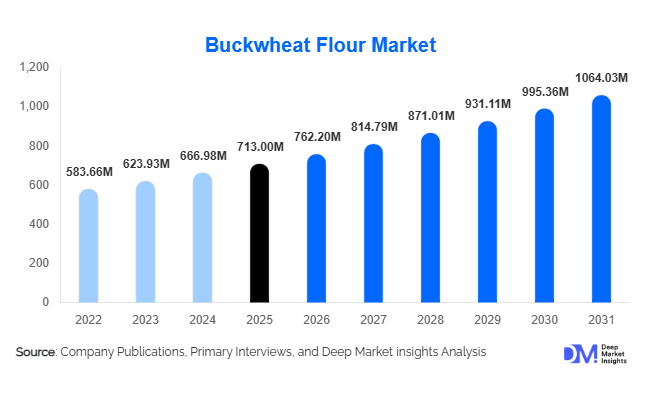
According to Deep Market Insights, the global buckwheat flour market size was valued at USD 713 million in 2025 and is projected to grow from USD 762.20 million in 2026 to reach USD 1,064.03 million by 2031, expanding at a CAGR of 6.9% during the forecast period (2026–2031). The buckwheat flour market growth is primarily driven by rising demand for gluten-free food products, increasing adoption of functional and plant-based nutrition, and expanding use of buckwheat flour in bakery, noodle, and health-focused food applications across developed and emerging economies.
Key Market Insights
- Gluten-free food demand is the strongest structural driver, with buckwheat flour increasingly used in bakery, pasta, and breakfast formulations as a natural wheat alternative.
- Europe dominates global consumption due to traditional buckwheat usage in countries such as Russia, France, Poland, and Germany.
- Asia-Pacific is the fastest-growing region, led by China, Japan, South Korea, and India, driven by noodle-based consumption and functional food demand.
- Food processing industry remains the largest end-use segment, accounting for nearly half of global demand due to widespread industrial applications.
- Online retail is expanding rapidly, supported by growing e-commerce penetration of organic and specialty flour products.
- Organic and stone-ground buckwheat flour are gaining premium traction due to clean-label and minimally processed food trends.
Buckwheat Flour Market Latest Trends
Rising Demand for Gluten-Free and Functional Foods
The buckwheat flour market is witnessing strong growth due to increasing global demand for gluten-free food alternatives. Rising cases of celiac disease and gluten intolerance, combined with consumer preference for digestive wellness, are accelerating adoption of buckwheat flour in bakery and packaged food applications. Food manufacturers are actively reformulating products such as bread, pancakes, cookies, noodles, and snacks using buckwheat flour due to its high fiber, protein, and antioxidant content. The trend is further reinforced by the growing popularity of functional foods that provide health benefits beyond basic nutrition, particularly in cardiovascular and metabolic health segments.
Expansion of Organic and Clean-Label Product Offerings
Consumers are increasingly shifting toward organic, non-GMO, and minimally processed food ingredients, creating strong momentum for organic buckwheat flour. Manufacturers are investing in certified organic farming, sustainable sourcing, and stone-milling techniques to meet rising clean-label expectations. Retailers are also expanding shelf space for organic flour products, particularly in Europe and North America. This trend is encouraging premiumization of buckwheat flour products, where consumers are willing to pay higher prices for transparency, nutritional integrity, and environmentally sustainable production practices.
Growth of E-Commerce and Direct-to-Consumer Channels
The rise of online grocery platforms and specialty health-food e-commerce channels is significantly transforming distribution patterns. Consumers increasingly purchase buckwheat flour through digital platforms due to wider product availability, access to premium organic brands, and convenience of home delivery. Direct-to-consumer (D2C) brands are leveraging digital marketing, subscription models, and influencer-driven awareness campaigns to expand their customer base. This shift is especially strong in North America and Europe, where digital grocery ecosystems are well-developed.
Buckwheat Flour Market Drivers
Rising Health Awareness and Dietary Shifts
Growing global awareness of healthy eating habits is a major driver of buckwheat flour demand. Consumers are actively replacing refined wheat flour with nutrient-rich alternatives that offer higher protein, fiber, and micronutrient content. Buckwheat flour is increasingly positioned as a superfood ingredient due to its antioxidant properties and low glycemic index. This shift is particularly strong among urban populations, fitness-focused consumers, and aging demographics seeking heart-healthy diets. Food manufacturers are responding by launching fortified bakery and snack products incorporating buckwheat flour as a core ingredient.
Expansion of Gluten-Free Food Manufacturing Industry
The rapid expansion of the global gluten-free packaged food industry is significantly boosting buckwheat flour consumption. Food companies are increasingly incorporating buckwheat flour into industrial formulations for baked goods, pasta, noodles, and breakfast cereals. Its functional properties, including binding capability and nutritional density, make it a preferred alternative to rice and corn flour in gluten-free formulations. This demand is further reinforced by regulatory labeling requirements and increasing availability of certified gluten-free ingredients across retail and foodservice channels.
Growth in Functional Food and Plant-Based Nutrition
The rise of plant-based diets and functional nutrition trends has significantly increased demand for buckwheat flour as a health-oriented ingredient. It is widely used in nutraceuticals, protein blends, sports nutrition products, and diabetic-friendly food formulations. Its natural composition, including rutin and essential amino acids, enhances its appeal among health-conscious consumers. This driver is particularly strong in developed markets where functional foods are experiencing rapid category expansion.
Buckwheat Flour Market Restraints
Limited Global Production and Supply Constraints
Buckwheat cultivation is geographically concentrated in a few regions, including Eastern Europe, China, and parts of North America. This limited supply base creates vulnerability to weather conditions, crop yield fluctuations, and geopolitical disruptions. As a result, raw material availability remains inconsistent, impacting pricing stability and production scalability. Manufacturers often face challenges in maintaining continuous supply chains, especially during low harvest years, which can constrain market expansion.
Higher Cost Compared to Conventional Wheat Flour
Despite rising demand, buckwheat flour remains more expensive than traditional wheat flour due to lower production volumes, specialized milling requirements, and certification costs associated with organic and gluten-free labeling. This price differential limits adoption in cost-sensitive markets, particularly in developing regions where wheat flour remains the dominant staple. While premium segments absorb higher prices, mainstream penetration remains constrained by affordability concerns.
Buckwheat Flour Industry Key Opportunities
Expansion into Functional and Nutraceutical Applications
The growing nutraceutical industry presents significant opportunities for buckwheat flour manufacturers. Its high antioxidant content and cardiovascular health benefits make it suitable for dietary supplements, fortified foods, and medical nutrition products. Manufacturers can develop specialized high-protein and sprouted buckwheat flour variants targeting sports nutrition, diabetic-friendly diets, and weight management products. This segment is expected to generate strong premium pricing opportunities.
Growth in Emerging Markets and Urban Food Consumption
Rapid urbanization in Asia-Pacific, Latin America, and parts of the Middle East is expanding demand for convenient, healthy food ingredients. Countries such as China, India, Brazil, and Mexico are witnessing rising adoption of gluten-free and premium bakery products. Local food manufacturers are increasingly incorporating buckwheat flour into noodles, snacks, and bakery formulations. This creates strong opportunities for global exporters and regional milling companies to expand distribution networks.
Sustainable Agriculture and Climate-Resilient Crop Development
Buckwheat is a fast-growing, low-input crop that requires fewer fertilizers and adapts well to marginal soils. This positions it as a key ingredient in sustainable agriculture initiatives. Governments and agricultural agencies are promoting alternative grains to enhance food security and reduce environmental impact. As sustainability becomes a core procurement requirement, buckwheat flour is expected to gain stronger adoption in environmentally conscious food manufacturing ecosystems.
Report Scope
| Report Metric | Details |
|---|---|
| Market Size in 2025 | USD 713.00 Million |
| Market Size in 2026 | USD 762.20 Million |
| Market Size in 2031 | USD 1064.03 Million |
| CAGR | 6.9% (2026-2031) |
| Base Year for Estimation | 2025 |
| Historical Data | 2022-2024 |
| Forecast Period | 2026-2031 |
| Report Coverage | Revenue Forecast, Competitive Landscape, Supply Chain Disruption, Growth Factors, Environment & Regulatory Landscape and Trends |
| Geographies Covered | North America, Europe, APAC, Middle East and Africa, LATAM |
| Countries Covered | U.S., Canada, U.K., Germany, France, Spain, Italy, Russia, Nordic, Benelux, Rest of Europe, China, Korea, Japan, India, Australia, Singapore, Taiwan, South East Asia, Rest of Asia-Pacific, UAE, Turky, Saudi Arabia, South Africa, Egypt, Nigeria, Rest of MEA, Brazil, Mexico, Argentina, Chile, Colombia, Rest of LATAM |
Explore more data points, trends and opportunities Download Free Sample Report
Product Type Insights
Conventional buckwheat flour accounted for the largest share of the global buckwheat flour market due to its affordability, consistent supply, and extensive utilization across commercial food manufacturing. Its cost efficiency and compatibility with large-scale processing have made it the preferred choice for industrial bakeries, noodle manufacturers, and processed food producers seeking to deliver gluten-free and functional food products at competitive prices. Conventional buckwheat flour is widely incorporated into bread, biscuits, cakes, crackers, pancakes, and ready-to-cook mixes, supported by its reliable functional properties and established distribution network. The dominance of this segment is further reinforced by growing demand from foodservice operators and institutional buyers that require high-volume, standardized flour products for continuous production.Stone-ground and specialty buckwheat flours are steadily gaining popularity within premium bakery, artisanal food, and gourmet product categories due to their traditional milling methods, enhanced flavor profile, and higher retention of naturally occurring nutrients. Whole buckwheat flour remains widely preferred in health-focused formulations because it preserves the bran and germ, delivering higher fiber, protein, antioxidants, vitamins, and minerals that appeal to wellness-conscious consumers. Conversely, light buckwheat flour continues to maintain strong demand in commercial baking applications where manufacturers require a milder taste, lighter texture, and greater formulation flexibility for mainstream bakery products.
Application Insights
Bakery applications dominated the global buckwheat flour market owing to the rapidly expanding demand for gluten-free baked goods, functional bakery products, and healthier alternatives to conventional wheat-based foods. The excellent nutritional profile of buckwheat flour, including its high protein, dietary fiber, essential amino acids, and antioxidant content, has encouraged widespread incorporation into bread, cookies, muffins, cakes, pancakes, waffles, crackers, and other baked products. Growing consumer preference for clean-label ingredients, rising incidences of gluten intolerance, and increasing product innovation by commercial bakeries continue to strengthen the leadership of this application segment.Functional food applications are expanding at a robust pace as manufacturers increasingly utilize buckwheat flour in protein blends, nutrition bars, meal replacement products, sports nutrition formulations, and dietary supplements targeting health-conscious consumers. Meanwhile, infant nutrition, beverage mixes, and specialized medical nutrition products represent emerging opportunities as demand grows for naturally nutrient-rich, allergen-friendly, and minimally processed food ingredients capable of supporting balanced diets across different age groups.
Distribution Channel Insights
Supermarkets and hypermarkets held the largest share of the global buckwheat flour market owing to their extensive retail networks, broad product assortment, high consumer footfall, and strong brand visibility. These organized retail formats provide consumers with convenient access to both conventional and premium buckwheat flour products while enabling manufacturers to reach diverse customer segments through attractive in-store merchandising and promotional campaigns. Consumer trust in established retail chains, coupled with the ability to compare multiple brands and product variants, continues to reinforce the dominance of this distribution channel.Specialty health food stores continue to play an important role in distributing certified organic, gluten-free, and premium buckwheat flour products, particularly across North America and Europe where consumer awareness of functional nutrition remains high. Foodservice distributors and wholesale suppliers maintain substantial demand by serving bakeries, restaurants, hotels, and noodle manufacturers that purchase flour in bulk quantities. At the same time, direct B2B sales are expanding steadily as flour producers increasingly establish long-term supply agreements with commercial food processors seeking stable procurement, customized formulations, and reliable raw material availability.
Explore more data points, trends and opportunities Download Free Sample Report
Buckwheat Flour Market Segmentations
By Product Type
- Conventional Buckwheat Flour
- Organic Buckwheat Flour
- Whole Buckwheat Flour
- Light Buckwheat Flour
- Stone-Ground Buckwheat Flour
By Application
- Bakery Products
- Noodles & Pasta
- Breakfast Mixes & Pancakes
- Functional Foods & Nutraceuticals
- Snacks
- Infant Nutrition
- Beverages
- Others
By Distribution Channel
- Supermarkets & Hypermarkets
- Online Retail
- Specialty Health Food Stores
- Foodservice & Wholesale
- Direct B2B Sales
Regional Insights
Europe
Europe remained the largest regional market for buckwheat flour, supported by long-established consumption traditions, extensive domestic cultivation, and strong consumer awareness of the grain's nutritional benefits. Countries including Russia, France, Poland, Germany, and Ukraine have historically incorporated buckwheat into everyday diets through products such as pancakes, galettes, porridges, breads, and traditional baked goods, ensuring stable baseline demand. Regional market growth is further driven by rising adoption of gluten-free and clean-label food products, increasing preference for organic ingredients, stringent food quality and safety regulations, strong government support for sustainable agriculture, expanding premium bakery and functional food industries, and continuous product innovation by European food manufacturers. The region also benefits from well-developed retail infrastructure and a mature organic food market that supports premium product positioning.
Asia-Pacific
Asia-Pacific is projected to register the fastest market growth, led by China, Japan, South Korea, and India. Strong regional demand is supported by centuries-old culinary traditions centered around buckwheat noodles and other staple foods, particularly in Japan and China. Rapid urbanization, rising disposable incomes, expanding middle-class populations, and changing dietary preferences are encouraging consumers to adopt healthier grain alternatives. Growth is further accelerated by increasing awareness of gluten-free nutrition, rising prevalence of lifestyle-related diseases, expansion of modern retail and e-commerce channels, growing investments in functional food manufacturing, and increasing government support for agricultural diversification. India is emerging as a promising growth market due to rising health consciousness, expanding wellness-focused food consumption, and increasing availability of value-added buckwheat products across organized retail channels.
North America
North America continues to demonstrate strong market potential, primarily driven by growing consumer preference for gluten-free, plant-based, and functional food products. The United States represents the largest regional market due to increasing health-conscious consumption, expanding availability of organic and specialty flour products, and continuous product innovation across bakery and packaged food categories. Rising diagnoses of gluten intolerance and celiac disease, increasing demand for clean-label ingredients, strong investments in premium health foods, and expanding online grocery retail are further stimulating market growth. Canada contributes significantly through domestic buckwheat cultivation, growing exports of specialty agricultural products, and increasing consumer demand for sustainable and nutrient-dense food ingredients.
Latin America
Latin America is gradually emerging as an attractive market for buckwheat flour, with Brazil, Mexico, and Argentina leading regional adoption. Market expansion is supported by increasing health awareness, growing urban populations, rising disposable incomes, and changing dietary preferences toward functional and natural foods. The expansion of organized retail, increasing imports of specialty food ingredients, growing popularity of gluten-free bakery products, and rising investments in premium food manufacturing are creating new growth opportunities. Consumer exposure to international food trends and wellness-oriented diets is also encouraging broader acceptance of buckwheat-based products throughout the region.
Middle East & Africa
The Middle East & Africa market is witnessing steady growth as consumer awareness of healthy eating habits continues to improve across major economies including the UAE, Saudi Arabia, and South Africa. Increasing demand from expatriate communities, expanding tourism and hospitality industries, and greater availability of imported premium health foods are supporting market development. Regional growth is further driven by rising disposable incomes, expansion of modern supermarket chains, increasing investments in specialty food retailing, growing popularity of gluten-free and organic diets among affluent consumers, and continuous diversification of food product offerings by international brands seeking to strengthen their presence across the region.
Key Players in the Buckwheat Flour Market
- Birkett Mills
- Bob's Red Mill Natural Foods
- Homestead Organics
- Arrowhead Mills
- Great River Organic Milling
- Hodgson Mill
- Shipton Mill
- Doves Farm Foods
- To Your Health Sprouted Flour Co.
- Molini Spigadoro