Pygeum Africanum Extract Market Size
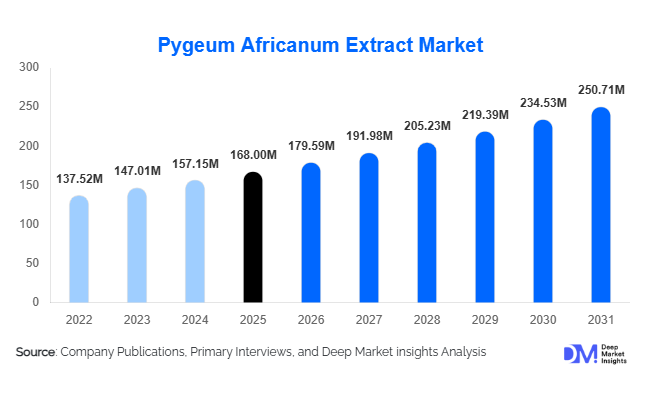
According to Deep Market Insights, theglobal Pygeum Africanum Extract market size was valued at USD 168 million in 2025 and is projected to grow from USD 175 million in 2026 to reach USD 245 million by 2031, expanding at a CAGR of 6.9% during the forecast period (2026–2031). The market growth is primarily driven by the increasing prevalence of benign prostatic hyperplasia (BPH), rising consumer preference for plant-based healthcare solutions, growing adoption of preventive men's health supplements, and expanding utilization of standardized botanical ingredients within pharmaceutical and nutraceutical formulations. Pygeum africanum extract, derived from the bark of the African cherry tree, has established itself as one of the most widely recognized botanical ingredients for prostate and urinary health applications globally.
Key Market Insights
- Dietary supplements remain the largest application segment, accounting for more than 50% of global demand, supported by growing consumer awareness regarding prostate health and healthy aging.
- Europe dominates the global market, driven by long-standing physician acceptance of phytotherapy and widespread use of botanical healthcare products.
- Asia-Pacific is the fastest-growing regional market, supported by rising healthcare expenditure, increasing nutraceutical consumption, and growing aging populations.
- Standardized extracts containing 13–14% sterols are gaining prominence as manufacturers seek clinically validated ingredients with consistent efficacy profiles.
- Sustainable sourcing and traceability programs are becoming critical competitive differentiators due to conservation concerns surrounding Prunus africana harvesting.
- B2B ingredient supply channels dominate market revenues, as pharmaceutical and nutraceutical manufacturers continue to incorporate pygeum extract into premium men's health formulations.
Pygeum Africanum Extract Market Latest Trends
Sustainable and Certified Sourcing Programs Expanding Globally
Sustainability has become one of the most influential trends shaping the global Pygeum Africanum Extract market. Due to increasing concerns regarding overharvesting of Prunus africana trees across Africa, manufacturers are investing heavily in certified sustainable sourcing programs, managed forestry initiatives, and traceable supply chains. Buyers in Europe and North America increasingly require sustainability certifications and compliance with international conservation regulations before approving suppliers. This trend is encouraging long-term partnerships between extract producers, local harvesting communities, and conservation organizations. Premium pricing opportunities are also emerging for sustainably sourced extracts, allowing suppliers to differentiate their offerings while ensuring raw material security. As environmental, social, and governance (ESG) requirements continue to gain importance, sustainable sourcing is expected to become a standard industry practice rather than a competitive advantage.
Growing Adoption of Standardized Botanical Ingredients
Manufacturers are increasingly shifting toward highly standardized pygeum extracts with defined sterol content to improve product consistency and support health claims. Standardized extracts containing 13–14% total sterols have become particularly popular among pharmaceutical and nutraceutical companies due to their established clinical acceptance. Regulatory scrutiny regarding ingredient quality is also encouraging greater adoption of standardized formulations. This trend supports premium product positioning and enables manufacturers to improve formulation efficacy while enhancing consumer confidence. In addition, advancements in extraction technologies are helping suppliers achieve higher purity levels, reduced contaminants, and improved bioavailability, further driving demand for standardized pygeum ingredients.
Pygeum Africanum Extract Market Drivers
Increasing Global Prevalence of Benign Prostatic Hyperplasia (BPH)
The growing prevalence of benign prostatic hyperplasia remains the primary driver for the Pygeum Africanum Extract market. BPH affects a substantial proportion of men over the age of 50, with incidence rates increasing significantly among aging populations worldwide. As healthcare systems place greater emphasis on preventive management and symptom control, pygeum extract has gained widespread recognition as a natural alternative for supporting prostate health and urinary function. Rising life expectancy across both developed and developing economies is expected to further expand the addressable patient population over the coming decade.
Growing Consumer Preference for Natural Healthcare Solutions
Consumers are increasingly favoring botanical and plant-derived ingredients over synthetic pharmaceuticals, particularly for long-term health management. The broader shift toward preventive healthcare and wellness-focused lifestyles has accelerated demand for natural supplements targeting men's health concerns. Pygeum extract benefits directly from this trend due to its long history of traditional use and growing body of scientific evidence supporting its efficacy. The expansion of e-commerce channels and direct-to-consumer wellness brands has further improved market accessibility and consumer adoption.
Expansion of the Global Nutraceutical Industry
The rapid growth of the global nutraceutical industry is creating significant opportunities for pygeum extract suppliers. Nutraceutical manufacturers are increasingly introducing specialized formulations targeting prostate health, urinary health, and healthy aging. Contract manufacturers and private-label supplement companies are also expanding production capacity, contributing to growing ingredient demand. Rising investment in functional nutrition and preventive healthcare products is expected to sustain long-term market growth.
Pygeum Africanum Extract Market Restraints
Raw Material Supply Constraints and Conservation Regulations
The market remains highly dependent on bark harvesting from African Prunus africana trees. Conservation regulations, harvesting restrictions, and environmental concerns can limit raw material availability and create supply chain disruptions. Fluctuations in harvest volumes often contribute to pricing volatility and procurement challenges for manufacturers.
Complex Regulatory Frameworks Across Markets
Regulatory requirements governing botanical ingredients vary significantly across North America, Europe, Asia-Pacific, and Middle Eastern markets. Compliance with quality standards, labeling regulations, and health claim restrictions increases operational complexity and can delay product commercialization. Smaller suppliers often face challenges in meeting evolving documentation and certification requirements.
Pygeum Africanum Extract Industry Key Opportunities
Expansion of Preventive Men's Health Programs
The growing focus on preventive healthcare presents substantial opportunities for Pygeum Africanum Extract manufacturers. Healthcare providers, insurers, and wellness platforms are increasingly promoting early intervention strategies for prostate health management. As awareness of age-related urinary disorders continues to increase, demand for preventive supplementation is expected to rise significantly. Companies developing clinically supported formulations targeting healthy aging and men's wellness are likely to benefit from expanding consumer adoption and recurring demand.
Growth Opportunities in Asia-Pacific Nutraceutical Markets
Asia-Pacific represents the most attractive growth opportunity within the global market. Rising disposable incomes, growing health awareness, expanding middle-class populations, and increasing acceptance of herbal medicine are driving demand across China, India, Japan, South Korea, and Southeast Asia. Local nutraceutical manufacturers are actively expanding men's health product portfolios, creating new demand for high-quality pygeum ingredients. Companies investing in regional manufacturing, distribution partnerships, and regulatory approvals are expected to capture significant market share gains over the forecast period.
Report Scope
| Report Metric | Details |
|---|---|
| Market Size in 2025 | USD 168.00 Million |
| Market Size in 2026 | USD 179.59 Million |
| Market Size in 2031 | USD 250.71 Million |
| CAGR | 6.9% (2026-2031) |
| Base Year for Estimation | 2025 |
| Historical Data | 2022-2024 |
| Forecast Period | 2026-2031 |
| Report Coverage | Revenue Forecast, Competitive Landscape, Supply Chain Disruption, Growth Factors, Environment & Regulatory Landscape and Trends |
| Geographies Covered | North America, Europe, APAC, Middle East and Africa, LATAM |
| Countries Covered | U.S., Canada, U.K., Germany, France, Spain, Italy, Russia, Nordic, Benelux, Rest of Europe, China, Korea, Japan, India, Australia, Singapore, Taiwan, South East Asia, Rest of Asia-Pacific, UAE, Turky, Saudi Arabia, South Africa, Egypt, Nigeria, Rest of MEA, Brazil, Mexico, Argentina, Chile, Colombia, Rest of LATAM |
Explore more data points, trends and opportunities Download Free Sample Report
Product Form Insights
The powder extract segment dominated the global Pygeum Africanum Extract market in 2025, accounting for approximately 61% of total revenue. The segment's leadership is primarily driven by its superior storage stability, longer shelf life, ease of handling, lower transportation and logistics costs, and high compatibility with large-scale pharmaceutical and nutraceutical manufacturing processes. Powder extracts are widely preferred by supplement manufacturers because they enable precise dosage standardization, facilitate incorporation into capsules and tablets, and ensure consistent active phytosterol concentrations across production batches. Furthermore, growing demand for standardized botanical ingredients in men's health formulations continues to strengthen the adoption of powder extracts worldwide. Liquid extracts represent a smaller but steadily expanding segment, supported by increasing consumer preference for liquid dietary supplements, tinctures, and functional beverage formulations that offer convenience and faster absorption. In addition, advancements in extraction technologies and formulation techniques are improving the stability and shelf life of liquid products. Encapsulated and bulk formulation grades are also experiencing notable growth as contract manufacturers and private-label supplement companies increasingly seek ready-to-use ingredients that reduce formulation complexity and accelerate product development timelines.
Standardization Level Insights
Extracts standardized to 13–14% total sterols represent the leading standardization category, accounting for approximately 44% of global market demand in 2025. The segment's dominance is supported by strong clinical validation, established efficacy profiles, and widespread acceptance among pharmaceutical and nutraceutical manufacturers seeking consistent therapeutic performance. Increasing consumer demand for evidence-based natural health products has further accelerated the adoption of standardized extracts, particularly in prostate health and urinary wellness applications. Manufacturers favor this concentration range because it offers an optimal balance between efficacy, cost-effectiveness, and regulatory compliance across major markets. Lower-standardization extracts continue to maintain relevance in cost-sensitive regions and value-oriented product categories, where affordability remains a key purchasing factor. Meanwhile, extracts containing sterol concentrations above 14% are gaining traction in premium formulations and specialized pharmaceutical applications, driven by growing interest in high-potency botanical ingredients and product differentiation strategies focused on enhanced clinical efficacy.
Application Insights
Dietary supplements remain the dominant application segment, contributing approximately 52% of total market revenues in 2025. The segment's growth is primarily driven by increasing awareness of prostate health management, urinary tract wellness, healthy aging, and preventive healthcare among aging male populations worldwide. Rising consumer preference for natural and plant-based alternatives to conventional treatments, coupled with expanding availability of scientifically supported nutraceutical products, continues to support demand growth. Pharmaceutical applications account for nearly 30% of global market consumption and remain a significant growth contributor due to increasing incorporation of pygeum extract into combination therapies and formulations designed to manage benign prostatic hyperplasia (BPH) and lower urinary tract symptoms. Ongoing research into botanical therapeutics and growing physician acceptance of complementary treatment approaches are further strengthening pharmaceutical demand. Functional foods and beverages represent an emerging application area, benefiting from broader trends toward preventive nutrition, personalized wellness, and the integration of bioactive botanical ingredients into everyday food products. Manufacturers are increasingly exploring opportunities to incorporate pygeum extract into fortified products targeting healthy aging and men's wellness.
Distribution Channel Insights
B2B ingredient supply channels accounted for approximately 68% of global market value in 2025, making them the largest distribution segment. The segment's leadership is driven by the industry's heavy dependence on pharmaceutical companies, nutraceutical manufacturers, and contract manufacturing organizations that purchase pygeum extract in bulk for formulation and product development purposes. Growing production of men's health supplements and botanical pharmaceutical products continues to support demand through this channel. Retail pharmacies and specialty health stores remain important distribution avenues for finished products, benefiting from consumer trust, professional recommendations, and convenient product accessibility. Meanwhile, e-commerce channels are witnessing the fastest growth rates due to increasing digital health awareness, expanding online supplement sales, and shifting consumer purchasing behavior. Direct-to-consumer business models, subscription-based wellness programs, and online health marketplaces are enabling brands to expand their customer reach while reducing traditional distribution expenses. The increasing influence of digital marketing and health-focused online communities is further accelerating online sales growth globally.
End-Use Industry Insights
The nutraceutical industry represents the largest end-use segment, accounting for approximately 48% of total global pygeum extract consumption in 2025. The segment's dominance is driven by growing consumer demand for preventive healthcare solutions, men's health supplements, and healthy aging products formulated with clinically supported botanical ingredients. Increasing preference for natural wellness products and rising expenditure on dietary supplements continue to strengthen market penetration across developed and emerging economies. Pharmaceutical manufacturers constitute the second-largest end-user group, supported by expanding utilization of botanical extracts in prostate health therapies and complementary treatment formulations. The pharmaceutical sector is also benefiting from increasing research focused on plant-derived bioactive compounds and their therapeutic applications. Functional food manufacturers are actively exploring opportunities to incorporate pygeum extract into specialized health-focused food products as consumers increasingly seek nutritional solutions that provide both dietary and wellness benefits. Additionally, the cosmetics and personal care industry is evaluating potential applications linked to the extract's antioxidant and anti-inflammatory properties, while veterinary healthcare remains an emerging niche with long-term growth potential as natural health solutions gain broader acceptance in animal wellness applications.
Explore more data points, trends and opportunities Download Free Sample Report
Pygeum Africanum Extract Market Segmentations
By Product Form
- Powder Extract
- Liquid Extract
- Encapsulated/Bulk Formulations
By Standardization Level
- Below 10% Sterols
- 10–13% Sterols
- 13–14% Sterols
- Above 14% Sterols
By Application
- Dietary Supplements
- Pharmaceuticals
- Functional Foods & Beverages
- Personal Care & Cosmetics
- Veterinary and Animal Health Products
By Distribution Channel
- B2B Ingredient Supply
- Retail Pharmacies & Health Stores
- E-commerce Platforms
By End User
- Nutraceutical Industry
- Pharmaceutical Industry
- Functional Food Industry
- Cosmetics & Personal Care Industry
- Veterinary Healthcare Industry
Regional Insights
Europe
Europe remains the largest regional market, accounting for approximately 36% of global demand in 2025. Germany, France, Italy, Spain, and the United Kingdom represent the region's primary consumption centers, supported by a long-established tradition of phytotherapy and widespread acceptance of herbal medicines. The region benefits from favorable regulatory frameworks governing botanical products, strong physician recommendations for plant-based therapies, and high consumer confidence in evidence-backed natural healthcare solutions. Germany alone contributes approximately 11% of global market demand and remains one of the most mature markets worldwide. Regional growth is further supported by a rapidly aging population, increasing prevalence of benign prostatic hyperplasia and urinary tract disorders, growing demand for preventive healthcare solutions, and continued innovation within the European nutraceutical and botanical pharmaceutical sectors. Strong healthcare infrastructure and extensive distribution networks across pharmacies and health stores also contribute significantly to market expansion.
North America
North America accounted for approximately 31% of global market revenues in 2025, with the United States representing nearly 26% of worldwide demand. The region continues to benefit from high dietary supplement consumption, growing awareness of prostate health management, and strong consumer preference for natural wellness products. Advanced retail distribution systems, widespread e-commerce penetration, and increasing healthcare expenditure further support market growth. The growing aging male population and rising prevalence of prostate-related health conditions have created favorable conditions for pygeum-based supplement adoption. In addition, increasing demand for preventive healthcare, expanding physician acceptance of nutraceutical interventions, and ongoing product innovation by leading supplement manufacturers continue to strengthen regional market development. Canada is also experiencing increasing demand due to growing acceptance of herbal healthcare products, expanding wellness trends, and heightened consumer focus on healthy aging.
Asia-Pacific
Asia-Pacific accounted for approximately 22% of global market revenues in 2025 and is projected to register the fastest growth rate through 2031. China, India, Japan, South Korea, and Australia are driving regional expansion through rising healthcare expenditures, increasing supplement consumption, and growing awareness of preventive healthcare. Rapid urbanization, expanding middle-class populations, and greater access to health information are encouraging consumers to adopt nutraceutical products focused on long-term wellness. The region's rapidly aging demographic profile is also contributing to higher demand for prostate health and healthy aging supplements. India is expected to emerge as the fastest-growing national market due to rapid expansion of its nutraceutical industry, increasing disposable incomes, growing penetration of online supplement sales, and rising awareness of men's health products. Additionally, favorable government initiatives supporting healthcare access and increasing investments in functional nutrition are expected to accelerate regional market growth.
Latin America
Latin America represents approximately 6% of global demand, with Brazil and Mexico serving as the region's largest markets. Market growth is being supported by rising healthcare awareness, improving economic conditions, growing disposable incomes, and expanding access to dietary supplements through modern retail channels. Consumers are increasingly seeking natural health products as awareness of preventive healthcare and wellness continues to improve across the region. The growing influence of global nutraceutical trends, increasing availability of imported botanical ingredients, and expansion of local supplement manufacturing capabilities are further contributing to market development. E-commerce growth and greater product accessibility through digital platforms are also helping manufacturers reach broader consumer populations, supporting long-term regional expansion.
Middle East & Africa
The Middle East & Africa region accounted for approximately 5% of global market revenues in 2025. South Africa, Kenya, Cameroon, and Morocco play important roles in both supply and consumption within the regional market. The region possesses strategic importance due to its connection to pygeum sourcing activities, particularly in African countries where Pygeum africanum trees are native. Market growth is supported by increasing investments in healthcare infrastructure, rising awareness of herbal and traditional medicines, expanding domestic pharmaceutical and nutraceutical industries, and growing demand for affordable natural healthcare products. Sustainable harvesting programs, forestry conservation initiatives, and improved supply chain management practices are helping secure long-term raw material availability while supporting responsible industry development. Furthermore, increasing local processing and value-addition capabilities, coupled with government efforts to promote botanical exports and natural product industries, are expected to enable the region to capture a larger share of global market revenues over the forecast period.
Key Players in the Pygeum Africanum Extract Market
- Naturex
- Euromed
- Maypro Industries
- Alchem International
- Natural Field
- Xi'An Herbking
- Naturactive
- Indena
- Martin Bauer Group
- Sabinsa
- Nexira
- Bio-Botanica
- Arjuna Natural
- Plamed Green Science
- Hunan Nutramax