Organic Apple Fiber Market Size
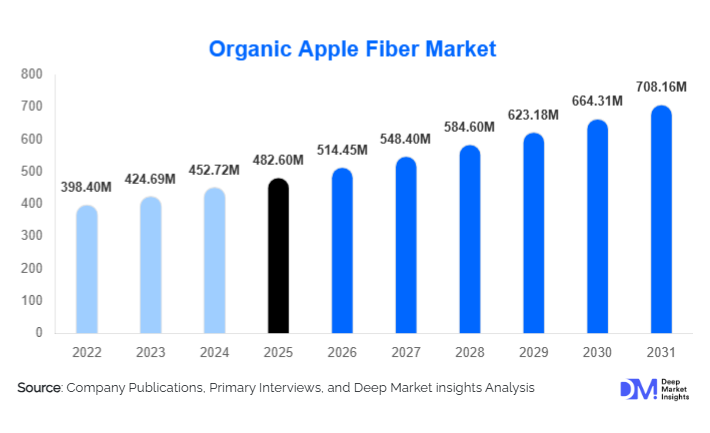
According to Deep Market Insights, the global organic apple fiber market size was valued at USD 482.6 million in 2025 and is projected to grow from USD 514.45 million in 2026 to reach USD 708.16 million by 2031, expanding at a CAGR of 6.6% during the forecast period (2026–2031). The organic apple fiber market growth is primarily driven by the increasing demand for clean-label food ingredients, rising consumer preference for organic dietary fibers, growing adoption of functional foods, and expanding applications across bakery, beverages, dietary supplements, and plant-based food formulations. Continuous investments in certified organic processing facilities and sustainable fruit ingredient production are further strengthening long-term market expansion.
Key Market Insights
- Europe dominates the global market, accounting for approximately 36.8% of total revenue owing to strong organic food consumption and advanced food processing infrastructure.
- Asia-Pacific is the fastest-growing regional market, supported by increasing health awareness, premium food consumption, and rapid expansion of functional food manufacturing.
- Powder organic apple fiber represents the leading product segment, contributing more than 61% of total market revenue due to its superior blending performance and extensive use in bakery and beverage applications.
- Food & beverages remain the largest application segment, accounting for nearly 57% of global demand, while dietary supplements continue to witness the fastest adoption.
- India is emerging as a key high-growth market, supported by expanding organic food manufacturing and increasing investments in functional nutrition products.
- Advancements in drying, micronization, and sustainable processing technologies are improving ingredient quality, production efficiency, and commercial adoption across multiple industries.
Organic Apple Fiber Market Latest Trends
Growing Adoption of Clean-Label Functional Ingredients
Food manufacturers are increasingly replacing synthetic stabilizers and texturizers with natural fruit-derived fibers as consumers prioritize clean-label products with recognizable ingredients. Organic apple fiber is witnessing rising utilization across bakery products, dairy alternatives, cereals, nutrition bars, confectionery, beverages, and plant-based foods because of its excellent water-binding capacity, texture enhancement, and dietary fiber content. Product launches featuring natural fiber claims continue to increase as food companies invest in premium formulations that meet evolving regulatory requirements and consumer expectations. The growing popularity of organic-certified ingredients is encouraging manufacturers to expand production capacity while strengthening supply chains for high-quality organic apple fiber.
Expansion of Functional Nutrition and Sustainable Food Processing
Functional nutrition continues to create significant opportunities for organic apple fiber manufacturers as digestive wellness becomes a major consumer priority worldwide. Dietary supplements, functional beverages, protein formulations, and meal replacement products are increasingly incorporating organic apple fiber to improve nutritional value while maintaining clean-label positioning. Technological advancements in drying, milling, and micronization are enhancing product consistency, particle size distribution, and processing performance. Manufacturers are also investing in sustainable production practices by utilizing apple processing by-products, reducing food waste, improving resource efficiency, and supporting circular economy initiatives across the global organic ingredient industry.
Organic Apple Fiber Market Drivers
Rising Demand for Organic and Functional Food Ingredients
Growing consumer awareness regarding digestive health, balanced nutrition, and natural food ingredients continues to accelerate demand for organic apple fiber across global food industries. Consumers increasingly prefer products containing plant-based dietary fibers that support digestive wellness without artificial additives. Food manufacturers are responding by expanding clean-label product portfolios across bakery, dairy alternatives, beverages, snacks, and nutritional foods. Government support for organic agriculture, growing retail availability of certified organic products, and continuous innovation in functional food formulations are further strengthening market expansion worldwide.
Increasing Applications Across Food Processing Industries
The versatility of organic apple fiber has significantly expanded its commercial applications across multiple food categories. Its excellent moisture retention, fat replacement capability, texture improvement, and fiber enrichment properties make it suitable for baked goods, processed meat alternatives, sauces, beverages, confectionery, cereals, and nutritional supplements. As manufacturers focus on product reformulation to satisfy health-conscious consumers, demand for multifunctional organic ingredients such as apple fiber continues to increase, supporting long-term industry growth.
Organic Apple Fiber Market Restraints
Limited Availability of Certified Organic Raw Materials
The availability of certified organic apples remains comparatively limited compared to conventional apple production, creating supply constraints for ingredient manufacturers. Organic cultivation requires strict compliance with certification standards, sustainable farming practices, and longer production cycles, resulting in relatively higher production costs. Seasonal variations, unfavorable weather conditions, and regional supply fluctuations can also affect raw material availability, limiting production capacity and increasing pricing volatility throughout the organic apple fiber value chain.
Higher Production and Certification Costs
Organic apple fiber manufacturing requires certified raw materials, specialized processing facilities, rigorous quality assurance systems, and compliance with international organic certification standards. These requirements increase manufacturing expenses compared to conventional dietary fiber ingredients, making organic apple fiber relatively expensive for cost-sensitive manufacturers. Smaller processors may also face financial challenges associated with certification renewals, traceability systems, and export compliance, restraining broader market penetration.
Organic Apple Fiber Industry Key Opportunities
Expansion of Plant-Based and Functional Nutrition Products
The rapidly growing plant-based food industry presents significant opportunities for organic apple fiber manufacturers. Increasing demand for meat alternatives, dairy substitutes, nutritional beverages, protein supplements, and healthy snacks is driving greater utilization of natural fruit fibers that improve texture, nutritional content, and product stability. Continuous product innovation within functional nutrition categories is expected to generate sustained commercial demand for organic apple fiber over the coming years.
Sustainable Food Manufacturing and Circular Economy Initiatives
Organic apple fiber production aligns closely with global sustainability objectives by converting apple processing residues into high-value functional ingredients. Food manufacturers are increasingly investing in waste reduction, resource optimization, and environmentally responsible production systems that maximize raw material utilization. Growing consumer preference for sustainably produced ingredients and increasing corporate sustainability commitments are expected to create attractive long-term opportunities for organic apple fiber producers worldwide.
Report Scope
| Report Metric | Details |
|---|---|
| Market Size in 2025 | USD 482.60 Million |
| Market Size in 2026 | USD 514.45 Million |
| Market Size in 2031 | USD 708.16 Million |
| CAGR | 6.6% (2026-2031) |
| Base Year for Estimation | 2025 |
| Historical Data | 2022-2024 |
| Forecast Period | 2026-2031 |
| Report Coverage | Revenue Forecast, Competitive Landscape, Supply Chain Disruption, Growth Factors, Environment & Regulatory Landscape and Trends |
| Geographies Covered | North America, Europe, APAC, Middle East and Africa, LATAM |
| Countries Covered | U.S., Canada, U.K., Germany, France, Spain, Italy, Russia, Nordic, Benelux, Rest of Europe, China, Korea, Japan, India, Australia, Singapore, Taiwan, South East Asia, Rest of Asia-Pacific, UAE, Turky, Saudi Arabia, South Africa, Egypt, Nigeria, Rest of MEA, Brazil, Mexico, Argentina, Chile, Colombia, Rest of LATAM |
Explore more data points, trends and opportunities Download Free Sample Report
Type Insights
Powder organic apple fiber dominates the market owing to its excellent dispersibility, fine particle size, superior hydration properties, and compatibility with a wide variety of food formulations. It is extensively utilized in bakery products, beverages, dairy alternatives, nutritional supplements, sauces, and confectionery applications. Granular organic apple fiber continues to gain adoption in breakfast cereals, snack products, processed foods, and meat alternatives where improved texture and controlled hydration are required. Blended organic apple fiber products, combining apple fiber with oat, citrus, or other plant-derived fibers, are witnessing increasing demand among food manufacturers seeking customized nutritional profiles, enhanced functionality, and improved processing performance.
Application Insights
Food & beverages represent the largest application segment, supported by increasing utilization across bakery products, cereals, beverages, dairy alternatives, snacks, confectionery, and processed foods. Dietary supplements are experiencing strong growth as manufacturers develop fiber-enriched capsules, powders, gummies, meal replacements, and digestive health formulations targeting health-conscious consumers. Animal feed applications are also expanding as organic livestock producers and premium pet food manufacturers increasingly incorporate organic apple fiber to improve digestive health, feed quality, and nutritional value while supporting clean-label product positioning.
Explore more data points, trends and opportunities Download Free Sample Report
Organic Apple Fiber Market Segmentations
By Type
- Powder
- Granules
- Blends
By Application
- Food & Beverages
- Dietary Supplements
- Animal Feed
Regional Insights
Europe
Europe remains the leading regional market for organic apple fiber due to its well-established organic agriculture sector, advanced food processing industry, and strong consumer demand for certified organic ingredients. Germany, France, Italy, Spain, and Poland represent the largest producing and consuming countries within the region. Strict food quality regulations, widespread adoption of clean-label products, and continuous innovation in functional foods continue to support regional market leadership. The presence of major fruit fiber manufacturers and extensive investments in sustainable ingredient production further strengthen Europe's competitive position.
North America
North America represents one of the most mature markets, driven primarily by growing demand for functional foods, premium organic products, and dietary supplements across the United States and Canada. Consumers increasingly prioritize digestive wellness, plant-based nutrition, and natural ingredients, encouraging manufacturers to incorporate organic apple fiber into diverse product categories. The region also benefits from strong research capabilities, advanced processing technologies, and a highly developed retail infrastructure supporting premium organic food products.
Asia-Pacific
Asia-Pacific is expected to register the fastest growth throughout the forecast period owing to increasing disposable income, rapid urbanization, expanding organic food consumption, and growing awareness regarding preventive healthcare. China, India, Japan, South Korea, and Australia continue to experience rising demand for functional foods, nutritional supplements, and clean-label ingredients. Expanding domestic food processing industries and increasing investments in premium food manufacturing are expected to accelerate regional market development over the coming years.
Latin America
Latin America is gradually emerging as a promising market supported by increasing organic farming activities, expanding food processing investments, and growing consumer interest in healthier dietary choices. Brazil, Argentina, Chile, and Mexico remain the primary markets for organic food ingredients within the region. Improving export opportunities and greater adoption of functional food products are expected to contribute to sustained market expansion.
Middle East & Africa
The Middle East & Africa market continues to develop steadily as consumer awareness regarding healthy nutrition and premium organic food products increases. Growing investments in modern retail infrastructure, expanding imports of certified organic ingredients, and rising demand for premium functional foods are supporting market growth across the UAE, Saudi Arabia, South Africa, and other developing economies. Increasing food industry diversification is expected to create additional opportunities for organic apple fiber suppliers throughout the region.
Key Players in the Organic Apple Fiber Market
- Herbstreith & Fox GmbH
- Marshall Ingredients
- Herbafood Ingredients GmbH
- J. Rettenmaier & Söhne GmbH
- CEAMSA
- Fiberstar Inc.
- Paradise Fruits Solutions
- InterFiber Sp. z o.o.
- Marshall Dry Goods
- Quadra Chemicals
- GreenField Sp. z o.o.
- Baobab Foods