Hops Extract Market Size
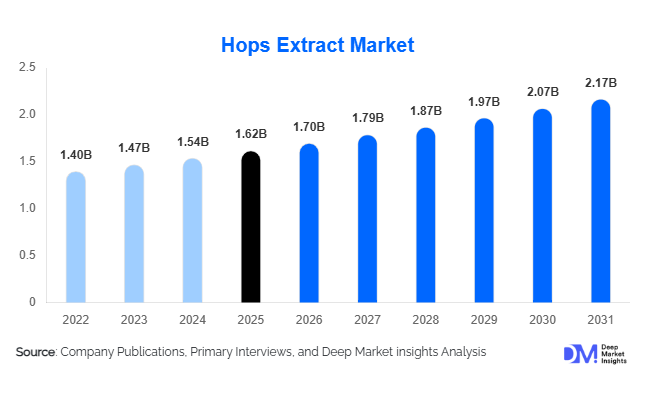
According to Deep Market Insights, the global hops extract market size was valued at USD 1.62 billion in 2025 and is projected to grow from USD 1.70 billion in 2026 to reach USD 2.17 billion by 2031, expanding at a CAGR of 5.0% during the forecast period (2026–2031). The hops extract market growth is primarily driven by the increasing demand for premium and craft beer, rising adoption of natural flavoring ingredients in food and beverages, expanding utilization of hop-derived bioactive compounds in nutraceuticals and pharmaceuticals, and continuous advancements in extraction technologies that improve product consistency, purity, and shelf life.
Key Market Insights
- CO₂ hop extracts continue to dominate the market, owing to their superior purity, standardized alpha-acid concentration, solvent-free processing, and widespread adoption among commercial breweries.
- The brewing industry remains the largest end-use sector, accounting for the majority of global consumption as breweries increasingly prefer concentrated hop extracts for flavor consistency, production efficiency, and longer product stability.
- Europe dominates the global market, supported by extensive hop cultivation, advanced extraction infrastructure, and the presence of established brewing industries across Germany, the Czech Republic, Poland, and the United Kingdom.
- Asia-Pacific represents the fastest-growing regional market, driven by increasing beer production, rapid expansion of craft breweries, rising disposable income, and growing consumption of premium alcoholic beverages.
- Pharmaceutical and nutraceutical applications are emerging as significant growth areas, supported by increasing research into the antioxidant, antimicrobial, and calming properties of hop-derived bioactive compounds.
- Technological advancements in supercritical CO₂ extraction, process automation, and quality monitoring systems are improving extraction efficiency, reducing solvent usage, and enabling manufacturers to deliver highly standardized products for multiple industrial applications.
Hops Extract Market Latest Trends
Advanced CO₂ Extraction Technologies Becoming Industry Standard
Manufacturers are increasingly investing in supercritical CO₂ extraction systems to improve extraction efficiency, product consistency, and environmental sustainability. These systems deliver higher alpha-acid recovery while eliminating solvent residues, making them highly suitable for premium brewing applications. Automation technologies, digital process monitoring, and AI-assisted quality control are also being integrated into extraction facilities to improve operational efficiency and reduce production costs. As breweries demand consistent bitterness, aroma profiles, and longer shelf life, technologically advanced hop extraction methods are becoming the preferred manufacturing approach across global production facilities.
Expanding Applications Beyond Brewing
Although brewing remains the primary application, hop extracts are increasingly being incorporated into functional beverages, dietary supplements, cosmetics, and pharmaceutical formulations. Manufacturers are introducing standardized botanical ingredients containing naturally occurring flavonoids, polyphenols, and bitter acids for health-oriented applications. Growing consumer preference for clean-label ingredients and plant-based formulations is encouraging food manufacturers to incorporate hop extracts into specialty beverages, functional foods, and preservative systems. These expanding applications are diversifying revenue opportunities beyond traditional brewery demand.
Hops Extract Market Drivers
Rapid Expansion of Premium and Craft Brewing
The continuous expansion of premium beer consumption and craft brewing worldwide remains the primary growth driver for the hops extract industry. Breweries increasingly prefer concentrated hop extracts because they provide consistent bitterness, enhanced aroma retention, simplified storage, and improved brewing efficiency compared to whole hops. Growing consumer demand for premium beer varieties, specialty ales, IPAs, and flavored beverages continues encouraging breweries to invest in high-quality hop extract formulations. Increasing investments in brewery modernization and automated brewing systems further strengthen long-term market expansion.
Growing Preference for Natural Food Ingredients
Consumers are increasingly shifting toward naturally sourced ingredients across food, beverage, and nutraceutical industries. Hop extracts offer antioxidant, antimicrobial, and flavor-enhancing properties that align well with clean-label product development strategies. Food manufacturers are increasingly replacing synthetic additives with botanical ingredients, while pharmaceutical companies continue exploring hop-derived compounds for stress management, sleep support, and wellness formulations. These evolving consumer preferences continue supporting sustained market expansion.
Hops Extract Market Restraints
Climate Variability Affecting Hop Cultivation
Hop cultivation remains highly dependent on favorable climatic conditions, making raw material availability vulnerable to changing weather patterns, droughts, excessive rainfall, and rising temperatures. Seasonal production fluctuations frequently impact hop quality, alpha-acid concentration, and overall crop yield. These agricultural uncertainties contribute to raw material price volatility, supply chain disruptions, and procurement challenges for extract manufacturers, particularly those dependent on premium hop varieties sourced from limited cultivation regions.
High Processing and Capital Investment Requirements
Modern extraction technologies require significant investments in specialized processing equipment, quality assurance systems, and regulatory compliance. Supercritical CO₂ extraction facilities involve considerably higher capital expenditure than conventional extraction methods, creating barriers for small and medium-sized manufacturers. In addition, strict quality certification requirements across food, pharmaceutical, and brewing industries increase operational costs throughout the value chain.
Hops Extract Industry Key Opportunities
Expansion of Pharmaceutical and Nutraceutical Applications
Growing scientific interest in hop-derived bioactive compounds is creating substantial opportunities beyond brewing applications. Pharmaceutical manufacturers are increasingly evaluating hop extracts for their antioxidant, anti-inflammatory, antimicrobial, and mild sedative properties. Simultaneously, nutraceutical companies are incorporating standardized hop ingredients into dietary supplements targeting sleep support, stress management, and women's health. Continued clinical research and increasing consumer acceptance of botanical wellness products are expected to accelerate commercial adoption over the coming years.
Increasing Demand from Emerging Brewing Markets
Rapid urbanization, rising disposable income, and changing consumer lifestyles across Asia-Pacific, Latin America, and parts of the Middle East are encouraging premium beer consumption. International brewing companies continue expanding manufacturing facilities across these regions while local craft breweries rapidly increase production capacity. This geographic expansion creates significant opportunities for hop extract manufacturers to establish regional supply chains and long-term commercial partnerships with expanding breweries.
Report Scope
| Report Metric | Details |
|---|---|
| Market Size in 2025 | USD 1.62 Billion |
| Market Size in 2026 | USD 1.70 Billion |
| Market Size in 2031 | USD 2.17 Billion |
| CAGR | 5% (2026-2031) |
| Base Year for Estimation | 2025 |
| Historical Data | 2022-2024 |
| Forecast Period | 2026-2031 |
| Report Coverage | Revenue Forecast, Competitive Landscape, Supply Chain Disruption, Growth Factors, Environment & Regulatory Landscape and Trends |
| Geographies Covered | North America, Europe, APAC, Middle East and Africa, LATAM |
| Countries Covered | U.S., Canada, U.K., Germany, France, Spain, Italy, Russia, Nordic, Benelux, Rest of Europe, China, Korea, Japan, India, Australia, Singapore, Taiwan, South East Asia, Rest of Asia-Pacific, UAE, Turky, Saudi Arabia, South Africa, Egypt, Nigeria, Rest of MEA, Brazil, Mexico, Argentina, Chile, Colombia, Rest of LATAM |
Explore more data points, trends and opportunities Download Free Sample Report
Type Insights
CO₂ extracts represent the largest segment of the global hop extracts market, driven by their exceptional purity, solvent-free production process, standardized alpha-acid content, and superior shelf stability. As breweries increasingly focus on maintaining consistent beer quality across large-scale production, CO₂ hop extracts have become the preferred choice due to their ability to deliver precise bitterness, aroma, and flavor characteristics while minimizing batch-to-batch variation. Their high utilization efficiency, reduced storage requirements, lower transportation costs, and improved oxidation resistance further strengthen their adoption among multinational brewing companies. In addition, the growing emphasis on sustainable and environmentally friendly extraction technologies has accelerated the use of supercritical CO₂ extraction, which eliminates solvent residues while preserving delicate hop compounds. Continuous investments in advanced extraction technologies, coupled with increasing production of premium and craft beers worldwide, continue to reinforce the leadership of the CO₂ extracts segment.Isomerized hop extracts are experiencing steady growth as commercial breweries increasingly prioritize brewing efficiency, product consistency, and enhanced beer stability. These extracts offer improved bitterness utilization, superior light stability, enhanced foam retention, and greater process control compared to conventional hop products. Their ability to reduce brewing losses while extending product shelf life makes them particularly attractive for high-volume brewing operations. Growing consumer demand for premium beer varieties, together with technological advancements in brewing processes and increasing automation across breweries, is expected to further accelerate demand for isomerized hop extracts during the forecast period.
Application Insights
Beer and brewing applications account for the largest share of the global hop extracts market as breweries increasingly rely on concentrated hop products to achieve consistent flavor profiles, controlled bitterness, improved aroma stability, and higher production efficiency. The growing global consumption of premium, craft, and specialty beers has significantly increased the demand for standardized hop extracts that simplify dosing, reduce storage and transportation costs, minimize raw material waste, and improve overall brewing economics. Large commercial breweries also benefit from improved process automation, enhanced product consistency across multiple production facilities, and greater flexibility in recipe formulation. Continuous innovation in brewing technologies and rising investments in premium beer production further reinforce the dominance of this application segment.Food and beverage manufacturers are steadily increasing the incorporation of hop extracts into specialty beverages, functional drinks, confectionery products, flavor systems, natural preservatives, and nutritional formulations. Growing consumer awareness regarding natural ingredients, clean-label formulations, and reduced synthetic additives is encouraging manufacturers to utilize hop-derived compounds for both flavor enhancement and preservation. The expansion of functional foods, botanical beverages, alcohol-free drinks, and wellness-oriented product categories continues to create new opportunities for hop extract suppliers, particularly as food manufacturers seek ingredients that provide both functional and sensory benefits.
Explore more data points, trends and opportunities Download Free Sample Report
Hops Extract Market Segmentations
By Type
- CO₂ Extract
- Ethanol Extract
- Isomerized Hop Extract
- Other Hop Extracts
By Application
- Beer & Brewing
- Food & Beverages
- Pharmaceuticals
- Nutraceuticals & Dietary Supplements
- Cosmetics & Personal Care
By Distribution Channel
- Direct Sales
- Distributors & Wholesalers
- Online B2B Platforms
- Specialty Ingredient Suppliers
- Retail & E-commerce
Regional Insights
Europe
Europe remains the dominant regional market for hop extracts, supported by its centuries-old brewing heritage, extensive hop cultivation, advanced extraction infrastructure, and the presence of numerous globally recognized brewing and ingredient manufacturers. Germany, the Czech Republic, Poland, and the United Kingdom collectively account for a significant share of regional hop production and processing capacity, ensuring a stable supply of premium-quality raw materials. The region also benefits from continuous investments in sustainable hop farming, precision agriculture, advanced CO₂ extraction technologies, and brewing innovation. Strong export capabilities, stringent quality standards, growing production of premium and craft beers, and increasing demand for high-value botanical ingredients continue to reinforce Europe's market leadership. Additionally, supportive agricultural policies, established supply chains, rising adoption of environmentally sustainable extraction processes, and continuous product innovation by leading breweries and ingredient suppliers are driving long-term regional growth.
North America
North America represents one of the largest consumption markets for hop extracts, primarily driven by its rapidly expanding craft brewing industry, strong premium beer culture, and high consumer demand for innovative beverage products. The United States dominates regional production and consumption through its extensive network of commercial and independent breweries, while Canada continues to invest in specialty brewing, botanical ingredient manufacturing, and functional food innovation. Increasing consumer preference for premium alcoholic beverages, flavored beers, alcohol-free beer alternatives, and naturally derived ingredients has significantly increased demand for standardized hop extracts. Growth is further supported by continuous investments in brewing automation, expansion of domestic hop cultivation, technological advancements in extraction processes, rising demand for nutraceutical ingredients, and increasing research into the health-promoting properties of hop-derived compounds, creating substantial opportunities across both brewing and non-brewing applications.
Asia-Pacific
Asia-Pacific is projected to register the fastest growth throughout the forecast period, fueled by rapid urbanization, rising disposable incomes, expanding middle-class populations, and evolving consumer preferences toward premium alcoholic beverages. China, Japan, Australia, India, and South Korea are witnessing strong growth in craft breweries, premium beer consumption, and modern food processing industries, significantly increasing demand for high-quality hop extracts. Expanding hospitality sectors, changing lifestyles, and growing Western influence on beverage consumption continue to support market expansion across the region. Increasing investments by international breweries, improving domestic brewing capabilities, favorable government initiatives supporting food processing industries, rising adoption of botanical ingredients in functional foods and dietary supplements, and continuous expansion of beverage manufacturing infrastructure are creating significant long-term growth opportunities for regional and international hop extract manufacturers.
Latin America
Latin America is steadily emerging as an attractive growth market, supported by increasing brewery investments across Brazil, Mexico, Argentina, and Chile, along with rising consumer preference for premium and craft beer products. Breweries throughout the region are increasingly adopting concentrated hop extracts to improve production efficiency, optimize brewing consistency, reduce ingredient losses, and enhance product quality. Growing disposable incomes, expanding urban populations, and increasing tourism activities are contributing to higher beer consumption across several countries. In addition, expanding food processing industries, rising demand for natural flavoring ingredients, increasing awareness of botanical extracts, and growing investments by international beverage manufacturers are strengthening regional demand. Continuous modernization of brewing facilities and improving distribution networks are expected to further accelerate market growth during the forecast period.
Middle East & Africa
The Middle East & Africa market is gradually expanding, supported by increasing investments in food processing, premium beverage manufacturing, and the import of high-quality botanical ingredients. South Africa remains the largest regional market due to its relatively mature brewing industry and established food manufacturing sector, while the United Arab Emirates, Saudi Arabia, and other Gulf countries continue investing in advanced food and beverage production facilities to meet growing domestic demand. Rising urbanization, improving disposable incomes, expanding hospitality and tourism industries, and increasing consumption of non-alcoholic malt beverages are encouraging manufacturers to adopt premium flavoring ingredients, including hop extracts. Furthermore, growing interest in functional foods, natural preservatives, herbal supplements, and clean-label formulations, together with ongoing industrial diversification and foreign investments in food manufacturing, is expected to create sustained long-term growth opportunities for hop extract suppliers across the region.
Key Players in the Hops Extract Market
- Hopsteiner
- BarthHaas GmbH & Co. KG
- Yakima Chief Hops
- John I. Haas Inc.
- HVG Hopfenverwertungsgenossenschaft e.G.
- Kalsec Inc.
- Naturex
- Hops Products Australia
- Totally Natural Solutions
- Charles Faram & Co. Ltd.