Oat Flour Market Size
According to Deep Market Insights, the global oat flour market size was valued at USD 1.92 billion in 2025 and is projected to grow from USD 2.09 billion in 2026 to reach USD 3.24 billion by 2031, expanding at a CAGR of 9.1% during the forecast period (2026–2031). The oat flour market growth is primarily driven by increasing consumer preference for healthy whole-grain foods, expanding demand for gluten-free bakery products, rising adoption of clean-label ingredients, and growing utilization of oat flour across functional foods, plant-based beverages, and nutritional products.
Key Market Insights
- Demand for clean-label and minimally processed ingredients continues to strengthen, encouraging food manufacturers to expand oat flour utilization across bakery, snacks, cereals, and functional food applications.
- Gluten-free oat flour is witnessing rapid adoption, supported by increasing consumer awareness regarding digestive health, food allergies, and specialty dietary requirements.
- North America dominates the global market, accounting for nearly 36.8% of total revenue due to strong oat cultivation, advanced milling infrastructure, and high consumption of healthy packaged foods.
- Asia-Pacific is projected to remain the fastest-growing regional market, driven by expanding bakery production, urbanization, increasing disposable income, and rising demand for premium nutritional foods.
- Conventional oat flour remains the leading product category, representing approximately 56.4% of overall revenue owing to its broad commercial availability and competitive pricing.
- Automation in milling technologies, dedicated gluten-free processing facilities, and premium product innovation are improving production efficiency while supporting new product launches across global food industries.
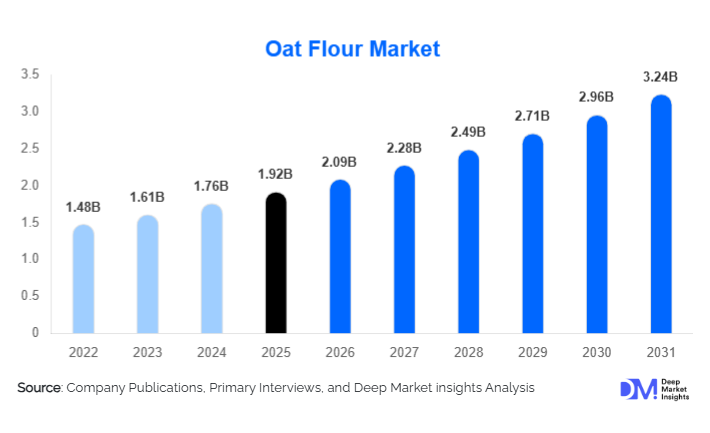
Oat Flour Market Latest Trends
Growing Adoption of Functional and Clean-Label Ingredients
Food manufacturers are increasingly incorporating oat flour into bakery products, breakfast cereals, nutrition bars, dairy alternatives, infant nutrition, and healthy snacks as consumers seek fiber-rich and minimally processed ingredients. Global oat flour production exceeded 1.78 million metric tons during 2025, while more than 63% of newly introduced healthy bakery products incorporated whole-grain ingredients. The increasing popularity of beta-glucan-rich foods, coupled with growing demand for digestive wellness and heart health products, continues to accelerate product innovation across retail and foodservice industries. Manufacturers are also expanding organic product portfolios to satisfy premium consumer demand.
Expansion of Gluten-Free and Plant-Based Food Manufacturing
Certified gluten-free oat flour is gaining strong momentum across food processing industries as consumers increasingly adopt gluten-free lifestyles. Certified gluten-free production exceeded 520 thousand metric tons in 2025, while procurement of oat-based ingredients by plant-based food manufacturers increased by nearly 22%. Modern precision milling technologies, improved contamination control systems, and dedicated production facilities are significantly improving manufacturing efficiency and product consistency. Rising demand for oat-based beverages, protein-enriched foods, and clean-label nutritional products continues to reinforce long-term market expansion.
Oat Flour Market Drivers
Increasing Consumer Preference for Healthy Whole-Grain Foods
Growing consumer awareness regarding digestive health, cholesterol reduction, and balanced nutrition continues to support global oat flour consumption. Nearly 71% of consumers actively prefer healthier grain alternatives, while functional food sales continue expanding at double-digit growth across major economies. Global bakery production surpassed 190 million metric tons, creating substantial opportunities for oat flour incorporation into breads, muffins, cookies, pancakes, and premium baked products. Continuous investments in healthy packaged foods, whole-grain product innovation, and nutritional labeling further strengthen long-term market expansion.
Rapid Expansion of Gluten-Free Food Consumption
The increasing prevalence of gluten intolerance, celiac disease awareness, and consumer preference for specialty diets has significantly accelerated gluten-free food production worldwide. Food manufacturers are investing in certified processing facilities, dedicated milling infrastructure, and premium oat ingredient development to meet rising demand. Expansion of gluten-free retail shelves, specialty supermarkets, and online grocery platforms continues creating new revenue opportunities across developed and emerging economies.
Oat Flour Market Restraints
Volatility in Raw Oat Prices and Agricultural Production
Fluctuating agricultural yields, unpredictable weather conditions, and changing commodity prices remain significant challenges for oat flour manufacturers. Annual oat harvest volumes fluctuate by nearly 8%–12%, while transportation and logistics costs have increased considerably in recent years. These factors directly influence production costs and pricing strategies, particularly for premium organic and certified gluten-free oat flour products. Limited certified processing infrastructure in several developing countries further restricts supply availability and market penetration.
Limited Availability of Certified Gluten-Free Processing Facilities
Cross-contamination risks throughout harvesting, storage, transportation, and milling require manufacturers to invest heavily in dedicated production facilities. Certified gluten-free processing capacity remains relatively limited compared to conventional milling infrastructure, increasing operational expenses and restricting production scalability. Compliance with stringent food safety standards also adds additional testing and certification costs for manufacturers serving premium food markets.
Oat Flour Industry Key Opportunities
Growing Functional Nutrition and Sports Food Industry
The rapid expansion of functional nutrition, meal replacement products, protein-enriched bakery items, and healthy snacks presents significant opportunities for oat flour manufacturers. Consumers increasingly prefer ingredients rich in dietary fiber, vitamins, and beta-glucans, encouraging manufacturers to launch innovative formulations targeting sports nutrition, elderly nutrition, and preventive healthcare. Growing investments in premium food manufacturing and expanding retail distribution networks are expected to accelerate future market development.
Expansion of Organic and Premium Food Categories
Organic food consumption continues rising globally, creating favorable conditions for premium oat flour manufacturers. Increasing investments in sustainable oat farming, environmentally friendly processing technologies, and traceable supply chains are supporting product differentiation. Premium positioning through organic certification, clean-label formulations, and specialty nutritional claims is expected to generate higher profit margins while attracting health-conscious consumers worldwide.
Report Scope
| Report Metric | Details |
|---|---|
| Market Size in 2025 | USD 1.92 Billion |
| Market Size in 2026 | USD 2.09 Billion |
| Market Size in 2031 | USD 3.24 Billion |
| CAGR | 9.1% (2026-2031) |
| Base Year for Estimation | 2025 |
| Historical Data | 2022-2024 |
| Forecast Period | 2026-2031 |
| Report Coverage | Revenue Forecast, Competitive Landscape, Supply Chain Disruption, Growth Factors, Environment & Regulatory Landscape and Trends |
| Geographies Covered | North America, Europe, APAC, Middle East and Africa, LATAM |
| Countries Covered | U.S., Canada, U.K., Germany, France, Spain, Italy, Russia, Nordic, Benelux, Rest of Europe, China, Korea, Japan, India, Australia, Singapore, Taiwan, South East Asia, Rest of Asia-Pacific, UAE, Turky, Saudi Arabia, South Africa, Egypt, Nigeria, Rest of MEA, Brazil, Mexico, Argentina, Chile, Colombia, Rest of LATAM |
Explore more data points, trends and opportunities Download Free Sample Report
Type Insights
Conventional oat flour accounted for approximately 56.4% of the global oat flour market share in 2025, making it the leading product segment due to its broad commercial availability, cost-effectiveness, and extensive adoption across industrial food manufacturing. The segment continues to benefit from its widespread use in breads, cookies, cakes, muffins, biscuits, pancakes, breakfast cereals, snack bars, and processed food formulations where manufacturers require consistent quality, high production efficiency, and competitive ingredient costs. Large-scale milling infrastructure, well-established supply chains, and strong availability through both domestic production and international trade further strengthen the leadership of conventional oat flour. Food manufacturers increasingly utilize conventional oat flour to improve fiber content, texture, moisture retention, and nutritional value while maintaining product affordability for mass-market consumers. Meanwhile, organic oat flour continues gaining significant traction among health-conscious consumers seeking pesticide-free, non-GMO, and sustainably sourced ingredients, particularly across premium bakery products, infant nutrition, organic cereals, and natural food applications. Certified organic farming practices, increasing environmental awareness, and rising consumer willingness to pay premium prices continue supporting demand for organic varieties. Gluten-free oat flour represents the fastest-growing product category as manufacturers expand certified gluten-free processing facilities to meet rising demand from consumers with celiac disease, gluten intolerance, and lifestyle-driven gluten-free preferences. Continuous advancements in milling technologies, improved contamination control systems, enhanced product consistency, and investments in premium ingredient development continue driving innovation across every major product category.
Application Insights
Bakery and confectionery remained the largest application segment, accounting for nearly 44.8% of total market demand in 2025, primarily driven by the growing incorporation of oat flour into breads, cakes, cookies, muffins, biscuits, pancakes, pastries, crackers, cereal bars, and healthy snack products. The segment maintains its market leadership as consumers increasingly prefer high-fiber, whole-grain, and clean-label baked goods that offer improved nutritional value without compromising taste or texture. Oat flour enhances moisture retention, softness, binding properties, and shelf life, making it an attractive ingredient for commercial bakeries and food manufacturers. The rapid expansion of gluten-free bakery products, functional baked foods, and premium artisanal bakery offerings continues further strengthening segment growth. Food and beverage applications are also expanding steadily through increasing utilization in breakfast cereals, oat beverages, smoothies, soups, dairy alternatives, nutritional supplements, protein blends, meal replacement products, and functional beverages as manufacturers respond to rising consumer demand for convenient and nutritious foods. Animal feed represents a stable application segment where oat flour improves nutritional value, digestibility, and energy content in livestock feed and premium pet food formulations. Continuous innovation in healthy convenience foods, plant-based nutrition, and functional ingredient applications continues creating new opportunities across every major application segment.
Distribution Channel Insights
Supermarkets and hypermarkets continue to dominate the global oat flour market by generating the largest share of overall sales due to their extensive product assortment, strong retail penetration, competitive pricing strategies, and convenient consumer accessibility. The segment benefits from increasing shelf space dedicated to healthy food products, private-label offerings, premium organic varieties, and gluten-free product ranges, enabling consumers to compare multiple brands under one retail platform. Strong promotional activities, expanding organized retail networks, and rising consumer preference for one-stop grocery shopping continue reinforcing the leadership of supermarkets and hypermarkets. Specialty health food stores continue strengthening their position by offering premium organic, certified gluten-free, and clean-label oat flour products targeted toward health-conscious consumers. Online retail platforms represent the fastest-growing distribution channel as digital grocery shopping, direct-to-consumer sales, subscription-based purchasing models, and e-commerce penetration continue expanding globally. Foodservice distributors and industrial ingredient suppliers also remain essential channels, supplying commercial bakeries, restaurants, cafés, hotels, institutional kitchens, and food processing companies with large-volume oat flour requirements supported by long-term procurement agreements and efficient supply chain networks.
End User Insights
Commercial food manufacturers accounted for the largest share of the global oat flour market as the food processing industry continues incorporating oat flour into bakery products, breakfast cereals, snacks, dairy alternatives, nutritional supplements, infant foods, ready-to-eat meals, and functional food formulations. The leadership of this segment is supported by rising consumer demand for healthier packaged foods, clean-label ingredients, whole-grain nutrition, and fiber-rich formulations, encouraging manufacturers to expand oat-based product portfolios across multiple food categories. Large-scale production capabilities, continuous product innovation, and growing investments in healthier food formulations continue supporting commercial demand. Household consumers are also increasing retail purchases as home baking, healthy cooking, plant-based diets, and gluten-free lifestyles become increasingly popular worldwide. Restaurants, cafés, artisan bakeries, hotels, catering companies, and institutional foodservice providers are expanding oat flour utilization to satisfy growing consumer demand for nutritious menu offerings, premium bakery products, and whole-grain recipes while diversifying healthier menu selections across both quick-service and full-service dining establishments.
Explore more data points, trends and opportunities Download Free Sample Report
Oat Flour Market Segmentations
By Type
- Organic Oat Flour
- Conventional Oat Flour
- Gluten-Free Oat Flour
By Application
- Bakery & Confectionery
- Food & Beverages
- Animal Feed
By Distribution Channel
- Supermarkets & Hypermarkets
- Specialty Stores
- Online Retail
- Convenience Stores
- Foodservice & Industrial Sales
Regional Insights
North America
North America accounted for approximately 36.8% of the global oat flour market revenue in 2025 and remained the largest regional market throughout the year. The United States contributes nearly 78% of regional demand, supported by large-scale oat cultivation, advanced milling infrastructure, highly developed food processing industries, and strong consumer awareness regarding healthy eating habits. The region benefits from the widespread popularity of gluten-free diets, increasing demand for whole-grain bakery products, high consumption of breakfast cereals, growing adoption of plant-based foods, and continuous innovation in functional food ingredients. Rising investments in clean-label food manufacturing, strong retail penetration, favorable distribution networks, and increasing demand for organic and high-fiber food products continue driving regional market expansion. Canada further strengthens regional growth as one of the world's largest oat-producing countries, providing a reliable supply of high-quality oats for domestic processing while supporting significant exports to international food manufacturers.
Europe
Europe represented approximately 30.4% of the global oat flour market revenue, led by Germany, the United Kingdom, France, Finland, and Sweden. Regional growth is driven by strong consumer preference for organic foods, sustainable agriculture, clean-label ingredients, and whole-grain nutrition, alongside increasing awareness regarding digestive health and preventive healthcare. High adoption of plant-based diets, expanding vegan and vegetarian populations, and growing demand for functional bakery products continue accelerating oat flour consumption across both retail and foodservice sectors. Europe also benefits from advanced food processing capabilities, stringent food quality regulations, well-established organic certification systems, and continuous investments in premium bakery, dairy alternatives, infant nutrition, and functional food manufacturing. Increasing research and product innovation focused on healthier food formulations continue supporting long-term market growth across the region.
Asia-Pacific
Asia-Pacific is projected to register the fastest growth throughout the forecast period, supported by rapidly expanding food processing industries across China, India, Japan, South Korea, and Australia. Regional expansion is primarily driven by rising disposable incomes, rapid urbanization, changing dietary preferences, growing health consciousness, and increasing consumption of bakery products, breakfast cereals, and convenient packaged foods. Expanding middle-class populations, greater awareness of whole-grain nutrition, and increasing prevalence of lifestyle-related health concerns are encouraging consumers to adopt healthier food alternatives, including oat-based products. The rapid development of modern retail infrastructure, expanding e-commerce platforms, rising investments by international food manufacturers, and increasing demand for premium nutritional foods, functional beverages, dairy alternatives, and plant-based products continue creating substantial opportunities for oat flour manufacturers across major metropolitan markets.
Latin America
Latin America continues experiencing steady market expansion led by Brazil, Mexico, Argentina, and Chile. Regional growth is supported by rising health awareness, increasing consumption of nutritious packaged foods, expanding bakery industries, and growing demand for fiber-rich and functional food ingredients. Improving disposable incomes, changing dietary habits, and increasing consumer preference for healthier breakfast products and baked goods are contributing to higher oat flour consumption across the region. Investments in local food manufacturing, modernization of retail infrastructure, expansion of supermarket chains, and greater availability of imported and locally processed oat-based products are further strengthening regional demand. The growing presence of multinational food companies and continuous product innovation are expected to support sustained market growth during the forecast period.
Middle East & Africa
The Middle East & Africa oat flour market is gradually expanding as consumers increasingly adopt healthier dietary habits and premium packaged food products. Countries including the United Arab Emirates, Saudi Arabia, and South Africa are witnessing rising demand for imported oat flour products supported by expanding modern retail networks, premium bakery development, and increasing awareness regarding whole-grain nutrition and functional foods. Regional growth is further driven by rising disposable incomes, rapid urbanization, growing expatriate populations, increasing investments in organized food retail, and expanding hospitality and foodservice industries. The growing availability of gluten-free products, healthier bakery offerings, and premium breakfast foods, together with continuous improvements in food distribution infrastructure and consumer awareness regarding balanced nutrition, are expected to accelerate long-term market development across the region.
Key Players in the Oat Flour Market
- Grain Millers Inc.
- Richardson International Limited
- Morning Foods Ltd.
- Avena Foods Limited
- Bob's Red Mill Natural Foods
- Quaker Oats Company
- Ardent Mills LLC
- General Mills Inc.
- Blue Lake Milling Pty Ltd.
- Finnamyl Oy
- Swany White Flour Mills
- Nature's Path Foods
- The Hain Celestial Group
- Shipton Mill Ltd.
- Hodgson Mill Inc.