Iodized Salt Market Size
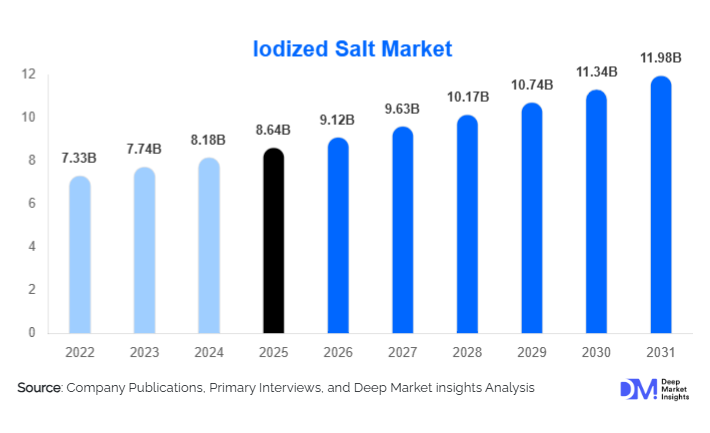
According to Deep Market Insights, the global iodized salt market size was valued at USD 8.64 billion in 2025 and is projected to grow from USD 9.12 billion in 2026 to reach USD 11.98 billion by 2031, expanding at a CAGR of 5.6% during the forecast period (2026–2031). The iodized salt market growth is primarily driven by expanding universal salt iodization programs, increasing public health awareness regarding iodine deficiency disorders, rising consumption of fortified food products, and growing demand from the global food processing industry.
Key Market Insights
- Universal salt iodization programs continue to strengthen global adoption, with more than 120 countries implementing mandatory or voluntary iodine fortification policies.
- Refined iodized salt remains the dominant product category, supported by high purity standards, improved iodine stability, and increasing retail distribution.
- Asia-Pacific dominates the global market owing to large-scale production capacity, supportive government nutrition initiatives, and high household consumption.
- Africa is projected to be the fastest-growing regional market, driven by expanding public health programs and improving access to fortified food products.
- Food processing manufacturers are increasingly adopting iodized salt to comply with nutritional regulations and meet consumer demand for fortified packaged foods.
- Modern production technologies, including automated iodization systems, precision dosing equipment, and improved moisture-resistant packaging, are enhancing product quality and iodine retention.
Iodized Salt Market Latest Trends
Expansion of Universal Salt Iodization Programs
Governments and public health organizations continue expanding universal salt iodization initiatives to reduce iodine deficiency disorders worldwide. National fortification policies are encouraging higher production of food-grade iodized salt while improving product quality through standardized iodine levels and stronger regulatory monitoring. Manufacturers are investing in automated iodization equipment, digital quality monitoring systems, and advanced packaging technologies that improve iodine stability throughout distribution. Growing collaboration between governments, healthcare organizations, and salt producers is strengthening global fortification coverage and supporting long-term market expansion.
Increasing Adoption Across Food Processing Industries
Food manufacturers are increasingly incorporating iodized salt into bakery products, dairy products, processed meat, ready-to-eat meals, snacks, and convenience foods to comply with food safety regulations and nutritional labeling requirements. Automated dosing technologies are improving production efficiency while ensuring consistent iodine concentration across large production batches. Rising demand for fortified packaged foods, coupled with increasing consumer awareness regarding preventive nutrition, continues to encourage food processors to adopt premium iodized salt formulations with enhanced quality assurance and longer shelf stability.
Iodized Salt Market Drivers
Growing Government Support for Food Fortification
Government-led nutrition initiatives remain the strongest driver for the iodized salt market. Mandatory iodization regulations, expanding healthcare awareness campaigns, and continuous monitoring of iodine deficiency have significantly increased global consumption of fortified edible salt. Public health agencies continue promoting iodized salt as a cost-effective nutritional intervention, while manufacturers are expanding production capacity to meet growing domestic and export demand. The increasing focus on preventive healthcare and nutritional security is expected to sustain long-term market growth.
Rising Demand from Processed Food Manufacturing
The continuous expansion of the processed food industry is creating sustained demand for iodized salt as an essential food ingredient. Manufacturers of bakery products, dairy foods, snacks, canned foods, frozen meals, and seasonings increasingly utilize iodized salt to improve nutritional value while complying with national food fortification standards. Rising urbanization, changing dietary habits, and growing consumption of packaged foods are further supporting demand across commercial food production facilities worldwide.
Iodized Salt Market Restraints
Quality Control and Iodine Stability Challenges
Maintaining consistent iodine concentration throughout storage, transportation, and retail distribution remains a significant challenge for manufacturers. Exposure to moisture, excessive heat, and improper packaging can reduce iodine content before consumption. In addition, variations in raw salt quality, limited quality-control infrastructure in developing countries, and increasing logistics costs create operational challenges for producers while affecting product consistency across regional markets.
Competition from Alternative Mineral Salts
The growing popularity of specialty salts, including Himalayan pink salt, sea salt, gourmet salts, and organic mineral salts, presents increasing competition for conventional iodized salt manufacturers. Although many premium salts naturally contain trace minerals, several products lack sufficient iodine fortification, creating nutritional concerns while influencing consumer purchasing preferences toward premium alternatives marketed as natural and minimally processed.
Iodized Salt Industry Key Opportunities
Expansion Across Emerging Economies
Emerging economies continue offering substantial opportunities as governments strengthen food fortification programs and improve healthcare infrastructure. Rising disposable income, increasing packaged food consumption, expanding retail networks, and growing awareness regarding micronutrient deficiencies are encouraging manufacturers to increase production capacity while expanding distribution into rural and underserved markets. International partnerships between governments and private salt producers are expected to accelerate market penetration across developing regions.
Development of Premium Fortified Salt Products
Manufacturers are increasingly introducing value-added iodized salt products containing additional minerals such as iron, zinc, calcium, and selenium to address multiple micronutrient deficiencies. Premium packaging, improved iodine retention technologies, clean-label formulations, and health-focused branding are creating new revenue opportunities across retail, healthcare, and institutional food service sectors. Continued innovation within functional food ingredients is expected to support premium market expansion throughout the forecast period.
Report Scope
| Report Metric | Details |
|---|---|
| Market Size in 2025 | USD 8.64 Billion |
| Market Size in 2026 | USD 9.12 Billion |
| Market Size in 2031 | USD 11.98 Billion |
| CAGR | 5.6% (2026-2031) |
| Base Year for Estimation | 2025 |
| Historical Data | 2022-2024 |
| Forecast Period | 2026-2031 |
| Report Coverage | Revenue Forecast, Competitive Landscape, Supply Chain Disruption, Growth Factors, Environment & Regulatory Landscape and Trends |
| Geographies Covered | North America, Europe, APAC, Middle East and Africa, LATAM |
| Countries Covered | U.S., Canada, U.K., Germany, France, Spain, Italy, Russia, Nordic, Benelux, Rest of Europe, China, Korea, Japan, India, Australia, Singapore, Taiwan, South East Asia, Rest of Asia-Pacific, UAE, Turky, Saudi Arabia, South Africa, Egypt, Nigeria, Rest of MEA, Brazil, Mexico, Argentina, Chile, Colombia, Rest of LATAM |
Explore more data points, trends and opportunities Download Free Sample Report
Type Insights
Refined iodized salt dominates the market due to its superior purity, consistent granule size, excellent iodine stability, and widespread adoption across households and commercial food manufacturing. The segment benefits from advanced refining technologies, automated iodization systems, and strict regulatory compliance that ensure standardized iodine concentration and longer shelf life. Coarse iodized salt continues to maintain stable demand in institutional kitchens, traditional food preparation, and food preservation applications where larger crystal size remains preferred. Specialty iodized salt, including premium sea salt and mineral-enriched variants, represents the fastest-growing segment as health-conscious consumers increasingly seek value-added products offering enhanced nutritional benefits alongside iodine fortification.
Application Insights
Household consumption remains the largest application segment, supported by mandatory iodization regulations, increasing nutrition awareness, and widespread retail availability across both developed and developing economies. Food processing represents the fastest-growing application as manufacturers incorporate iodized salt into bakery products, dairy products, snacks, sauces, processed meat, frozen foods, and ready-to-eat meals to satisfy nutritional labeling requirements. Industrial applications continue generating steady demand through pharmaceutical manufacturing, animal nutrition, specialty chemical production, and selected industrial processing operations where controlled iodine concentration is required for specialized formulations.
Distribution Channel Insights
Supermarkets and hypermarkets remain the leading distribution channels owing to their extensive product availability, competitive pricing, and strong consumer trust. Convenience stores continue supporting daily household purchases, particularly in urban markets. Online retail platforms are experiencing rapid growth as consumers increasingly purchase packaged food essentials through e-commerce channels offering subscription deliveries, promotional pricing, and wider product selections. Wholesale distributors continue serving institutional buyers, food manufacturers, restaurants, hospitals, and government nutrition programs through long-term procurement contracts.
End User Insights
Residential consumers account for the largest share of iodized salt consumption due to routine household cooking and mandatory public health recommendations supporting iodine intake. Commercial food manufacturers continue expanding their utilization of iodized salt across multiple processed food categories to improve nutritional value and maintain regulatory compliance. Institutional users, including hospitals, schools, military organizations, and public food distribution programs, represent a stable demand segment as governments continue implementing nationwide nutrition improvement initiatives focused on preventing iodine deficiency disorders.
Explore more data points, trends and opportunities Download Free Sample Report
Iodized Salt Market Segmentations
By Type
- Refined Iodized Salt
- Coarse Iodized Salt
- Specialty Iodized Salt
By Application
- Household Consumption
- Food Processing
- Industrial Use
By Distribution Channel
- Supermarkets & Hypermarkets
- Convenience Stores
- Online Retail
- Wholesale Distributors
- Institutional Sales
Regional Insights
Asia-Pacific
Asia-Pacific dominates the global iodized salt market owing to its extensive salt production capacity, large population base, and strong government support for universal salt iodization. China and India remain the leading producers and consumers, supported by mandatory fortification regulations, expanding food processing industries, and continuous public health awareness campaigns. Growing packaged food production, improving retail penetration, and rising healthcare investments continue strengthening regional market leadership throughout the forecast period.
North America
North America represents a mature market characterized by high consumer awareness, advanced food manufacturing infrastructure, and widespread adoption of fortified food products. The United States accounts for the majority of regional demand, supported by processed food manufacturers, strong retail distribution, and stringent food safety standards. Continuous product innovation and increasing demand for premium fortified ingredients continue supporting stable market expansion across the region.
Europe
Europe maintains a significant share of the global market through established food safety regulations, increasing nutritional awareness, and growing consumption of fortified packaged foods. Germany, France, Italy, and the United Kingdom remain major consumers, while manufacturers continue introducing premium iodized salt formulations with enhanced quality standards. Government-supported nutrition initiatives and expanding functional food production continue driving regional demand.
Latin America
Latin America continues experiencing steady market growth supported by mandatory food fortification regulations, improving healthcare awareness, and increasing packaged food consumption. Brazil and Mexico represent the largest regional markets, while expanding retail infrastructure and rising household incomes continue improving consumer access to fortified edible salt products. Food processing industries throughout the region are also increasing utilization of iodized salt in commercial food production.
Middle East & Africa
The Middle East & Africa region is expected to register the fastest growth throughout the forecast period as governments expand nutrition programs targeting micronutrient deficiencies. Countries including South Africa, Nigeria, Saudi Arabia, and Egypt continue strengthening salt iodization policies while improving healthcare infrastructure and food distribution networks. International development programs, increasing consumer education, and growing domestic salt production capacity are expected to significantly enhance regional market growth.
Key Players in the Iodized Salt Market
- Tata Consumer Products Limited
- Cargill Incorporated
- Compass Minerals International Inc.
- K+S AG
- Morton Salt Inc.
- Mitsui & Co., Ltd.
- Salins Group
- China National Salt Industry Corporation
- Cheetham Salt Limited
- Dominion Salt Limited
- INFOSA
- Akzo Nobel Salt
- Salina Group
- Hindustan Salt Limited
- Nouryon