Nutrition Market Size
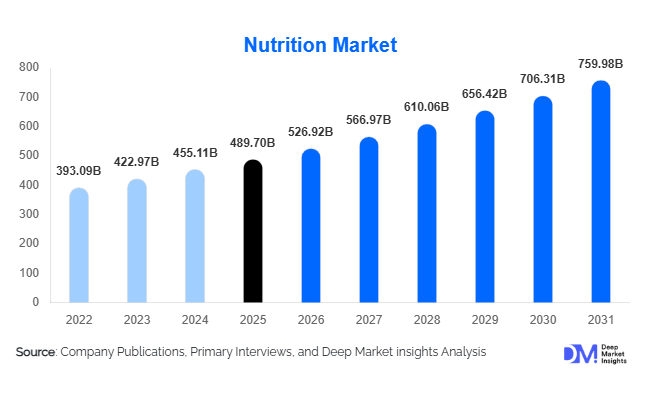
According to Deep Market Insights, the global nutrition market size was valued at USD 489.7 billion in 2025 and is projected to grow from USD 526.92 billion in 2026 to reach USD 759.98 billion by 2031, expanding at a CAGR of 7.6% during the forecast period (2026–2031). The nutrition market growth is primarily driven by rising preventive healthcare awareness, increasing demand for functional foods and dietary supplements, expanding sports and clinical nutrition adoption, and growing consumer preference for personalized wellness solutions.
Key Market Insights
- Functional and preventive nutrition products are increasingly replacing reactive healthcare approaches, with consumers prioritizing immunity, gut health, cognitive wellness, and healthy aging.
- Plant-based and sustainable nutrition products are rapidly expanding globally, driven by environmental concerns, vegan lifestyles, and innovations in alternative protein technologies.
- North America dominates the global nutrition market, supported by high supplement consumption, advanced healthcare infrastructure, and strong wellness spending.
- Asia-Pacific is the fastest-growing region, fueled by urbanization, rising middle-class incomes, and growing healthcare awareness in China, India, and Southeast Asia.
- Personalized nutrition platforms and AI-driven health recommendations are reshaping consumer purchasing behavior and long-term engagement models.
- E-commerce and direct-to-consumer distribution channels are accelerating market accessibility through subscription-based nutrition services and digital wellness ecosystems.
nutrition market latest trends
Personalized Nutrition and Digital Wellness Expansion
The nutrition industry is increasingly moving toward personalized wellness solutions tailored to individual health goals, genetic profiles, microbiome composition, and lifestyle preferences. Companies are integrating artificial intelligence, wearable devices, and health-monitoring applications to create customized supplement recommendations and nutrition plans. Subscription-based personalized nutrition services are gaining significant popularity among urban consumers seeking long-term health optimization. This trend is particularly strong in North America, Europe, Japan, and South Korea, where consumers are willing to pay premium prices for highly targeted health solutions. Advances in nutrigenomics and microbiome science are also encouraging manufacturers to develop precision-based nutritional products with higher efficacy and improved consumer retention rates.
Growing Adoption of Plant-Based and Sustainable Nutrition
Demand for plant-based nutrition products continues to accelerate globally as consumers prioritize sustainability, ethical sourcing, and environmentally friendly dietary habits. Manufacturers are investing heavily in alternative proteins derived from peas, soy, oats, algae, fungi, and fermentation-based technologies. Sustainable packaging, clean-label formulations, and carbon-conscious ingredient sourcing are becoming critical competitive differentiators. Food and beverage companies are increasingly incorporating plant proteins, fibers, probiotics, and botanical extracts into mainstream products to meet evolving consumer expectations. Governments and regulatory bodies are also encouraging sustainable food production and healthier dietary patterns, further strengthening long-term demand for plant-based nutrition solutions.
nutrition market drivers
Rising Prevalence of Lifestyle Diseases
The growing incidence of obesity, diabetes, cardiovascular disorders, gastrointestinal diseases, and immunity-related conditions is significantly driving demand for nutritional supplements and functional foods. Consumers are increasingly adopting preventive healthcare strategies to reduce long-term medical expenses and improve quality of life. Nutritional products focused on immunity support, weight management, digestive health, and heart wellness are witnessing strong global demand. Healthcare professionals are also recommending dietary supplementation and functional nutrition products as complementary solutions for chronic disease management, further supporting market expansion.
Expansion of Sports and Fitness Culture
The rapid growth of gym memberships, athletic participation, wellness lifestyles, and recreational fitness activities is accelerating demand for sports nutrition products worldwide. Protein powders, amino acid supplements, hydration beverages, energy formulations, and recovery nutrition products are increasingly consumed not only by professional athletes but also by mainstream health-conscious consumers. Millennials and Gen Z populations are driving strong demand through fitness-focused lifestyles, social media influence, and increasing awareness regarding muscle recovery and performance optimization. The integration of sports nutrition into everyday wellness routines continues to expand the addressable consumer base globally.
global market restraints
Regulatory Complexity Across Regions
The nutrition industry faces substantial regulatory challenges due to varying standards related to ingredient approvals, labeling requirements, health claims, and product safety regulations across countries. Companies operating internationally must comply with different frameworks established by regulatory authorities in North America, Europe, Asia-Pacific, and the Middle East. Regulatory delays can increase product development costs and restrict speed-to-market for innovative formulations. Clinical validation requirements and stricter scrutiny regarding product efficacy claims also create operational challenges for both emerging and established nutrition companies.
Volatility in Raw Material Prices
Fluctuating prices of proteins, vitamins, botanical extracts, omega oils, probiotics, and specialty nutritional ingredients continue to impact industry profitability. Agricultural disruptions, geopolitical tensions, climate-related supply shortages, and logistics cost inflation significantly influence procurement expenses. Manufacturers are increasingly investing in diversified sourcing strategies and regional supply chain networks to reduce dependency on limited suppliers. However, sustained volatility in raw material costs remains a major challenge, particularly for companies competing in price-sensitive product categories such as mass-market supplements and functional foods.
nutrition industry key opportunities
Growth of Clinical and Medical Nutrition
The rising global aging population and increasing prevalence of chronic diseases are creating strong opportunities within clinical and medical nutrition. Hospitals, rehabilitation centers, and long-term elderly care facilities are increasingly utilizing disease-specific nutritional formulations for diabetes management, oncology support, renal health, and gastrointestinal disorders. Demand for enteral and parenteral nutrition products is expanding steadily due to growing healthcare expenditures and the integration of nutrition therapy into patient recovery protocols. Companies investing in clinically validated formulations and advanced medical nutrition technologies are expected to benefit significantly from this expanding healthcare segment.
Emerging Market Expansion
Emerging economies including India, China, Indonesia, Brazil, Vietnam, Saudi Arabia, and South Africa present substantial untapped growth potential for nutrition manufacturers. Rising disposable incomes, urbanization, increasing internet penetration, and growing awareness regarding preventive healthcare are accelerating consumption of supplements, fortified foods, and wellness products. Companies localizing formulations and pricing strategies for regional dietary preferences can gain strong competitive advantages. Government-backed nutritional awareness campaigns and expanding healthcare infrastructure across developing economies are also supporting long-term industry growth opportunities.
Report Scope
| Report Metric | Details |
|---|---|
| Market Size in 2025 | USD 489.70 Billion |
| Market Size in 2026 | USD 526.92 Billion |
| Market Size in 2031 | USD 759.98 Billion |
| CAGR | 7.6% (2026-2031) |
| Base Year for Estimation | 2025 |
| Historical Data | 2022-2024 |
| Forecast Period | 2026-2031 |
| Report Coverage | Revenue Forecast, Competitive Landscape, Supply Chain Disruption, Growth Factors, Environment & Regulatory Landscape and Trends |
| Geographies Covered | North America, Europe, APAC, Middle East and Africa, LATAM |
| Countries Covered | U.S., Canada, U.K., Germany, France, Spain, Italy, Russia, Nordic, Benelux, Rest of Europe, China, Korea, Japan, India, Australia, Singapore, Taiwan, South East Asia, Rest of Asia-Pacific, UAE, Turky, Saudi Arabia, South Africa, Egypt, Nigeria, Rest of MEA, Brazil, Mexico, Argentina, Chile, Colombia, Rest of LATAM |
Explore more data points, trends and opportunities Download Free Sample Report
Product Type Insights
Functional nutrition dominates the global nutrition market, accounting for the largest share due to rising demand for fortified foods, probiotic beverages, immunity-boosting supplements, and wellness-oriented products integrated into daily diets. Consumers increasingly prefer functional products delivering digestive health, cognitive wellness, and energy support benefits. Sports and performance nutrition is one of the fastest-growing segments, supported by expanding fitness participation and increasing protein supplement consumption globally. Clinical nutrition continues to witness strong adoption in hospitals and healthcare institutions, particularly for disease-specific nutrition management and elderly care applications. Personalized nutrition is also emerging rapidly as digital wellness technologies and AI-driven recommendation systems enable highly customized supplementation and dietary planning solutions.
Ingredient Insights
Proteins represent the leading ingredient category within the nutrition market, driven by surging demand for sports nutrition, meal replacements, plant-based alternatives, and weight management products. Plant proteins are expanding particularly rapidly due to sustainability concerns and growing vegan dietary trends. Vitamins and minerals remain core ingredients across dietary supplements and fortified foods, supported by increasing immunity and preventive health awareness. Probiotics and prebiotics are gaining strong traction due to growing consumer focus on gut health and microbiome optimization. Botanical extracts, omega fatty acids, and specialty lipids are also witnessing rising adoption within premium wellness formulations targeting cognitive function, heart health, and anti-aging benefits.
Distribution Channel Insights
Supermarkets and hypermarkets continue to dominate the nutrition market due to broad product availability, strong retail penetration, and consumer preference for one-stop shopping experiences. However, e-commerce and direct-to-consumer channels are witnessing the fastest growth globally. Online platforms allow consumers to access personalized product recommendations, subscription-based supplement plans, transparent ingredient information, and influencer-driven product marketing. Pharmacies and specialty nutrition retailers remain important channels for clinical nutrition and premium wellness products requiring professional guidance. Fitness centers and wellness clinics are also increasingly serving as retail touchpoints for sports nutrition and personalized health products.
Consumer Group Insights
Adults account for the largest share of the nutrition market due to increasing preventive healthcare awareness, growing supplement adoption, and expanding wellness spending among working populations. Athletes and fitness-focused consumers are driving substantial growth in sports nutrition and performance enhancement categories. The geriatric population represents one of the fastest-growing consumer groups globally as aging demographics increase demand for bone health, cognitive wellness, immunity support, and clinical nutrition products. Infant and maternal nutrition also remains a major segment due to rising focus on pediatric development, prenatal health, and fortified infant nutrition solutions in both developed and emerging economies.
Explore more data points, trends and opportunities Download Free Sample Report
Nutrition Market Segmentations
By Product Type
- Functional Nutrition
- Clinical Nutrition
- Sports & Performance Nutrition
- Infant & Maternal Nutrition
- Personalized Nutrition
- Weight Management Nutrition
- Healthy Aging Nutrition
By Ingredient Type
- Proteins
- Vitamins
- Minerals
- Fibers
- Probiotics & Prebiotics
- Omega Fatty Acids
- Botanical Extracts
- Enzymes
By Distribution Channel
- Supermarkets & Hypermarkets
- Pharmacies & Drug Stores
- Specialty Nutrition Stores
- Online Retail/E-Commerce
- Direct-to-Consumer (DTC)
- Hospitals & Clinics
- Fitness Centers & Health Clubs
By Consumer Group
- Infants
- Children
- Adults
- Pregnant Women
- Geriatric Population
- Athletes & Fitness Consumers
By Region
- North America
- Europe
- Asia-Pacific
- Latin America
- Middle East & Africa
Regional Insights
North America
North America remains the dominant regional market, accounting for approximately 34% of the global nutrition industry in 2025. The United States leads regional demand due to high supplement consumption, strong preventive healthcare adoption, advanced retail infrastructure, and growing interest in personalized wellness solutions. Functional foods, sports nutrition, and plant-based supplements are particularly popular across the region. Canada also demonstrates strong growth potential, supported by rising organic nutrition demand and increasing consumer focus on healthy aging and immunity enhancement.
Europe
Europe represents a major nutrition market driven by high consumer awareness regarding sustainability, clean-label products, and preventive health management. Germany leads the European market because of strong nutraceutical manufacturing capabilities and high supplement consumption rates. The United Kingdom is witnessing rising demand for vegan supplements, sports nutrition, and personalized wellness products. France, Italy, and the Nordic countries continue to support growth in premium nutrition categories focused on organic ingredients, digestive health, and healthy aging solutions. Regulatory emphasis on food quality and sustainability further strengthens demand across the region.
Asia-Pacific
Asia-Pacific is the fastest-growing regional market, accounting for nearly 29% of global market share. China dominates regional demand due to increasing healthcare awareness, growing middle-class spending, and expanding consumption of infant nutrition and functional beverages. India is emerging as one of the fastest-growing nutrition markets globally, driven by urbanization, rising disposable incomes, and government-backed nutrition awareness initiatives. Japan remains a mature but innovation-focused market emphasizing healthy aging, clinical nutrition, and functional foods. Southeast Asia and South Korea are also witnessing strong growth in beauty nutrition, protein supplements, and wellness beverages.
Latin America
Latin America is experiencing steady growth in nutrition consumption, led primarily by Brazil and Mexico. Sports nutrition, weight management products, and fortified foods are gaining traction due to increasing fitness participation and rising health awareness. Brazil dominates regional demand because of its expanding wellness industry and strong sports supplement consumption. Mexico and Argentina are also witnessing rising adoption of immunity-focused supplements and preventive healthcare nutrition products among urban consumers.
Middle East & Africa
The Middle East & Africa region is witnessing rising demand for pediatric nutrition, sports supplements, and functional wellness products. Saudi Arabia and the UAE are leading growth due to increasing healthcare investments, expanding fitness culture, and rising obesity awareness. South Africa remains the largest African nutrition market because of improving retail infrastructure and growing healthcare nutrition demand. Government-led health awareness programs and increasing investments in healthcare infrastructure are expected to support long-term market growth across the region.
Key Players in the Nutrition Market
- Nestlé
- Danone
- Abbott Laboratories
- Herbalife
- Glanbia
- Amway
- Kerry Group
- DSM-Firmenich
- BASF
- Ajinomoto
- Yakult Honsha
- BellRing Brands
- Otsuka Holdings
- PepsiCo
- Unilever