Noni Juice Market Size
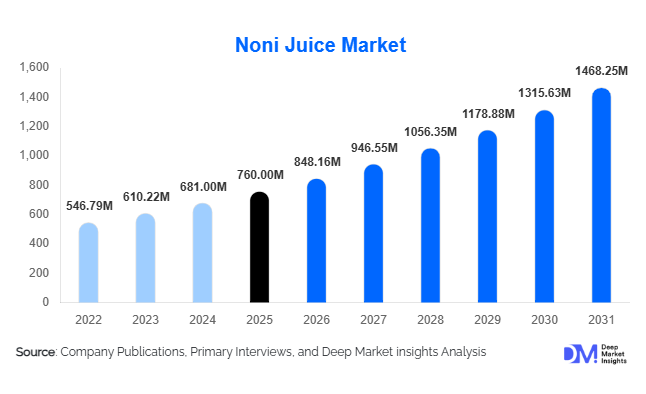
According to Deep Market Insights, the global noni juice market size was valued at USD 760 million in 2025 and is projected to grow from USD 848.16 million in 2026 to reach USD 1,468.25 million by 2031, expanding at a CAGR of 11.6% during the forecast period (2026–2031). The noni juice market growth is primarily driven by rising consumer preference for plant-based nutraceuticals, increasing awareness of preventive healthcare, and expanding demand for functional beverages enriched with natural bioactive compounds. Growing popularity of organic products and the shift toward clean-label consumption are further strengthening market expansion globally.
Key Market Insights
- Noni juice demand is increasingly driven by nutraceutical applications, particularly for immunity support and antioxidant benefits.
- Organic noni juice variants are gaining strong traction, commanding premium pricing due to clean-label preferences.
- Asia-Pacific dominates production, supported by favorable climatic conditions and abundant cultivation.
- North America leads consumption, driven by high health awareness and developed distribution networks.
- Online distribution channels are expanding rapidly, enabling direct-to-consumer engagement and global reach.
- Product innovation through blends and flavor enhancements is improving consumer acceptance and market penetration.
What are the latest trends in the noni juice market?
Rising Popularity of Functional Beverage Blends
Noni juice is increasingly being incorporated into functional beverage blends with fruits such as blueberry, mango, and grape to improve taste and nutritional value. These blends are gaining popularity among younger consumers and first-time users who find pure noni juice too bitter. Manufacturers are focusing on multi-functional beverages targeting immunity, detoxification, and digestive health. This trend is expanding the consumer base beyond traditional herbal supplement users and positioning noni juice within the broader functional beverage category.
Shift Toward Organic and Clean-Label Products
Consumers are showing strong preference for organic, non-GMO, and chemical-free beverages. Organic noni juice is emerging as a dominant segment, supported by certifications and transparent sourcing practices. Brands are investing in sustainable farming, eco-friendly packaging, and traceability to appeal to environmentally conscious consumers. Clean-label positioning is also helping companies command premium pricing and differentiate in a competitive nutraceutical market.
What are the key drivers in the noni juice market?
Growing Demand for Natural Health Supplements
The increasing shift toward plant-based and herbal supplements is a key driver of the noni juice market. Consumers are actively seeking natural alternatives to synthetic products, particularly for immunity enhancement and chronic disease prevention. Noni juice, rich in antioxidants and phytochemicals, aligns well with these preferences, driving consistent demand growth.
Rising Preventive Healthcare Awareness
Post-pandemic, there has been a significant increase in preventive healthcare spending. Consumers are proactively incorporating functional beverages into daily routines to boost immunity and overall wellness. This behavioral shift is strongly supporting noni juice consumption across both developed and emerging markets.
What are the restraints for the global market?
Strong Taste Profile Limiting Mass Adoption
The naturally bitter and pungent taste of noni juice remains a major barrier to widespread consumer acceptance. While blends and flavor enhancements are addressing this issue, pure noni juice continues to face resistance among new consumers, limiting its mass-market penetration.
Regulatory and Scientific Validation Challenges
Strict regulations regarding health claims, particularly in Europe and North America, pose challenges for manufacturers. Limited large-scale clinical evidence supporting certain health benefits also affects consumer trust and restricts aggressive marketing strategies in regulated markets.
What are the key opportunities in the noni juice industry?
Expansion in Emerging Markets
Emerging economies such as India, Indonesia, and Brazil present significant growth opportunities due to rising disposable incomes, increasing awareness of herbal medicine, and expanding retail infrastructure. These markets offer untapped potential for both domestic consumption and export-oriented production.
Integration with Nutraceutical and Pharmaceutical Applications
Noni juice is increasingly being utilized in capsules, powders, and medicinal formulations. Growing research into its bioactive properties could lead to new pharmaceutical applications, opening high-value revenue streams for manufacturers. Strategic partnerships with nutraceutical companies can further accelerate product development and market penetration.
Report Scope
| Report Metric | Details |
|---|---|
| Market Size in 2025 | USD 760.00 Million |
| Market Size in 2026 | USD 848.16 Million |
| Market Size in 2031 | USD 1468.25 Million |
| CAGR | 11.6% (2026-2031) |
| Base Year for Estimation | 2025 |
| Historical Data | 2022-2024 |
| Forecast Period | 2026-2031 |
| Report Coverage | Revenue Forecast, Competitive Landscape, Supply Chain Disruption, Growth Factors, Environment & Regulatory Landscape and Trends |
| Geographies Covered | North America, Europe, APAC, Middle East and Africa, LATAM |
| Countries Covered | U.S., Canada, U.K., Germany, France, Spain, Italy, Russia, Nordic, Benelux, Rest of Europe, China, Korea, Japan, India, Australia, Singapore, Taiwan, South East Asia, Rest of Asia-Pacific, UAE, Turky, Saudi Arabia, South Africa, Egypt, Nigeria, Rest of MEA, Brazil, Mexico, Argentina, Chile, Colombia, Rest of LATAM |
Explore more data points, trends and opportunities Download Free Sample Report
Product Type Insights
The global noni juice market is characterized by a diverse product landscape, with noni juice blends emerging as the dominant segment, accounting for approximately 42% of the global market share in 2025. This dominance is primarily attributed to the enhanced palatability of blends, as pure noni juice is often associated with a strong and pungent taste that can limit widespread consumer acceptance. Manufacturers have strategically introduced blends incorporating fruit juices such as grape, pineapple, and berry extracts, thereby improving flavor profiles while retaining perceived health benefits. The leading driver behind the growth of this segment is the increasing consumer preference for functional beverages that balance taste and wellness, enabling repeat consumption and broader demographic reach.Pure noni juice continues to maintain a steady presence, particularly among traditional users and health-conscious consumers who prioritize authenticity and maximum therapeutic value. This segment is driven by the perception of higher potency and minimal processing, appealing to niche markets that value natural and unaltered formulations. However, its growth remains relatively moderate compared to blends due to taste constraints and limited mainstream appeal.Flavored and ready-to-drink (RTD) noni beverages are also gaining significant momentum, particularly among younger consumers. This sub-segment is expected to grow rapidly as companies invest in product innovation, packaging enhancements, and branding strategies aimed at positioning noni juice as a mainstream wellness drink. The convergence of taste innovation, convenience, and functional benefits is expected to reinforce the long-term dominance of noni juice blends while supporting the expansion of adjacent product formats.
Application Insights
Nutraceutical applications represent the leading segment in the noni juice market, holding approximately 45% share. This dominance is driven by the strong positioning of noni juice as a dietary supplement known for its antioxidant, immune-boosting, and anti-inflammatory properties. The primary growth driver for this segment is the increasing global inclination toward preventive healthcare, where consumers actively seek natural remedies and functional ingredients to support overall well-being. The integration of noni juice into capsules, tablets, and liquid supplements has further strengthened its presence in the nutraceutical industry.Pharmaceutical applications are gradually expanding as scientific research continues to explore the therapeutic potential of noni, particularly in areas such as immune modulation, pain management, and metabolic health. The leading driver for this segment is the growing body of clinical studies supporting the medicinal properties of noni, which is encouraging its incorporation into complementary and alternative medicine formulations. Although still in a developing phase, this segment holds significant long-term potential.The personal care and cosmetics segment represents an emerging niche, where noni extracts are utilized for their antioxidant and skin-rejuvenating properties. The increasing demand for natural and plant-based ingredients in skincare and beauty products is the primary driver for this segment. As consumers become more conscious of ingredient transparency and sustainability, noni-based formulations are gaining attention in premium and organic cosmetic lines.
Distribution Channel Insights
Offline distribution channels continue to dominate the noni juice market, accounting for nearly 60% of the total market share. Supermarkets, hypermarkets, specialty health stores, and pharmacies remain the preferred purchasing points for consumers who value physical product verification and immediate availability. The leading driver for this segment is consumer trust, as buyers often prefer to examine product labels, certifications, and expiration dates before making a purchase, particularly for health-related products. Additionally, established retail networks and in-store promotions play a crucial role in influencing purchasing decisions.Despite the dominance of offline channels, online distribution is emerging as the fastest-growing segment, driven by the rapid expansion of e-commerce platforms and digital retail ecosystems. The key growth driver for this segment is convenience, as consumers increasingly opt for home delivery, wider product selection, and access to customer reviews. Online platforms also enable direct-to-consumer engagement, allowing brands to build stronger relationships and offer personalized experiences through subscription models and targeted marketing strategies.The integration of omnichannel strategies is becoming increasingly important, as companies seek to bridge the gap between physical and digital retail. Features such as click-and-collect services, online-exclusive product launches, and digital promotions are enhancing the overall consumer experience. As internet penetration and smartphone usage continue to rise globally, the online segment is expected to play a pivotal role in shaping the future distribution landscape of the noni juice market.
End-Use Insights
Individual consumers represent the largest end-use segment, accounting for approximately 52% of the market share. This dominance is primarily driven by the growing trend of direct consumption of noni juice for health and wellness purposes. The leading driver for this segment is the increasing awareness of natural remedies and the shift toward self-managed health practices, where consumers proactively incorporate functional foods and beverages into their daily routines. The availability of diverse product formats, including RTD beverages and supplements, has further facilitated adoption among individual users.Functional beverage manufacturers also play a crucial role in the market, utilizing noni juice to develop differentiated products that align with health and wellness trends. The primary driver for this segment is the growing competition within the beverage industry, prompting companies to innovate and introduce unique offerings that stand out in a crowded marketplace.The cosmetics and personal care industry represents an emerging end-use segment with promising growth potential. The increasing demand for natural and organic skincare products is driving the incorporation of noni extracts into formulations aimed at improving skin health and combating aging. As consumer preferences continue to shift toward clean beauty and sustainable ingredients, this segment is expected to gain further traction in the coming years.
Explore more data points, trends and opportunities Download Free Sample Report
Noni Juice Market Segmentations
By Product Type
- 100% Pure Noni Juice
- Noni Juice Blends
- Concentrated Noni Juice
- Powder-Based Noni Juice
By Nature
- Organic Noni Juice
- Conventional Noni Juice
By Processing Method
- Cold-Pressed
- Fermented
- Pasteurized
- Freeze-Dried
By Application
- Nutraceuticals
- Functional Beverages
- Pharmaceuticals
- Personal Care & Cosmetics
By End User
- Individual Consumers
- Health & Wellness Centers
- Food & Beverage Manufacturers
- Pharmaceutical Companies
Regional Insights
Asia-Pacific
Asia-Pacific dominates the global noni juice market, holding approximately 38% share in 2025. The region benefits from favorable climatic conditions that support large-scale cultivation of noni, particularly in countries such as India, Indonesia, and Thailand. One of the primary drivers of regional growth is the strong agricultural base combined with low production costs, enabling competitive pricing and high export potential. Additionally, the deep-rooted tradition of herbal medicine and Ayurveda in countries like India significantly contributes to the widespread acceptance of noni-based products.Rising consumer awareness regarding natural health products and preventive healthcare is further accelerating demand across the region. Rapid urbanization, increasing disposable income, and the expansion of modern retail and e-commerce channels are also playing a crucial role in market growth. Government initiatives promoting herbal and organic products, along with the growing popularity of functional beverages, are expected to sustain Asia-Pacific’s leadership position in the global market.
North America
North America accounts for approximately 30% of the global noni juice market share, with the United States being the key contributor. The region’s growth is primarily driven by high health consciousness among consumers and a strong inclination toward dietary supplements and functional foods. The leading driver in North America is the well-established nutraceutical industry, which активно incorporates noni juice into a wide range of products.Additionally, the presence of advanced distribution networks, including both offline retail chains and sophisticated e-commerce platforms, facilitates easy product accessibility. Innovation is another critical factor, as companies continuously introduce premium, organic, and value-added products to cater to evolving consumer preferences. The growing demand for clean-label and non-GMO products further supports market expansion in the region.
Europe
Europe holds around 18% share of the global market, with key countries including Germany, France, and the United Kingdom. The region’s growth is driven by a strong preference for organic, natural, and sustainably sourced products. The primary driver in Europe is the stringent regulatory framework that ensures high product quality and safety standards, thereby enhancing consumer trust and encouraging adoption.Increasing awareness of plant-based nutrition and the rising popularity of functional foods and beverages are also contributing to market growth. European consumers are particularly inclined toward premium and ethically sourced products, which has prompted manufacturers to focus on transparency, certification, and sustainable practices. The expansion of specialty health stores and online retail channels further supports market penetration across the region.
Latin America
Latin America contributes approximately 8% of the global noni juice market, with Brazil emerging as a key growth market. The region’s expansion is driven by increasing health awareness and the growing middle-class population, which is leading to higher spending on wellness products. The leading driver for Latin America is the improving retail infrastructure, including the expansion of supermarkets and e-commerce platforms, which enhances product availability and accessibility.Additionally, favorable climatic conditions in certain parts of the region support local cultivation of noni, creating opportunities for domestic production and reducing dependency on imports. As awareness of the health benefits of noni continues to grow, the market is expected to witness steady expansion in the coming years.
Middle East & Africa
The Middle East & Africa region accounts for approximately 6% of the global market share. Growth in this region is primarily driven by increasing urbanization, rising disposable incomes, and a growing focus on health and wellness. The key driver here is the expanding expatriate population and the influence of global health trends, which are introducing noni juice to a broader consumer base.In countries such as the UAE and South Africa, the development of modern retail infrastructure and the increasing presence of international brands are supporting market growth. Additionally, the rising demand for premium health products and dietary supplements is encouraging the adoption of noni juice. Although the market is still in its early stages, ongoing economic development and improving consumer awareness are expected to create significant growth opportunities in the long term.
Key Players in the Noni Juice Market
- Tahitian Noni International
- Morinda Holdings Inc.
- Dynamic Health Laboratories
- NOW Foods
- Nature’s Way
- Herbal Hills
- Biovea
- Piping Rock Health Products
- Earth’s Bounty
- Royal Tropics
- Healing Noni
- Noni Biotech
- Sunrise Nutrachem Group
- Pure Noni
- Tropical Noni Inc.