Banana Juice Market Size
According to Deep Market Insights, the global banana juice market size was valued at USD 1.82 billion in 2025 and is projected to grow from USD 1.93 billion in 2026 to reach USD 2.58 billion by 2031, expanding at a CAGR of 6.0% during the forecast period (2026–2031). The banana juice market growth is primarily driven by rising consumer preference for natural fruit beverages, increasing demand for clean-label and preservative-free drinks, expanding functional beverage consumption, and growing investments in fruit processing infrastructure across emerging economies.
Key Market Insights
- 100% banana juice remains the leading product category, supported by increasing consumer demand for natural, minimally processed, and nutrient-rich beverages.
- Banana juice blends are witnessing the fastest adoption, driven by innovation in tropical fruit combinations, functional ingredients, and premium beverage formulations.
- Asia-Pacific dominates the global market, supported by abundant banana production, expanding beverage manufacturing capacity, and strong domestic consumption.
- Middle East & Africa is projected to be the fastest-growing regional market, fueled by increasing urbanization, organized retail expansion, and rising demand for healthy fruit beverages.
- Modern processing technologies, including aseptic packaging, high-pressure processing (HPP), and cold-pressed extraction, are improving product quality and shelf life.
- Growing online grocery platforms and premium retail channels are accelerating the availability of banana juice products across developed and emerging markets.
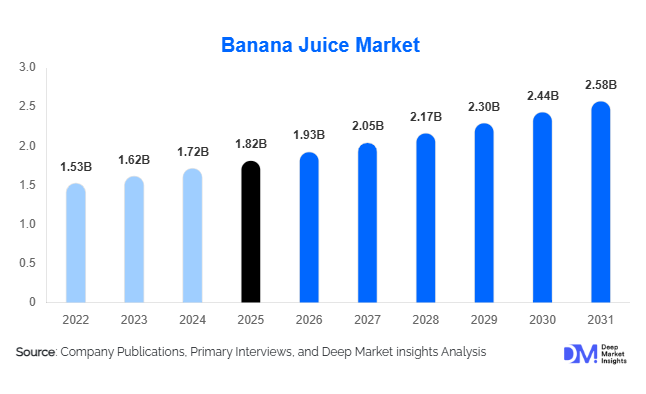
Banana Juice Market Latest Trends
Clean-Label and Functional Beverage Innovation
Manufacturers are increasingly introducing preservative-free, organic, and functional banana juice products enriched with vitamins, minerals, probiotics, and plant-based ingredients. Consumer preference for clean-label beverages continues to encourage investment in cold-pressed extraction, high-pressure processing, and aseptic packaging technologies that preserve nutritional value while extending shelf life. Premium product launches are also expanding rapidly through supermarkets, specialty health stores, and online retail platforms as consumers increasingly prioritize natural beverages over carbonated alternatives.
Rising Demand for Blended Fruit Beverages
Banana juice blended with mango, pineapple, strawberry, coconut water, oats, and citrus fruits is becoming increasingly popular among health-conscious consumers. Beverage companies are introducing innovative formulations that combine improved taste, enhanced nutritional value, and convenient packaging. Growing consumer interest in tropical fruit beverages, plant-based nutrition, and functional drinks is encouraging manufacturers to diversify product portfolios while targeting younger consumers seeking healthier beverage alternatives.
Banana Juice Market Drivers
Increasing Consumer Preference for Natural Fruit Beverages
Growing awareness regarding healthy lifestyles and balanced nutrition is significantly increasing global demand for fruit-based beverages. Consumers are actively replacing sugar-rich carbonated drinks with natural fruit juices containing vitamins, potassium, antioxidants, and dietary fiber. Expanding disposable income, increasing urbanization, and continuous product innovation are encouraging beverage manufacturers to introduce premium banana juice offerings across retail and foodservice channels. Government initiatives supporting fruit processing industries in developing countries are also strengthening long-term market expansion.
Expansion of Functional Beverage Consumption
The global functional beverage industry continues to create favorable opportunities for banana juice manufacturers. Consumers increasingly seek beverages offering digestive health, natural energy, immunity support, and nutritional benefits. Banana juice naturally contains potassium, vitamin B6, magnesium, and carbohydrates, making it an attractive ingredient for sports nutrition, breakfast beverages, smoothies, and wellness drinks. Continuous innovation in plant-based and fortified beverages further supports market growth.
Banana Juice Market Restraints
Limited Shelf Life and Seasonal Raw Material Availability
Fresh banana juice has relatively limited shelf stability due to oxidation, enzymatic browning, and microbial sensitivity. Manufacturers often require advanced processing technologies and refrigerated storage to maintain product quality. Seasonal fluctuations in banana production, adverse weather conditions, transportation costs, and raw material price volatility also affect production planning and operating margins, particularly for small and medium-sized beverage producers.
Competition from Alternative Fruit Beverages
The market faces intense competition from orange juice, apple juice, mixed fruit beverages, coconut water, smoothies, flavored water, and plant-based drinks. Consumers have access to a wide variety of healthy beverage options, increasing competitive pressure on banana juice manufacturers. Continuous product innovation, premium positioning, attractive packaging, and flavor diversification remain essential for maintaining market competitiveness.
Banana Juice Industry Key Opportunities
Growth of Premium and Organic Beverage Categories
Increasing consumer spending on premium beverages creates substantial opportunities for organic, non-GMO, preservative-free, and cold-pressed banana juice products. Premium packaging, sustainable sourcing, recyclable containers, and clean-label certification are becoming important purchasing factors. Manufacturers focusing on premium positioning are expected to capture higher-value consumer segments across developed economies.
Expansion Across Emerging Markets
Rapid urbanization, rising middle-class income, expanding organized retail, and improving cold-chain infrastructure across Asia-Pacific, Latin America, and Africa continue creating new opportunities for banana juice manufacturers. Increasing supermarket penetration, digital grocery platforms, and foodservice expansion are supporting wider product availability while encouraging both domestic production and international exports.
Report Scope
| Report Metric | Details |
|---|---|
| Market Size in 2025 | USD 1.82 Billion |
| Market Size in 2026 | USD 1.93 Billion |
| Market Size in 2031 | USD 2.58 Billion |
| CAGR | 6% (2026-2031) |
| Base Year for Estimation | 2025 |
| Historical Data | 2022-2024 |
| Forecast Period | 2026-2031 |
| Report Coverage | Revenue Forecast, Competitive Landscape, Supply Chain Disruption, Growth Factors, Environment & Regulatory Landscape and Trends |
| Geographies Covered | North America, Europe, APAC, Middle East and Africa, LATAM |
| Countries Covered | U.S., Canada, U.K., Germany, France, Spain, Italy, Russia, Nordic, Benelux, Rest of Europe, China, Korea, Japan, India, Australia, Singapore, Taiwan, South East Asia, Rest of Asia-Pacific, UAE, Turky, Saudi Arabia, South Africa, Egypt, Nigeria, Rest of MEA, Brazil, Mexico, Argentina, Chile, Colombia, Rest of LATAM |
Explore more data points, trends and opportunities Download Free Sample Report
Type Insights
The 100% banana juice segment accounted for the largest share of the global banana juice market and is expected to maintain its leadership throughout the forecast period. The dominance of this segment is primarily driven by the growing consumer preference for natural, minimally processed beverages that are free from artificial preservatives, colors, sweeteners, and added sugars. Rising health consciousness, increasing awareness regarding clean-label ingredients, and the shift toward plant-based and naturally sourced beverages have significantly strengthened demand for pure banana juice. Consumers increasingly perceive 100% fruit juice as a healthier alternative to carbonated soft drinks and synthetic fruit beverages, particularly among health-conscious millennials, working professionals, families with children, and aging populations seeking nutrient-rich dietary options. Banana juice is naturally rich in potassium, vitamin B6, dietary fiber, antioxidants, and essential minerals, making it an attractive choice for consumers seeking functional beverages that support digestive health, energy levels, and overall wellness. Manufacturers are responding by introducing premium, organic, cold-pressed, and preservative-free banana juice products while expanding distribution across supermarkets, convenience stores, specialty health retailers, and online platforms. Continuous innovation in sustainable packaging, improved shelf-life technologies, and premium product positioning further reinforces the leadership of the 100% banana juice segment across developed and emerging markets.
Application Insights
The beverages segment dominates the global banana juice market and is projected to retain its leading position throughout the forecast period. The primary driver behind this dominance is the rapidly increasing consumer demand for healthy, ready-to-drink beverages that provide natural nutrition and convenience. Banana juice has become a preferred ingredient in fruit juices, smoothies, functional beverages, breakfast drinks, protein shakes, wellness beverages, and sports nutrition products due to its naturally sweet taste, creamy texture, and high nutritional content. Growing consumer awareness regarding the health risks associated with sugar-sweetened carbonated beverages has accelerated the transition toward natural fruit-based alternatives. Additionally, increasing urbanization, busy lifestyles, expanding retail availability, and continuous product innovation by beverage manufacturers continue to strengthen demand. The introduction of organic, fortified, cold-pressed, and clean-label banana juice beverages is further expanding the segment across supermarkets, convenience stores, cafés, and e-commerce channels worldwide.Foodservice applications are also expanding steadily as restaurants, cafés, hotels, quick-service restaurants, smoothie outlets, juice bars, and wellness cafés increasingly incorporate fresh banana juice into their beverage offerings. Rising consumer preference for freshly prepared smoothies, mocktails, milkshakes, tropical beverages, and customized healthy drinks has encouraged foodservice operators to diversify their menus using banana juice as a versatile base ingredient. The continued growth of hospitality, tourism, café culture, and premium dining experiences, particularly across urban centers, is expected to further contribute to the expansion of banana juice consumption within the foodservice sector.
Explore more data points, trends and opportunities Download Free Sample Report
Banana Juice Market Segmentations
By Type
- 100% Banana Juice
- Banana Juice Blends
- Concentrated Banana Juice
By Application
- Beverages
- Food Processing
- Foodservice
By Distribution Channel
- Supermarkets & Hypermarkets
- Convenience Stores
- Online Retail
- Specialty Stores
- Foodservice Distribution
Regional Insights
Asia-Pacific
Asia-Pacific dominated the global banana juice market and is anticipated to remain the largest regional market throughout the forecast period. The region benefits from abundant banana cultivation, favorable tropical climatic conditions, well-established fruit processing industries, and a large consumer base with increasing demand for fruit-based beverages. Major banana-producing countries including India, China, Indonesia, the Philippines, Thailand, and Vietnam serve as both significant producers and consumers, ensuring a stable supply of raw materials for juice manufacturing. One of the key drivers supporting regional growth is the rapid expansion of the food and beverage processing industry, supported by government initiatives promoting agricultural value addition, food processing infrastructure, and export-oriented manufacturing. Rising disposable incomes, rapid urbanization, expanding middle-class populations, and increasing health awareness have significantly boosted the consumption of natural fruit juices and functional beverages. Furthermore, the strong presence of domestic beverage manufacturers, continuous investment in processing technologies, growing organized retail networks, expanding e-commerce penetration, and increasing demand for clean-label products among younger consumers continue to strengthen the long-term growth prospects of the Asia-Pacific banana juice market.
North America
North America represents a significant market for banana juice, supported by strong consumer demand for natural, organic, and functional beverages. The United States accounts for the largest share of regional consumption, followed by Canada, driven by increasing health consciousness and consumer preference for beverages containing natural ingredients and minimal processing. A major growth driver for the region is the continuous expansion of the functional beverage industry, where banana juice is increasingly incorporated into smoothies, wellness drinks, protein beverages, meal replacement products, and fortified nutritional formulations. The presence of advanced beverage manufacturing capabilities, extensive retail infrastructure, high consumer purchasing power, and widespread availability of premium fruit beverages further support market expansion. Additionally, growing adoption of clean-label products, increasing demand for plant-based nutrition, rising organic product consumption, and continuous product innovation by leading beverage companies are expected to sustain healthy regional growth throughout the forecast period.
Europe
Europe continues to exhibit steady growth in the banana juice market owing to rising consumer preference for premium fruit beverages, organic food products, and sustainably sourced ingredients. Germany, France, the United Kingdom, Italy, Spain, and the Netherlands remain among the major importing and consuming countries within the region. The primary driver of regional growth is the increasing consumer demand for healthier beverage alternatives with reduced sugar content, natural ingredients, and transparent product labeling. Strict food safety regulations and high quality standards continue encouraging manufacturers to develop preservative-free, organic, and clean-label banana juice products that meet evolving consumer expectations. In addition, growing environmental awareness has accelerated investments in recyclable packaging, sustainable sourcing practices, and carbon footprint reduction initiatives. The expansion of premium supermarkets, specialty health food retailers, and online grocery platforms further enhances product accessibility, supporting the continued development of the European banana juice market.
Latin America
Latin America continues to strengthen its position within the global banana juice market due to abundant banana production, expanding fruit processing capabilities, and increasing domestic consumption of fruit-based beverages. Brazil, Ecuador, Colombia, Costa Rica, Peru, and Guatemala remain among the leading banana-producing countries supporting regional supply chains. A major driver of market growth is the increasing investment in value-added agricultural processing, enabling producers to diversify beyond fresh fruit exports into processed juice products with higher commercial value. Rising urbanization, improving household incomes, expanding modern retail formats, and increasing consumer awareness regarding healthier beverage options are contributing to stronger domestic demand. Furthermore, favorable export opportunities, government support for agribusiness development, modernization of food processing facilities, and growing international demand for tropical fruit beverages are expected to continue driving the expansion of the Latin American banana juice market.
Middle East & Africa
The Middle East & Africa is projected to register the fastest growth during the forecast period, driven by rapid urbanization, rising disposable incomes, changing dietary preferences, and increasing demand for premium packaged fruit beverages. South Africa, Saudi Arabia, the United Arab Emirates, Egypt, Kenya, and Nigeria represent some of the key markets experiencing growing consumption of healthy beverage products. The leading driver supporting regional expansion is the rapid development of modern retail infrastructure, including supermarkets, hypermarkets, convenience stores, and e-commerce platforms, which has significantly improved product availability across both metropolitan and emerging urban markets. Continuous improvements in cold-chain logistics, expanding foodservice and hospitality industries, rising tourism activities, and increasing investments by international beverage manufacturers are further accelerating market development. Moreover, growing consumer awareness regarding nutrition, preventive healthcare, and natural fruit-based beverages, coupled with favorable demographic trends and expanding middle-income populations, is expected to support robust long-term growth across the Middle East & Africa banana juice market.
Key Players in the Banana Juice Market
- Del Monte Foods, Inc.
- Dole plc
- Dabur India Ltd.
- PepsiCo, Inc.
- The Coca-Cola Company
- Eckes-Granini Group GmbH
- Britvic plc
- Lassonde Industries Inc.
- Parle Agro Pvt. Ltd.
- ITC Limited
- Princes Group
- Tropicana Brands Group
- Refresco Group
- Malee Group Public Company Limited
- AGRANA Beteiligungs-AG