Champagne Market Size
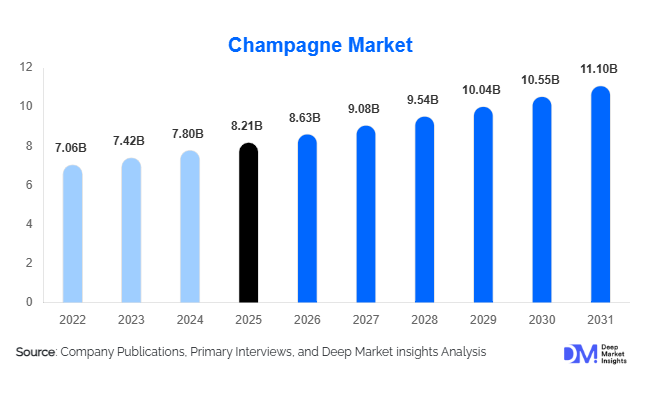
According to Deep Market Insights, the global champagne market was valued at USD 8.21 billion in 2025 and is projected to grow from USD 8.63 billion in 2026 to reach USD 11.10 billion by 2031, expanding at a CAGR of 5.16% during the forecast period (2026–2031). Market expansion is being driven by rising premium beverage consumption, increasing demand for luxury alcoholic beverages, expanding hospitality and tourism industries, and growing consumer preference for authentic sparkling wines. The continued expansion of premium retail channels, international exports, and digital sales platforms is further supporting long-term industry development across developed and emerging economies.
Key Market Insights
- Europe dominates the global market, accounting for nearly 64.8% of total revenue owing to its established production base, strong domestic consumption, and extensive export network.
- Asia-Pacific is the fastest-growing regional market, supported by increasing disposable income, expanding luxury retail, and growing demand for premium imported beverages.
- Non-vintage champagne represents the largest product category, contributing more than 71% of global sales due to consistent quality, affordability, and wide commercial availability.
- Prestige cuvée products continue to gain momentum, driven by premiumization, luxury gifting, and increasing demand among affluent consumers.
- Digital commerce and direct-to-consumer sales are reshaping distribution, with online premium beverage purchases expanding rapidly across North America, Europe, and Asia.
- Sustainability initiatives, including lightweight bottles, environmentally certified vineyards, recyclable packaging, and precision viticulture, are becoming major competitive differentiators for leading producers.
Champagne Trends
Premiumization and Sustainable Production Continue to Transform the Industry
Consumer preference is steadily shifting toward premium and prestige champagne varieties as disposable incomes rise and luxury experiences become increasingly important. Producers are investing significantly in sustainable vineyard management, precision farming technologies, renewable energy adoption, and environmentally responsible packaging. Lightweight glass bottles, recycled packaging materials, and carbon reduction initiatives are becoming standard across major producers. Environmental certification programs continue to expand, strengthening consumer confidence while supporting long-term vineyard sustainability. Premium product launches, limited-edition collections, and vintage offerings are further enhancing brand value across international markets.
Digital Retail and Luxury Hospitality Drive Premium Consumption
The expansion of online retail platforms has significantly improved accessibility to premium champagne products worldwide. Consumers increasingly purchase luxury beverages through e-commerce platforms offering authentication services, personalized recommendations, subscription programs, and premium home delivery. Luxury hotels, fine dining restaurants, international tourism, weddings, corporate events, and travel retail remain major consumption channels. At the same time, QR-enabled product authentication, digital marketing campaigns, and direct-to-consumer strategies are improving customer engagement while strengthening brand loyalty among younger affluent consumers seeking convenience and premium experiences.
Champagne Market Drivers
Growing Demand for Premium Alcoholic Beverages
Rising disposable income, changing consumer lifestyles, and increasing spending on premium alcoholic beverages continue to drive global champagne consumption. Luxury celebrations, destination weddings, hospitality expansion, and premium gifting culture have increased demand across both developed and emerging economies. International tourism recovery has also strengthened on-trade sales through hotels, restaurants, lounges, and entertainment venues. Premium consumers increasingly seek authentic regional products with protected geographical indications, encouraging producers to expand premium portfolios while investing in product innovation and brand differentiation.
Expansion of Global Hospitality and Luxury Tourism
The rapid growth of luxury hospitality, international tourism, and premium dining experiences continues to support champagne consumption worldwide. Five-star hotels, luxury resorts, cruise operators, and upscale restaurants are expanding premium beverage offerings to attract affluent travelers. Corporate celebrations, sporting events, fashion shows, and international entertainment activities further stimulate demand for high-quality sparkling wines. The continuous expansion of global travel infrastructure and premium tourism experiences is expected to sustain long-term market growth throughout the forecast period.
Champagne Market Restraints
High Production Costs and Strict Geographic Regulations
Champagne production remains highly regulated, requiring grapes to originate exclusively from designated vineyards in the Champagne region of France. Strict production standards, labor-intensive traditional fermentation methods, vineyard maintenance costs, glass packaging expenses, and aging requirements significantly increase production costs. These factors limit production scalability and contribute to premium pricing, restricting accessibility among price-sensitive consumers in developing economies.
Climate Change and Agricultural Uncertainty
Changing climatic conditions, unpredictable rainfall patterns, rising temperatures, frost events, and vineyard diseases continue to present challenges for grape cultivation. Seasonal production fluctuations may reduce harvest quality and increase operational risks for producers. Supply chain disruptions, higher logistics costs, and raw material price volatility further affect production efficiency, requiring producers to invest in climate-resilient viticulture and sustainable agricultural practices to maintain consistent product quality.
Champagne Market Opportunities
Expansion of Digital Premium Retail Channels
Growing consumer confidence in online alcohol purchasing presents significant opportunities for premium champagne producers. E-commerce platforms, luxury beverage marketplaces, and direct-to-consumer websites are expanding rapidly through personalized recommendations, digital authentication, subscription services, and premium delivery options. Improved digital accessibility enables producers to strengthen customer relationships while expanding into previously underpenetrated international markets.
Growing Demand Across Emerging Luxury Markets
Rapid urbanization, increasing middle-class wealth, and expanding luxury consumption across Asia-Pacific, the Middle East, and Latin America are creating new growth opportunities. Rising numbers of affluent consumers, premium hospitality investments, international tourism, and luxury gifting culture are encouraging producers to strengthen regional distribution networks. Strategic collaborations with luxury retailers, hotels, and premium restaurants are expected to accelerate market penetration across emerging economies.
Report Scope
| Report Metric | Details |
|---|---|
| Market Size in 2025 | USD 8.21 Billion |
| Market Size in 2026 | USD 8.63 Billion |
| Market Size in 2031 | USD 11.10 Billion |
| CAGR | 5.16% (2026-2031) |
| Base Year for Estimation | 2025 |
| Historical Data | 2022-2024 |
| Forecast Period | 2026-2031 |
| Report Coverage | Revenue Forecast, Competitive Landscape, Supply Chain Disruption, Growth Factors, Environment & Regulatory Landscape and Trends |
| Geographies Covered | North America, Europe, APAC, Middle East and Africa, LATAM |
| Countries Covered | U.S., Canada, U.K., Germany, France, Spain, Italy, Russia, Nordic, Benelux, Rest of Europe, China, Korea, Japan, India, Australia, Singapore, Taiwan, South East Asia, Rest of Asia-Pacific, UAE, Turky, Saudi Arabia, South Africa, Egypt, Nigeria, Rest of MEA, Brazil, Mexico, Argentina, Chile, Colombia, Rest of LATAM |
Explore more data points, trends and opportunities Download Free Sample Report
Product Type Insights
Non-vintage champagne dominates the global market, accounting for approximately 71.3% of total revenue due to its consistent flavor profile, reliable availability, and broad consumer acceptance. These products represent the foundation of champagne consumption worldwide, with annual production exceeding 220 million bottles. Non-vintage variants are widely preferred by restaurants, retail consumers, corporate buyers, and first-time champagne purchasers because producers can maintain consistent quality through blending grapes from multiple harvest years. Vintage champagne represents a premium segment, contributing around 18.5% of market revenue, with production volumes exceeding 55 million bottles annually. These products are associated with exceptional harvest years, extended aging periods of more than 36 months, and strong collector demand. Prestige cuvée champagne accounts for nearly 10.2% share but generates significant value due to premium pricing, limited availability, luxury branding, and exclusive positioning. Production of prestige cuvée exceeds 35 million bottles annually, with increasing demand from high-net-worth consumers, luxury hospitality providers, and premium gifting markets.
Application Insights
Luxury celebrations and special occasions represent a major application area for champagne consumption, driven by weddings, anniversaries, corporate events, festivals, and milestone celebrations. This segment contributes significantly to global demand as consumers associate champagne with premium experiences, status, and social recognition. Hospitality applications, including luxury hotels, fine dining restaurants, bars, and resorts, account for a substantial share of consumption, supported by premium beverage menus and increasing international tourism. The hospitality sector represents nearly 46% of high-value champagne consumption, with annual usage exceeding 118 million bottles. Corporate gifting and business events are also emerging as important applications, particularly in North America, Europe, and Asia-Pacific, where premium champagne is increasingly used for relationship-building and executive gifting. Travel retail, including airports, cruise lines, and duty-free stores, continues expanding due to rising international passenger traffic and demand for luxury products. Digital consumers purchasing champagne for personal celebrations, home entertainment, and premium lifestyle experiences represent a rapidly growing application segment, supported by online retail penetration exceeding 19%.
Distribution Channel Insights
On-trade distribution remains the leading channel for champagne sales, accounting for approximately 56.4% of market revenue. Restaurants, luxury hotels, bars, clubs, resorts, and event venues contribute significantly to consumption as champagne continues to be positioned as a premium beverage for social occasions and luxury experiences. The segment records annual consumption exceeding 175 million bottles, supported by tourism recovery and increasing demand for premium dining experiences. Off-trade channels, including supermarkets, specialty beverage retailers, and premium liquor stores, represent nearly 31.8% share. These channels benefit from growing home consumption trends, festive purchasing, and improved availability of premium brands. Online retail is the fastest-growing distribution channel, accounting for approximately 11.8% share and expanding at a CAGR of nearly 8.2%. Digital platforms provide consumers access to international brands, product reviews, authentication features, and convenient delivery options, accelerating adoption among younger affluent consumers.
Traveler Type Insights
Champagne consumption is strongly influenced by affluent consumer groups, luxury travelers, corporate buyers, and premium lifestyle customers. High-net-worth individuals represent a significant consumer base, with demand driven by exclusive experiences, collectible bottles, vintage releases, and prestige cuvée offerings. Luxury travelers contribute significantly through airport duty-free purchases, cruise experiences, five-star hotels, and destination events. Corporate consumers represent another important segment, using premium champagne for business celebrations, executive gifting, and client relationship management. Millennials and younger affluent consumers are increasingly entering the market through social media influence, experiential dining, and lifestyle-driven purchasing behavior. These consumers prefer premium brands offering sustainability credentials, unique storytelling, and authentic production heritage. Emerging markets are also witnessing increased adoption among middle- and upper-income consumers as luxury beverage awareness expands.
Age Group Insights
Consumers aged 35–55 years represent the largest champagne-consuming demographic due to higher purchasing power, established preferences for premium beverages, and frequent participation in celebrations and luxury experiences. This segment primarily purchases non-vintage and premium champagne varieties for personal occasions, hospitality, and gifting. Consumers aged 25–35 years represent a rapidly growing segment influenced by social media, premium lifestyle trends, experiential dining, and digital shopping platforms. Younger consumers increasingly prefer sustainable brands, limited editions, and visually appealing packaging. The 55+ age group remains highly valuable due to strong brand loyalty, interest in vintage collections, and preference for luxury products. Collectors and connoisseurs within this segment significantly influence demand for prestige cuvée and rare champagne offerings.
Explore more data points, trends and opportunities Download Free Sample Report
Champagne Market Segmentations
By Product Type
- Non-Vintage Champagne
- Vintage Champagne
- Prestige Cuvée Champagne
By Application
- Luxury Celebrations and Events
- Hospitality and Fine Dining
- Corporate Gifting and Business Events
- Travel Retail and Duty-Free
- Personal Consumption and Lifestyle Use
By Distribution Channel
- On-Trade
- Off-Trade
- Online Retail
By Region
- North America
- Europe
- Asia-Pacific
- Latin America
- Middle East & Africa
Regional Insights
Europe
Europe dominates the global champagne market with approximately 64.8% revenue share, supported by France’s position as the primary production hub and strong regional consumption. France contributes more than 95% of global champagne production, with annual output exceeding 300 million bottles. The United Kingdom, Germany, Italy, Belgium, and Spain represent major consumption markets due to established luxury beverage cultures and strong hospitality industries. European consumers demonstrate high demand for vintage and prestige cuvée products, while sustainability initiatives and organic vineyard practices are gaining importance. Luxury tourism, premium restaurants, and seasonal celebrations continue supporting regional growth.
North America
North America represents the second-largest champagne market, accounting for approximately 18.7% of global revenue. The United States contributes nearly 82% of regional consumption, supported by premium restaurants, luxury hotels, corporate events, and strong demand for imported beverages. Annual champagne imports exceed 30 million bottles, with increasing demand for prestige brands among affluent consumers. Online retail expansion, premium gifting culture, and growing interest in French luxury products are strengthening market opportunities across the region. Canada also contributes through premium dining, tourism, and luxury retail channels.
Asia-Pacific
Asia-Pacific is the fastest-growing regional market, accounting for approximately 11.2% share and projected to expand at a CAGR of 6.8%. China, Japan, South Korea, India, Singapore, and Australia represent key markets. Rising disposable income, luxury consumption growth, international tourism, and premium lifestyle adoption are accelerating demand. China remains a major growth contributor, with the market projected to reach approximately USD 1.18 billion by 2031. Premium hotels, luxury retailers, and online beverage platforms are expanding rapidly across the region, increasing champagne accessibility among affluent consumers.
Latin America
Latin America contributes approximately 3.1% of global champagne revenue, with Brazil and Mexico accounting for more than 67% of regional consumption. Rising urbanization, premium dining expansion, luxury tourism, and growing interest in international beverages are supporting market development. Consumers increasingly prefer champagne for weddings, celebrations, and social events. Improved distribution networks and online retail expansion are expected to enhance accessibility across emerging Latin American economies.
Middle East & Africa
The Middle East & Africa region accounts for approximately 2.2% of global revenue, supported by luxury hospitality development, premium tourism, and high-income consumer groups. The UAE, Saudi Arabia, and South Africa represent important markets due to expanding five-star hotels, international events, and luxury retail infrastructure. The region’s premium hospitality sector continues increasing demand for imported champagne brands, while Africa’s tourism development and luxury resorts provide additional growth opportunities. Despite regulatory differences, premium consumption trends continue strengthening regional market potential.
Key Players in the Champagne Market
- LVMH Moët Hennessy Louis Vuitton SE
- Pernod Ricard SA
- Vranken-Pommery Monopole
- Laurent-Perrier Group
- Nicolas Feuillatte
- Champagne Bollinger
- Taittinger
- Louis Roederer
- Pol Roger
- Piper-Heidsieck
- Charles Heidsieck
- Lanson
- Ruinart
- Champagne Deutz
- Champagne Gosset