Bulk Baijiu Market Size
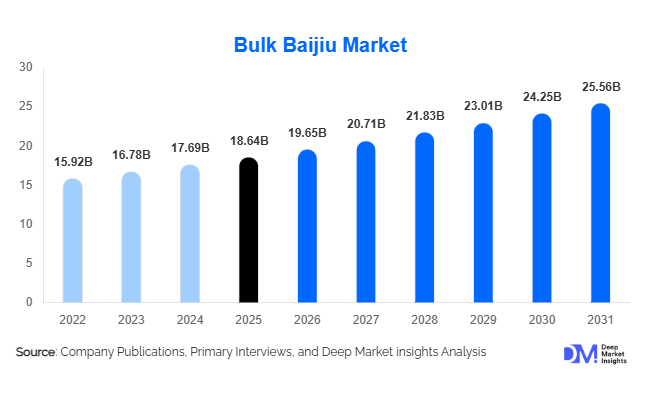
According to Deep Market Insights, the global bulk baijiu market size was valued at USD 18.64 billion in 2025 and is projected to grow from USD 19.65 billion in 2026 to reach USD 25.56 billion by 2031, expanding at a CAGR of 5.4% during the forecast period (2026–2031). The bulk baijiu market growth is primarily driven by increasing demand from branded baijiu manufacturers, expanding contract bottling operations, rising premium liquor production, and continuous investments in automated fermentation and large-scale distillation infrastructure across major production hubs.
Key Market Insights
- China continues to dominate global bulk baijiu production, accounting for more than 93% of worldwide output, supported by established distillation ecosystems and large-scale commercial suppliers.
- Strong aroma baijiu remains the leading product segment, contributing nearly 58.6% of global production due to its broad acceptance among branded liquor manufacturers.
- Bottled baijiu production represents the largest application segment, accounting for approximately 64.2% of total market demand.
- East Asia dominates the global market, contributing nearly 74.8% of total revenue through extensive production capacity and mature domestic consumption.
- Southeast Asia is emerging as the fastest-growing regional market, supported by increasing premium spirit imports, expanding hospitality industries, and growing contract bottling activities.
- Digital fermentation monitoring, AI-enabled production control, and intelligent warehouse management are improving product consistency, reducing production losses, and increasing operational efficiency across commercial distilleries.
Bulk Baijiu Market Latest Trends
Premium Bulk Spirit Production Continues to Expand
Large commercial distilleries are increasingly investing in premium-grade bulk baijiu production to meet rising demand from branded liquor companies and contract bottlers. Premium bulk products with extended aging periods and standardized flavor profiles are witnessing growing acceptance among domestic and export-oriented beverage manufacturers. Modern storage facilities, intelligent fermentation management systems, and automated distillation equipment are helping producers improve production consistency while supporting premium positioning. Long-term procurement agreements between large distilleries and branded beverage companies continue to strengthen supply chain stability across the global bulk baijiu industry.
Digital Manufacturing and Smart Distillery Adoption
Bulk baijiu manufacturers are increasingly adopting artificial intelligence, industrial automation, IoT-enabled monitoring systems, and digital quality management solutions throughout fermentation and distillation processes. Smart production facilities improve batch consistency, reduce energy consumption, enhance traceability, and optimize warehouse management for aged inventory. Digital production technologies are also supporting regulatory compliance while improving operational efficiency and production planning, allowing manufacturers to respond more effectively to changing commercial demand and premium product requirements.
Bulk Baijiu Market Drivers
Growing Demand from Premium Branded Baijiu Manufacturers
Premium baijiu brands continue expanding production volumes while increasingly sourcing high-quality bulk spirits from specialized commercial distilleries. Rising consumer preference for premium alcoholic beverages has encouraged manufacturers to increase procurement of standardized bulk baijiu with consistent flavor characteristics and strict quality specifications. Continuous investments in fermentation capacity, automated processing, aging warehouses, and quality control infrastructure further strengthen production capabilities, making premium bulk baijiu an essential component of branded liquor manufacturing.
Expansion of Commercial Contract Bottling Operations
The growing presence of contract bottling companies is creating sustained demand for bulk baijiu supplies across domestic and international markets. Beverage companies increasingly outsource production and bottling activities to improve manufacturing flexibility while reducing capital investment. Long-term procurement contracts, improved logistics infrastructure, and standardized production practices continue supporting commercial supply chain expansion and stable purchasing volumes throughout the industry.
Bulk Baijiu Market Restraints
Volatility in Raw Material Prices
Bulk baijiu production remains highly dependent on agricultural commodities such as sorghum, wheat, rice, and corn. Price fluctuations caused by weather conditions, changing agricultural policies, and supply chain disruptions directly influence manufacturing costs and profit margins. Rising transportation expenses and increasing energy costs further affect overall production economics, particularly for small and medium-sized distilleries operating with limited procurement flexibility.
Stringent Environmental and Regulatory Requirements
Governments continue implementing stricter environmental regulations related to wastewater treatment, emissions management, energy consumption, and industrial waste disposal within alcohol manufacturing facilities. Compliance requires significant investments in environmental protection equipment, production modernization, and operational upgrades. Smaller producers often face financial challenges in meeting evolving regulatory standards, limiting capacity expansion and reducing competitiveness within the market.
Bulk Baijiu Industry Key Opportunities
Growing Export Demand for Chinese Spirits
International recognition of Chinese alcoholic beverages is creating significant opportunities for bulk baijiu suppliers serving overseas bottlers and premium beverage manufacturers. Expanding exports across Southeast Asia, Europe, North America, and emerging markets are encouraging distilleries to increase production capacity while developing export-grade quality standards. International distribution partnerships and growing consumer awareness of Chinese spirits further support long-term export expansion.
Adoption of Smart Manufacturing Technologies
Digital transformation presents significant opportunities for commercial distilleries to improve production efficiency, optimize inventory management, reduce production losses, and maintain standardized product quality. Artificial intelligence, machine learning, predictive maintenance, industrial automation, and blockchain-enabled traceability systems are increasingly supporting quality assurance while strengthening customer confidence in large-scale bulk baijiu supply chains.
Report Scope
| Report Metric | Details |
|---|---|
| Market Size in 2025 | USD 18.64 Billion |
| Market Size in 2026 | USD 19.65 Billion |
| Market Size in 2031 | USD 25.56 Billion |
| CAGR | 5.4% (2026-2031) |
| Base Year for Estimation | 2025 |
| Historical Data | 2022-2024 |
| Forecast Period | 2026-2031 |
| Report Coverage | Revenue Forecast, Competitive Landscape, Supply Chain Disruption, Growth Factors, Environment & Regulatory Landscape and Trends |
| Geographies Covered | North America, Europe, APAC, Middle East and Africa, LATAM |
| Countries Covered | U.S., Canada, U.K., Germany, France, Spain, Italy, Russia, Nordic, Benelux, Rest of Europe, China, Korea, Japan, India, Australia, Singapore, Taiwan, South East Asia, Rest of Asia-Pacific, UAE, Turky, Saudi Arabia, South Africa, Egypt, Nigeria, Rest of MEA, Brazil, Mexico, Argentina, Chile, Colombia, Rest of LATAM |
Explore more data points, trends and opportunities Download Free Sample Report
Type Insights
Strong aroma baijiu represents the leading segment in the global bulk baijiu market, supported by its widespread adoption in commercial blending operations, branded liquor manufacturing, and large-scale distillery production. The segment benefits from its balanced flavor profile, efficient fermentation and distillation processes, consistent quality characteristics, and broad acceptance among domestic and international consumers. The extensive use of strong aroma baijiu as a base ingredient for blended spirits and mass-market liquor brands continues to strengthen its market position, particularly among manufacturers seeking scalability, production efficiency, and flavor consistency across product portfolios.Sauce aroma baijiu is witnessing strong growth within the premium segment, driven by increasing consumer preference for high-quality spirits, traditional production methods, and premium gifting culture. Its extended fermentation cycles, complex production techniques, distinctive flavor characteristics, and limited production volumes contribute to higher product value and pricing potential. Growing investments in premium distillation facilities, modernization of aging infrastructure, and rising demand for luxury Chinese spirits are encouraging manufacturers to expand sauce aroma baijiu production capacity.
Application Insights
Bottled baijiu production dominates the application segment, driven by the expansion of branded liquor manufacturers, premium spirit portfolios, and contract bottling operations worldwide. Increasing commercialization of baijiu products, rising demand for packaged alcoholic beverages, and the growth of organized liquor distribution channels are encouraging manufacturers to secure reliable bulk baijiu supplies for large-scale bottling activities. The growing focus on brand differentiation and premium packaging strategies further supports demand from bottled baijiu producers.Blending applications represent a rapidly expanding segment as producers increasingly combine different aroma profiles to develop customized flavor characteristics and maintain product consistency across multiple beverage categories. The rising demand for innovative spirit formulations, premium blended liquor products, and differentiated consumer offerings is encouraging manufacturers to increase their reliance on bulk baijiu for blending operations.Food and industrial applications continue experiencing steady growth due to increasing utilization of bulk baijiu in food processing, ingredient manufacturing, specialty beverage formulations, and industrial alcohol extraction processes. Expanding applications beyond traditional alcoholic beverages, combined with advancements in food ingredient technologies, are creating additional opportunities for bulk baijiu suppliers.
Explore more data points, trends and opportunities Download Free Sample Report
Bulk Baijiu Market Segmentations
By Type
- Strong Aroma
- Light Aroma
- Sauce Aroma
By Application
- Blending
- Bottled Baijiu Production
- Food & Industrial Use
Regional Insights
East Asia
East Asia dominates the global bulk baijiu market, supported by its mature production ecosystem, extensive distillation capacity, deep cultural association with baijiu consumption, and established supply chain infrastructure. China remains the largest producer and consumer of baijiu globally, benefiting from centuries of fermentation expertise, abundant agricultural raw material availability, advanced manufacturing capabilities, and continuous investments in automated and intelligent production technologies. The presence of leading commercial distilleries, premium baijiu producers, and contract bottling facilities continues strengthening regional market growth. Increasing modernization of production plants, expansion of premium liquor categories, rising domestic consumption, and growing investments in large-scale fermentation and aging facilities are expected to further support the dominance of East Asia in the global market.
Southeast Asia
Southeast Asia is projected to be the fastest-growing regional market, driven by rising imports of premium Chinese spirits, expanding hospitality and tourism industries, increasing urbanization, and growing consumer interest in international alcoholic beverages. Countries such as Vietnam, Thailand, and Singapore are experiencing increased commercial demand from beverage distributors, restaurants, hotels, and specialty liquor retailers. The region is benefiting from improving trade relationships with Chinese producers, expanding cross-border alcohol distribution networks, and growing demand for premium spirits among middle-income consumers. Additionally, the rapid development of food service industries and increasing adoption of Chinese culinary culture are creating new opportunities for bulk baijiu suppliers across Southeast Asia.
North America
North America represents a steadily expanding bulk baijiu market, supported by increasing consumer awareness of premium Asian spirits, multicultural consumption trends, and growing interest in authentic Chinese alcoholic beverages. The United States accounts for the largest regional demand, driven by expanding premium liquor portfolios among distributors, restaurants, and specialty retailers. Growth in Asian cuisine restaurants, rising demand for imported spirits, increasing availability through specialized alcohol channels, and greater acceptance of international beverage categories are key factors supporting regional expansion. Furthermore, beverage companies are increasingly exploring bulk baijiu as an ingredient for customized spirit products and fusion beverage concepts, creating additional commercial opportunities.
Europe
Europe continues witnessing steady growth in the bulk baijiu market as premium spirit distributors, hospitality operators, and international food service companies increasingly incorporate Chinese alcoholic beverages into their offerings. Major markets including Germany, France, and the United Kingdom are experiencing rising demand due to expanding specialty liquor retail channels and growing consumer interest in premium global spirits. The region's growth is supported by increasing international trade activities, rising popularity of Asian cuisine, development of premium alcohol categories, and growing demand among restaurants and beverage specialists seeking differentiated imported spirits. The expansion of luxury beverage segments and increasing acceptance of traditional Asian spirits are expected to create additional growth opportunities for bulk baijiu suppliers throughout Europe.
Key Players in the Bulk Baijiu Market
- Kweichow Moutai Co., Ltd.
- Wuliangye Yibin Co., Ltd.
- Luzhou Laojiao Co., Ltd.
- Shanxi Xinghuacun Fen Wine Factory Co., Ltd.
- Yanghe Distillery Co., Ltd.
- Gujing Distillery Co., Ltd.
- Jiannanchun Group
- Shunxin Agriculture Niulanshan Distillery
- Shede Spirits Co., Ltd.
- Anhui Kouzi Distillery Co., Ltd.
- Langjiu Group
- Jinpai Co., Ltd.
- Xifeng Liquor Group
- Guotai Liquor Group
- Huanghelou Liquor Co., Ltd.