Espresso Capsules Market Size
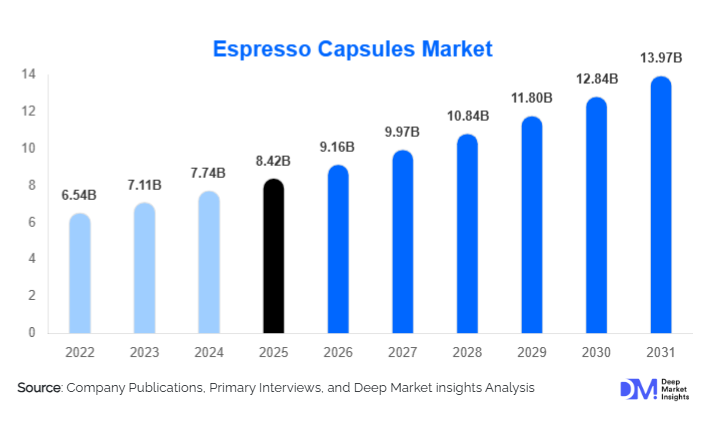
According to Deep Market Insights, the global espresso capsules market size was valued at USD 8.42 billion in 2025 and is projected to grow from USD 9.16 billion in 2026 to reach USD 13.97 billion by 2031, expanding at a CAGR of 8.8% during the forecast period (2026–2031). The espresso capsules market growth is primarily driven by rising demand for premium coffee experiences at home and workplaces, increasing adoption of single-serve coffee machines, and continuous innovation in recyclable and compostable capsule technologies. Growing consumer preference for convenience, consistent brewing quality, and specialty coffee blends is further supporting long-term market expansion.
Key Market Insights
- Sustainable espresso capsules are witnessing rapid adoption, with recyclable aluminum and compostable capsule formats becoming key product innovations across developed markets.
- Premium coffee consumption continues to expand globally, supported by increasing demand for specialty blends, gourmet coffee, and convenient single-serve brewing solutions.
- Europe dominates the global market owing to its established coffee culture, high penetration of capsule coffee machines, and strong premium coffee consumption.
- Asia-Pacific remains the fastest-growing regional market, driven by expanding urban populations, rising disposable income, and growing café culture in China, India, Japan, and South Korea.
- Household consumption accounts for the largest share, supported by increasing ownership of home espresso machines and subscription-based coffee services.
- Smart coffee ecosystems, including connected brewing machines, AI-enabled coffee customization, and direct-to-consumer subscription platforms, are transforming consumer purchasing behavior.
Espresso Capsules Market Latest Trends
Sustainable and Compostable Capsules Becoming Mainstream
Environmental sustainability is becoming one of the strongest trends shaping the espresso capsules industry. Coffee manufacturers are investing heavily in recyclable aluminum capsules, bio-based materials, and industrially compostable capsule formats to reduce packaging waste and improve recycling rates. Premium brands are also introducing responsibly sourced coffee beans alongside eco-friendly packaging to strengthen brand positioning. Governments across Europe continue implementing stricter packaging regulations, encouraging manufacturers to accelerate innovation in sustainable capsule technologies. These developments are improving consumer acceptance while supporting long-term environmental objectives across the coffee value chain.
Growth of Connected Coffee Machines and Subscription Services
The integration of smart technologies into coffee machines is enhancing the overall consumer experience. Connected espresso machines now offer customized brewing profiles, smartphone-based operation, maintenance alerts, and automated capsule replenishment through subscription services. Direct-to-consumer business models are expanding rapidly as coffee brands strengthen customer loyalty through personalized coffee recommendations and recurring deliveries. The combination of premium coffee experiences, digital convenience, and advanced brewing technologies continues to reshape purchasing decisions across residential and commercial consumers.
Espresso Capsules Market Drivers
Growing Preference for Premium Coffee at Home
Consumers increasingly seek café-quality beverages without leaving their homes, driving substantial investments in capsule coffee systems. Rising disposable incomes, busy lifestyles, and increasing appreciation for specialty coffee have accelerated adoption of espresso capsule machines worldwide. Manufacturers continue expanding premium coffee portfolios with single-origin beans, organic blends, flavored varieties, and limited-edition offerings to attract consumers seeking convenience without compromising taste. The expanding penetration of household coffee machines continues to strengthen long-term demand across developed and emerging economies.
Expansion of Specialty Coffee Culture
The global specialty coffee movement continues to fuel espresso capsule consumption as consumers increasingly value consistent brewing quality and premium coffee experiences. Independent cafés, coffee chains, hospitality operators, and workplace coffee programs are also adopting capsule systems to deliver standardized beverages with minimal preparation time. Continuous product innovation, wider retail availability, and growing online sales channels further reinforce long-term industry expansion.
Espresso Capsules Market Restraints
Environmental Concerns Associated with Single-Use Packaging
Despite continuous advancements in recyclable and compostable materials, environmental concerns surrounding single-use coffee capsules remain a major restraint for market expansion. Limited recycling infrastructure in several countries and inconsistent consumer participation in recycling programs reduce overall sustainability performance. Regulatory pressure regarding plastic waste management is encouraging manufacturers to redesign packaging, increase recycled content, and develop environmentally responsible disposal solutions, which may increase production costs.
Machine Compatibility Limitations
The presence of multiple proprietary capsule formats creates compatibility challenges between coffee capsules and brewing machines. Consumers often remain restricted to brand-specific systems, limiting purchasing flexibility and increasing dependence on original manufacturers. These compatibility constraints continue to influence purchasing decisions while creating technical and operational complexities for third-party capsule producers.
Espresso Capsules Industry Key Opportunities
Expansion of Compostable Capsule Technologies
The growing global emphasis on sustainable packaging presents significant opportunities for compostable espresso capsules manufactured from renewable plant-based materials. Companies investing in certified biodegradable packaging, circular economy initiatives, and environmentally responsible coffee sourcing are expected to strengthen competitive positioning. Rising consumer awareness regarding sustainable consumption continues supporting investment across the entire espresso capsule supply chain.
Growth of Emerging Coffee Markets
Rapid urbanization, rising middle-class incomes, and increasing coffee consumption across Asia-Pacific, Latin America, and the Middle East create substantial opportunities for premium espresso capsule manufacturers. Expansion of organized retail, e-commerce platforms, premium hospitality establishments, and modern workplaces is increasing demand for convenient single-serve coffee solutions across emerging economies.
Report Scope
| Report Metric | Details |
|---|---|
| Market Size in 2025 | USD 8.42 Billion |
| Market Size in 2026 | USD 9.16 Billion |
| Market Size in 2031 | USD 13.97 Billion |
| CAGR | 8.8% (2026-2031) |
| Base Year for Estimation | 2025 |
| Historical Data | 2022-2024 |
| Forecast Period | 2026-2031 |
| Report Coverage | Revenue Forecast, Competitive Landscape, Supply Chain Disruption, Growth Factors, Environment & Regulatory Landscape and Trends |
| Geographies Covered | North America, Europe, APAC, Middle East and Africa, LATAM |
| Countries Covered | U.S., Canada, U.K., Germany, France, Spain, Italy, Russia, Nordic, Benelux, Rest of Europe, China, Korea, Japan, India, Australia, Singapore, Taiwan, South East Asia, Rest of Asia-Pacific, UAE, Turky, Saudi Arabia, South Africa, Egypt, Nigeria, Rest of MEA, Brazil, Mexico, Argentina, Chile, Colombia, Rest of LATAM |
Explore more data points, trends and opportunities Download Free Sample Report
Type Insights
Aluminum capsules dominate the global market due to their superior oxygen barrier properties, excellent aroma preservation, extended shelf life, and compatibility with premium coffee brands. Plastic capsules continue maintaining an important position by offering cost-effective manufacturing and broad machine compatibility, particularly within value-oriented consumer segments. Compostable capsules represent the fastest-growing category as consumers increasingly prioritize sustainable packaging solutions. Manufacturers continue investing in innovative bio-based materials capable of maintaining brewing performance while minimizing environmental impact, positioning compostable capsules as a major future growth segment.
Application Insights
Household applications account for the largest share of the espresso capsules market owing to widespread adoption of home coffee machines and increasing consumer preference for café-quality beverages prepared within minutes. Commercial establishments including cafés, hotels, restaurants, and hospitality venues continue expanding capsule usage to improve operational efficiency and beverage consistency. Office applications are also experiencing steady growth as organizations increasingly install premium coffee systems to improve workplace amenities, employee satisfaction, and overall convenience.
Distribution Channel Insights
Supermarkets and hypermarkets remain major distribution channels by providing broad product availability and extensive brand visibility. Online retail continues registering the fastest expansion as consumers increasingly purchase coffee capsules through e-commerce platforms and manufacturer-operated subscription services. Specialty coffee retailers, direct-to-consumer websites, and premium gourmet stores continue strengthening market penetration by offering exclusive coffee blends, personalized recommendations, and recurring delivery programs that improve customer retention.
Material Insights
Metal-based capsules, primarily aluminum, continue leading the market because of their excellent recyclability, superior product protection, and premium positioning. Plastic materials remain widely utilized due to manufacturing flexibility and lower production costs despite increasing environmental scrutiny. Bio-based and compostable materials are rapidly gaining market acceptance as manufacturers align product portfolios with sustainability regulations and changing consumer preferences for environmentally responsible packaging solutions.
Explore more data points, trends and opportunities Download Free Sample Report
Espresso Capsules Market Segmentations
By Type
- Aluminum Capsules
- Plastic Capsules
- Compostable Capsules
By Application
- Household
- Commercial
- Offices
By Distribution Channel
- Supermarkets & Hypermarkets
- Online Retail
- Specialty Stores
- Direct-to-Consumer
- Convenience Stores
Regional Insights
North America
North America represents one of the largest regional markets for espresso capsules, supported by strong premium coffee consumption, widespread household ownership of capsule coffee machines, and growing subscription-based coffee services. The United States dominates regional demand, while Canada continues experiencing increasing adoption of sustainable coffee products and premium brewing systems. Growing investments in specialty coffee brands and connected coffee technologies continue supporting long-term regional expansion.
Europe
Europe remains the leading regional market owing to its deeply established coffee culture, high penetration of capsule brewing systems, and widespread acceptance of premium espresso beverages. Germany, France, Italy, Switzerland, Spain, and the United Kingdom collectively account for the majority of regional demand. Strong sustainability regulations, extensive recycling infrastructure, and continuous product innovation position Europe as the global leader in premium espresso capsule consumption.
Asia-Pacific
Asia-Pacific is projected to record the fastest market growth during the forecast period as coffee consumption expands rapidly across China, India, Japan, South Korea, and Australia. Urbanization, rising disposable incomes, growing café culture, and increasing exposure to international coffee brands continue accelerating household adoption of espresso capsule systems. Premium coffee retail expansion and digital commerce platforms further strengthen regional growth prospects.
Latin America
Latin America benefits from its position as one of the world's largest coffee-producing regions while gradually expanding domestic premium coffee consumption. Brazil, Mexico, Chile, and Argentina continue witnessing rising adoption of single-serve brewing solutions as premium coffee culture develops across urban populations. Increasing investments in organized retail and specialty coffee chains continue supporting regional market development.
Middle East & Africa
The Middle East & Africa is emerging as a promising regional market driven by rapid expansion of luxury hospitality, premium cafés, and modern office infrastructure. The United Arab Emirates and Saudi Arabia remain major demand centers due to high disposable income and premium lifestyle preferences, while South Africa continues expanding specialty coffee consumption through organized retail and growing café culture.
Key Players in the Espresso Capsules Market
- Nestlé S.A.
- JDE Peet's N.V.
- Luigi Lavazza S.p.A.
- illycaffè S.p.A.
- Starbucks Corporation
- Keurig Dr Pepper Inc.
- Tchibo GmbH
- Kimbo S.p.A.
- Caffitaly System S.p.A.
- Dualit Limited
- Ethical Coffee Company
- Café Royal
- Jacobs Douwe Egberts
- L'OR Coffee
- Peet's Coffee