Latte Instant Coffee Market Size
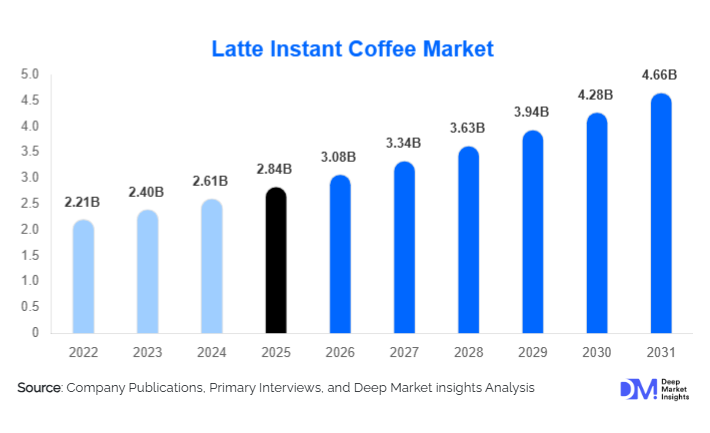
According to Deep Market Insights, the global latte instant coffee market size was valued at USD 2.84 billion in 2025 and is projected to grow from USD 3.03 billion in 2026 to reach USD 4.66 billion by 2031, expanding at a CAGR of 8.6% during the forecast period (2026–2031). Market expansion is supported by the increasing consumer preference for premium instant beverages, growing demand for café-style coffee at home and workplaces, wider availability through organized retail and e-commerce channels, and continuous product innovations in flavored, low-sugar, and functional instant coffee formulations.
Key Market Insights
- Premium and café-style instant beverages are becoming mainstream, supported by increasing consumer demand for convenience, superior taste, and barista-inspired coffee experiences.
- Asia-Pacific dominates the market, accounting for approximately 42.8% of global revenue, driven by strong consumption in China, Japan, South Korea, and India.
- Middle East & Africa is projected to witness the fastest growth, fueled by rapid urbanization, premium coffee adoption, and expansion of modern retail infrastructure.
- Original latte products remain the largest category, while flavored latte variants are witnessing the fastest adoption due to continuous product innovation.
- Online retail continues to gain momentum, supported by subscription-based coffee services, direct-to-consumer sales, and digital shopping platforms.
- Sustainable packaging, freeze-drying technology, and plant-based formulations are reshaping product development across the global market.
Latte Instant Coffee Market Trends
Premium and Functional Instant Coffee Products Expanding
Manufacturers are increasingly introducing premium latte instant coffee products enriched with plant-based milk, collagen, protein, probiotics, and reduced-sugar formulations. Consumers are seeking café-quality beverages that can be prepared within seconds while offering enhanced nutritional value and premium taste. Flavored varieties including vanilla, caramel, hazelnut, mocha, and seasonal editions continue to gain popularity among younger consumers. Companies are also investing in premium freeze-drying technologies to preserve aroma, flavor, and product quality while expanding their premium product portfolios across developed and emerging markets.
Digital Retail and Sustainable Packaging Accelerating Market Evolution
E-commerce platforms are becoming one of the fastest-growing sales channels for latte instant coffee as consumers increasingly prefer online grocery shopping and subscription-based beverage services. Manufacturers are simultaneously investing in recyclable packaging materials, biodegradable sachets, lightweight containers, and environmentally responsible sourcing practices. Smart manufacturing technologies, automated filling systems, and digital quality monitoring are improving production efficiency while supporting sustainability goals. These innovations are strengthening product accessibility, enhancing consumer convenience, and supporting long-term market expansion.
Latte Instant Coffee Market Drivers
Growing Consumer Preference for Convenient Premium Coffee
Rapid urbanization, busy lifestyles, and increasing disposable income are encouraging consumers to choose premium instant coffee products that deliver café-style experiences without requiring specialized brewing equipment. Growing work-from-home culture, office coffee consumption, and increasing demand for quick beverage preparation continue to support product adoption. Premium latte instant coffee products also benefit from rising acceptance among younger professionals who prioritize convenience, consistent quality, and product variety.
Expanding Coffee Culture Across Emerging Economies
The expansion of café culture across Asia-Pacific, the Middle East, and Latin America is significantly increasing consumer awareness of premium coffee products. Manufacturers are leveraging this trend by introducing localized flavors, region-specific formulations, and affordable premium offerings. Retailers continue expanding shelf space for premium instant beverages, while online platforms enable brands to reach consumers in previously underpenetrated markets, accelerating long-term industry expansion.
Latte Instant Coffee Market Restraints
Volatile Coffee Bean and Dairy Ingredient Prices
Fluctuating global prices of Arabica coffee beans, dairy ingredients, sugar, and packaging materials continue to impact manufacturing costs. Transportation expenses, currency fluctuations, and supply chain disruptions also increase production costs and create pricing pressure for manufacturers. These cost variations may reduce profit margins and influence retail pricing strategies, particularly for premium latte instant coffee products.
Intense Competition from Freshly Brewed and Ready-to-Drink Coffee
The growing availability of specialty cafés, ready-to-drink coffee beverages, capsule coffee systems, and home brewing machines presents competitive pressure for instant coffee manufacturers. Consumers seeking freshly brewed coffee experiences may prefer alternative beverage formats, requiring instant coffee producers to continuously innovate in taste, texture, convenience, and packaging to remain competitive.
Latte Instant Coffee Market Opportunities
Expansion of Functional and Health-Oriented Coffee Products
Growing consumer interest in health and wellness is creating opportunities for manufacturers to develop functional latte instant coffee formulations enriched with protein, vitamins, collagen, adaptogens, probiotics, and plant-based ingredients. Low-calorie, sugar-free, lactose-free, and vegan products are expected to attract new consumer segments while supporting premium pricing strategies.
Growing Penetration Across Emerging Markets
Rapid urbanization, rising disposable income, increasing internet penetration, and expanding organized retail networks across India, Southeast Asia, the Middle East, and Africa are creating attractive growth opportunities. Manufacturers are investing in localized production facilities, regional partnerships, and digital marketing initiatives to strengthen market presence and improve product accessibility across developing economies.
Report Scope
| Report Metric | Details |
|---|---|
| Market Size in 2025 | USD 2.84 Billion |
| Market Size in 2026 | USD 3.08 Billion |
| Market Size in 2031 | USD 4.66 Billion |
| CAGR | 8.6% (2026-2031) |
| Base Year for Estimation | 2025 |
| Historical Data | 2022-2024 |
| Forecast Period | 2026-2031 |
| Report Coverage | Revenue Forecast, Competitive Landscape, Supply Chain Disruption, Growth Factors, Environment & Regulatory Landscape and Trends |
| Geographies Covered | North America, Europe, APAC, Middle East and Africa, LATAM |
| Countries Covered | U.S., Canada, U.K., Germany, France, Spain, Italy, Russia, Nordic, Benelux, Rest of Europe, China, Korea, Japan, India, Australia, Singapore, Taiwan, South East Asia, Rest of Asia-Pacific, UAE, Turky, Saudi Arabia, South Africa, Egypt, Nigeria, Rest of MEA, Brazil, Mexico, Argentina, Chile, Colombia, Rest of LATAM |
Explore more data points, trends and opportunities Download Free Sample Report
Product Type Insights
Original latte products account for the largest share of the latte instant coffee market owing to their broad consumer acceptance, balanced coffee-to-milk flavor profile, affordability, and widespread availability across both developed and emerging economies. Consumers continue to prefer original formulations for everyday consumption at home, workplaces, and institutional settings due to their consistent taste, quick preparation, and compatibility with different serving preferences. The segment also benefits from strong retail penetration, frequent promotional campaigns, and extensive product portfolios offered by leading manufacturers. Continuous improvements in freeze-drying technology and premium coffee blends have further enhanced product quality, allowing brands to deliver café-style beverages while maintaining convenience, making original latte products the leading contributor to overall market revenue.
Flavored latte products represent the fastest-growing segment as manufacturers continue introducing innovative flavors such as caramel, vanilla, hazelnut, mocha, chocolate, and seasonal limited-edition offerings that appeal particularly to millennials and Gen Z consumers. Growing consumer willingness to experiment with premium coffee experiences, increasing café culture, and the influence of social media on beverage trends are accelerating demand for flavored instant coffee. Companies are also launching sugar-free, protein-enriched, and plant-based flavored variants to target health-conscious consumers while differentiating their product portfolios in an increasingly competitive market.
Low-fat latte products are steadily gaining popularity among consumers seeking healthier beverage alternatives without compromising taste or convenience. Rising awareness regarding calorie intake, weight management, and balanced nutrition is encouraging demand for reduced-fat formulations. Manufacturers are responding by introducing lactose-free, plant-based, low-sugar, and fortified latte instant coffee products enriched with protein, vitamins, probiotics, collagen, and functional ingredients. These innovations are expanding the consumer base beyond traditional coffee drinkers and creating attractive opportunities within the premium health and wellness beverage category.
Distribution Channel Insights
Supermarkets and hypermarkets continue to dominate the distribution landscape owing to their extensive product assortment, attractive promotional pricing, organized shelf placement, and strong relationships with global beverage manufacturers. Consumers prefer these retail formats because they offer multiple brands, pack sizes, premium product variants, and convenient one-stop shopping experiences. The rapid expansion of organized retail chains across emerging economies, coupled with increasing investments in premium grocery formats, continues to strengthen the leadership of this distribution channel.
Online retail is projected to witness the fastest growth throughout the forecast period, supported by rising internet penetration, increasing smartphone usage, expanding digital payment infrastructure, and growing consumer preference for home delivery. Subscription-based coffee services, direct-to-consumer platforms, personalized product recommendations, and exclusive online product launches are encouraging repeat purchases. E-commerce platforms also enable manufacturers to introduce premium and niche coffee products while reaching consumers in underserved markets, making online retail an increasingly important growth driver.
Convenience stores continue to maintain a significant market presence by serving consumers seeking quick purchases and immediate product availability. Their strategic locations near residential neighborhoods, transportation hubs, offices, and educational institutions support frequent impulse purchases of single-serve sachets and compact packaging formats. Additionally, specialty food retailers and premium grocery chains are expanding their premium instant coffee offerings, catering to consumers seeking gourmet, organic, sustainably sourced, and functional coffee products.
Explore more data points, trends and opportunities Download Free Sample Report
Latte Instant Coffee Market Segmentations
By Product Type
- Original Latte
- Flavored Latte
- Low-fat Latte
By Distribution Channel
- Supermarkets & Hypermarkets
- Online Retail
- Convenience Stores
Regional Insights
Asia-Pacific
Asia-Pacific dominates the global latte instant coffee market and is expected to maintain its leadership throughout the forecast period. China, Japan, South Korea, and India remain the major revenue contributors, supported by expanding middle-class populations, increasing disposable income, rapid urbanization, and changing beverage consumption habits. The growing influence of café culture, particularly among younger consumers, has accelerated demand for premium instant coffee products that offer convenience without compromising quality. Strong manufacturing capabilities, abundant regional distribution networks, and continuous product innovation by both multinational and domestic companies further strengthen regional market leadership. Government support for food processing industries, increasing organized retail penetration, and the rapid expansion of e-commerce platforms continue to create favorable conditions for sustained regional growth.
North America
North America represents one of the most established premium instant coffee markets, driven by high consumer purchasing power, busy lifestyles, and increasing preference for convenient café-style beverages prepared at home and in offices. The growing work-from-home and hybrid working culture has significantly increased household coffee consumption, encouraging consumers to purchase premium instant latte products with enhanced flavor profiles and functional ingredients. Rising demand for organic, clean-label, low-sugar, and plant-based coffee products, combined with strong e-commerce infrastructure and subscription-based coffee services, continues to support market expansion across the United States and Canada. Continuous product innovation and premiumization remain the primary regional growth drivers.
Europe
Europe remains a mature yet highly attractive market, supported by one of the world's strongest coffee-drinking cultures. Countries including Germany, the United Kingdom, France, Italy, and Spain continue to generate substantial demand for premium instant coffee products featuring sustainably sourced coffee beans, recyclable packaging, and superior freeze-dried formulations. Growing consumer awareness regarding environmental sustainability, ethical sourcing, and premium product quality encourages manufacturers to invest in certified coffee sourcing and eco-friendly packaging solutions. The presence of leading global coffee manufacturers, established retail infrastructure, and continuous innovation in premium coffee formulations further contribute to stable regional growth.
Latin America
Latin America is experiencing steady expansion as premium coffee consumption continues to increase across Brazil, Mexico, Argentina, Chile, and Colombia. Brazil remains the largest regional contributor owing to its position as one of the world's leading coffee producers, abundant raw material availability, and expanding domestic demand for value-added coffee products. Increasing urbanization, rising disposable income, modernization of retail channels, and greater consumer exposure to premium international brands are supporting market development. Growing investments in organized retail, digital commerce, and premium packaged beverages are further strengthening long-term regional growth prospects.
Middle East & Africa
The Middle East & Africa is expected to register the fastest growth during the forecast period, driven by rapid urbanization, increasing premium beverage consumption, and expanding café culture across the UAE, Saudi Arabia, South Africa, Qatar, and other Gulf countries. Rising disposable incomes, a young consumer population, and growing preference for international coffee brands continue to stimulate demand for premium instant coffee products. Significant investments in modern supermarkets, convenience retail formats, hospitality infrastructure, and digital grocery platforms are improving product accessibility throughout the region. Additionally, increasing tourism, expansion of international coffee chains, and growing adoption of Western beverage consumption patterns are expected to further accelerate long-term market growth across the Middle East and Africa.
Key Players in the Latte Instant Coffee Market
- Nestlé S.A.
- Starbucks Corporation
- The J.M. Smucker Company
- JDE Peet's N.V.
- Tata Consumer Products Limited
- Luigi Lavazza S.p.A.
- Massimo Zanetti Beverage Group
- UCC Holdings Co., Ltd.
- Trung Nguyen Legend
- OldTown Berhad
- Lotte Chilsung Beverage Co., Ltd.
- Ajinomoto General Foods, Inc.