Sugar Free Beer Market Size
According to Deep Market Insights, the global Sugar Free Beer market size was valued at USD 3.8 billion in 2025 and is projected to grow from USD 4.31 billion in 2026 to reach USD 8.12 billion by 2031, expanding at a CAGR of 13.5% during the forecast period (2026–2031). The Sugar Free Beer market growth is primarily driven by increasing consumer preference for low-carbohydrate beverages, rising health awareness, demand for diabetic-friendly drinks, and continuous innovation in fermentation and brewing technologies.
Key Market Insights
- Sugar Free Beer is increasingly gaining traction as a health-focused alcoholic beverage category, supported by rising demand for reduced-sugar and low-calorie drinks among global consumers.
- North America dominates the Sugar Free Beer market, accounting for approximately 38% market share in 2025, while Asia-Pacific represents the fastest-growing region with a projected CAGR of 16.8% during 2026–2031.
- Alcoholic Sugar Free Beer remains the dominant product segment, contributing nearly 56% of market share, while Non-Alcoholic Sugar Free Beer is witnessing faster adoption due to wellness trends.
- Retail Consumption leads application demand, representing nearly 52% share due to increasing supermarket availability, premium beverage adoption, and consumer preference for home consumption.
- India is emerging as a high-growth market, projected to reach approximately USD 420 million by 2031, expanding at around 18.5% CAGR due to urbanization and rising health-conscious consumers.
- Technological advancements in brewing, including modified yeast strains, enzyme-based fermentation, and advanced filtration systems, are improving sugar reduction efficiency and product quality.
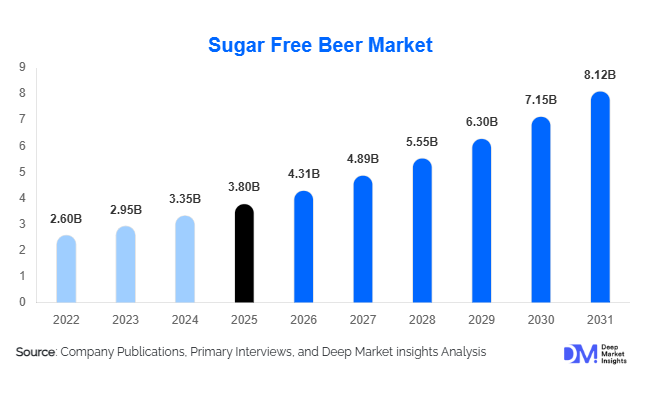
Sugar Free Beer Market Latest Trends
Health-Oriented Brewing Innovation
Sugar Free Beer manufacturers are increasingly adopting advanced fermentation technologies to develop beverages with reduced sugar content while maintaining traditional beer flavor profiles. Global Sugar Free Beer production reached approximately 1.6 billion liters in 2025, with nearly 35% of new beer launches between 2023 and 2025 featuring reduced-sugar positioning. Modified yeast strains, enzyme treatment, and precision fermentation technologies have improved sugar reduction efficiency by nearly 20%–30%. Demand from fitness-oriented consumers, diabetic-conscious populations, and low-carbohydrate diet followers continues to increase, strengthening the overall Sugar Free Beer market Trend.
Growth of Non-Alcoholic and Functional Beer Categories
Non-Alcoholic Sugar Free Beer production reached approximately 520 million liters in 2025, supported by increasing adoption among younger consumers and wellness-focused demographics. Around 28% of new beer consumers are showing preference toward alcohol-free and sugar-free alternatives, particularly in developed markets. Advanced brewing systems such as vacuum distillation and membrane filtration have improved production efficiency by nearly 25%. Foodservice demand for Sugar Free Beer alternatives is growing at approximately 18% annually, supporting the expansion of the Sugar Free Beer market Trend.
Sugar Free Beer Market Drivers
Increasing Consumer Preference for Low-Carbohydrate Beverages
Growing health awareness is one of the strongest drivers influencing Sugar Free Beer market expansion. Approximately 48% of global beer consumers now review sugar and carbohydrate information before purchasing beverages. Production of low-sugar alcoholic drinks increased by nearly 30% between 2022 and 2025, while demand for diabetic-friendly beverages expanded by approximately 15% annually. Breweries are developing products containing less than 1 gram of sugar per 100 ml, improving acceptance among health-conscious consumers. These changing preferences continue to accelerate Sugar Free Beer market Growth.
Sugar Free Beer Market Restraints
High Production Costs and Consumer Taste Concerns
The Sugar Free Beer market faces limitations due to higher manufacturing costs associated with specialized brewing processes. Production expenses are approximately 12%–20% higher compared with conventional beer due to advanced fermentation and filtration requirements. Around 27% of consumers express concerns regarding flavor differences, while nearly 18% remain uncertain about product authenticity. Small breweries often require investments between USD 500,000 and USD 2 million for specialized equipment, restricting market participation and affecting Sugar Free Beer market Growth.
Sugar Free Beer Market Opportunities
Expansion Across Emerging Markets and Digital Distribution
Emerging economies provide significant growth opportunities for Sugar Free Beer manufacturers, with Asia-Pacific expected to register a CAGR of approximately 16.8% during 2026–2031. Online beverage sales increased by nearly 35% between 2022 and 2025, improving product accessibility among younger consumers. India, China, and Southeast Asian countries collectively represent more than 30% of future demand potential. Growing investment in digital retail channels and localized product development is creating new opportunities for Sugar Free Beer market Demand.
Challenges in Sugar Free Beer Market
Regulatory Differences and Limited Consumer Awareness
Different sugar labeling regulations across countries create operational challenges for global Sugar Free Beer producers. Approximately 40% of international markets require different nutritional disclosure formats, increasing compliance costs by nearly 5%–10%. Consumer awareness remains below 35% in several developing markets, limiting penetration. Traditional beer preferences, limited distribution infrastructure, and premium pricing continue to challenge Sugar Free Beer market expansion.
Sugar Free Beer Market Segmentation
The Sugar Free Beer market segmentation is analyzed based on type and application, with type-based segmentation representing the largest category due to differences in brewing technology and consumer preferences. Alcoholic Sugar Free Beer dominated the market with approximately 56% share in 2025, while Retail Consumption remained the leading application segment with nearly 52% share.
Report Scope
| Report Metric | Details |
|---|---|
| Market Size in 2025 | USD 3.80 Billion |
| Market Size in 2026 | USD 4.31 Billion |
| Market Size in 2031 | USD 8.12 Billion |
| CAGR | 13.5% (2026-2031) |
| Base Year for Estimation | 2025 |
| Historical Data | 2022-2024 |
| Forecast Period | 2026-2031 |
| Report Coverage | Revenue Forecast, Competitive Landscape, Supply Chain Disruption, Growth Factors, Environment & Regulatory Landscape and Trends |
| Geographies Covered | North America, Europe, APAC, Middle East and Africa, LATAM |
| Countries Covered | U.S., Canada, U.K., Germany, France, Spain, Italy, Russia, Nordic, Benelux, Rest of Europe, China, Korea, Japan, India, Australia, Singapore, Taiwan, South East Asia, Rest of Asia-Pacific, UAE, Turky, Saudi Arabia, South Africa, Egypt, Nigeria, Rest of MEA, Brazil, Mexico, Argentina, Chile, Colombia, Rest of LATAM |
Explore more data points, trends and opportunities Download Free Sample Report
BY TYPE
Alcoholic Sugar Free Beer: Alcoholic Sugar Free Beer accounted for approximately 56% market share in 2025, with global production reaching nearly 900 million liters. These products generally contain less than 1 gram of sugar per serving and utilize modified yeast technology to reduce residual carbohydrates while maintaining alcoholic content.Non-Alcoholic Sugar Free Beer: Non-Alcoholic Sugar Free Beer represented nearly 31% market share, producing approximately 520 million liters in 2025. These products contain less than 0.5% alcohol volume and use advanced filtration and fermentation techniques to deliver healthier alternatives.Low-Calorie Sugar Free Beer: Low-Calorie Sugar Free Beer contributed approximately 13% share, with production reaching nearly 210 million liters. These products offer around 30%–50% fewer calories compared with traditional beer formulations.
BY APPLICATION
Retail Consumption: Retail Consumption dominated the Sugar Free Beer market application segment with approximately 52% share and more than 830 million liters in sales during 2025. Supermarkets, specialty beverage stores, and convenience retailers are expanding product availability, with consumer penetration exceeding 30% among premium beer buyers.Foodservice: Foodservice applications accounted for approximately 33% market share, consuming nearly 530 million liters in 2025. Restaurants, hotels, and bars are increasingly introducing Sugar Free Beer options, with adoption reaching approximately 22% among premium dining establishments.Online Distribution: Online Distribution represented nearly 15% share, with sales exceeding 240 million liters. Digital platforms recorded growth above 35% annually, supported by direct-to-consumer sales and subscription-based beverage models.
Explore more data points, trends and opportunities Download Free Sample Report
Sugar Free Beer Market Segmentations
By Type
- Alcoholic Sugar Free Beer
- Non-Alcoholic Sugar Free Beer
- Low-Calorie Sugar Free Beer
By Application
- Retail Consumption
- Foodservice
- Online Distribution
Sugar Free Beer Market Regional Insights
North America
North America dominates the global Sugar Free Beer market, accounting for approximately 38% market share in 2025 with revenue generation of nearly USD 1.4 billion. The region produced more than 600 million liters of Sugar Free Beer during 2025, supported by strong consumer awareness regarding low-carbohydrate beverages and premium health-oriented alcohol products. The United States contributed approximately 75% of regional demand, while Canada and Mexico accounted for around 15% and 10%, respectively. Alcoholic Sugar Free Beer represents nearly 58% of North American consumption, while Non-Alcoholic Sugar Free Beer contributes approximately 32%. Retail channels dominate regional distribution with more than 55% share, supported by supermarket expansion, premium beverage shelves, and growing demand among fitness-focused consumers.
Europe
Europe represents the second-largest Sugar Free Beer market region, accounting for approximately 30% market share in 2025 with production exceeding 480 million liters. Germany, the United Kingdom, and France collectively contribute nearly 65% of regional demand due to established beer consumption culture and increasing interest in healthier beverage alternatives. Non-Alcoholic Sugar Free Beer holds approximately 38% share in Europe, supported by consumer preference for moderate alcohol consumption and wellness-focused lifestyles. Retail distribution contributes nearly 50% of sales, while foodservice channels represent approximately 35%.
Asia-Pacific
Asia-Pacific is the fastest-growing Sugar Free Beer market region, projected to expand at a CAGR of approximately 16.8% during 2026–2031. The region generated nearly USD 600 million in revenue in 2025 with production reaching approximately 350 million liters. China contributed nearly 35% of regional consumption, while India accounted for around 22%. Japan, Australia, and Southeast Asian countries collectively represent significant emerging demand due to increasing disposable income and changing beverage preferences.The Asia-Pacific Sugar Free Beer market is experiencing strong adoption through digital retail channels, with online sales representing nearly 20% of regional distribution. Urban consumers, particularly younger demographics, are driving demand for low-calorie and functional beverages. India is expected to become one of the fastest-growing markets, reaching approximately USD 420 million by 2031 at a CAGR of 18.5%. Increasing fitness awareness, premium beverage consumption, and expansion of international brewery brands are accelerating Sugar Free Beer market Growth in the region.
Latin America
Latin America accounted for approximately 7% of the global Sugar Free Beer market share in 2025, with production reaching nearly 110 million liters. Brazil and Mexico represent the largest contributors, collectively accounting for approximately 70% of regional consumption. The market is supported by increasing urbanization, rising middle-class income levels, and growing awareness of healthier alcohol alternatives. Retail consumption contributes nearly 55% of regional sales, while foodservice applications account for approximately 30%.Sugar Free Beer adoption in Latin America is concentrated in major metropolitan areas where consumers increasingly prefer premium and functional beverages. Approximately 15% annual growth is being recorded in urban demand segments, particularly among younger consumers and fitness-oriented populations. International breweries are expanding distribution networks across Brazil, Mexico, and Argentina to capture emerging opportunities and strengthen the regional Sugar Free Beer market Demand.
Middle East & Africa
The Middle East & Africa region represented approximately 5% market share in 2025, with production estimated at nearly 80 million liters. Demand is primarily concentrated in urban hospitality sectors, where Non-Alcoholic Sugar Free Beer represents more than 50% of regional consumption. Countries including the United Arab Emirates, Saudi Arabia, and South Africa contribute significantly to regional sales due to rising premium beverage demand and expanding tourism industries.The Middle East & Africa Sugar Free Beer market is supported by increasing availability of alcohol-free alternatives, health-focused consumer preferences, and hospitality sector expansion. Approximately 25% of premium hotels in major cities have expanded healthier beverage offerings, supporting category awareness. Investments in modern retail infrastructure and digital commerce platforms are expected to improve product accessibility and contribute to long-term Sugar Free Beer market Growth.
Key Players in the Sugar Free Beer Market
- Anheuser-Busch InBev
- Heineken N.V.
- Carlsberg Group
- Molson Coors Beverage Company
- Asahi Group Holdings
- Kirin Holdings Company
- Diageo
- Constellation Brands
- Boston Beer Company
- Suntory Holdings