Galangal Market Size
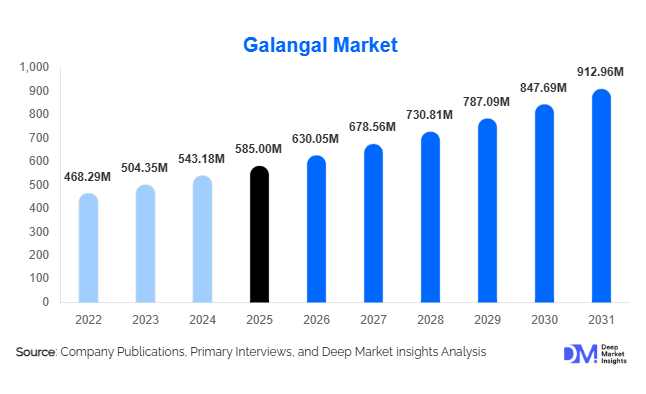
According to Deep Market Insights, the global galangal market size was valued at USD 585 million in 2025 and is projected to grow from USD 630.05 million in 2026 to reach USD 912.96 million by 2031, expanding at a CAGR of 7.7% during the forecast period (2026–2031). The market growth is being supported by increasing consumption of natural spices, expanding demand for traditional herbal ingredients, growing popularity of Asian cuisine worldwide, and rising utilization of galangal-derived extracts in nutraceutical, pharmaceutical, and personal care applications. Galangal has evolved from a regionally consumed rhizome in Southeast Asia into a globally traded botanical ingredient, finding applications across food processing, dietary supplements, herbal medicines, essential oils, and cosmetic formulations. Increasing consumer preference for clean-label ingredients, plant-based health products, and natural flavoring agents continues to strengthen demand across developed and emerging markets. Furthermore, advancements in ingredient standardization, organic cultivation practices, and extraction technologies are enabling suppliers to target premium-value segments, supporting long-term market expansion.
Key Market Insights
- Food and beverage applications account for nearly 48% of global demand, making them the largest application segment for galangal products worldwide.
- Greater galangal (Alpinia galanga) dominates species consumption, contributing approximately 62% of global market revenue due to its widespread use in culinary and medicinal applications.
- Asia-Pacific leads the global market, accounting for nearly 58% of global consumption owing to strong production and domestic demand in Thailand, Indonesia, India, Vietnam, and China.
- Nutraceutical and dietary supplement applications represent the fastest-growing segment, supported by increasing demand for immunity-enhancing botanical ingredients.
- Organic galangal cultivation is gaining momentum globally, driven by consumer demand for certified natural ingredients and premium herbal products.
- Extract-based galangal ingredients are witnessing accelerated adoption, particularly in pharmaceuticals, functional beverages, and personal care formulations.
Galangal Market Latest Trends
Expansion of Functional Food and Botanical Ingredient Applications
Galangal is increasingly being incorporated into functional food products, herbal beverages, dietary supplements, and nutraceutical formulations. Consumers are actively seeking ingredients with perceived digestive, anti-inflammatory, antioxidant, and immunity-supporting benefits. As a result, food manufacturers are introducing galangal-infused teas, wellness drinks, herbal shots, and plant-based nutritional products. Standardized galangal extracts are becoming more common in supplement formulations targeting digestive health and immune support. This trend is expanding the market beyond traditional culinary consumption and creating new value-added opportunities for ingredient manufacturers.
Growing Adoption of Organic and Sustainable Cultivation Practices
Organic galangal production is emerging as a significant trend across Southeast Asia and South Asia. Exporters are increasingly obtaining organic certifications to address growing demand from Europe and North America, where consumers prefer sustainably sourced and chemical-free ingredients. Buyers are placing greater emphasis on traceability, environmental sustainability, and ethical sourcing practices. Farmers are also adopting regenerative agricultural methods and precision farming techniques to improve yields while maintaining soil health. These developments are enabling suppliers to command premium pricing and improve export competitiveness.
Galangal Market Drivers
Rising Global Popularity of Asian Cuisine
The growing popularity of Thai, Indonesian, Malaysian, and Vietnamese cuisines has significantly increased demand for galangal across international foodservice and retail channels. Restaurants, meal-kit providers, and food manufacturers are increasingly incorporating authentic Asian ingredients into their offerings. The expansion of Asian restaurant chains across North America, Europe, and the Middle East has further accelerated demand for fresh and processed galangal products. As consumers seek authentic culinary experiences, galangal continues to gain importance as a key flavoring ingredient.
Increasing Demand for Natural Herbal Ingredients
Consumers are shifting away from synthetic additives and increasingly adopting plant-derived ingredients for health and wellness purposes. Galangal contains bioactive compounds that are widely used in traditional medicine systems and herbal health products. Pharmaceutical and nutraceutical manufacturers are investing in botanical ingredient portfolios, creating sustained demand for galangal extracts, powders, and standardized formulations. This trend is particularly prominent in Europe, North America, Japan, and South Korea.
Growth of Nutraceutical and Functional Beverage Industries
The rapid expansion of the global nutraceutical industry is creating significant opportunities for galangal suppliers. Functional beverages, herbal supplements, and botanical wellness products are incorporating galangal as an active ingredient due to its traditional health associations. The increasing consumer focus on immunity, digestive wellness, and preventive healthcare is supporting strong demand from supplement manufacturers and functional food developers worldwide.
Galangal Market Restraints
Supply Chain Dependence on Southeast Asian Production
Global galangal production remains heavily concentrated in Southeast Asia, making the market vulnerable to climatic disruptions, crop diseases, labor shortages, and export restrictions. Adverse weather conditions such as flooding, droughts, and changing rainfall patterns can significantly impact yields and create supply volatility. Dependence on a limited number of producing countries continues to pose procurement risks for international buyers.
Lack of Standardization in Herbal Ingredient Markets
The absence of globally harmonized standards for galangal extracts and herbal ingredients creates challenges for manufacturers seeking regulatory approvals and consistent product quality. Variations in active compound concentrations, cultivation practices, and processing methods can affect product performance and market acceptance. Addressing quality consistency remains a key challenge for industry participants seeking expansion into pharmaceutical-grade applications.
Galangal Industry Key Opportunities
Expansion into Nutraceutical and Preventive Healthcare Markets
The global preventive healthcare movement presents significant opportunities for galangal-based ingredients. Nutraceutical manufacturers are increasingly developing botanical supplements focused on immunity enhancement, digestive support, and anti-inflammatory benefits. Standardized galangal extracts can be positioned as premium functional ingredients within high-growth wellness categories. As consumers continue prioritizing preventive health management, demand for clinically validated herbal ingredients is expected to increase substantially.
Growth of Organic and Premium Export Markets
Organic-certified galangal products command substantially higher prices in developed markets. Exporters that invest in certification programs, traceability systems, and sustainable sourcing initiatives can capitalize on growing demand from Europe, North America, Australia, and Japan. Premium organic galangal powders, extracts, and essential oils are increasingly being adopted by food manufacturers, supplement producers, and personal care brands seeking differentiated natural ingredients.
Report Scope
| Report Metric | Details |
|---|---|
| Market Size in 2025 | USD 585.00 Million |
| Market Size in 2026 | USD 630.05 Million |
| Market Size in 2031 | USD 912.96 Million |
| CAGR | 7.7% (2026-2031) |
| Base Year for Estimation | 2025 |
| Historical Data | 2022-2024 |
| Forecast Period | 2026-2031 |
| Report Coverage | Revenue Forecast, Competitive Landscape, Supply Chain Disruption, Growth Factors, Environment & Regulatory Landscape and Trends |
| Geographies Covered | North America, Europe, APAC, Middle East and Africa, LATAM |
| Countries Covered | U.S., Canada, U.K., Germany, France, Spain, Italy, Russia, Nordic, Benelux, Rest of Europe, China, Korea, Japan, India, Australia, Singapore, Taiwan, South East Asia, Rest of Asia-Pacific, UAE, Turky, Saudi Arabia, South Africa, Egypt, Nigeria, Rest of MEA, Brazil, Mexico, Argentina, Chile, Colombia, Rest of LATAM |
Explore more data points, trends and opportunities Download Free Sample Report
Product Type Insights
Fresh galangal rhizomes represent the largest product category, accounting for approximately 39% of the global market in 2025. The segment maintains its leadership position due to widespread utilization across restaurants, foodservice establishments, traditional culinary applications, and fresh ingredient retail channels. Fresh galangal is preferred by chefs and food manufacturers because it delivers superior aroma, flavor intensity, and authenticity compared to processed alternatives. The growing popularity of Southeast Asian cuisine globally, coupled with rising demand for premium and natural culinary ingredients, continues to support segment expansion. Increasing consumption of fresh herbs and spices in both developed and emerging markets further reinforces demand for fresh galangal products.Galangal powder is gaining traction among processed food manufacturers due to its convenience, consistent flavor profile, and formulation flexibility. The segment benefits from increasing incorporation into spice blends, seasonings, instant foods, sauces, and ready-to-cook meal products. Growing urbanization and consumer preference for convenience foods are expected to support sustained growth in powdered galangal demand.Galangal extracts constitute the fastest-growing product segment, driven by rising utilization across nutraceutical, pharmaceutical, functional food, and cosmetic applications. Manufacturers are increasingly investing in advanced extraction technologies to improve bioactive compound concentration, product consistency, and commercial scalability. The growing scientific validation of galangal’s antioxidant, antimicrobial, and anti-inflammatory properties is accelerating demand for standardized extracts in value-added applications, positioning the segment for robust long-term growth.
Application Insights
Food and beverage applications dominate the global galangal market, accounting for approximately 48% of total revenue in 2025. The segment benefits from extensive use in sauces, soups, curry pastes, spice blends, marinades, processed foods, functional beverages, and traditional Asian recipes. Rising global consumption of ethnic cuisines, increasing demand for natural flavoring agents, and the expansion of premium food product categories continue to strengthen the segment’s position. The growing presence of Asian-inspired menu offerings across restaurants and foodservice establishments worldwide further supports market expansion.Pharmaceutical applications represent approximately 14% of market demand and continue to benefit from increasing interest in herbal medicines and traditional therapeutic systems. Galangal is widely utilized in various formulations targeting digestive health, inflammation management, and immune support. Growing investments in natural product research and herbal drug development are expected to enhance the commercial potential of galangal-based pharmaceutical products.Cosmetics and personal care applications are expanding steadily as manufacturers increasingly incorporate galangal extracts into skincare, anti-aging, haircare, and natural beauty formulations. Consumer preference for clean-label and plant-based cosmetic products is encouraging greater adoption of botanical ingredients across premium beauty categories. Additionally, essential oil and aromatherapy applications are generating niche growth opportunities within wellness-focused consumer segments seeking natural therapeutic products.
Cultivation Type Insights
Conventional galangal cultivation accounts for nearly 82% of global production volume, supported by established farming practices, extensive cultivation infrastructure, and comparatively lower production costs. Conventional farming remains the preferred approach across major producing countries due to higher yield potential and the ability to meet large-scale commercial demand from food processing and export industries. Continuous improvements in agricultural productivity and supply chain efficiency further strengthen the competitiveness of conventional cultivation systems.Organic galangal cultivation, however, is emerging as one of the most attractive growth areas within the market. Expansion is particularly evident in Thailand, India, Indonesia, and Vietnam, where growers are increasingly pursuing organic certification to access premium export markets. The segment benefits from rising consumer awareness regarding pesticide residues, food safety, environmental sustainability, and clean-label consumption trends. Organic-certified galangal products command higher prices across food, nutraceutical, and personal care applications, encouraging producers to invest in sustainable farming practices. As global demand for certified organic ingredients continues to increase, organic cultivation is expected to register above-average growth throughout the forecast period.
Species Insights
Greater galangal (Alpinia galanga) dominates the global market, accounting for approximately 62% of total revenue in 2025. Its leadership is supported by extensive use across Southeast Asian cuisines, traditional medicine systems, processed food manufacturing, and herbal formulations. The species is widely cultivated across major producing countries and benefits from strong commercial availability, well-established supply chains, and broad consumer familiarity. Increasing demand from food processing, nutraceutical, and export markets continues to reinforce its market position.Sand galangal occupies a smaller but strategically important niche within the market. Demand is concentrated in traditional medicinal applications, aromatic preparations, and specialty herbal products. Although its commercial scale remains limited compared to Greater galangal, increasing consumer interest in diverse medicinal plants is expected to create opportunities for niche market expansion. Greater galangal is anticipated to maintain its leadership throughout the forecast period due to its broader application base, superior production volumes, and stronger international trade presence.
Distribution Channel Insights
B2B sales channels account for approximately 72% of total market revenue, making them the dominant distribution pathway within the global galangal industry. The segment is driven by procurement activities from food processors, spice manufacturers, pharmaceutical companies, nutraceutical producers, ingredient suppliers, and cosmetic manufacturers. Long-term supply agreements, contract farming arrangements, and bulk purchasing strategies characterize this channel. Increasing industrial utilization of galangal-derived ingredients across multiple end-use sectors continues to strengthen B2B demand globally.Online retail channels represent the fastest-growing distribution segment within the B2C market. Rising consumer interest in specialty spices, herbal ingredients, functional foods, and wellness products is encouraging direct-to-consumer purchases through digital platforms. E-commerce channels provide greater product accessibility, wider product variety, and improved availability of premium and organic galangal products across international markets. Growing digital adoption and expanding cross-border online trade are expected to support sustained channel growth over the coming years.
End-Use Industry Insights
The food processing industry remains the largest end-use segment, accounting for approximately 41% of global demand. The segment benefits from widespread utilization of galangal in seasonings, sauces, ready-to-eat meals, processed foods, beverages, and culinary ingredient formulations. Rising global demand for authentic ethnic flavors and natural ingredients continues to drive consumption among food manufacturers.Nutraceutical manufacturers represent the fastest-growing end-use industry, supported by the rapid expansion of the global dietary supplement market and increasing consumer focus on preventive healthcare. Growing demand for botanical extracts, immunity-support products, digestive health supplements, and plant-based wellness solutions is creating significant opportunities for galangal ingredient suppliers.Pharmaceutical companies continue expanding the use of galangal-derived ingredients within herbal formulations and traditional medicine products. Simultaneously, cosmetic manufacturers are increasingly incorporating botanical extracts into skincare, anti-aging, and personal care products to meet growing demand for natural beauty solutions. Export-oriented demand from multinational ingredient suppliers and food companies is also encouraging producers to expand cultivation capacity, invest in value-added processing, and strengthen global supply chains.
Explore more data points, trends and opportunities Download Free Sample Report
Galangal Market Segmentations
By Product Type
- Fresh Galangal Rhizomes
- Dried Galangal Rhizomes
- Galangal Powder
- Galangal Paste & Puree
- Galangal Extracts
By Cultivation Type
- Conventional Galangal
- Organic Certified Galangal
By Species
- Greater Galangal
- Lesser Galangal
- Sand Galangal
By Application
- Food & Beverage Ingredients
- Nutraceuticals & Dietary Supplements
- Pharmaceuticals & Traditional Medicines
- Cosmetics & Personal Care
- Essential Oils & Aromatherapy
- Animal Feed & Veterinary Applications
By Distribution Channel
- Business-to-Business
- Business-to-Consumer
Regional Insights
Asia-Pacific
Asia-Pacific dominates the global galangal market with approximately 58% market share in 2025, making it both the largest production and consumption region. Thailand remains the leading producer and exporter globally, supported by favorable climatic conditions, extensive cultivation expertise, and strong domestic consumption. Indonesia and Vietnam continue expanding cultivation areas and processing capabilities to address rising international demand. India is emerging as an important production hub due to increasing herbal ingredient consumption, government support for medicinal plant cultivation, and growing nutraceutical manufacturing activities. China remains a significant importer and processor of galangal products for food manufacturing and traditional medicine applications, while Japan and South Korea are increasingly utilizing galangal extracts in functional foods and dietary supplements.The region’s growth is driven by its strong agricultural base, expanding food processing sector, increasing exports of spices and herbal ingredients, rising demand for traditional medicines, and growing investments in nutraceutical production. The continued global popularity of Southeast Asian cuisine and the concentration of major galangal-producing countries within the region further strengthen Asia-Pacific’s dominant position in the market.
Europe
Europe accounts for approximately 18% of global demand and represents one of the most important import-dependent markets for galangal products. Germany, the United Kingdom, France, and the Netherlands serve as key consumption and distribution centers due to strong demand for Asian cuisine ingredients, herbal supplements, and premium spice products. Organic-certified galangal products enjoy particularly strong demand across Western Europe, where consumers increasingly prioritize sustainability, traceability, and clean-label ingredients.Regional growth is being supported by expanding ethnic food consumption, increasing popularity of plant-based wellness products, rising adoption of botanical supplements, and growing demand for functional beverages containing natural ingredients. In addition, Europe’s well-developed natural health and organic food industries continue to create opportunities for suppliers of high-quality galangal products.
North America
North America contributes approximately 14% of global market revenue, with the United States accounting for nearly 78% of regional demand. The market is benefiting from growing consumer interest in ethnic cuisines, functional foods, herbal supplements, and natural wellness products. Rising multicultural populations and increased exposure to Asian culinary traditions are driving broader acceptance of galangal across retail and foodservice channels. Canada is also witnessing increasing demand for organic spices and specialty botanical ingredients.The primary growth drivers in North America include the rapid expansion of the nutraceutical industry, increasing consumption of functional beverages, growing preference for clean-label food ingredients, and rising demand for plant-based health products. Continued innovation in dietary supplements and wellness-focused consumer products is expected to further accelerate regional market growth.
Latin America
Brazil, Mexico, and Argentina represent the major markets within Latin America. Although regional demand remains comparatively smaller than in Asia-Pacific, Europe, and North America, consumption is steadily increasing due to expanding food processing activities and growing awareness of herbal wellness products. Brazil leads regional demand owing to its large food manufacturing sector, extensive consumer base, and increasing utilization of natural ingredients in processed food formulations.Regional growth is supported by rising investments in food manufacturing, increasing adoption of functional ingredients, expanding retail availability of specialty spices, and growing consumer interest in natural healthcare solutions. The gradual development of nutraceutical and botanical supplement industries across key Latin American economies is also contributing to market expansion.
Middle East & Africa
The Middle East and Africa market is experiencing steady growth, led by the United Arab Emirates, Saudi Arabia, South Africa, and Egypt. Demand is supported by the expansion of hospitality, foodservice, tourism, and ethnic food industries throughout the region. The UAE serves as a major re-export and trading hub for spices and herbal ingredients, facilitating product distribution across neighboring countries. Saudi Arabia is emerging as one of the fastest-growing markets due to increasing demand for premium food ingredients, herbal supplements, and natural health products.Regional growth is driven by rising disposable incomes, expanding hospitality and tourism sectors, increasing demand for imported specialty food ingredients, growing awareness of herbal wellness products, and the strengthening role of regional trade hubs. The ongoing diversification of food manufacturing industries and increasing adoption of natural ingredients in health and wellness applications are expected to support sustained market growth across the Middle East and Africa.
Key Players in the Galangal Market
- PT Haldin Pacific Semesta
- Nilon's Enterprises Pvt. Ltd.
- Naturex (Givaudan)
- Martin Bauer Group
- Thai Herb and Spice Co., Ltd.
- Amax NutraSource Inc.
- Herbo Nutra
- Shaanxi Undersun Biomedtech
- Xi'an Lyphar Biotech
- Bio-Botanica Inc.
- Organic Herb Inc.
- Indesso Aroma
- Botanic Healthcare Group
- Arjuna Natural Pvt. Ltd.
- Sabinsa Corporation