Fruit Juice Market Size
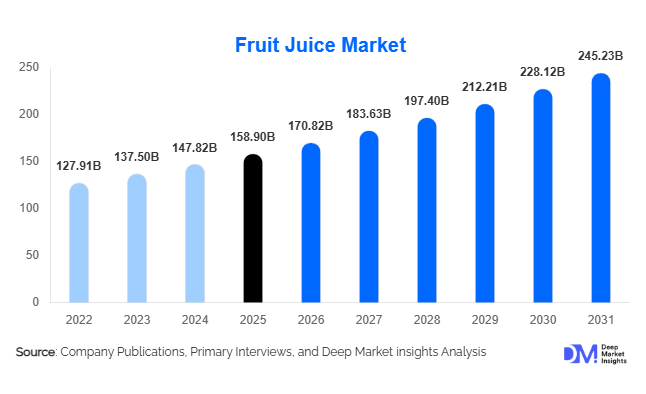
According to Deep Market Insights, theglobal fruit juice market size was valued at USD 158.9 billion in 2025 and is projected to grow from USD 170.82 billion in 2026 to reach USD 245.23 billion by 2031, expanding at a CAGR of 7.5% during the forecast period (2026–2031). The fruit juice market growth is primarily driven by increasing consumer preference for natural and healthy beverages, rising demand for functional and fortified drinks, and the expansion of organized retail and e-commerce distribution channels globally.
Key Market Insights
- Health-conscious consumption is reshaping the fruit juice market, with consumers increasingly opting for low-sugar, organic, and clean-label products.
- Premium segments such as cold-pressed and functional juices are gaining strong traction, particularly in developed economies.
- Asia-Pacific dominates the global fruit juice market, supported by high population density and rising disposable incomes.
- North America and Europe are witnessing product innovation, especially in low-calorie and fortified juice categories.
- E-commerce and direct-to-consumer channels are expanding rapidly, improving accessibility and brand engagement.
- Technological advancements such as high-pressure processing (HPP) and aseptic packaging are enhancing product quality and shelf life.
What are the latest trends in the fruit juice market?
Rising Demand for Functional and Fortified Juices
The fruit juice market is witnessing a strong shift toward functional beverages enriched with vitamins, minerals, probiotics, and plant-based nutrients. Consumers are increasingly seeking juices that offer additional health benefits such as immunity boosting, digestive health, and energy enhancement. This trend has led to the development of fortified orange juices, antioxidant-rich berry blends, and probiotic fruit drinks. Manufacturers are also focusing on sugar reduction and natural sweeteners to align with evolving consumer preferences. The functional juice segment is growing at a faster pace than traditional juice categories, driven by wellness-focused consumption patterns globally.
Premiumization and Cold-Pressed Juice Growth
Premium juice offerings, particularly cold-pressed juices, are gaining popularity due to their perceived higher nutritional value and minimal processing. These products cater to urban and affluent consumers willing to pay a premium for freshness and quality. Cold-pressed juices retain more nutrients compared to conventional pasteurized juices, making them attractive to health-conscious buyers. This trend is particularly strong in North America and Europe, where consumers are prioritizing clean-label and organic products. The rise of boutique juice brands and wellness-focused retail outlets is further supporting this premiumization trend.
What are the key drivers in the fruit juice market?
Increasing Health Awareness and Lifestyle Changes
Growing awareness regarding the health risks associated with carbonated beverages has led consumers to shift toward fruit juices as a healthier alternative. Urbanization, rising disposable incomes, and changing dietary habits are further driving this transition. Consumers are increasingly incorporating fruit juices into daily diets for hydration, nutrition, and convenience. The demand is particularly strong among millennials and working professionals seeking quick and healthy beverage options.
Expansion of Organized Retail and E-commerce
The rapid expansion of supermarkets, hypermarkets, and online retail platforms has significantly improved the availability and accessibility of fruit juice products. E-commerce platforms enable consumers to explore a wide variety of products, compare prices, and access premium offerings that may not be available in traditional retail outlets. This has also allowed smaller and niche brands to compete effectively with established players, contributing to overall market growth.
What are the restraints for the global market?
Concerns Over High Sugar Content
Despite being perceived as healthy, fruit juices often contain high levels of natural sugars, leading to increasing scrutiny from health-conscious consumers and regulatory bodies. This has resulted in declining consumption in certain developed markets and the introduction of sugar taxes in some regions. Manufacturers are under pressure to reformulate products with reduced sugar content or introduce alternative variants.
Volatility in Raw Material Prices
The fruit juice industry is highly dependent on agricultural outputs, making it vulnerable to seasonal fluctuations, climate change, and supply chain disruptions. Variability in fruit production affects raw material availability and pricing, impacting profit margins and pricing strategies for manufacturers. This remains a key challenge for market participants globally.
What are the key opportunities in the fruit juice industry?
Growth in Emerging Markets
Emerging economies in Asia-Pacific, Latin America, and Africa present significant growth opportunities due to rising urbanization, increasing disposable incomes, and expanding middle-class populations. Countries such as India, China, and Brazil are witnessing strong demand for packaged beverages, particularly in affordable juice drink segments. Government initiatives supporting food processing industries further enhance growth prospects in these regions.
Sustainable Packaging and Clean-Label Innovations
Consumers are increasingly prioritizing sustainability, creating opportunities for manufacturers to adopt eco-friendly packaging solutions such as biodegradable materials and recyclable cartons. Clean-label products with minimal additives and transparent ingredient sourcing are also gaining traction. Companies investing in sustainable practices are likely to gain a competitive advantage and attract environmentally conscious consumers.
Report Scope
| Report Metric | Details |
|---|---|
| Market Size in 2025 | USD 158.90 Billion |
| Market Size in 2026 | USD 170.82 Billion |
| Market Size in 2031 | USD 245.23 Billion |
| CAGR | 7.5% (2026-2031) |
| Base Year for Estimation | 2025 |
| Historical Data | 2022-2024 |
| Forecast Period | 2026-2031 |
| Report Coverage | Revenue Forecast, Competitive Landscape, Supply Chain Disruption, Growth Factors, Environment & Regulatory Landscape and Trends |
| Geographies Covered | North America, Europe, APAC, Middle East and Africa, LATAM |
| Countries Covered | U.S., Canada, U.K., Germany, France, Spain, Italy, Russia, Nordic, Benelux, Rest of Europe, China, Korea, Japan, India, Australia, Singapore, Taiwan, South East Asia, Rest of Asia-Pacific, UAE, Turky, Saudi Arabia, South Africa, Egypt, Nigeria, Rest of MEA, Brazil, Mexico, Argentina, Chile, Colombia, Rest of LATAM |
Explore more data points, trends and opportunities Download Free Sample Report
Product Type Insights
The global fruit juice market is characterized by a diverse portfolio of product types, each catering to distinct consumer preferences, income levels, and health perceptions. Among these, 100% fruit juice continues to dominate the market, accounting for approximately 34% of the global market share in 2025. This dominance is primarily driven by increasing consumer inclination toward natural, clean-label, and minimally processed beverages. As awareness around artificial additives, preservatives, and added sugars continues to rise, consumers are actively shifting toward products that are perceived as healthier and closer to their natural state. The leading segment driver for 100% fruit juice lies in the strong association with health and wellness, particularly its positioning as a rich source of essential vitamins, antioxidants, and natural sugars that provide energy without compromising nutritional value.Juice drinks and nectars continue to maintain a strong presence, particularly in price-sensitive markets where affordability remains a key purchasing factor. These products appeal to a broader consumer base due to their lower price points and wide availability. The segment benefits from product innovation in flavors, packaging formats, and marketing strategies that target younger demographics and mass-market consumers. While they may contain added sugars and lower fruit content compared to pure juices, their accessibility and adaptability to regional taste preferences contribute significantly to their sustained demand.Cold-pressed juices represent one of the fastest-growing premium segments within the market. These products are gaining traction particularly in urban centers and developed regions, where consumers are willing to pay a premium for perceived freshness, higher nutrient retention, and artisanal quality. The leading driver for this segment is the growing focus on functional health benefits and detoxification trends, with cold-pressed juices often marketed as part of wellness routines. Technological advancements in high-pressure processing (HPP) have enabled manufacturers to extend shelf life without compromising nutritional integrity, further accelerating adoption. As consumer awareness of nutrient preservation increases, this segment is expected to witness robust growth over the forecast period.
Application Insights
The application landscape of the fruit juice market is heavily influenced by consumer taste preferences, nutritional awareness, and cultural consumption patterns. Citrus-based juices, particularly orange juice, dominate the market with nearly 40% share. This segment’s leadership is largely driven by its strong association with vitamin C content and immune system support, which has gained even greater importance in recent years due to heightened health consciousness. The leading segment driver for citrus juices lies in their well-established positioning as a daily health beverage, combined with their widespread availability and familiarity among consumers globally.Orange juice, in particular, benefits from a long-standing presence in breakfast consumption habits across regions such as North America and Europe. Its consistent demand is supported by strong branding, extensive supply chains, and continuous product innovation, including fortified variants and low-sugar options. Additionally, marketing campaigns emphasizing immunity and wellness have further reinforced consumer trust and consumption frequency.Berry-based juices, such as those derived from blueberries, strawberries, and cranberries, are gaining traction in developed markets due to their high antioxidant content and associated health benefits. These juices are often positioned as premium products with functional attributes, including heart health support and anti-aging properties. The growing demand for superfoods and functional beverages is acting as a key growth driver for this segment, particularly among health-conscious consumers and aging populations.Mixed fruit blends are also witnessing increasing demand, driven by innovation and the desire for unique flavor combinations. These products allow manufacturers to experiment with new formulations, enhance nutritional profiles, and differentiate their offerings in a competitive market. The leading driver for this segment is product innovation, which enables brands to cater to evolving consumer preferences while also optimizing production costs by combining different fruit sources.
Distribution Channel Insights
The distribution landscape of the fruit juice market plays a critical role in shaping consumer access, purchasing behavior, and brand visibility. Supermarkets and hypermarkets dominate the distribution channel, accounting for approximately 48% of total sales. The leading segment driver for this channel is its ability to offer a wide variety of products under one roof, combined with strong retail networks and attractive promotional strategies. Consumers prefer these outlets for their convenience, product assortment, and the opportunity to compare brands and prices before making purchasing decisions.Convenience stores play a significant role in catering to on-the-go consumption patterns, particularly in urban areas where busy lifestyles demand quick and accessible beverage options. These outlets are strategically located in high-traffic areas such as transportation hubs, office complexes, and residential neighborhoods, making them a preferred choice for immediate consumption. The segment is driven by increasing urbanization and the growing demand for single-serve packaging formats that align with modern consumption habits.Online retail is emerging as the fastest-growing distribution channel, driven by rapid digitalization, increasing smartphone penetration, and the expansion of e-commerce platforms. The leading driver for this segment is the shift toward direct-to-consumer (DTC) strategies, which allow manufacturers to engage directly with customers, offer personalized experiences, and improve profit margins. Subscription-based models, doorstep delivery services, and the availability of niche and premium products are further accelerating growth in this channel.Foodservice channels, including cafes, restaurants, and hotels, are also contributing to increasing demand for fruit juices, particularly in the premium and freshly prepared segments. The rise of health-focused cafes and juice bars has created new opportunities for fresh and cold-pressed juice offerings. This segment is driven by changing consumer lifestyles, increased dining-out frequency, and the growing popularity of experiential consumption.
End-Use Insights
End-use segmentation highlights the diverse applications of fruit juice across different consumption environments. Household consumption remains the largest segment, contributing over 60% of total demand. The leading segment driver for this category is the integration of fruit juice into daily dietary habits, particularly as a breakfast staple and a convenient source of nutrition for families. Increasing awareness of health and wellness, combined with the growing preference for ready-to-drink beverages, continues to support strong demand in this segment.The foodservice industry represents the fastest-growing end-use segment, expanding at a CAGR exceeding 8%. This growth is fueled by increasing demand from cafes, hotels, quick-service restaurants (QSRs), and juice bars. The leading driver for this segment is the rising trend of dining out and the growing popularity of premium and freshly prepared beverages. Consumers are increasingly seeking high-quality, natural, and visually appealing drinks as part of their overall dining experience.The beverage processing industry is also witnessing rising demand for fruit juice as a base ingredient in a variety of applications, including smoothies, cocktails, mocktails, and functional beverages. The versatility of fruit juice as an ingredient, combined with its natural sweetness and nutritional benefits, makes it an attractive option for manufacturers. This segment is driven by innovation in product development and the increasing demand for value-added beverages that offer both taste and health benefits.
Explore more data points, trends and opportunities Download Free Sample Report
Fruit Juice Market Segmentations
By Product Type
- 100% Fruit Juice
- Nectars
- Juice Drinks
- Concentrates
- Cold-Pressed Juice
- Powdered Juice Mixes
By Fruit Type
- Citrus Fruits
- Tropical Fruits
- Berries
- Pome Fruits
- Stone Fruits
- Mixed Fruit Blends
By Distribution Channel
- Supermarkets/Hypermarkets
- Convenience Stores
- Online Retail
- Foodservice
- Institutional Sales
Regional Insights
Asia-Pacific
Asia-Pacific dominates the fruit juice market with approximately 38% share in 2025, making it the largest and one of the fastest-growing regions globally. The region’s growth is driven by a combination of demographic, economic, and cultural factors. Rapid urbanization, increasing disposable incomes, and a growing middle-class population are significantly influencing consumption patterns. Countries such as China and India are at the forefront of this growth, supported by their large population bases and evolving dietary habits.One of the key drivers of regional growth is the increasing awareness of health and nutrition, which is encouraging consumers to shift from carbonated beverages to healthier alternatives such as fruit juices. In addition, the expansion of modern retail infrastructure, including supermarkets, hypermarkets, and e-commerce platforms, is improving product accessibility and availability. Government initiatives promoting healthy lifestyles and the development of the food processing sector are also contributing to market expansion.
North America
North America accounts for nearly 25% of the global market, with the United States being the largest contributor. The region is characterized by a mature market landscape, but it continues to grow through innovation and premiumization. One of the primary drivers of regional growth is the increasing demand for organic, low-sugar, and functional beverages. Consumers in this region are highly health-conscious and are actively seeking products that align with clean-label and sustainability trends.The shift toward premium and cold-pressed juices is particularly prominent, driven by higher disposable incomes and a willingness to pay for quality and health benefits. In addition, advancements in food processing technologies and strong distribution networks are supporting market growth. The presence of established brands and continuous product innovation further contribute to the region’s stability and expansion.
Europe
Europe holds around 22% share of the global fruit juice market, with key countries including Germany, France, and the United Kingdom. The region’s growth is influenced by stringent regulatory frameworks, particularly those related to sugar content and labeling requirements. These regulations are driving manufacturers to reformulate their products and introduce healthier alternatives, thereby supporting market growth.The increasing demand for organic and sustainably sourced products is a major driver in this region. Consumers are highly aware of environmental and ethical considerations, prompting companies to adopt eco-friendly practices and transparent supply chains. Additionally, the popularity of functional beverages and fortified juices is contributing to market expansion, as consumers seek products that offer additional health benefits beyond basic nutrition.
Latin America
Latin America accounts for approximately 8% share, with Brazil playing a pivotal role as both a major producer and exporter of fruit juice concentrates. The region benefits from abundant availability of raw materials, including a wide variety of tropical fruits, which supports cost-effective production and strong export potential.The key driver of regional growth is the strong agricultural base combined with increasing global demand for fruit juice concentrates. Domestic consumption is also rising, supported by urbanization and improving economic conditions. In addition, investments in processing infrastructure and supply chain development are enhancing the region’s competitiveness in the global market.
Middle East & Africa
The Middle East & Africa region is emerging as a promising growth market for fruit juices, driven by rapid urbanization, changing consumer lifestyles, and increasing demand for packaged beverages. Countries such as the UAE and South Africa are witnessing significant growth, supported by expanding retail infrastructure and rising disposable incomes.The key driver of regional growth is the shift toward convenient and ready-to-drink beverage options, particularly among urban populations. In addition, the hot climate in many parts of the region encourages higher consumption of refreshing beverages such as fruit juices. The growing presence of international brands and the expansion of modern retail channels are further contributing to market development.Overall, the global fruit juice market is poised for steady growth, supported by evolving consumer preferences, continuous product innovation, and expanding distribution networks across regions.
Key Players in the Fruit Juice Market
- PepsiCo Inc.
- The Coca-Cola Company
- Nestlé S.A.
- Del Monte Foods Inc.
- Ocean Spray Cranberries Inc.
- Tropicana Products Inc.
- Welch’s
- Suntory Beverage & Food Ltd.
- Dabur India Ltd.
- Parle Agro Pvt. Ltd.
- Lassonde Industries Inc.
- Eckes-Granini Group
- Refresco Group
- Kerry Group
- Britvic plc