Fennel Seeds Market Size
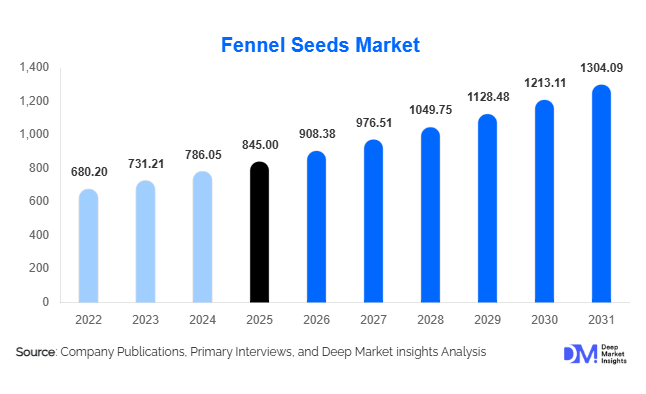
According to Deep Market Insights, the global fennel seeds market size was valued at USD 845 million in 2025 and is projected to grow from USD 908.38 million in 2026 to reach USD 1304.09 million by 2031, expanding at a CAGR of 7.5% during the forecast period (2026–2031). Market growth is primarily driven by rising demand for natural spices and flavoring agents, increasing consumption of herbal and functional beverages, growing adoption of plant-based nutraceutical ingredients, and expanding use of fennel-derived products across pharmaceutical and personal care industries. Global trade expansion, particularly from major producing countries such as India, Egypt, China, and Turkey, continues to support market penetration across developed and emerging economies.
Key Market Insights
- Food processing remains the largest end-use segment, accounting for more than 40% of global fennel seed consumption due to widespread use in spice blends, bakery products, confectionery, and savory foods.
- Organic fennel seeds are witnessing faster growth than conventional varieties, driven by clean-label trends and increasing consumer preference for certified organic ingredients.
- Asia-Pacific dominates the global market, supported by strong production and consumption in India, China, and Southeast Asia.
- North America is among the fastest-growing regions, fueled by rising demand for herbal teas, digestive health supplements, and ethnic food products.
- Nutraceutical and pharmaceutical applications are expanding rapidly, leveraging fennel's digestive, anti-inflammatory, and antioxidant properties.
- Digital sourcing platforms and contract farming models are improving supply chain transparency and quality consistency across global markets.
Fennel Seeds Market Latest Trends
Growing Demand for Functional Foods and Herbal Ingredients
The global shift toward preventive healthcare is increasing the use of fennel seeds in functional foods, herbal teas, digestive supplements, and nutraceutical formulations. Consumers increasingly seek ingredients with scientifically supported health benefits, particularly those related to digestive wellness, gut health, immunity support, and metabolic health. Fennel seeds are benefiting from this trend due to their natural content of antioxidants, volatile oils, and bioactive compounds such as anethole. Food manufacturers are incorporating fennel into wellness-focused products ranging from herbal infusions to fortified snacks and functional beverages. This trend is particularly evident in North America and Europe, where demand for botanical ingredients continues to outpace conventional food additives.
Expansion of Organic and Traceable Spice Supply Chains
Organic certification and supply-chain traceability are becoming critical purchasing criteria for food manufacturers and retailers. Buyers increasingly prefer sustainably sourced fennel seeds with transparent origin verification and compliance with international food safety standards. Major exporters are investing in contract farming, residue-free cultivation, and digital traceability technologies to meet stringent import requirements. Organic fennel cultivation is expanding across India, Egypt, and parts of Europe as premium pricing opportunities encourage farmer participation. The trend is further supported by growing consumer willingness to pay higher prices for certified organic spices and herbal ingredients.
Fennel Seeds Market Drivers
Rising Global Consumption of Ethnic and Processed Foods
Growing urbanization and increasing demand for ethnic cuisines are driving consumption of spices globally. Fennel seeds are widely used across Indian, Middle Eastern, Mediterranean, and European cuisines, supporting steady demand from food manufacturers and restaurant chains. The expansion of packaged foods, ready-to-cook products, bakery items, and spice blends continues to increase industrial procurement of fennel seeds. International migration and growing multicultural food preferences are further contributing to demand expansion in developed economies.
Increasing Adoption in Nutraceutical and Pharmaceutical Products
Fennel seeds possess recognized digestive, antimicrobial, anti-inflammatory, and antioxidant properties, making them valuable ingredients in dietary supplements and herbal medicines. Manufacturers are increasingly incorporating fennel extracts into digestive aids, women's health supplements, respiratory formulations, and wellness products. The global trend toward plant-based healthcare solutions is strengthening long-term demand across pharmaceutical and nutraceutical sectors. Scientific research supporting traditional medicinal applications is also contributing to broader commercialization opportunities.
Expansion of Herbal Tea and Functional Beverage Markets
The growing popularity of herbal beverages represents a major demand catalyst. Fennel seeds are increasingly used in caffeine-free herbal teas, digestive beverages, and botanical drink formulations. Consumers seeking natural alternatives to carbonated and sugary drinks are supporting rapid growth within this segment. Premium tea manufacturers are launching fennel-based blends targeting digestive wellness, detoxification, and relaxation benefits, creating additional market opportunities globally.
Fennel Seeds Market Restraints
Price Volatility Due to Agricultural Dependence
Fennel seed production remains highly dependent on weather conditions, rainfall patterns, and agricultural yields. Climate variability, droughts, pest infestations, and changing cultivation economics can significantly affect annual output and pricing. Such volatility creates procurement challenges for processors and exporters while impacting profit margins throughout the value chain.
Stringent Import Regulations and Residue Standards
Export-oriented producers face increasingly strict regulations regarding pesticide residues, food safety compliance, and traceability requirements. Developed markets, particularly in Europe and North America, continue to implement rigorous quality standards that require significant investments in testing, certification, and compliance infrastructure. Smaller producers often face barriers in meeting these requirements, limiting market accessibility.
Fennel Seeds Industry Key Opportunities
Growth of Organic and Premium Spice Segments
Premiumization within the spice industry presents significant opportunities for market participants. Organic, non-GMO, residue-free, and sustainably sourced fennel seeds command higher margins and are increasingly preferred by multinational food manufacturers. Companies that invest in certified cultivation programs, traceable sourcing networks, and sustainability initiatives can capitalize on growing demand from premium retail and foodservice channels.
Expansion of Botanical Extracts and Essential Oils
Fennel-derived extracts and essential oils are gaining traction in nutraceuticals, cosmetics, aromatherapy, and pharmaceutical formulations. Manufacturers can diversify beyond raw seed sales by developing value-added products with higher profitability. Increasing demand for natural ingredients in personal care products creates particularly attractive opportunities for specialized processors and ingredient suppliers.
Emerging Demand Across Africa and Latin America
Rising urbanization, expanding retail infrastructure, and increasing disposable incomes are creating new consumption opportunities across emerging markets. Food processing industries in countries such as Brazil, South Africa, Nigeria, and Mexico are increasing spice usage across packaged foods and beverages. Exporters that establish early distribution networks in these regions can benefit from above-average growth rates during the forecast period.
Report Scope
| Report Metric | Details |
|---|---|
| Market Size in 2025 | USD 845.00 |
| Market Size in 2026 | USD 908.38 |
| Market Size in 2031 | USD 1304.09 |
| CAGR | 7.5% (2026-2031) |
| Base Year for Estimation | 2025 |
| Historical Data | 2022-2024 |
| Forecast Period | 2026-2031 |
| Report Coverage | Revenue Forecast, Competitive Landscape, Supply Chain Disruption, Growth Factors, Environment & Regulatory Landscape and Trends |
| Geographies Covered | North America, Europe, APAC, Middle East and Africa, LATAM |
| Countries Covered | U.S., Canada, U.K., Germany, France, Spain, Italy, Russia, Nordic, Benelux, Rest of Europe, China, Korea, Japan, India, Australia, Singapore, Taiwan, South East Asia, Rest of Asia-Pacific, UAE, Turky, Saudi Arabia, South Africa, Egypt, Nigeria, Rest of MEA, Brazil, Mexico, Argentina, Chile, Colombia, Rest of LATAM |
Explore more data points, trends and opportunities Download Free Sample Report
Product Type Insights
Conventional fennel seeds continue to dominate the global market, accounting for approximately 78% of global market revenue in 2025. This leadership is primarily driven by their widespread agricultural availability, established supply chains, and cost-efficient production economics, making them the preferred choice for large-scale food processors, spice manufacturers, and export-oriented traders. Strong integration into conventional farming systems across major producing regions such as India and parts of the Middle East further reinforces supply stability and price competitiveness, which in turn sustains their dominant market position.Organic fennel seeds represent the fastest-growing product category, supported by a structural shift in global consumption toward clean-label, pesticide-free, and sustainably sourced ingredients. Growth is being accelerated by tightening regulatory frameworks around food safety in developed markets, alongside rising retailer mandates for certified organic inputs. Premium pricing advantages, expanding organic farmland under certification, and increasing adoption by nutraceutical and health-focused food manufacturers are further strengthening demand momentum. The segment is increasingly benefiting from brand differentiation strategies where manufacturers position organic fennel as a value-added ingredient in premium spice blends, herbal formulations, and functional food products.
Form Insights
Whole fennel seeds accounted for approximately 62% of global market value in 2025, maintaining their leadership due to superior shelf stability, lower processing requirements, and broad usability across foodservice, retail, and industrial applications. The dominance of whole seeds is further reinforced by strong export demand, where minimal processing helps preserve essential oils and ensures longer shelf life during international logistics, making them highly preferred in global spice trade networks.Growth in ground fennel powder is being driven by increasing demand from packaged food manufacturers and seasoning producers seeking standardized flavor profiles and improved formulation efficiency. The convenience factor associated with ready-to-use spice blends, along with rising penetration of processed and convenience foods in urban markets, continues to support expansion in this segment. Fennel extracts and essential oils, while still niche, are witnessing accelerated adoption in pharmaceuticals, nutraceuticals, and personal care applications, driven by the rising preference for concentrated botanical actives with digestive, antimicrobial, and aromatic properties. Technological advancements in extraction and distillation are further improving yield efficiency and expanding commercial viability.
Application Insights
Culinary applications remain the dominant segment, accounting for approximately 46% of total market revenue in 2025, supported by the deep-rooted use of fennel seeds in global cuisines, spice blends, bakery products, confectionery formulations, and processed foods. Demand is particularly strong in emerging economies where traditional dietary habits continue to drive large-scale consumption, while developed markets are experiencing renewed interest in ethnic foods and natural flavoring agents.The nutraceutical and pharmaceutical segment is emerging as the fastest-growing application area, fueled by increasing awareness of digestive health, gut wellness, and plant-based preventive healthcare solutions. The integration of fennel-based extracts into herbal supplements and digestive formulations is expanding rapidly as consumers shift toward natural alternatives to synthetic medications. Essential oil applications are also expanding steadily, supported by growing demand in aromatherapy, cosmetics, and personal care formulations where natural fragrance and therapeutic properties are highly valued. Innovation in functional ingredient development continues to unlock new application pathways across wellness-oriented product categories.
Distribution Channel Insights
Direct B2B sales and ingredient distributors collectively account for nearly 58% of global fennel seed sales, reflecting the highly structured nature of procurement within food manufacturing, pharmaceutical production, and industrial spice blending sectors. These channels remain dominant due to their ability to ensure bulk supply consistency, standardized quality control, and long-term contractual sourcing arrangements that are essential for large-scale buyers. Wholesale trading networks in key producing countries continue to play a central role in aggregating supply from farmers and channeling it into export markets.E-commerce platforms are emerging as a high-growth distribution channel, driven by increasing digitalization of agricultural trade and rising demand for premium, organic, and branded spice products among retail consumers. Digital sourcing ecosystems are also enhancing procurement transparency, enabling global buyers to access verified suppliers, quality certifications, and real-time pricing data. This shift is improving supply chain efficiency and reducing dependency on traditional intermediaries, particularly in cross-border spice trade. The expansion of direct-to-consumer spice brands is further accelerating online channel penetration.
End-Use Industry Insights
The food processing industry remains the largest end-use segment, accounting for approximately 42% of global fennel seed demand in 2025. This dominance is driven by increasing global consumption of packaged foods, ready-to-eat meals, bakery products, and spice blends, where fennel seeds are widely used for flavoring and functional enhancement. Expansion of industrial food production, particularly in emerging markets, continues to reinforce steady baseline demand.The nutraceutical sector is the fastest-growing end-use industry, supported by strong consumer preference for preventive healthcare, digestive wellness, and plant-based supplements. Pharmaceutical applications are also expanding, particularly in herbal medicine systems and natural therapeutic formulations where fennel is valued for its carminative and anti-inflammatory properties. The personal care industry is emerging as a promising growth avenue, with fennel extracts increasingly incorporated into skincare, haircare, and aromatherapy products due to their antioxidant and soothing characteristics. This diversification across end-use industries is significantly broadening the commercial footprint of fennel-based ingredients.
Explore more data points, trends and opportunities Download Free Sample Report
Fennel Seeds Market Segmentations
By Product Type
- Conventional Fennel Seeds
- Organic Fennel Seeds
By Form
- Whole Fennel Seeds
- Crushed/Broken Fennel Seeds
- Ground Fennel Powder
- Fennel Extracts
- Fennel Essential Oil
By Application
- Culinary & Food Processing
- Beverage & Herbal Tea
- Nutraceuticals & Dietary Supplements
- Pharmaceuticals
- Personal Care & Cosmetics
- Animal Feed Additives
By Distribution Channel
- B2B Direct Sales
- Food Ingredient Distributors
- Wholesale Agricultural Markets
- Supermarkets & Hypermarkets
- E-commerce Platforms
By End-Use Industry
- Food Processing Industry
- Beverage Industry
- Nutraceutical Industry
- Pharmaceutical Industry
- Personal Care Industry
Regional Insights
Asia-Pacific
Asia-Pacific dominated the global fennel seeds market with approximately 46% market share in 2025, driven by its dual role as both the largest production hub and a major consumption base. India is the central growth engine of the region, supported by favorable agro-climatic conditions, extensive cultivation acreage, and well-established spice export infrastructure. The primary driver in India is the integration of fennel into both domestic culinary traditions and large-scale export supply chains, reinforced by government support for spice cultivation, export incentives, and agricultural modernization initiatives. India alone contributes nearly 28% of global market revenue, reflecting its critical role in global supply stability.China contributes significantly through its strong processing industry and growing demand for natural ingredients in food manufacturing and traditional medicine systems. Southeast Asian markets are experiencing rising imports driven by rapid expansion of packaged food production, restaurant chains, and flavoring industries. Across the region, urbanization, rising disposable incomes, and increasing penetration of convenience foods are key structural drivers supporting long-term demand expansion.
Europe
Europe accounted for approximately 22% of global market share in 2025, with demand strongly influenced by premiumization trends and strict food safety regulations. The primary growth driver in the region is the rising consumption of organic, traceable, and sustainably sourced spices, particularly across Germany, Italy, France, Spain, and the United Kingdom. Regulatory emphasis on transparency and quality assurance has encouraged suppliers to invest in certified supply chains and advanced traceability systems.Additionally, the expanding nutraceutical and herbal tea industries are significantly boosting demand for fennel-based ingredients, as consumers increasingly prioritize natural digestive health solutions. The shift toward clean-label food formulations and plant-based wellness products is further reinforcing steady long-term growth across European markets.
North America
North America represents one of the fastest-growing regional markets, driven primarily by the United States, where rising consumer adoption of herbal supplements, functional foods, and ethnic cuisines is reshaping demand patterns. The key growth driver is increasing awareness of gut health and natural wellness solutions, which has significantly boosted the use of fennel seeds in dietary supplements and functional beverages.Canada is also experiencing steady expansion supported by growing multicultural food consumption and rising demand for organic spices. The region is expected to maintain strong momentum, with projected annual growth exceeding 8%, driven by premiumization trends, expanding health-conscious consumer bases, and rapid growth of natural product retail channels.
Middle East & Africa
The Middle East and Africa region plays a dual role as both a strong consumption market and an important trade hub for fennel seeds. Key demand drivers include traditional culinary usage, widespread incorporation into herbal medicine systems, and increasing consumption in food processing industries. Countries such as Saudi Arabia, UAE, Egypt, Turkey, and South Africa are central to regional demand growth, supported by rising population, expanding foodservice sectors, and increasing imports of spice ingredients.Egypt is emerging as a strategic export base due to its favorable agricultural conditions and proximity to European and Middle Eastern markets, strengthening its role in global spice trade flows. The growing modernization of retail and food distribution networks across the region is further supporting market expansion.
Latin America
Latin America is witnessing gradual but steady market growth, led by Brazil, Mexico, Argentina, and Chile. The primary driver in the region is the increasing consumption of processed foods, herbal health products, and natural ingredients, supported by rising health awareness among consumers. Brazil stands as the largest market in the region, benefiting from a rapidly expanding food processing sector and growing integration of natural spices into mainstream culinary applications.Improving import infrastructure and increasing exposure to global food trends are also contributing to the gradual expansion of fennel seed usage across retail and industrial channels, creating long-term opportunities for international suppliers.
Key Players in the Fennel Seeds Market
- Virdhara International
- AOS Products Pvt. Ltd.
- Mangalam Seeds Limited
- Shreeji Expeller Industries
- Dhaval Agri Exports LLP
- Sun Impex International Foods LLC
- McCormick & Company
- Olam Food Ingredients
- Frontier Co-op
- Pacific Spice Company
- Naturevibe Botanicals
- P.C. Kannan & Co.
- Kancor Ingredients
- Aarkay Food Products Ltd.
- Rapid Organic Pvt. Ltd.