Pine Nut Oil Market Size
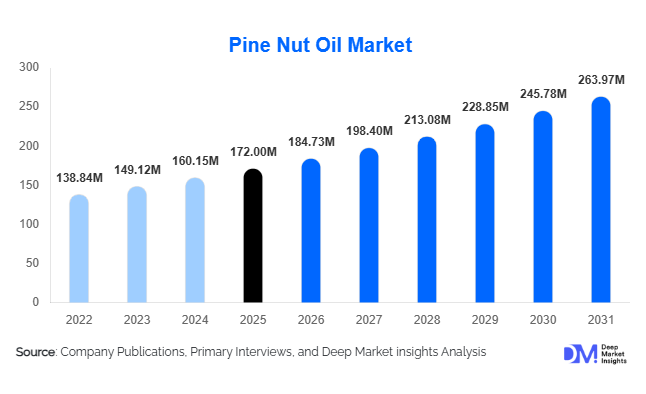
According to Deep Market Insights, the global pine nut oil market size was valued at USD 172 million in 2025 and is projected to grow from USD 184.73 million in 2026 to reach USD 263.97 million by 2031, expanding at a CAGR of 7.4% during the forecast period (2026–2031). The pine nut oil market growth is primarily driven by increasing consumer demand for premium plant-based oils, expanding nutraceutical applications, rising adoption of natural cosmetic ingredients, and growing awareness of the health benefits associated with pinolenic acid, omega fatty acids, and antioxidant-rich botanical oils. As consumers increasingly seek clean-label, minimally processed, and sustainably sourced ingredients, pine nut oil has emerged as a premium specialty oil utilized across food & beverage, dietary supplements, cosmetics, pharmaceuticals, and wellness products. Growing investments in cold-press extraction technologies, organic certification programs, and sustainable forest management practices are further strengthening industry development globally.
Key Market Insights
- Cold-pressed pine nut oil accounts for approximately 42% of global market revenue, driven by increasing demand for minimally processed premium oils.
- Food & beverage applications dominate the market with nearly 51% share, supported by growing consumption of gourmet and functional foods.
- Europe leads global consumption with approximately 36% market share, driven by strong demand for organic foods and natural cosmetic products.
- Asia-Pacific is the fastest-growing regional market, supported by expanding nutraceutical industries and increasing health-conscious consumer spending.
- Korean pine-derived oil remains the largest source segment, accounting for nearly 38% of global production and consumption.
- Organic and sustainably sourced pine nut oils are gaining significant traction, particularly among premium food and cosmetic manufacturers.
Pine Nut Oil Market Latest Trends
Growing Adoption of Cold-Pressed and Organic Pine Nut Oil
Consumers across North America, Europe, Japan, and South Korea are increasingly preferring cold-pressed pine nut oil products due to their superior nutritional retention, natural flavor profile, and clean-label positioning. Premium food manufacturers are incorporating cold-pressed oils into gourmet products, salad dressings, sauces, and functional foods. At the same time, organic certification has become a key purchasing criterion among health-conscious consumers. Producers are investing heavily in certified organic sourcing programs and sustainable harvesting practices to meet rising demand from premium retail and industrial buyers. This trend is enabling manufacturers to command premium pricing while improving brand differentiation in a relatively niche specialty oils market.
Expansion of Pine Nut Oil in Nutraceutical and Wellness Products
The nutraceutical industry is increasingly utilizing pine nut oil as a functional ingredient due to its unique pinolenic acid content and associated benefits related to appetite management, cardiovascular health, and metabolic wellness. Supplement manufacturers are launching soft-gel capsules, specialty oil blends, and functional nutrition products targeting weight management and healthy aging consumers. Wellness-focused brands are also integrating pine nut oil into sports nutrition, clinical nutrition, and preventive healthcare formulations. This trend is particularly visible in developed markets where consumers increasingly seek scientifically supported botanical ingredients for long-term health management.
Pine Nut Oil Market Drivers
Rising Demand for Functional and Specialty Edible Oils
The growing popularity of functional foods and premium culinary ingredients is significantly driving pine nut oil consumption. Consumers are increasingly seeking oils that provide both nutritional and sensory benefits. Pine nut oil offers a unique combination of essential fatty acids, antioxidants, and bioactive compounds that support cardiovascular wellness and healthy lifestyles. Gourmet food manufacturers are incorporating pine nut oil into premium product lines, while restaurants and food service operators increasingly utilize specialty oils to differentiate menus and enhance product quality.
Growing Natural Cosmetics and Personal Care Industry
The global shift toward natural beauty and clean-label skincare products is accelerating demand for pine nut oil in cosmetic formulations. Rich in vitamin E and essential fatty acids, pine nut oil is increasingly utilized in moisturizers, anti-aging creams, serums, massage oils, and hair care products. Cosmetic manufacturers are actively replacing synthetic ingredients with plant-derived alternatives to meet evolving consumer preferences. The premium skincare segment, particularly in Europe and Asia-Pacific, continues to generate strong demand for high-quality botanical oils with proven moisturizing and skin-repair properties.
Expansion of Nutraceutical and Preventive Healthcare Markets
Rising health awareness and increasing focus on preventive healthcare are creating substantial opportunities for pine nut oil manufacturers. Nutraceutical companies are developing dietary supplements and wellness products utilizing pine nut oil as an active ingredient. Growing demand for plant-based nutrition, healthy aging products, and metabolic wellness solutions is expected to support long-term market expansion, particularly across developed economies where dietary supplement penetration remains high.
Pine Nut Oil Market Restraints
Limited Raw Material Availability and Supply Volatility
The pine nut oil industry remains highly dependent on pine nut harvests sourced from specific geographic regions including China, Russia, Mongolia, and parts of Europe. Climatic variability, forest management practices, pests, and seasonal fluctuations can significantly impact pine nut availability. Since pine trees require long maturation periods, supply expansion cannot be rapidly scaled, creating periodic shortages and pricing instability throughout the value chain.
High Production Costs and Premium Pricing
Compared with mainstream vegetable oils, pine nut oil production involves higher raw material costs and lower extraction yields. Cold-press extraction methods, organic certification requirements, and quality control standards further increase production expenses. As a result, pine nut oil remains positioned as a premium specialty ingredient, limiting mass-market adoption and restricting demand primarily to higher-income consumer segments and premium industrial applications.
Pine Nut Oil Industry Key Opportunities
Expansion in Premium Cosmeceutical Formulations
The rapidly expanding natural skincare and cosmeceutical industries present significant opportunities for pine nut oil producers. Luxury beauty brands are increasingly incorporating premium botanical oils into anti-aging, hydration, and skin-repair formulations. Pine nut oil's antioxidant profile and skin-conditioning properties position it as an attractive ingredient for high-end cosmetic products. Companies capable of offering traceable, sustainably sourced, and certified organic oils are expected to benefit substantially from this trend.
Growth of Functional Foods and Clinical Nutrition Products
The functional food sector continues to expand globally as consumers seek ingredients that provide measurable health benefits. Pine nut oil's association with satiety, metabolic health, and cardiovascular wellness supports increasing adoption in nutritional beverages, meal replacements, functional snacks, and medical nutrition products. Manufacturers are increasingly investing in clinical validation studies to support product claims and strengthen commercial adoption across healthcare-focused markets.
Sustainable Forestry and Traceability Programs
Growing sustainability requirements among multinational food and cosmetic companies create opportunities for producers that can establish transparent and environmentally responsible supply chains. Investments in forest stewardship programs, sustainable harvesting practices, and digital traceability systems are enabling suppliers to access premium international markets while meeting increasingly stringent environmental standards. These initiatives also improve long-term raw material security and strengthen consumer confidence in product sourcing.
Report Scope
| Report Metric | Details |
|---|---|
| Market Size in 2025 | USD 172.00 Million |
| Market Size in 2026 | USD 184.73 Million |
| Market Size in 2031 | USD 263.97 Million |
| CAGR | 7.4% (2026-2031) |
| Base Year for Estimation | 2025 |
| Historical Data | 2022-2024 |
| Forecast Period | 2026-2031 |
| Report Coverage | Revenue Forecast, Competitive Landscape, Supply Chain Disruption, Growth Factors, Environment & Regulatory Landscape and Trends |
| Geographies Covered | North America, Europe, APAC, Middle East and Africa, LATAM |
| Countries Covered | U.S., Canada, U.K., Germany, France, Spain, Italy, Russia, Nordic, Benelux, Rest of Europe, China, Korea, Japan, India, Australia, Singapore, Taiwan, South East Asia, Rest of Asia-Pacific, UAE, Turky, Saudi Arabia, South Africa, Egypt, Nigeria, Rest of MEA, Brazil, Mexico, Argentina, Chile, Colombia, Rest of LATAM |
Explore more data points, trends and opportunities Download Free Sample Report
Product Type Insights
The cold-pressed pine nut oil segment continues to dominate the global pine nut oil market, accounting for approximately 42% of total revenue. Its leadership is primarily attributed to growing consumer preference for minimally processed, nutrient-rich oils that retain their natural antioxidant compounds, essential fatty acids, and characteristic flavor profile. Increasing demand for clean-label food ingredients, premium culinary oils, and naturally derived wellness products has further strengthened the adoption of cold-pressed variants across food, nutraceutical, and personal care industries. Organic pine nut oil represents the fastest-growing product category, supported by rising consumer awareness regarding sustainable agriculture, chemical-free production practices, and certified organic ingredients. The expanding penetration of organic products across developed markets, particularly in North America and Europe, continues to accelerate demand for organic pine nut oil in dietary supplements, skincare formulations, and functional foods. Refined pine nut oil maintains stable demand among industrial manufacturers due to its improved shelf stability, neutral sensory characteristics, and formulation consistency, making it suitable for large-scale food processing and cosmetic production. Meanwhile, blended pine nut oil formulations are witnessing increasing adoption in specialty nutrition products, fortified food applications, and premium wellness formulations where manufacturers seek to combine nutritional benefits with cost efficiency. Gourmet-grade pine nut oil continues to command the highest average selling prices, supported by its premium positioning, superior flavor attributes, limited production volumes, and growing use in high-end culinary applications.
Source Species Insights
Korean pine (Pinus koraiensis) remains the leading source species segment, contributing approximately 38% of global pine nut oil production. The segment's dominance is supported by high kernel oil content, favorable fatty acid composition, established cultivation infrastructure, and strong commercial availability across major producing countries. Manufacturers increasingly prefer Korean pine-derived oil due to its consistent quality characteristics and suitability for both food and nutraceutical applications. Siberian pine-derived oil continues to maintain strong market demand, particularly in Europe and North America, where consumers associate Siberian botanical ingredients with premium quality, purity, and traditional wellness benefits. Stone pine varieties cultivated across Mediterranean countries support a specialized niche market focused on gourmet culinary products and premium food ingredients. Chinese pine species contribute significantly to overall global production volumes and remain essential for meeting rising domestic consumption and export requirements. As supply chain resilience becomes increasingly important, manufacturers are actively diversifying sourcing strategies across multiple pine species and geographic origins to mitigate raw material supply risks, address climate-related production uncertainties, and ensure long-term procurement stability.
Application Insights
Food and beverage applications account for approximately 51% of global pine nut oil demand, making this the largest application segment throughout the forecast period. The segment's leadership is driven by increasing consumer interest in premium edible oils, functional food ingredients, clean-label products, and gourmet culinary experiences. Pine nut oil is increasingly incorporated into specialty cooking oils, premium salad dressings, sauces, spreads, and fortified food formulations due to its distinctive flavor profile and nutritional benefits. Cosmetics and personal care represent the fastest-growing application segment, supported by rising demand for natural skincare ingredients, plant-based beauty products, anti-aging formulations, and premium haircare solutions. The growing trend toward botanical cosmetics and clean beauty products continues to encourage manufacturers to incorporate pine nut oil into a broad range of personal care applications. Nutraceutical applications are also expanding steadily as research highlighting the health benefits of unsaturated fatty acids and bioactive compounds supports the development of dietary supplements targeting cardiovascular wellness, weight management, metabolic health, and overall well-being. Pharmaceutical and aromatherapy applications continue to witness gradual growth as consumers increasingly seek natural therapeutic solutions, holistic wellness products, and plant-derived active ingredients for preventive healthcare and complementary treatment approaches.
Distribution Channel Insights
Direct B2B sales remain the largest distribution channel, accounting for approximately 34% of global market revenue. The segment's dominance is driven by growing procurement requirements from food manufacturers, cosmetic producers, nutraceutical companies, and specialty ingredient processors that prioritize supply reliability, quality consistency, and long-term sourcing partnerships. Large industrial buyers increasingly establish strategic procurement agreements with pine nut oil suppliers to secure raw material availability amid fluctuating agricultural production conditions. Specialty ingredient distributors continue to play a critical role in market development by facilitating product access across multiple end-use industries and geographic markets while supporting regulatory compliance and technical product integration. Online retail channels are emerging as one of the fastest-growing distribution formats, supported by increasing digital commerce adoption, growing consumer interest in premium wellness products, and expanding direct-to-consumer marketing strategies. Brand-owned e-commerce platforms are also gaining traction as manufacturers seek to strengthen customer engagement, enhance brand visibility, gather consumer insights, and improve profitability through direct sales channels. The continued expansion of digital retail infrastructure and cross-border e-commerce platforms is expected to further support market accessibility and product availability globally.
End-User Insights
The food processing industry remains the largest end-user segment, accounting for approximately 29% of total global demand. The segment's leadership is supported by increasing incorporation of pine nut oil into premium food formulations, gourmet products, functional foods, and value-added nutritional offerings. Rising consumer willingness to pay for high-quality ingredients and healthier food alternatives continues to drive utilization across the food manufacturing sector. Cosmetic and personal care manufacturers represent one of the fastest-growing end-user categories as demand for botanical ingredients, natural emollients, and plant-derived active compounds continues to expand within the global beauty industry. Nutraceutical manufacturers are also contributing significantly to market growth through the increasing use of pine nut oil in dietary supplements, wellness capsules, and specialized health formulations. Household consumers are gradually increasing adoption of pine nut oil for culinary applications, home wellness routines, and preventive health management. Additionally, wellness centers, spas, and aromatherapy practitioners are incorporating pine nut oil into premium therapeutic treatments, massage products, and relaxation therapies, further diversifying the market's end-user base.
Explore more data points, trends and opportunities Download Free Sample Report
Pine Nut Oil Market Segmentations
By Product Type
- Cold-Pressed Pine Nut Oil
- Refined Pine Nut Oil
- Organic Pine Nut Oil
- Conventional Pine Nut Oil
- Blended Pine Nut Oil
By Source Species
- Korean Pine (Pinus koraiensis)
- Siberian Pine (Pinus sibirica)
- Stone Pine (Pinus pinea)
- Chinese Pine Species
- American Pine Species
- Other Regional Pine Species
By Application
- Food & Beverage
- Nutraceuticals & Dietary Supplements
- Cosmetics & Personal Care
- Pharmaceutical Applications
- Aromatherapy & Wellness
- Industrial & Specialty Uses
By Distribution Channel
- Direct B2B Sales
- Specialty Ingredient Distributors
- Supermarkets & Hypermarkets
- Specialty Health Stores
- Pharmacies & Drug Stores
- Online Retail
- Brand-Owned E-Commerce
By End User
- Food Processing Industry
- Cosmetic & Personal Care Manufacturers
- Nutraceutical Manufacturers
- Pharmaceutical Companies
- Food Service Industry
- Household Consumers
- Wellness & Spa Operators
Regional Insights
Europe
Europe remains the largest regional market, accounting for approximately 36% of global pine nut oil consumption. Germany represents nearly 11% of global demand, followed by France, Italy, the United Kingdom, and Spain. The region's market leadership is supported by strong consumer preference for organic foods, premium culinary ingredients, natural cosmetics, and functional wellness products. Increasing demand for clean-label products, growing adoption of plant-based lifestyles, and high consumer spending on premium health and beauty products continue to drive market expansion. Additionally, stringent quality standards, advanced food processing industries, and widespread implementation of sustainable sourcing and traceability programs encourage the use of premium-grade pine nut oil across multiple applications. The presence of well-established nutraceutical and natural cosmetics industries further strengthens regional demand, while growing investments in sustainable and ethically sourced ingredients continue to support long-term market growth.
Asia-Pacific
Asia-Pacific accounts for approximately 31% of global market demand and is expected to register the fastest growth during the forecast period. China dominates regional production and consumption due to abundant raw material availability, extensive pine cultivation activities, and a large domestic food, wellness, and personal care industry. South Korea and Japan continue to exhibit strong demand for premium dietary supplements, functional foods, and advanced skincare products containing botanical ingredients. India is emerging as one of the fastest-growing national markets, supported by expanding nutraceutical manufacturing capabilities, increasing health awareness, rising disposable incomes, and growing consumer expenditure on wellness-oriented products. Regional growth is further driven by rapid urbanization, expanding middle-class populations, increasing adoption of preventive healthcare practices, and growing demand for natural and plant-based ingredients across food, pharmaceutical, and cosmetic industries. The region also benefits from its role as a major production hub, ensuring improved supply chain efficiency and raw material accessibility.
North America
North America accounts for approximately 22% of global pine nut oil consumption, with the United States representing the largest national market within the region. Demand is primarily driven by growing consumption of functional foods, dietary supplements, natural personal care products, and premium specialty oils. Rising consumer awareness regarding plant-based nutrition, preventive healthcare, and clean-label ingredients continues to support market expansion. The increasing popularity of natural beauty products and botanical skincare formulations is also contributing to demand growth across the cosmetics sector. Furthermore, strong e-commerce penetration, widespread availability of premium health products, and ongoing product innovation by nutraceutical and wellness companies are enhancing market accessibility. Canada contributes additional demand through its expanding organic food sector, specialty health retailers, and growing consumer preference for sustainable and naturally derived ingredients.
Latin America
Latin America accounts for approximately 6% of global pine nut oil consumption, with Brazil representing the largest regional market. Market growth is supported by rising awareness of natural health products, increasing demand for premium food ingredients, and expanding adoption of botanical cosmetic formulations. Growing urban populations, improving retail infrastructure, and increasing consumer interest in wellness and preventive healthcare products are creating favorable conditions for market development. The gradual expansion of the region's nutraceutical and natural beauty industries is further supporting demand for specialty plant-based oils. Although overall market penetration remains lower than in developed regions, increasing disposable incomes, changing dietary preferences, and rising acceptance of premium health products are expected to generate significant long-term growth opportunities.
Middle East & Africa
The Middle East & Africa region represents approximately 5% of global pine nut oil demand. The United Arab Emirates and Saudi Arabia are among the leading consumption markets, driven by strong demand for imported premium food products, luxury cosmetics, and high-end wellness formulations. The region's growing affluent consumer base and increasing interest in health-focused lifestyles continue to support market expansion. Demand is also benefiting from the rapid growth of premium retail channels, luxury personal care segments, and wellness tourism activities across key Gulf countries. South Africa remains the largest market within Africa due to its relatively developed natural products industry, expanding health and wellness sector, and increasing utilization of botanical ingredients across food and personal care applications. Rising disposable incomes, expanding urbanization, growing health consciousness, and increasing investment in modern retail infrastructure are expected to support sustained market growth across the broader Middle East and Africa region.
Key Players in the Pine Nut Oil Market
- Siberian Green
- Cedar Products Company
- Taiga Siberica
- Eco-Oils Germany
- Natura Siberica Ingredients
- Henry Lamotte Oils GmbH
- Gustav Heess GmbH
- Koster Keunen
- Biopurus
- AOS Products
- Aromex Industry
- OLVEA Group
- Earthoil Plantations
- Aromatics International
- Botanica Natural Products