Cognac Market Size
According to Deep Market Insights, the global cognac market size was valued at USD 4.71 billion in 2025 and is projected to grow from USD 4.95 billion in 2026 to reach USD 6.38 billion by 2031, expanding at a CAGR of 5.2% during the forecast period (2026–2031). The cognac market growth is primarily driven by increasing global demand for premium alcoholic beverages, rising luxury consumption trends, expanding cocktail culture, and growing adoption of high-end spirits across hospitality, nightlife, and gifting applications.
Key Market Insights
- Premiumization trends are reshaping the global spirits industry, with consumers increasingly shifting toward aged and luxury cognac products.
- North America dominates the cognac market, led by strong consumption in the United States across nightlife, hospitality, and premium retail channels.
- Asia-Pacific is the fastest-growing regional market, supported by rising affluent populations, gifting culture, and expanding imported spirits demand.
- XO and ultra-premium cognac categories are witnessing accelerated growth due to increasing luxury spending and collectible beverage demand.
- Digital alcohol retail and travel retail channels are significantly expanding market accessibility, particularly among younger affluent consumers.
- Sustainable viticulture and carbon-conscious production practices are emerging as critical competitive differentiators among leading cognac producers.
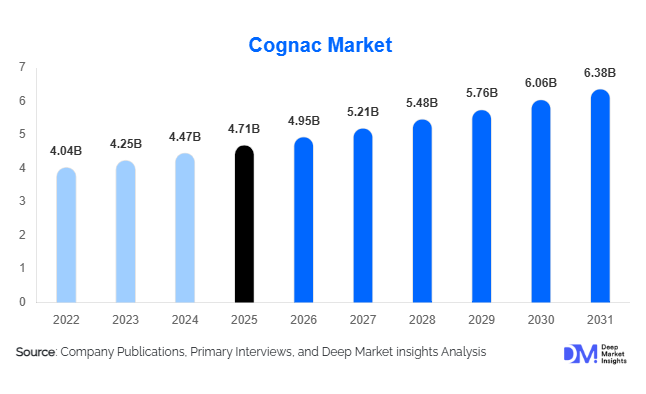
Cognac Market Latest Trends
Luxury and Ultra-Premium Cognac Demand Accelerating
The global cognac market is increasingly shifting toward premium and ultra-premium product categories as consumers prioritize exclusivity, heritage branding, and superior aging quality. XO, Hors d’Age, and limited-edition cognac variants are experiencing substantial growth across North America, China, Japan, and the Middle East. Luxury consumers are treating cognac not only as a beverage but also as a collectible lifestyle product associated with status and sophistication. Premium packaging innovations, crystal decanters, limited releases, and collaborations with fashion and entertainment brands are further strengthening consumer interest in high-value cognac products. This trend is particularly evident among affluent millennials and high-net-worth individuals seeking personalized luxury experiences.
Cocktail Culture and Experiential Drinking Expanding Consumption
Cognac is increasingly being integrated into premium cocktail menus across luxury bars, restaurants, and nightlife venues worldwide. Traditionally consumed neat, cognac is now gaining popularity among younger consumers through mixology-driven experiences and modern beverage innovations. Bartenders are incorporating VS and VSOP cognacs into high-end cocktails, helping expand consumption frequency and market accessibility. Experiential hospitality concepts, tasting lounges, private cellar events, and cognac-pairing dinners are also becoming prominent. Social media influence and celebrity endorsements are further contributing to cognac’s aspirational image among younger demographics globally.
Cognac Market Drivers
Rising Global Premium Spirits Consumption
The global shift toward premium alcoholic beverages is one of the strongest growth drivers for the cognac market. Consumers are increasingly favoring high-quality, heritage-rich spirits over mass-market alcohol products. Cognac benefits significantly from this trend due to its protected geographical identity, strict production standards, and luxury positioning. Rising disposable incomes, especially among urban consumers in Asia-Pacific and North America, are supporting increased spending on premium spirits. Gifting culture in China, luxury hospitality demand in the United States, and affluent lifestyle consumption trends globally continue strengthening long-term market growth.
Growth of Luxury Hospitality and Travel Retail
The rapid expansion of luxury hospitality, nightlife entertainment, and international travel retail channels is significantly boosting cognac demand worldwide. Premium hotels, rooftop lounges, casinos, cruise operators, and airport duty-free outlets are increasingly promoting luxury cognac portfolios to affluent travelers and consumers. Exclusive airport launches, collectible editions, and premium gift packaging are driving strong sales growth in travel retail channels. In addition, rising tourism activity and experiential dining trends are encouraging hospitality establishments to integrate premium cognac into curated beverage programs and mixology offerings.
Cognac Market Restraints
Strict Alcohol Regulations and Taxation Policies
The cognac industry faces substantial regulatory challenges due to strict alcohol advertising restrictions, import regulations, labeling standards, and excise taxation policies across multiple countries. High import duties in emerging markets can significantly increase product prices, limiting affordability and slowing market penetration. Regulatory variations between countries also complicate international expansion strategies for producers. Restrictions on digital alcohol advertising and sponsorship activities in certain markets can further limit consumer engagement and promotional opportunities.
Supply Constraints and Aging Inventory Pressures
Cognac production is highly dependent on specific grape varieties cultivated within the Cognac region of France, making supply vulnerable to climate variability, vineyard diseases, and agricultural disruptions. Furthermore, cognac requires extended aging cycles, particularly for XO and prestige products, resulting in substantial inventory holding costs and long-term capital commitments. Sudden increases in global demand can create supply imbalances due to limited aged inventory availability. Rising oak barrel costs and fluctuations in grape harvest yields also contribute to pricing pressure across the industry.
Cognac Industry Key Opportunities
Expansion Across Emerging Asia-Pacific Markets
Asia-Pacific represents one of the largest long-term opportunities for cognac producers due to rising disposable income, urbanization, and growing interest in imported luxury spirits. China remains a dominant premium cognac market driven by gifting traditions, corporate hospitality, and luxury entertainment spending. India, Vietnam, Thailand, and South Korea are also emerging as high-potential growth markets due to increasing westernized consumption patterns and affluent millennial populations. Producers are increasingly introducing mid-premium and premium product portfolios targeting aspirational consumers in these developing markets. Expanding luxury retail infrastructure and premium nightlife establishments are further supporting demand growth across Asia-Pacific.
Sustainable and Organic Cognac Production
Sustainability-focused production practices are creating significant differentiation opportunities within the global cognac market. Consumers, particularly in Europe and North America, are increasingly prioritizing environmentally responsible alcoholic beverage brands. Producers are investing in organic viticulture, renewable energy adoption, carbon-neutral distillation, and sustainable packaging solutions to strengthen premium positioning. Blockchain-enabled traceability systems and environmentally certified production methods are also gaining traction among luxury consumers seeking transparency and authenticity. Sustainable branding strategies are expected to become increasingly important as environmental awareness continues influencing consumer purchasing behavior globally.
Report Scope
| Report Metric | Details |
|---|---|
| Market Size in 2025 | USD 4.71 Billion |
| Market Size in 2026 | USD 4.95 Billion |
| Market Size in 2031 | USD 6.38 Billion |
| CAGR | 5.2% (2026-2031) |
| Base Year for Estimation | 2025 |
| Historical Data | 2022-2024 |
| Forecast Period | 2026-2031 |
| Report Coverage | Revenue Forecast, Competitive Landscape, Supply Chain Disruption, Growth Factors, Environment & Regulatory Landscape and Trends |
| Geographies Covered | North America, Europe, APAC, Middle East and Africa, LATAM |
| Countries Covered | U.S., Canada, U.K., Germany, France, Spain, Italy, Russia, Nordic, Benelux, Rest of Europe, China, Korea, Japan, India, Australia, Singapore, Taiwan, South East Asia, Rest of Asia-Pacific, UAE, Turky, Saudi Arabia, South Africa, Egypt, Nigeria, Rest of MEA, Brazil, Mexico, Argentina, Chile, Colombia, Rest of LATAM |
Explore more data points, trends and opportunities Download Free Sample Report
Grade Insights
VSOP cognac dominates the global market with the largest revenue share due to its balance between affordability and premium quality positioning. Consumers widely perceive VSOP products as suitable for both gifting and regular luxury consumption, making them highly popular across North America and Asia-Pacific. XO cognac represents the fastest-growing category, driven by rising demand for collectible luxury spirits, premium gifting, and long-aged products among affluent consumers. Hors d’Age and prestige cuvée variants continue gaining popularity in luxury hospitality and duty-free retail channels, where exclusivity and limited production volumes support premium pricing structures.
Product Type Insights
Premium cognac accounts for the largest market share globally, supported by increasing consumer preference for higher-quality aged spirits. Super-premium and ultra-premium categories are experiencing accelerated growth due to strong luxury consumption trends and growing demand for exclusive drinking experiences. Standard cognac continues to maintain demand in emerging markets and cocktail applications, particularly in nightlife venues and mixology-focused establishments. Producers are increasingly diversifying portfolios to cater to both aspirational premium consumers and ultra-luxury buyers seeking heritage-focused collectible products.
Distribution Channel Insights
Off-trade channels dominate the global cognac market, supported by strong sales through specialty liquor stores, supermarkets, duty-free outlets, and online alcohol platforms. E-commerce growth has significantly improved product accessibility and consumer engagement, especially among younger demographics. Direct-to-consumer digital sales, luxury subscription models, and personalized online promotions are becoming increasingly common. On-trade channels, including luxury hotels, bars, nightclubs, and fine dining restaurants, are witnessing rapid recovery and expansion due to increasing cocktail culture and experiential hospitality demand. Travel retail remains a strategic distribution segment, particularly for limited-edition and premium packaging formats.
Packaging Type Insights
Glass bottles continue dominating the global cognac market due to their premium visual appeal, brand heritage preservation, and compatibility with luxury positioning strategies. Decorative decanters and collectible packaging formats are rapidly gaining popularity within ultra-premium and gifting categories. Miniature bottles and travel-exclusive packaging are expanding in airport retail and hospitality applications. Producers are also increasingly investing in sustainable packaging innovations, including lightweight glass, recyclable materials, and environmentally responsible labeling systems to align with evolving consumer preferences.
Application Insights
Personal consumption remains the leading application segment within the cognac market, driven by premium home consumption trends and rising interest in luxury spirits among urban consumers. Gifting applications represent a substantial share of demand, especially across China and other Asian markets where premium alcohol gifting culture is deeply established. Cocktail mixology is one of the fastest-growing application segments globally as bars and restaurants increasingly incorporate cognac into curated beverage programs. Corporate hospitality, luxury celebrations, and exclusive events are also expanding as important consumption channels for premium and prestige cognac products.
Explore more data points, trends and opportunities Download Free Sample Report
Cognac Market Segmentations
By Grade / Age Classification
- VS (Very Special)
- VSOP (Very Superior Old Pale)
- XO (Extra Old)
- Hors d’Age
- Napoléon
- Extra / Prestige Cuvée
By Product Type
- Standard Cognac
- Premium Cognac
- Super Premium Cognac
- Ultra-Premium / Luxury Cognac
By Distribution Channel
- Bars & Lounges
- Fine Dining Restaurants
- Hotels & Hospitality Venues
- Specialty Liquor Stores
- Duty-Free Stores
- Online Retail
- Hypermarkets & Supermarkets
By Application
- Personal Consumption
- Luxury Gifting
- Corporate Hospitality
- Cocktail Mixology
- Celebrations & Events
By Packaging Type
- Glass Bottles
- Luxury Decanters
- Gift Packs
- Miniatures
- Travel Retail Exclusive Packs
Regional Insights
North America
North America dominates the global cognac market, accounting for nearly 39% of global revenue share. The United States remains the world’s largest cognac-consuming country due to strong premium spirits demand, nightlife culture, luxury hospitality growth, and celebrity-driven branding influence. Consumers in the U.S. increasingly prefer premium and ultra-premium cognac products across bars, lounges, and retail channels. Canada also demonstrates stable growth supported by rising premium alcohol adoption among urban consumers and expanding imported luxury beverage demand.
Europe
Europe represents a major production and consumption hub for cognac, led by France, the United Kingdom, Germany, and the Netherlands. France remains the global production center due to protected geographical indication regulations governing cognac manufacturing. European consumers increasingly favor sustainable, artisanal, and heritage-focused cognac brands. Luxury tourism, fine dining, and duty-free retail channels continue supporting premium product demand across Western Europe. Rising preference for organic alcoholic beverages is also contributing to sustainable cognac adoption in the region.
Asia-Pacific
Asia-Pacific is the fastest-growing regional market, driven primarily by China, India, Japan, South Korea, and Southeast Asian economies. China remains one of the largest premium cognac consumers globally due to gifting traditions, luxury business entertainment, and rising affluent populations. India is emerging as a high-growth market supported by increasing imported spirits consumption and expanding urban middle-class wealth. Japan and South Korea maintain stable demand through luxury dining culture and premium cocktail applications. Expanding luxury hospitality infrastructure and digital alcohol retail are further accelerating regional market growth.
Latin America
Latin America is witnessing gradual growth in cognac demand, particularly in Brazil and Mexico, where premiumization trends within the alcoholic beverages industry are strengthening imported luxury spirit sales. Rising affluent populations and expanding upscale nightlife establishments are supporting demand for premium cognac products. Consumers in the region increasingly associate cognac with luxury celebrations and social status, creating long-term growth potential for international producers.
Middle East & Africa
The Middle East & Africa region is demonstrating steady market growth, particularly within luxury tourism hubs such as the UAE and high-income Gulf countries. Premium hospitality expansion, international tourism, and luxury nightlife establishments are supporting cognac consumption in the Middle East. South Africa remains one of the strongest premium alcohol markets within Africa due to developed retail infrastructure and increasing consumer preference for imported luxury spirits. Rising affluent populations and growing tourism investments are expected to strengthen regional demand further.
Key Players in the Cognac Market
- Hennessy
- Rémy Martin
- Martell
- Courvoisier
- Camus
- Hine Cognac
- Frapin
- Delamain
- Hardy Cognac
- Meukow
- Pierre Ferrand
- Godet Cognac
- Bache-Gabrielsen
- Louis Royer
- Kelt Cognac