Coffee Cherry Market Size
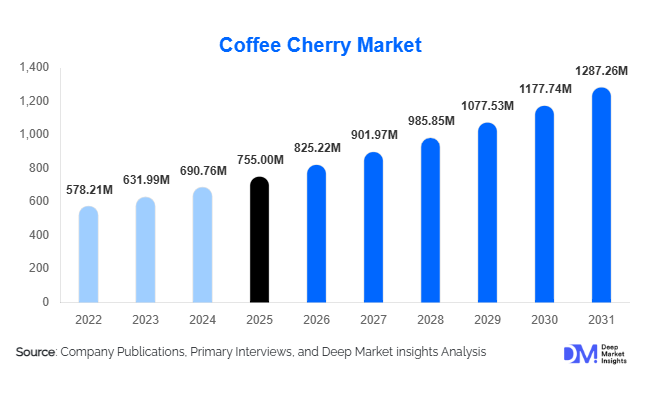
According to Deep Market Insights, the global coffee cherry market size was valued at USD 755 million in 2025 and is projected to grow from USD 825.22 million in 2026 to reach USD 1,287.26 million by 2031, expanding at a CAGR of 9.3% during the forecast period (2026–2031). The coffee cherry market growth is primarily driven by increasing demand for upcycled food ingredients, rising adoption of functional nutrition products, growing utilization of coffee fruit extracts in dietary supplements, and expanding commercialization of cascara-based beverages. Coffee cherry, once considered a by-product of coffee processing, is increasingly being transformed into value-added ingredients used across food and beverage, nutraceutical, pharmaceutical, cosmetic, and agricultural applications. Sustainability initiatives across the global coffee industry and growing consumer preference for natural antioxidant-rich ingredients continue to support long-term market expansion.
Key Market Insights
- Coffee cherry is increasingly being positioned as a sustainable upcycled ingredient, helping coffee producers generate additional revenue while reducing agricultural waste.
- Food and beverage applications account for approximately 43% of global demand, driven by growth in functional beverages, cascara tea, and clean-label nutrition products.
- Europe dominates the global market with nearly 31% market share, supported by strong demand for sustainable and natural food ingredients.
- Asia-Pacific is the fastest-growing regional market, led by expanding nutraceutical consumption and functional beverage innovation in China, India, Japan, and South Korea.
- Coffee cherry extracts represent the largest product segment, accounting for approximately 31% of global market revenue due to broad application versatility.
- Technological advancements in extraction, drying, and ingredient standardization are improving product quality and enabling wider commercialization across high-value industries.
Coffee Cherry Market Latest Trends
Growing Adoption of Upcycled and Circular Economy Ingredients
The coffee industry is increasingly embracing circular economy principles, creating substantial opportunities for coffee cherry utilization. Historically discarded during coffee bean processing, coffee cherries are now being converted into premium ingredients for food, beverage, nutraceutical, and cosmetic applications. Major coffee-producing countries are encouraging waste valorization initiatives to improve sustainability metrics and increase farmer incomes. Brands are increasingly marketing coffee cherry ingredients as environmentally responsible alternatives that reduce food waste while supporting sustainable agriculture. The trend is particularly strong among consumers seeking products with transparent sourcing and measurable environmental benefits. Growing investments in processing infrastructure across Brazil, Colombia, Ethiopia, Vietnam, and Central America are accelerating commercialization of coffee cherry products globally.
Expansion of Functional Beverage and Wellness Nutrition Products
Functional beverage manufacturers are increasingly incorporating coffee cherry extracts and cascara ingredients into energy drinks, wellness beverages, botanical infusions, and ready-to-drink products. Coffee cherry contains naturally occurring caffeine, chlorogenic acids, and antioxidants that align with growing consumer demand for natural performance-enhancing ingredients. Supplement manufacturers are also leveraging coffee fruit extracts in formulations targeting cognitive health, active nutrition, and healthy aging. As consumers increasingly prioritize preventive healthcare and functional nutrition, coffee cherry ingredients are emerging as a differentiated solution within premium wellness product portfolios. Product innovation activity remains particularly strong across North America, Europe, Japan, and South Korea, where functional food penetration continues to rise.
Coffee Cherry Market Drivers
Rising Demand for Functional and Antioxidant-Rich Ingredients
Consumers worldwide are increasingly seeking ingredients that deliver health benefits beyond basic nutrition. Coffee cherry contains polyphenols, antioxidants, and bioactive compounds that support growing demand for functional foods and beverages. Manufacturers are responding by incorporating coffee fruit ingredients into dietary supplements, sports nutrition products, functional beverages, and wellness formulations. The growing popularity of natural health products and clean-label ingredients continues to drive market adoption. Scientific interest in coffee fruit's potential cognitive and antioxidant properties has further strengthened demand among nutraceutical companies seeking differentiated ingredients.
Sustainability and Agricultural Waste Reduction Initiatives
Global sustainability initiatives are significantly contributing to coffee cherry market growth. Coffee processing generates substantial volumes of fruit biomass annually, much of which has historically remained underutilized. Governments, coffee cooperatives, and industry stakeholders are increasingly investing in technologies that convert coffee cherry waste into commercially viable products. This approach not only reduces environmental impact but also improves profitability throughout the coffee value chain. Sustainability certifications and ESG-focused procurement practices among multinational food manufacturers are further supporting demand for coffee cherry-derived ingredients.
Coffee Cherry Market Restraints
Supply Chain and Processing Infrastructure Limitations
The collection, preservation, and processing of coffee cherries require specialized infrastructure and rapid post-harvest handling. Many coffee-producing regions lack adequate facilities to process coffee cherries at commercial scale, resulting in supply inconsistencies and elevated logistics costs. Seasonal production patterns and fragmented farming structures further complicate procurement activities, limiting market scalability in certain regions.
Regulatory and Consumer Awareness Challenges
Although awareness is growing, coffee cherry products remain relatively unfamiliar to many consumers. Regulatory approval processes for novel ingredients can vary across jurisdictions, creating commercialization challenges for manufacturers. Market participants must continue investing in consumer education, scientific validation, and regulatory compliance to accelerate broader adoption. Limited understanding of coffee cherry's nutritional and functional benefits remains a key barrier in several emerging markets.
Coffee Cherry Industry Key Opportunities
Nutraceutical and Cognitive Health Applications
The global nutraceutical industry presents significant opportunities for coffee cherry ingredient suppliers. Coffee fruit extracts are increasingly being studied for their antioxidant and cognitive wellness properties, creating opportunities in brain health, healthy aging, sports nutrition, and immune support formulations. As supplement manufacturers seek clinically differentiated ingredients, standardized coffee cherry extracts can command premium pricing and support long-term product innovation. Companies investing in scientific research and clinical validation are expected to benefit from growing demand across North America, Europe, and Asia-Pacific.
Premium Functional Beverage Development
The continued expansion of the functional beverage sector creates a major growth avenue for coffee cherry ingredients. Cascara tea, botanical energy drinks, ready-to-drink wellness beverages, and antioxidant-rich functional drinks are gaining traction among health-conscious consumers. Coffee cherry's natural caffeine content and fruit-forward flavor profile position it as an attractive ingredient for manufacturers seeking alternatives to synthetic energy additives. Increasing demand for clean-label beverage formulations is expected to drive substantial innovation and market expansion over the forecast period.
Report Scope
| Report Metric | Details |
|---|---|
| Market Size in 2025 | USD 755.00 Million |
| Market Size in 2026 | USD 825.22 Million |
| Market Size in 2031 | USD 1287.26 Million |
| CAGR | 9.3% (2026-2031) |
| Base Year for Estimation | 2025 |
| Historical Data | 2022-2024 |
| Forecast Period | 2026-2031 |
| Report Coverage | Revenue Forecast, Competitive Landscape, Supply Chain Disruption, Growth Factors, Environment & Regulatory Landscape and Trends |
| Geographies Covered | North America, Europe, APAC, Middle East and Africa, LATAM |
| Countries Covered | U.S., Canada, U.K., Germany, France, Spain, Italy, Russia, Nordic, Benelux, Rest of Europe, China, Korea, Japan, India, Australia, Singapore, Taiwan, South East Asia, Rest of Asia-Pacific, UAE, Turky, Saudi Arabia, South Africa, Egypt, Nigeria, Rest of MEA, Brazil, Mexico, Argentina, Chile, Colombia, Rest of LATAM |
Explore more data points, trends and opportunities Download Free Sample Report
Product Type Insights
The coffee cherry market is segmented into coffee cherry extract, coffee cherry powder, dried coffee cherry (cascara), concentrates, and syrups. Among these, coffee cherry extract remains the leading product category, accounting for approximately 31% of global market revenue in 2025. The segment’s leadership is primarily driven by the increasing demand for standardized functional ingredients with consistent antioxidant and polyphenol concentrations across nutraceutical, food and beverage, cosmetic, and dietary supplement applications. Manufacturers increasingly prefer coffee cherry extracts due to their ease of formulation, longer shelf stability, and ability to deliver scientifically supported health benefits associated with chlorogenic acids, antioxidants, and natural bioactive compounds. Growing consumer interest in cognitive wellness, healthy aging, and immunity-supporting products continues to reinforce demand for extract-based formulations.Dried coffee cherry, commonly marketed as cascara, continues to gain significant traction within specialty beverage markets. Rising consumer interest in premium tea alternatives, natural energy beverages, and novel botanical ingredients has accelerated cascara adoption across cafes, specialty beverage brands, and wellness-focused product portfolios. Meanwhile, coffee cherry concentrates and syrups are witnessing increasing utilization among beverage manufacturers seeking natural flavor enhancement, reduced-sugar beverage solutions, and multifunctional ingredients that combine flavor with nutritional benefits. The growing innovation pipeline across ready-to-drink beverages, functional drinks, and specialty food products is expected to support continued expansion across all product categories throughout the forecast period.
Application Insights
Based on application, the market is categorized into food and beverages, nutraceuticals, cosmetics and personal care, pharmaceuticals, animal feed, and agricultural applications. Food and beverage applications account for nearly 43% of total market revenue in 2025, making it the dominant application segment globally. The segment's leadership is driven by growing consumer demand for functional foods, natural ingredients, clean-label formulations, and beverages offering additional health benefits beyond basic nutrition. Coffee cherry ingredients are increasingly incorporated into functional beverages, cascara teas, bakery products, dairy formulations, nutrition bars, and wellness-oriented food products. The expansion of premium beverage categories and rising demand for naturally derived antioxidant-rich ingredients continue to strengthen segment growth.The cosmetics and personal care sector is also experiencing notable growth as manufacturers increasingly integrate coffee fruit extracts into skincare, anti-aging, skin protection, and natural beauty formulations. The antioxidant-rich profile of coffee cherry ingredients aligns with growing consumer preference for plant-based and naturally derived cosmetic ingredients. Pharmaceutical applications continue to offer long-term growth opportunities as ongoing research explores the potential role of coffee fruit compounds in metabolic health, inflammation management, and oxidative stress reduction. Additionally, animal feed and agricultural applications, while currently representing a smaller share of the market, are gaining momentum as industry participants seek innovative methods to utilize coffee processing by-products for nutritional supplementation and sustainable agricultural solutions.
Distribution Channel Insights
The coffee cherry market is distributed through direct business-to-business sales, ingredient distributors, online procurement platforms, and specialty retail channels. Direct business-to-business sales dominate the market, accounting for approximately 61% of global revenue in 2025. The segment's leadership is primarily driven by the need for long-term supply agreements, quality assurance, traceability, and procurement efficiency among large food, beverage, nutraceutical, and cosmetic manufacturers. Direct sourcing arrangements enable buyers to secure consistent raw material quality while maintaining greater control over supply chain management and product specifications.Digital procurement channels are gaining increasing importance as ingredient sourcing becomes more transparent and technology-driven. Online ingredient procurement platforms are enabling buyers to compare suppliers, verify certifications, and streamline purchasing processes. In parallel, specialty retailers and health-focused distribution networks continue supporting growth in consumer-facing coffee cherry products, particularly within premium wellness, functional nutrition, and natural health categories where consumer demand for innovative plant-based ingredients remains strong.
End User Insights
The market serves a diverse range of end users including food and beverage manufacturers, nutraceutical companies, cosmetic manufacturers, pharmaceutical companies, and agricultural and feed producers. Food and beverage manufacturers constitute the largest end-user segment, accounting for approximately 40% of global demand in 2025. The segment’s dominance is driven by the rapid expansion of functional foods and beverages, increasing demand for clean-label ingredients, and growing consumer preference for products containing naturally derived antioxidants and plant-based bioactive compounds. Product innovation across energy drinks, wellness beverages, bakery products, and fortified foods continues to support strong adoption among food manufacturers.Nutraceutical manufacturers represent the fastest-growing end-user category, supported by strong growth across cognitive health, sports nutrition, immunity enhancement, and healthy aging product segments. Rising consumer spending on preventive healthcare and dietary supplements has encouraged manufacturers to incorporate coffee cherry-derived ingredients into premium wellness formulations.Cosmetic companies are increasingly integrating coffee fruit extracts into skincare and anti-aging formulations as consumers seek natural alternatives to synthetic ingredients. Pharmaceutical manufacturers continue evaluating coffee fruit compounds for potential therapeutic applications, creating future commercialization opportunities. Meanwhile, agricultural and feed producers are expanding their utilization of coffee processing by-products to improve sustainability outcomes and generate additional value from coffee production streams.
Nature Insights
Based on nature, the market is segmented into conventional and organic coffee cherry products. Conventional coffee cherry products account for approximately 68% of global market revenue, making them the dominant category in 2025. The segment's leadership is primarily attributed to higher production volumes, broader raw material availability, lower procurement costs, and greater supply chain scalability. Large-scale food and beverage manufacturers continue to favor conventional sourcing models due to their ability to support consistent production requirements while maintaining competitive pricing structures.Organic coffee cherry products, although representing a comparatively smaller market share, are projected to experience faster growth during the forecast period. Increasing consumer demand for certified organic, sustainably sourced, and clean-label ingredients is encouraging manufacturers to expand their organic product portfolios. Premium beverage brands, nutraceutical companies, and natural cosmetic manufacturers are increasingly incorporating organic coffee fruit ingredients to align with evolving consumer preferences for transparency, environmental responsibility, and minimally processed products. Strong demand for organic wellness products across North America and Europe is expected to further accelerate growth within this segment.
Explore more data points, trends and opportunities Download Free Sample Report
Coffee Cherry Market Segmentations
By Product Type
- Fresh Coffee Cherry
- Dried Coffee Cherry
- Coffee Cherry Extract
- Coffee Cherry Powder
- Coffee Cherry Concentrate
- Coffee Cherry Flour
- Coffee Cherry Pulp Products
- Coffee Cherry Husk Products
By Coffee Species Source
- Arabica Coffee Cherry
- Robusta Coffee Cherry
- Liberica Coffee Cherry
- Other Specialty Coffee Cherry Varieties
By Nature
- Organic
- Conventional
By Processing Method
- Sun-Dried
- Mechanical Dried
- Fermented
- Freeze-Dried
- Spray-Dried Extract
By Form
- Whole Cherry
- Crushed/Granulated
- Powder
- Liquid Extract
- Concentrated Syrup
Regional Insights
Europe
Europe represents the largest regional market, accounting for approximately 31% of global coffee cherry market revenue in 2025. The region's leadership is supported by a highly developed functional food and nutraceutical industry, strong consumer awareness regarding wellness-oriented products, and widespread adoption of sustainable consumption practices. Countries such as Germany, France, the United Kingdom, Italy, Spain, and the Netherlands continue to drive regional demand through extensive product innovation and commercialization activities.A major growth driver in Europe is the increasing consumer preference for upcycled ingredients and environmentally responsible products. Coffee cherry ingredients align strongly with the region's sustainability objectives by transforming coffee processing by-products into value-added functional ingredients. Furthermore, rising demand for clean-label foods, natural antioxidants, plant-based nutrition products, and premium functional beverages continues to support market expansion. Favorable regulatory developments, growing availability of coffee cherry-based products through established retail channels, and strong investment in circular economy initiatives are expected to reinforce Europe's position as the leading regional market throughout the forecast period.
North America
North America accounts for approximately 28% of global market revenue, making it the second-largest regional market. The United States represents the primary demand center due to strong consumption of dietary supplements, functional beverages, sports nutrition products, and clean-label food ingredients. Canada is also witnessing growing adoption of coffee fruit-derived ingredients across wellness and nutritional product categories.The region's growth is primarily driven by increasing consumer focus on preventive healthcare, cognitive wellness, and functional nutrition. Rising demand for scientifically validated natural ingredients, coupled with a highly developed nutraceutical ecosystem, continues to create favorable conditions for market growth. Additionally, growing investment in sustainable food innovation, expanding functional beverage launches, and increasing awareness regarding antioxidant-rich ingredients are accelerating the adoption of coffee cherry products across multiple end-use industries.
Asia-Pacific
Asia-Pacific is the fastest-growing regional market and is projected to expand at a CAGR exceeding 11% through 2031. China remains the largest contributor to regional growth due to rapid expansion of the functional beverage, dietary supplement, and health food industries. India is emerging as an important market driven by rising health consciousness, growing disposable incomes, expanding coffee production activities, and increasing consumer interest in natural wellness products. Japan and South Korea continue to demonstrate strong demand for premium functional ingredients, while Australia supports market growth through its mature wellness and specialty beverage sectors.The primary growth driver across Asia-Pacific is the rapid expansion of the health and wellness industry combined with rising consumer awareness regarding functional nutrition. Increasing urbanization, changing dietary habits, growing middle-class populations, and greater willingness to spend on premium health products are accelerating market penetration. In addition, the region's expanding coffee cultivation and processing infrastructure creates significant opportunities for local value addition and commercialization of coffee cherry-derived ingredients.
Latin America
Latin America occupies a unique position within the global coffee cherry market as both a major production hub and an increasingly important consumption market. Brazil accounts for approximately 8% of global demand while simultaneously serving as the world's largest coffee-producing nation. Colombia, Honduras, Guatemala, and Peru are increasingly investing in value-added coffee cherry processing capabilities to diversify revenue streams and improve export competitiveness.The key growth driver in Latin America is the increasing focus on agricultural waste valorization and sustainable coffee production practices. Producers across the region are recognizing the economic potential of converting coffee processing by-products into high-value ingredients for food, beverage, nutraceutical, and cosmetic applications. Rising domestic awareness of sustainability, growing investments in processing infrastructure, and increasing export demand for upcycled ingredients are expected to strengthen the region's role in the global market over the coming years.
Middle East & Africa
The Middle East & Africa region accounts for approximately 5% of global market revenue and is gradually emerging as an attractive growth market. Ethiopia remains strategically important due to its strong coffee heritage, abundant coffee production resources, and growing coffee fruit processing activities. South Africa serves as a major regional demand center for nutraceuticals and wellness products, while the United Arab Emirates and Saudi Arabia are witnessing increasing consumption of premium health ingredients and functional beverages.Growth across the region is primarily driven by rising consumer spending on health and wellness products, expanding food processing industries, and increasing demand for premium imported functional ingredients. Growing investments in specialty food manufacturing, diversification of beverage portfolios, and increasing awareness regarding natural health products are supporting market development. Additionally, ongoing efforts to enhance value addition within coffee-producing African economies are expected to create new opportunities for coffee cherry commercialization and regional market expansion throughout the forecast period.
Key Players in the Coffee Cherry Market
- VDF FutureCeuticals
- Kerry Group
- ADM
- Ingredion
- Nexira
- Layn Natural Ingredients
- Martin Bauer Group
- Sensient Technologies
- Kalsec
- Applied Food Sciences
- Coffee Cherry Co.
- Taith Coffee
- Blue Macaw Flora
- Naturex
- FutureCeuticals