Beer Clarifiers Market Size
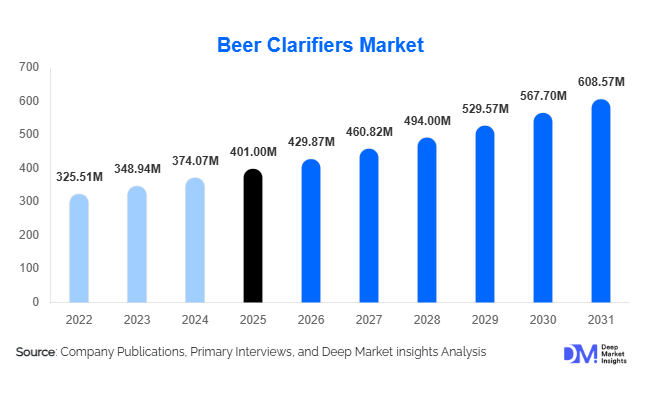
According to Deep Market Insights, the global beer clarifiers market size was valued at USD 401 million in 2025 and is projected to grow from USD 429.87 million in 2026 to reach USD 608.57 million by 2031, expanding at a CAGR of 7.2% during the forecast period (2026–2031). The beer clarifiers market growth is primarily driven by rising global beer production, increasing demand for premium and export-quality beers, growing investments in brewery modernization, and expanding adoption of advanced clarification technologies that improve shelf-life stability and product consistency. As breweries seek to optimize production efficiency while maintaining high-quality standards, clarifiers have become an essential component of modern brewing operations.
Key Market Insights
- Premium and craft beer production continues to drive demand for advanced clarification solutions, particularly those that preserve flavor while improving visual clarity and stability.
- Vegan and plant-based clarifiers are gaining market share as breweries respond to consumer demand for clean-label and sustainable beer products.
- Europe dominates the global beer clarifiers market, supported by its mature brewing industry, extensive beer exports, and stringent quality standards.
- Asia-Pacific is the fastest-growing regional market, driven by brewery capacity expansions in China, India, Vietnam, and Southeast Asia.
- Macro breweries account for the largest share of clarifier consumption due to their large production volumes and continuous investments in process optimization.
- Technological advancements in enzyme-based clarifiers and filtration integration are improving clarification efficiency while reducing processing time and operational costs.
Beer Clarifiers Market Latest Trends
Growing Adoption of Vegan and Plant-Based Clarifiers
The beer industry is witnessing a significant shift toward vegan-certified brewing ingredients as consumers increasingly demand transparency and sustainability. Traditional animal-derived clarifiers such as isinglass are gradually being replaced by plant-based, mineral-based, and enzyme-based alternatives. Breweries are incorporating vegan-friendly clarification systems to align with evolving consumer preferences while also expanding market accessibility among health-conscious and environmentally aware customers. This trend is particularly prominent in Europe and North America, where clean-label products and sustainability certifications influence purchasing decisions. Suppliers are investing heavily in research and development to improve the performance of plant-derived clarifiers while maintaining brewing efficiency and beer quality.
Integration of Clarification and Filtration Technologies
Modern breweries are increasingly integrating clarification agents with advanced filtration systems to improve throughput and reduce production costs. Crossflow filtration, membrane technologies, and enzyme-assisted clarification are being adopted to achieve greater process efficiency and consistent product quality. Large breweries are utilizing digital monitoring systems that optimize clarifier dosing and filtration performance in real time. These technologies help reduce beer losses, shorten maturation periods, and enhance shelf-life stability, making them particularly valuable for export-oriented beer production. The trend toward automation and smart brewery operations is expected to further increase adoption of integrated clarification solutions throughout the forecast period.
Beer Clarifiers Market Drivers
Rising Demand for Premium and Export-Quality Beer
Consumers increasingly associate beer clarity, consistency, and stability with premium product quality. As breweries expand premium product portfolios, demand for high-performance clarifiers continues to increase. Export-oriented breweries particularly depend on advanced clarification systems to maintain product appearance and flavor stability throughout extended transportation and storage periods. The growing international trade of premium beers has made clarifiers a critical process input for global brewing companies.
Expansion of the Global Craft Brewing Industry
The rapid growth of craft breweries across North America, Europe, Asia-Pacific, and Latin America is significantly contributing to market expansion. Craft brewers seek clarification technologies that preserve unique flavor characteristics while improving product stability. Many smaller breweries also rely on clarifiers to accelerate production cycles and maximize operational efficiency without substantial investments in extended maturation infrastructure. This growing customer base continues to create new opportunities for specialty clarifier manufacturers.
Beer Clarifiers Market Restraints
Increasing Popularity of Naturally Hazy Beer Styles
The growing popularity of hazy IPAs, unfiltered beers, and naturally cloudy craft beer styles presents a challenge for conventional clarification products. In several craft beer categories, haze is increasingly viewed as a desirable characteristic rather than a quality defect. This trend may partially limit demand growth for traditional clarification solutions in certain beer segments.
Regulatory and Ingredient Compliance Challenges
Breweries and clarifier manufacturers must comply with increasingly stringent food safety, labeling, and sustainability regulations. Animal-derived clarifiers face additional scrutiny regarding allergen concerns, traceability requirements, and vegan certifications. Compliance costs and reformulation requirements can create barriers for market participants and slow product commercialization.
Beer Clarifiers Industry Key Opportunities
Growth of Low- and No-Alcohol Beer Production
The rapidly expanding low-alcohol and alcohol-free beer segment presents a significant opportunity for clarifier manufacturers. These products often require enhanced stabilization and clarification processes to maintain sensory characteristics comparable to traditional beers. As consumer demand for healthier beverage alternatives grows globally, breweries are increasing production of low-alcohol offerings, creating additional demand for advanced clarification technologies. Suppliers capable of developing specialized solutions tailored to alcohol-free beer production stand to benefit significantly from this emerging segment.
Expansion into High-Growth Asia-Pacific Brewing Markets
Asia-Pacific continues to attract substantial investments in brewing infrastructure and premium beer production. Countries such as China, India, Vietnam, and Thailand are witnessing increasing beer consumption and growing consumer preference for premium brands. International brewers are expanding production capacity across the region, creating opportunities for clarifier suppliers to establish local manufacturing, technical support services, and strategic partnerships. As brewery modernization accelerates, demand for high-performance clarification products is expected to rise significantly.
Report Scope
| Report Metric | Details |
|---|---|
| Market Size in 2025 | USD 401.00 Million |
| Market Size in 2026 | USD 429.87 Million |
| Market Size in 2031 | USD 608.57 Million |
| CAGR | 7.2% (2026-2031) |
| Base Year for Estimation | 2025 |
| Historical Data | 2022-2024 |
| Forecast Period | 2026-2031 |
| Report Coverage | Revenue Forecast, Competitive Landscape, Supply Chain Disruption, Growth Factors, Environment & Regulatory Landscape and Trends |
| Geographies Covered | North America, Europe, APAC, Middle East and Africa, LATAM |
| Countries Covered | U.S., Canada, U.K., Germany, France, Spain, Italy, Russia, Nordic, Benelux, Rest of Europe, China, Korea, Japan, India, Australia, Singapore, Taiwan, South East Asia, Rest of Asia-Pacific, UAE, Turky, Saudi Arabia, South Africa, Egypt, Nigeria, Rest of MEA, Brazil, Mexico, Argentina, Chile, Colombia, Rest of LATAM |
Explore more data points, trends and opportunities Download Free Sample Report
Product Type Insights
Processing clarifiers represent the largest product category in the global beer clarifiers market, with silica gel clarifiers accounting for approximately 28% of total market revenue in 2025. The leadership of this segment is primarily attributed to the growing emphasis on beer clarity, colloidal stability, and extended shelf life across both large-scale and craft brewing operations. Silica gel clarifiers are widely utilized due to their effectiveness in selectively removing haze-forming proteins while preserving the sensory profile, flavor characteristics, aroma, and foam stability of beer. As breweries increasingly focus on delivering visually appealing and quality-consistent products across domestic and export markets, demand for silica gel-based clarification solutions continues to strengthen.PVPP clarifiers maintain a significant market position owing to their superior ability to reduce polyphenols responsible for oxidative instability and chill haze formation. Their application is particularly important among premium and export-oriented breweries seeking to enhance product freshness and maintain flavor stability throughout extended distribution cycles. Enzyme-based clarifiers are emerging as one of the fastest-growing product segments as breweries pursue more sustainable, efficient, and process-optimized production methods. These solutions help reduce maturation times, improve filtration performance, and lower energy consumption, making them increasingly attractive for modern brewing facilities. Clarification equipment, including membrane filtration systems, crossflow filtration technologies, centrifuges, and automated clarification units, is also witnessing growing adoption among large breweries seeking operational efficiency, process automation, reduced product losses, and improved production throughput.
Source Insights
Synthetic clarifiers dominated the global beer clarifiers market in 2025, accounting for approximately 36% of total revenue. The leading position of this segment is driven by the consistent performance, high reliability, scalability, and compatibility of synthetic clarification agents with high-volume industrial brewing processes. Large breweries continue to favor synthetic clarifiers because they deliver predictable clarification outcomes, support standardized production requirements, and facilitate efficient quality control across multiple production batches.Mineral-based clarifiers maintain a substantial market presence due to their cost-effectiveness, widespread availability, and long-established use in brewing operations. Their ability to effectively remove suspended particles while supporting economical production makes them particularly attractive for regional and value-oriented breweries. Plant-based clarifiers are experiencing robust growth as breweries increasingly respond to rising consumer demand for vegan-certified, clean-label, and naturally sourced beer products. Growing awareness regarding ingredient transparency and sustainable brewing practices is accelerating adoption of botanical clarification solutions. Enzyme-based clarifiers are also gaining popularity due to their ability to shorten processing cycles, improve filtration efficiency, reduce resource consumption, and support sustainability objectives, making them an increasingly important component of next-generation brewing operations.
Brewing Stage Insights
Final beer stabilization and clarification represent the largest brewing-stage segment, accounting for approximately 33% of global market revenue in 2025. The dominance of this stage is primarily driven by the critical role clarification plays in ensuring visual clarity, flavor consistency, microbiological stability, and shelf-life performance before packaging and distribution. As breweries face growing consumer expectations for premium-quality products and increasingly competitive retail environments, investments in final-stage clarification technologies continue to rise.
Fermentation clarification and maturation-stage clarification also account for significant market demand as breweries seek to improve process efficiency and optimize production timelines. Clarification during fermentation helps reduce suspended solids and improve downstream processing efficiency, while maturation-stage clarification contributes to improved flavor development and product stability. The growing adoption of process optimization strategies, advanced filtration systems, and automated brewing technologies is encouraging breweries to integrate clarification solutions throughout multiple stages of production. This trend is particularly evident among large commercial breweries focused on maximizing production efficiency, reducing product losses, and maintaining consistent beer quality.
Brewery Scale Insights
Macro breweries remain the largest consumers of beer clarifiers, accounting for nearly 52% of global market demand in 2025. The dominance of this segment is driven by high production volumes, stringent quality requirements, and the need to maintain consistency across large-scale brewing operations. As global beer brands continue expanding their distribution networks and export activities, investments in advanced clarification technologies remain essential for ensuring product stability, visual appeal, and operational efficiency.Regional breweries constitute an important customer segment as the premiumization of beer consumption continues to gain momentum across developed and emerging markets. These breweries increasingly adopt clarification solutions to enhance product quality while maintaining production flexibility. Craft breweries and microbreweries represent some of the fastest-growing users of beer clarifiers as they seek technologies capable of preserving flavor authenticity while achieving desired clarity standards and production efficiency. Growing consumer interest in specialty beers, premium craft products, and small-batch brewing is further supporting demand within this segment. Brewpubs are also increasingly incorporating specialized clarification products to improve consistency and support the production of premium on-site beer offerings.
Function Insights
Haze removal remains the leading functional application in the beer clarifiers market, accounting for approximately 39% of total demand in 2025. The primary driver of this segment is the growing consumer preference for visually clear and aesthetically appealing beer products, particularly within premium lager, pilsner, and export beer categories. As breweries increasingly compete on product quality and brand perception, investments in haze prevention and stabilization technologies continue to rise. The ability to achieve consistent clarity while preserving flavor characteristics remains a critical performance requirement for breweries worldwide.Shelf-life enhancement and flavor stability improvement are becoming increasingly important applications as breweries expand into international markets and develop wider distribution networks. Clarification technologies help minimize oxidation-related quality degradation, maintain freshness, and support extended storage periods, making them essential for export-oriented producers. Polyphenol reduction and protein stabilization functions also contribute significantly to market growth by helping breweries prevent haze formation, improve colloidal stability, and maintain product quality throughout the product lifecycle. The growing emphasis on premium beer quality, supply chain efficiency, and consumer satisfaction continues to support adoption across all functional categories.
Explore more data points, trends and opportunities Download Free Sample Report
Beer Clarifiers Market Segmentations
By Product Type
- Silica Gel Clarifiers
- PVPP (Polyvinylpolypyrrolidone) Clarifiers
- Isinglass Clarifiers
- Gelatin-Based Clarifiers
- Carrageenan Clarifiers
- Bentonite Clarifiers
- Enzyme-Based Clarifiers
- Plant-Based/Vegan Clarifiers
- Mixed/Formulated Clarifier Blends
- Clarification Equipment
By Source
- Animal-Derived Clarifiers
- Mineral-Based Clarifiers
- Synthetic Clarifiers
- Plant-Based Clarifiers
- Enzyme-Based Clarifiers
By Form
- Powder Clarifiers
- Granular Clarifiers
- Liquid Clarifiers
- Gel Clarifiers
By Brewing Stage
- Wort Clarification
- Fermentation Clarification
- Maturation Clarification
- Final Beer Stabilization & Clarification
By Beer Type Application
- Lager Beer
- Ale Beer
- Stout & Porter Beer
- Wheat Beer
- Specialty & Craft Beer
- Low/No Alcohol Beer
Regional Insights
Europe
Europe accounted for approximately 34% of the global beer clarifiers market in 2025, making it the largest regional market. Germany leads regional demand with nearly 11% of global market revenue, supported by its extensive brewing industry, strong beer export activity, and long-standing brewing traditions. Other major contributors include the United Kingdom, Belgium, France, the Netherlands, Italy, and Spain, all of which maintain well-established beer production industries and significant premium beer consumption. The region benefits from stringent beer quality standards, widespread adoption of advanced brewing technologies, and strong demand for premium and specialty beer products.Regional market growth is being driven by increasing investments in brewing modernization, rising demand for high-quality and export-grade beer, growing focus on product stability and shelf-life extension, and the continued expansion of premium and craft beer segments. Additionally, the increasing adoption of sustainable brewing practices, clean-label processing solutions, and vegan-friendly clarification agents is creating new opportunities for clarifier manufacturers across European markets.
North America
North America represented approximately 28% of global beer clarifiers market revenue in 2025. The United States accounts for nearly 23% of worldwide demand, supported by its large brewing industry, extensive network of craft breweries, and strong consumer demand for premium beer products. Canada also contributes significantly through continued investments in specialty beer production and brewing innovation.The region's growth is supported by increasing premiumization trends, expansion of craft and independent breweries, rising consumer expectations for product quality and consistency, and growing adoption of sustainable brewing technologies. Demand for vegan-certified clarifiers and environmentally friendly brewing solutions is increasing as breweries focus on improving sustainability performance and meeting evolving consumer preferences. Continued investments in automated brewing facilities and advanced filtration technologies are further supporting clarifier adoption throughout the region.
Asia-Pacific
Asia-Pacific accounted for approximately 24% of the global beer clarifiers market in 2025 and is projected to register the fastest growth during the forecast period. China remains the largest regional market due to its substantial brewing capacity, large consumer base, and growing demand for premium beer products. India is emerging as the fastest-growing national market, supported by brewery expansion projects, rising disposable incomes, rapid urbanization, and increasing adoption of premium alcoholic beverages. Japan, South Korea, Vietnam, Thailand, and Australia continue to invest in advanced brewing technologies and product quality enhancement initiatives.Regional growth is being driven by rising beer consumption, rapid expansion of brewing infrastructure, increasing penetration of international beer brands, growing demand for premium and craft beer products, and improving consumer awareness regarding product quality. The modernization of brewery operations, growing foreign investments in brewing facilities, and increasing adoption of advanced processing technologies are further accelerating demand for beer clarification solutions throughout the region.
Latin America
Latin America accounted for approximately 8% of global market revenue in 2025. Brazil leads regional demand owing to its large-scale beer production industry, strong domestic consumption, and expanding premium beer segment. Mexico and Argentina also contribute significantly to regional revenue, supported by growing export activities and increasing investments in brewery modernization programs.Market growth across the region is primarily driven by rising disposable incomes, expansion of the middle-class population, increasing consumption of premium and specialty beer products, and ongoing investments in production efficiency improvements. Breweries are increasingly adopting advanced clarification technologies to enhance product quality, improve shelf-life performance, and support growing export requirements. The gradual development of craft brewing industries across several Latin American countries is also creating additional opportunities for clarifier suppliers.
Middle East & Africa
The Middle East and Africa accounted for approximately 6% of global beer clarifiers market revenue in 2025. South Africa remains the largest market within the region, supported by established brewing operations, growing adoption of modern processing technologies, and increasing demand for quality-focused beer production. The United Arab Emirates and Saudi Arabia are emerging growth markets, particularly within the non-alcoholic malt beverage segment, where clarification technologies play an important role in maintaining product stability, appearance, and flavor consistency.Regional growth is being supported by rising investments in beverage manufacturing infrastructure, increasing consumption of malt-based beverages, growing adoption of advanced processing equipment, and expanding food and beverage industries across key economies. Improvements in production standards, rising urbanization, and increasing consumer demand for premium-quality beverages are further encouraging breweries and beverage manufacturers to invest in modern clarification technologies throughout the region.
Key Players in the Beer Clarifiers Market
- Ashland Inc.
- Kerry Group plc
- DSM-Firmenich
- BASF SE
- AB Vickers
- Erbslöh Geisenheim AG
- AEB Group
- Eaton Corporation
- Pall Corporation
- Sartorius AG
- Novozymes
- Lallemand Inc.
- Murphy & Son Ltd.
- Gusmer Enterprises
- W. R. Grace & Co.