BCAA Energy Drink Market Size
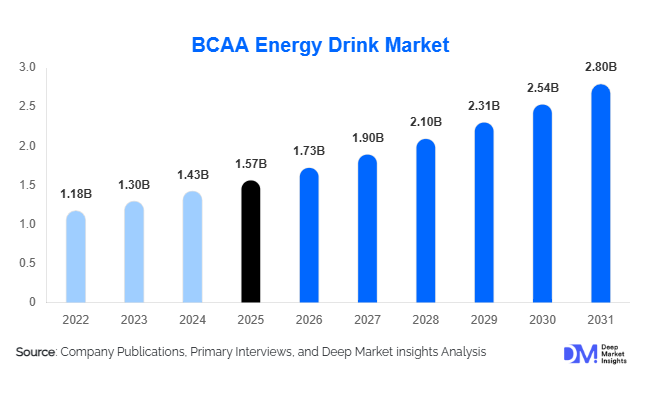
According to Deep Market Insights, the global BCAA energy drink market size was valued at USD 1.57 billion in 2025 and is projected to grow from USD 1.73 billion in 2026 to reach USD 2.80 billion by 2031, expanding at a CAGR of 10.1% during the forecast period (2026–2031). The BCAA energy drink market growth is being driven by the convergence of sports nutrition and functional beverages, increasing participation in fitness and endurance activities, and growing consumer preference for energy drinks that provide muscle recovery, hydration, and performance-enhancing benefits. Branched-chain amino acids (BCAAs), including leucine, isoleucine, and valine, are increasingly being incorporated into ready-to-drink (RTD) formulations, enabling manufacturers to differentiate products beyond traditional caffeine-based energy beverages.
The market is witnessing strong demand for sugar-free, clean-label, and natural caffeine-based products as consumers become more health-conscious. RTD formats dominate the category due to convenience, portability, and increasing shelf presence across supermarkets, convenience stores, fitness centers, and e-commerce channels. North America remains the largest regional market due to its mature sports nutrition industry, while Asia-Pacific is emerging as the fastest-growing region supported by expanding gym memberships, rising disposable incomes, and increasing awareness of performance nutrition. Product innovation around hydration, electrolytes, vitamins, adaptogens, and nootropic ingredients is further expanding the appeal of BCAA energy drinks among athletes, active lifestyle consumers, gamers, and wellness-focused individuals worldwide.
Key Market Insights
- Ready-to-drink (RTD) BCAA energy drinks account for approximately 68% of global revenue, making convenience-driven consumption the dominant growth engine.
- Sugar-free products represent nearly 57% of the market, reflecting strong consumer demand for low-calorie and health-oriented functional beverages.
- North America dominates the global market with approximately 39% share, supported by a mature sports nutrition ecosystem and widespread fitness participation.
- Asia-Pacific is the fastest-growing region, driven by rising demand from China, India, Japan, South Korea, and Southeast Asian countries.
- Fitness enthusiasts represent the largest consumer segment, accounting for nearly 34% of total global demand.
- Functional beverage innovation is accelerating, with manufacturers integrating electrolytes, vitamins, natural caffeine, nootropics, and adaptogens into BCAA energy formulations.
- E-commerce and direct-to-consumer channels are expanding rapidly, enabling brands to reach niche fitness and wellness audiences globally.
BCAA Energy Drink Market Latest Trends
Rise of Sugar-Free and Clean-Label Functional Beverages
The global functional beverage industry is experiencing a major shift toward clean-label and sugar-free formulations, and BCAA energy drinks are at the forefront of this trend. Consumers are increasingly seeking products that deliver energy, hydration, and muscle recovery without excessive sugar or artificial ingredients. As a result, manufacturers are reformulating products using natural sweeteners, plant-based caffeine sources, and transparent ingredient labeling. Brands are also emphasizing clinically supported ingredients and performance-focused formulations to attract health-conscious consumers. This trend is particularly strong among millennials and Gen Z consumers, who prioritize wellness, calorie management, and ingredient transparency when selecting energy beverages.
Expansion Beyond Traditional Sports Nutrition Consumers
BCAA energy drinks are increasingly moving beyond the traditional bodybuilding and athletic communities into mainstream lifestyle consumption. Professionals, students, gamers, shift workers, and wellness-focused consumers are adopting these beverages as alternatives to conventional energy drinks. Manufacturers are responding by introducing lifestyle-oriented flavors, cognitive performance formulations, hydration-focused variants, and multifunctional beverages that combine energy support with recovery benefits. The growing popularity of gaming, e-sports, and hybrid work environments is creating new consumption occasions that extend market demand beyond gym environments and sports applications.
BCAA Energy Drink Market Drivers
Growing Global Fitness Participation
The increasing number of gym memberships, fitness club enrollments, endurance sports participants, and recreational athletes worldwide continues to drive demand for BCAA energy drinks. Consumers are increasingly aware of the role amino acids play in muscle recovery and performance optimization, leading to higher adoption of sports nutrition beverages. The expansion of fitness culture across emerging economies is creating a larger addressable consumer base for manufacturers. Fitness influencers, digital coaching platforms, and social media content are further supporting market growth by increasing awareness of performance-focused nutritional products.
Rising Demand for Functional Energy Beverages
Consumers are increasingly shifting away from traditional energy drinks toward multifunctional beverages that offer additional health and wellness benefits. BCAA energy drinks provide a unique value proposition by combining energy enhancement, hydration support, muscle recovery, and endurance performance in a single product. This multifunctionality aligns with evolving consumer preferences for convenient, health-focused beverages. Growing demand for preventive wellness products and active lifestyle nutrition continues to accelerate category expansion globally.
BCAA Energy Drink Market Restraints
Regulatory Scrutiny of Energy Drink Ingredients
Governments and food regulatory agencies worldwide are increasing oversight of energy drink ingredients, particularly caffeine content, labeling practices, and health-related marketing claims. Compliance requirements vary across regions, increasing complexity for multinational manufacturers. Additional restrictions on caffeine levels or marketing practices could create challenges for product formulation and market expansion. Regulatory scrutiny is particularly pronounced in Europe and certain Asia-Pacific countries, where consumer safety concerns continue to influence policy discussions.
Consumer Debate Around BCAA Supplementation Benefits
Although BCAA supplementation is widely accepted within sports nutrition communities, some consumers remain uncertain regarding the incremental benefits of standalone BCAA products compared with complete protein supplementation. Scientific debate surrounding amino acid efficacy may affect adoption among mainstream consumers. Manufacturers must continue investing in consumer education, clinical research, and evidence-based marketing to reinforce product differentiation and support long-term category growth.
BCAA Energy Drink Industry Key Opportunities
Asia-Pacific Market Expansion
Asia-Pacific represents the largest growth opportunity for BCAA energy drink manufacturers. Countries such as China, India, Indonesia, Thailand, Vietnam, South Korea, and Japan are witnessing rapid growth in gym memberships, fitness participation, and sports nutrition awareness. Rising disposable incomes and expanding middle-class populations are creating favorable conditions for premium functional beverage adoption. Market penetration remains significantly lower than in North America, providing substantial room for both multinational brands and regional entrants to expand their presence.
Premium Lifestyle and Wellness Positioning
Manufacturers are increasingly positioning BCAA energy drinks as everyday wellness beverages rather than products exclusively designed for athletes. This shift enables brands to target broader consumer groups, including office workers, students, gamers, and health-conscious individuals seeking sustained energy and recovery support. The integration of vitamins, electrolytes, adaptogens, and nootropic ingredients creates opportunities for premium pricing and category differentiation. Lifestyle-focused branding strategies are expected to expand addressable market potential considerably over the forecast period.
Report Scope
| Report Metric | Details |
|---|---|
| Market Size in 2025 | USD 1.57 Billion |
| Market Size in 2026 | USD 1.73 Billion |
| Market Size in 2031 | USD 2.80 Billion |
| CAGR | 10.1% (2026-2031) |
| Base Year for Estimation | 2025 |
| Historical Data | 2022-2024 |
| Forecast Period | 2026-2031 |
| Report Coverage | Revenue Forecast, Competitive Landscape, Supply Chain Disruption, Growth Factors, Environment & Regulatory Landscape and Trends |
| Geographies Covered | North America, Europe, APAC, Middle East and Africa, LATAM |
| Countries Covered | U.S., Canada, U.K., Germany, France, Spain, Italy, Russia, Nordic, Benelux, Rest of Europe, China, Korea, Japan, India, Australia, Singapore, Taiwan, South East Asia, Rest of Asia-Pacific, UAE, Turky, Saudi Arabia, South Africa, Egypt, Nigeria, Rest of MEA, Brazil, Mexico, Argentina, Chile, Colombia, Rest of LATAM |
Explore more data points, trends and opportunities Download Free Sample Report
Product Format Insights
The Ready-to-Drink (RTD) segment dominates the global BCAA energy drink market, accounting for approximately 68% of total revenue in 2025 and maintaining its position as the leading product format worldwide. The segment’s leadership is primarily driven by growing consumer preference for convenience-oriented nutrition products that require no preparation and can be consumed instantly before, during, or after physical activity. The increasing pace of modern lifestyles, rising participation in fitness activities, and strong demand for portable functional beverages have significantly accelerated RTD adoption across both sports nutrition and mainstream wellness consumer groups. Furthermore, extensive retail availability across supermarkets, convenience stores, fitness centers, vending channels, and e-commerce platforms has strengthened product accessibility and market penetration. Manufacturers continue to introduce innovative RTD formulations featuring sugar-free ingredients, enhanced amino acid profiles, natural sweeteners, and functional additives such as electrolytes, vitamins, and adaptogens, further supporting category growth.BCAA energy powders represent the second-largest segment and continue to attract consumers seeking greater dosage flexibility, customization, and cost-effective supplementation. Powder formats remain particularly popular among bodybuilders, athletes, and regular gym-goers who prefer tailored serving sizes and stacking options with other performance-enhancing supplements. Liquid concentrates and energy shots occupy a smaller share of the market but are gaining traction among endurance athletes, professional sports participants, and consumers seeking highly concentrated performance nutrition in compact formats. Ongoing product innovation, packaging advancements, and expanding consumer demand for functional convenience beverages are expected to reinforce the leadership position of RTD products throughout the forecast period.
Sugar Profile Insights
Sugar-free BCAA energy drinks account for approximately 57% of global demand in 2025, making them the largest segment within the market. The segment's dominance is largely driven by increasing consumer focus on calorie management, weight control, metabolic health, and clean-label nutrition. Growing concerns regarding obesity, diabetes, and excessive sugar consumption have encouraged consumers to transition toward healthier functional beverage alternatives that deliver performance benefits without added sugars. The expanding popularity of ketogenic, low-carbohydrate, and fitness-oriented dietary lifestyles has further accelerated demand for sugar-free formulations.Manufacturers are increasingly incorporating natural sweetening solutions such as stevia, monk fruit, and erythritol to enhance taste profiles while maintaining low-calorie positioning and label transparency. Reduced-sugar products continue to gain traction among consumers seeking a balanced transition away from conventional energy drinks, while sugar-based variants retain relevance among endurance athletes and high-performance users requiring rapid carbohydrate replenishment and immediate energy support during intensive physical activities. As health-conscious consumption patterns continue to strengthen globally, sugar-free product innovation, supported by advances in flavor technology and natural ingredient development, is expected to remain one of the most significant growth drivers across the BCAA energy drink industry.
Functional Positioning Insights
Pre-workout BCAA energy drinks represent approximately 38% of global market revenue and remain the leading functional positioning category. The segment's leadership is primarily supported by rising participation in fitness training, strength conditioning, high-intensity interval training, and sports performance activities. Consumers increasingly utilize pre-workout formulations to enhance energy levels, improve endurance, support mental focus, and maximize workout efficiency. The growing integration of caffeine, amino acids, electrolytes, and performance-enhancing ingredients within pre-workout beverages has further strengthened consumer demand across both professional athletes and recreational fitness participants.Intra-workout formulations are experiencing steady adoption as consumers place greater emphasis on maintaining hydration, electrolyte balance, and sustained performance during exercise sessions. Recovery-focused BCAA energy drinks are emerging as a rapidly expanding segment due to growing awareness regarding muscle repair, reduced fatigue, and post-exercise recovery optimization. At the same time, daily energy and wellness beverages are gaining broader consumer acceptance as functional nutrition expands beyond traditional sports applications into mainstream lifestyle consumption. The category’s evolution toward holistic wellness solutions, encompassing energy support, recovery enhancement, hydration, and cognitive performance, is expected to create substantial growth opportunities across all functional positioning segments.
Distribution Channel Insights
Supermarkets and hypermarkets remain the largest distribution channel, accounting for approximately 32% of global sales in 2025. The segment benefits from extensive consumer reach, broad product assortments, strong promotional capabilities, and the ability to provide immediate product availability across multiple brands and price points. The widespread presence of functional beverage sections within large retail stores continues to improve consumer awareness and encourage trial purchases, supporting channel leadership across developed and emerging markets.Convenience stores represent another significant distribution avenue, benefiting from the impulse-driven purchasing behavior commonly associated with energy beverages. Their strategic locations near workplaces, transportation hubs, educational institutions, and fitness facilities support frequent consumer purchases. Online retail and direct-to-consumer platforms are witnessing the fastest growth among all distribution channels, driven by increasing digitalization, subscription-based purchasing models, personalized product recommendations, and direct brand engagement. E-commerce platforms also enable manufacturers to access niche consumer segments and expand geographic reach with lower distribution barriers. Specialty nutrition retailers, sports supplement stores, and fitness centers continue to play a critical role in promoting premium formulations and educating consumers regarding product benefits. Continued expansion of digital commerce infrastructure and omnichannel retail strategies is expected to further strengthen online sales growth over the forecast period.
Consumer Type Insights
Fitness enthusiasts account for approximately 34% of global demand and represent the largest consumer segment within the BCAA energy drink market. The segment's leadership is driven by increasing gym participation, growing focus on physical fitness, and rising consumer awareness regarding performance nutrition. Fitness-oriented consumers actively seek products that enhance workout performance, improve endurance, support hydration, and accelerate post-exercise recovery, making BCAA energy drinks an attractive solution for everyday training routines.Professional and amateur athletes continue to contribute significantly to premium product demand due to their emphasis on performance optimization, recovery efficiency, and competitive advantage. Bodybuilders remain a core consumer base, utilizing BCAA beverages to support muscle preservation, protein synthesis, and training intensity. Meanwhile, active lifestyle consumers are increasingly adopting BCAA energy drinks as healthier alternatives to traditional energy beverages, particularly as wellness-focused consumption trends expand beyond athletic communities. Emerging demand from gamers, e-sports participants, and digitally engaged consumers is creating new growth opportunities for manufacturers developing formulations that combine sustained energy delivery, cognitive support, hydration, and enhanced focus. The diversification of consumer demographics is expected to broaden the market's addressable customer base and support long-term industry expansion.
End-Use Industry Insights
Sports nutrition remains the largest end-use industry, accounting for approximately 41% of global market demand in 2025. The segment's dominance is primarily driven by growing participation in professional sports, amateur athletics, endurance competitions, and organized fitness activities worldwide. Increasing consumer emphasis on performance enhancement, recovery support, and muscle maintenance continues to fuel demand for amino acid-based functional beverages within the sports nutrition ecosystem.Fitness and gym nutrition represents the fastest-growing application area, supported by rising health club memberships, expanding fitness infrastructure, and increasing consumer expenditure on wellness and performance-oriented products. Active lifestyle consumption is becoming an increasingly important market contributor as consumers incorporate functional beverages into daily routines for sustained energy, productivity, and overall well-being. Beyond traditional applications, emerging opportunities within military nutrition programs, tactical performance initiatives, corporate wellness schemes, first responder nutrition, and e-sports are expanding the scope of BCAA energy drink utilization. The growing diversification of end-use industries reduces dependence on traditional sports applications and is expected to strengthen long-term market resilience and growth prospects.
Explore more data points, trends and opportunities Download Free Sample Report
BCAA Energy Drink Market Segmentations
By Product Format
- Ready-to-Drink (RTD) BCAA Energy Drinks
- BCAA Energy Powders
- BCAA Energy Concentrates & Shots
By Sugar Profile
- Sugar-Based BCAA Energy Drinks
- Reduced-Sugar BCAA Energy Drinks
- Sugar-Free / Zero-Calorie BCAA Energy Drinks
By Caffeine Source
- Synthetic Caffeine-Based
- Natural Caffeine-Based
By Functional Positioning
- Pre-Workout BCAA Energy Drinks
- Intra-Workout BCAA Energy Drinks
- Recovery-Oriented BCAA Energy Drinks
- Endurance Performance Drinks
- Daily Energy & Wellness Drinks
By Consumer Type
- Professional Athletes
- Amateur Athletes
- Fitness Enthusiasts
- Bodybuilders
- Lifestyle Consumers
- Gamers & E-sports Consumers
Regional Insights
North America
North America accounted for approximately 39% of global BCAA energy drink revenue in 2025, making it the largest regional market. The United States contributes nearly 32% of global demand and remains the primary growth engine for the regional industry. Market leadership is supported by a highly developed sports nutrition ecosystem, widespread fitness participation, strong consumer purchasing power, and the presence of major functional beverage manufacturers. High awareness regarding performance nutrition, muscle recovery, and exercise supplementation has encouraged broad consumer adoption across athletes, gym-goers, and lifestyle consumers. Additional growth is being driven by increasing demand for sugar-free formulations, premium functional beverages, clean-label ingredients, and personalized nutrition solutions. Canada is also experiencing rising demand for wellness-oriented and low-calorie energy drinks, supported by growing health-conscious consumption patterns. The region’s mature retail infrastructure, strong e-commerce penetration, and continuous product innovation are expected to sustain market leadership throughout the forecast period.
Europe
Europe represents approximately 28% of global demand and remains one of the most important markets for clean-label and wellness-focused BCAA energy beverages. Germany, the United Kingdom, France, Italy, and Spain account for the majority of regional consumption. European consumers demonstrate strong preferences for natural ingredients, transparent labeling practices, reduced-sugar formulations, and environmentally sustainable packaging solutions. Market growth is further supported by increasing participation in recreational sports, fitness training, running events, cycling activities, and health-oriented lifestyle programs. Rising awareness regarding preventive healthcare, active aging, and nutritional supplementation continues to encourage adoption of functional beverages across broader consumer demographics. In addition, stringent regulatory standards have encouraged manufacturers to invest in ingredient quality, product transparency, and premium positioning, contributing to sustained market development across the region.
Asia-Pacific
Asia-Pacific accounts for approximately 22% of global market revenue and is projected to be the fastest-growing regional market throughout the forecast period. China, Japan, South Korea, India, and Australia represent the largest national markets within the region. Rapid urbanization, rising disposable incomes, expanding middle-class populations, and growing consumer awareness regarding fitness and wellness are significantly increasing demand for performance nutrition products. The proliferation of gyms, fitness centers, organized sporting events, and digital health platforms has accelerated adoption of BCAA energy drinks among younger consumers. Growth is further supported by increasing westernization of dietary habits, rising e-commerce penetration, and expanding availability of international sports nutrition brands. India is emerging as one of the fastest-growing markets due to growing sports participation, expanding fitness culture, rising health consciousness, and increasing accessibility of functional beverages through both online and offline channels. The region's large population base and improving consumer spending capacity position Asia-Pacific as a major future growth hub for the industry.
Latin America
Latin America accounts for approximately 6% of global demand, with Brazil and Mexico serving as the leading regional markets. Market expansion is being driven by increasing participation in fitness activities, rising awareness of sports nutrition benefits, and growing consumer interest in healthier energy beverage alternatives. The expanding influence of social media fitness culture, increasing urbanization, and improving access to international nutritional products are further supporting category development. Younger demographics are demonstrating strong interest in performance-oriented beverages that combine energy enhancement with wellness benefits. As disposable incomes gradually improve and modern retail infrastructure expands across major metropolitan areas, demand for premium and functional beverage products is expected to strengthen, creating significant long-term growth opportunities throughout the region.
Middle East & Africa
The Middle East & Africa region represents approximately 5% of global market revenue and continues to demonstrate steady growth potential. The United Arab Emirates, Saudi Arabia, and South Africa remain the largest contributors to regional demand. Market growth is supported by rising disposable incomes, increasing urbanization, expanding gym memberships, and growing consumer awareness regarding fitness, wellness, and sports nutrition. Government-led health promotion initiatives aimed at reducing lifestyle-related diseases and encouraging active living are positively influencing demand for functional beverages across several countries. The growing popularity of fitness events, endurance sports competitions, and premium wellness products is further supporting market expansion. In addition, increasing investments in modern retail infrastructure, digital commerce platforms, and international brand presence are expected to enhance product accessibility and accelerate long-term market development throughout the region.
Company Market Share
Key Players in the BCAA Energy Drink Market
- Nutrabolt
- Glanbia plc
- Ghost Lifestyle
- Kaged
- Cellucor
- Monster Beverage Corporation
- Red Bull GmbH
- Celsius Holdings Inc.
- GNC Holdings LLC
- Rule One Proteins
- BSN
- MusclePharm Corporation
- EHP Labs
- Applied Nutrition
- EVL Nutrition