Wallpaper Market Size
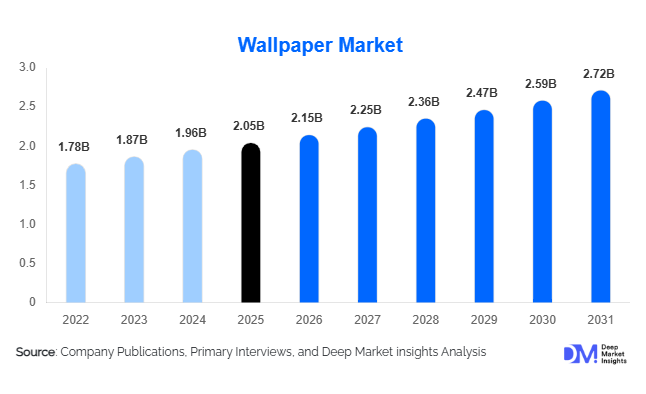
According to Deep Market Insights, the global wallpaper market size was valued at USD 2.05 billion in 2025 and is projected to grow from USD 2.15 billion in 2026 to reach USD 2.72 billion by 2031, expanding at a CAGR of 4.8% during the forecast period (2026–2031). The wallpaper market growth is being driven by rising residential renovation activity, increasing consumer preference for aesthetically enhanced interiors, growing adoption of customized wall décor solutions, and continuous innovation in digital printing technologies. Wallpaper has evolved beyond traditional decorative applications and is increasingly being used as a premium interior design element across residential, hospitality, commercial office, retail, healthcare, and institutional environments. The emergence of peel-and-stick wallpapers, eco-friendly materials, and digitally printed customized wall coverings has broadened consumer appeal and improved product accessibility. Rapid urbanization, expanding middle-class spending on home improvement, and growing demand for sustainable interior decoration products are further contributing to market expansion globally.
Key Market Insights
- Vinyl wallpaper dominates the global market, accounting for approximately 42% of total revenue in 2025 due to its durability, moisture resistance, and affordability.
- Digital printing technology is transforming the wallpaper industry, enabling personalized designs, shorter production runs, and premium customization opportunities.
- North America leads the global wallpaper market, representing nearly 34% of total revenue in 2025, supported by strong renovation spending and premium interior design adoption.
- Asia-Pacific is the fastest-growing regional market, driven by urbanization, housing development, and rising disposable incomes in China, India, and Southeast Asia.
- Commercial applications account for the largest end-user share, supported by demand from hotels, offices, retail outlets, healthcare facilities, and hospitality projects.
- Sustainable and non-toxic wallpapers are gaining significant traction, with manufacturers increasingly investing in low-VOC materials, recyclable substrates, and eco-certified production processes.
Wallpaper Market Trends
Rapid Adoption of Digitally Printed Customized Wallpapers
Digital printing technologies are revolutionizing the wallpaper industry by enabling highly customized and on-demand wall covering solutions. Consumers increasingly prefer unique interior designs that reflect personal tastes and brand identities. Digital wallpaper allows manufacturers to offer customized patterns, photographic murals, corporate branding graphics, and luxury artistic designs without requiring expensive production setups. The hospitality, corporate office, retail, and luxury residential sectors are particularly embracing personalized wall coverings to create differentiated interior experiences. Technological advancements in UV-curable and latex-based printing systems have improved color accuracy, durability, environmental performance, and production efficiency, further accelerating adoption across developed and emerging markets.
Growing Demand for Sustainable and Eco-Friendly Wall Coverings
Sustainability has emerged as a major trend influencing purchasing decisions within the wallpaper market. Consumers and commercial developers increasingly prefer products manufactured using recyclable materials, water-based inks, natural fibers, and low-VOC adhesives. Regulatory pressure surrounding indoor air quality and environmental performance is encouraging manufacturers to develop greener product portfolios. Non-woven wallpapers, natural fiber wallpapers, grasscloth products, and PVC-free wall coverings are experiencing strong demand growth. Leading manufacturers are incorporating sustainability certifications and circular production practices into their business models to address evolving consumer expectations and regulatory requirements. This trend is expected to remain a significant growth catalyst throughout the forecast period.
Wallpaper Market Drivers
Increasing Residential Renovation and Remodeling Activity
Growing investments in home improvement and interior renovation projects continue to drive wallpaper demand globally. Homeowners are increasingly seeking cost-effective methods to upgrade living spaces, and wallpaper offers a practical solution compared to structural remodeling. Rising property values, hybrid work arrangements, and growing consumer spending on home aesthetics have significantly increased demand for decorative wall coverings. Premium wallpaper products are particularly benefiting from the trend toward personalized and luxury interior environments.
Expansion of Hospitality and Commercial Construction
The hospitality, retail, healthcare, and corporate office sectors represent major consumers of wallpaper products. Hotels increasingly utilize decorative wall coverings to enhance guest experiences and strengthen brand positioning. Similarly, commercial offices use wallpaper to create visually appealing workspaces that improve employee engagement and productivity. The global expansion of hospitality infrastructure, mixed-use developments, premium retail environments, and healthcare facilities continues to create substantial demand for durable and aesthetically attractive wall coverings.
Technological Advancements in Wallpaper Manufacturing
Continuous advancements in digital printing, surface textures, adhesive technologies, and material science have significantly improved wallpaper functionality and design flexibility. Peel-and-stick wallpapers have simplified installation and removal processes, making products more attractive to renters and DIY consumers. Enhanced durability, moisture resistance, scratch protection, and washable surfaces have expanded wallpaper adoption across various end-use sectors. These innovations continue to improve customer satisfaction while opening new growth opportunities for manufacturers.
Wallpaper Market Restraints
Competition from Alternative Wall Finishing Materials
Paints, decorative coatings, wall panels, textured finishes, and ceramic wall claddings continue to compete directly with wallpaper products. In many markets, consumers perceive paint as a more economical and flexible solution, particularly for frequent interior redesigns. This competitive pressure limits wallpaper penetration in price-sensitive regions and residential segments.
Raw Material Price Volatility
The wallpaper industry remains vulnerable to fluctuations in raw material costs, particularly PVC resins, paper pulp, textile fibers, specialty inks, and adhesives. Rising energy prices and logistics costs can further impact manufacturing profitability. Manufacturers must continuously balance pricing competitiveness with margin protection, particularly during periods of inflation and supply chain disruptions.
Wallpaper Market Opportunities
Expansion of Peel-and-Stick Wallpaper Solutions
The increasing popularity of rental housing and DIY home improvement projects presents substantial opportunities for peel-and-stick wallpaper products. These solutions offer easy installation, minimal labor requirements, and convenient removal without wall damage. Younger consumers, urban renters, and first-time homeowners increasingly prefer self-adhesive products due to flexibility and affordability. Manufacturers that expand product portfolios within this category are expected to capture significant future growth.
Growth of Smart Commercial Interiors
The modernization of offices, retail stores, healthcare facilities, and hospitality venues creates opportunities for premium commercial wall covering solutions. Businesses increasingly use customized wallpapers to reinforce branding, improve customer experiences, and create visually distinctive environments. Integration of acoustic properties, antimicrobial surfaces, and specialty coatings further enhances the value proposition of commercial wallpaper applications.
Emerging Market Urbanization and Housing Development
Rapid urbanization across Asia-Pacific, Latin America, and the Middle East is creating significant opportunities for wallpaper manufacturers. Rising disposable incomes, expanding housing construction, and increasing awareness of interior design trends are accelerating wallpaper adoption among middle-income consumers. Localization of manufacturing and distribution networks can help companies capitalize on these high-growth markets.
Report Scope
| Report Metric | Details |
|---|---|
| Market Size in 2025 | USD 2.05 Billion |
| Market Size in 2026 | USD 2.15 Billion |
| Market Size in 2031 | USD 2.72 Billion |
| CAGR | 4.8% (2026-2031) |
| Base Year for Estimation | 2025 |
| Historical Data | 2022-2024 |
| Forecast Period | 2026-2031 |
| Report Coverage | Revenue Forecast, Competitive Landscape, Supply Chain Disruption, Growth Factors, Environment & Regulatory Landscape and Trends |
| Geographies Covered | North America, Europe, APAC, Middle East and Africa, LATAM |
| Countries Covered | U.S., Canada, U.K., Germany, France, Spain, Italy, Russia, Nordic, Benelux, Rest of Europe, China, Korea, Japan, India, Australia, Singapore, Taiwan, South East Asia, Rest of Asia-Pacific, UAE, Turky, Saudi Arabia, South Africa, Egypt, Nigeria, Rest of MEA, Brazil, Mexico, Argentina, Chile, Colombia, Rest of LATAM |
Explore more data points, trends and opportunities Download Free Sample Report
Product Type Insights
Vinyl wallpaper dominates the global wallpaper market, accounting for approximately 42% of total revenue in 2025. Its leading position is attributed to superior durability, moisture resistance, stain resistance, and cost-effectiveness. Vinyl products are extensively used across residential kitchens, bathrooms, hospitality projects, healthcare facilities, and commercial buildings where long-term performance is critical. Non-woven wallpaper represents the fastest-growing category due to ease of installation, environmental benefits, and growing consumer preference for sustainable products. Digitally printed wallpapers are also experiencing strong growth as personalization and premium interior design trends gain momentum across residential and commercial sectors.
Printing Technology Insights
Digital inkjet printing accounts for nearly 38% of global wallpaper production value and represents the fastest-growing printing segment. The technology enables rapid customization, shorter lead times, and high-quality image reproduction. Commercial clients increasingly utilize digitally printed wallpapers for branding, promotional graphics, and experiential interior environments. Traditional gravure printing remains important for large-volume production runs due to its cost efficiency and consistency, while UV-curable digital printing continues gaining adoption in premium wall covering applications.
Distribution Channel Insights
Home improvement retailers and specialty décor stores collectively account for approximately 46% of wallpaper sales globally. These channels provide consumers with direct product evaluation, professional consultation, and installation support. E-commerce platforms represent the fastest-growing distribution channel as consumers increasingly purchase wallpaper online through manufacturer websites and digital marketplaces. The availability of virtual room visualization tools, customized design platforms, and direct-to-consumer business models is accelerating online channel expansion.
End-Use Insights
Commercial applications account for approximately 54% of global wallpaper demand in 2025. Hotels, offices, retail outlets, restaurants, healthcare facilities, and educational institutions continue driving substantial wallpaper consumption. The hospitality sector remains particularly influential due to continuous refurbishment cycles and increasing emphasis on differentiated guest experiences. Residential demand remains strong, supported by renovation activity and growing consumer interest in personalized home décor. Healthcare and institutional applications are increasingly adopting antimicrobial and high-durability wallpaper solutions, creating additional growth opportunities.
Explore more data points, trends and opportunities Download Free Sample Report
Wallpaper Market Segmentations
By Product Type
- Vinyl Wallpaper
- Non-Woven Wallpaper
- Paper Wallpaper
- Textile/Fabric Wallpaper
- Natural Material Wallpaper
- Fiberglass Wallpaper
- Metallic Wallpaper
- Peel-and-Stick Wallpaper
- Digitally Printed Wallpaper
By Printing Technology
- Screen Printed Wallpaper
- Gravure Printed Wallpaper
- Flexographic Printed Wallpaper
- Digital Inkjet Printed Wallpaper
- UV-Cured Digital Wallpaper
- Latex Printed Wallpaper
By Installation Type
- Paste-the-Wall Wallpaper
- Paste-the-Paper Wallpaper
- Self-Adhesive Wallpaper
- Pre-Pasted Wallpaper
By Distribution Channel
- Home Improvement Retail Stores
- Specialty Interior Decor Stores
- Hypermarkets & Supermarkets
- Direct Sales
- E-Commerce Platforms
- Professional Interior Design Channels
By End User
- Residential
- Commercial
- Institutional
- Industrial Interior Applications
Regional Insights
North America
North America accounts for approximately 34% of the global wallpaper market, making it the largest regional market. The United States dominates regional demand due to strong residential renovation activity, high consumer spending on home décor, and widespread adoption of premium interior design solutions. Commercial sectors including hospitality, healthcare, and corporate offices continue investing heavily in decorative wall coverings. Canada also contributes significantly through residential remodeling and commercial construction projects. The region benefits from mature distribution networks and strong adoption of customized wallpaper solutions.
Europe
Europe represents approximately 29% of global wallpaper revenue and remains a mature but innovation-driven market. Germany is the region's largest market, supported by its strong manufacturing base and established interior decoration industry. The United Kingdom, France, Italy, and the Nordic countries continue driving demand for premium wallpapers, sustainable products, and luxury wall coverings. European consumers exhibit strong preferences for environmentally friendly products, supporting growth in non-woven and natural material wallpapers.
Asia-Pacific
Asia-Pacific accounts for nearly 27% of global market revenue and is the fastest-growing regional market, expanding at an estimated CAGR exceeding 6.5% through 2031. China dominates regional demand and manufacturing, supported by extensive residential construction activity and growing urban populations. India is emerging as a high-growth market due to rapid urbanization, increasing housing investments, and rising middle-class spending. Japan and South Korea maintain strong demand for premium and technologically advanced wallpaper products, while Southeast Asian countries continue witnessing increased adoption across residential and hospitality applications.
Latin America
Latin America accounts for approximately 5% of global wallpaper demand. Brazil represents the largest market within the region, supported by residential housing projects and commercial property development. Mexico and Chile are also experiencing increasing wallpaper adoption as interior design trends become more mainstream. Growing urban populations and rising disposable incomes are expected to support long-term market expansion.
Middle East & Africa
The Middle East and Africa contribute approximately 5% of global market revenue. The UAE and Saudi Arabia are major demand centers due to luxury real estate developments, hospitality investments, and commercial construction activity. South Africa remains a key market within Africa, supported by residential and commercial refurbishment projects. Large-scale tourism infrastructure developments across the Gulf region continue creating opportunities for premium wall covering manufacturers.
Key Players in the Wallpaper Market
- York Wallcoverings
- A.S. Création Tapeten AG
- Sangetsu Corporation
- Graham & Brown
- F. Schumacher & Co.
- Rasch GmbH
- Cole & Son
- Arte International
- Zambaiti Parati
- Marburg Wallcoverings
- Brewster Home Fashions
- Walker Greenbank
- Muraspec
- Sandberg Wallpaper
- LSI Wallcovering